Andrew the Apostle: An Anglican Perspective
Today is the Feast of Saint Andrew. The collect prays for grace to follow without delay and to bring those near to us into his gracious presence. That is Andrew’s entire ministry in one sentence. He heard, he came, he brought someone with him.
Feast Day: November 30
The Anglican calendar is ordered by a hierarchy of holy days, each carrying a different weight of observance. At the top sit the seven Principal Feasts — the highest days of the liturgical year. Below them are the Red-Letter Holy Days, appointed in the BCP 2019 with their own collects, propers, and lectionary readings, listed on page 688. They are called Red-Letter Days because, in the tradition of printing church calendars, these days appear in red ink, distinguished from the Optional Commemorations which appear in ordinary type. The Feast of Saint Andrew the Apostle, observed on November 30, is one of these Red-Letter Holy Days.
November 30 falls at the very threshold of the liturgical year — the last day of the Season after Pentecost, or just after Christ the King Sunday, on the eve of Advent. The Church’s year ends with a feast of the first-called apostle. There is a fittingness to this placement: Andrew is the one who heard the call and came without delay, who brought his brother to Jesus, who made introductions and then stepped aside. His feast closes the long green season of ordinary discipleship and opens the door toward the new year. He is the apostle of the threshold.
The Biblical Portrait
Andrew appears in two distinct calling narratives in the Gospels, and both tell essentially the same story: he hears, he comes, and he brings someone else. In John 1:35–42, Andrew is one of two disciples of John the Baptist who hear John call Jesus the Lamb of God. They follow Jesus, ask where he is staying, and spend the day with him. What happens next is the sentence that defines Andrew’s entire Gospel portrait: “He first found his own brother Simon and said to him, ‘We have found the Messiah’ (which means Christ). He brought him to Jesus.” (John 1:41–42, ESV) He first found his own brother. The first thing Andrew does after meeting Jesus is go find Peter. He does not consolidate his own position as the first follower. He does not wait for a more convenient moment. He goes immediately and brings his brother. It is the defining gesture of Andrew’s life.
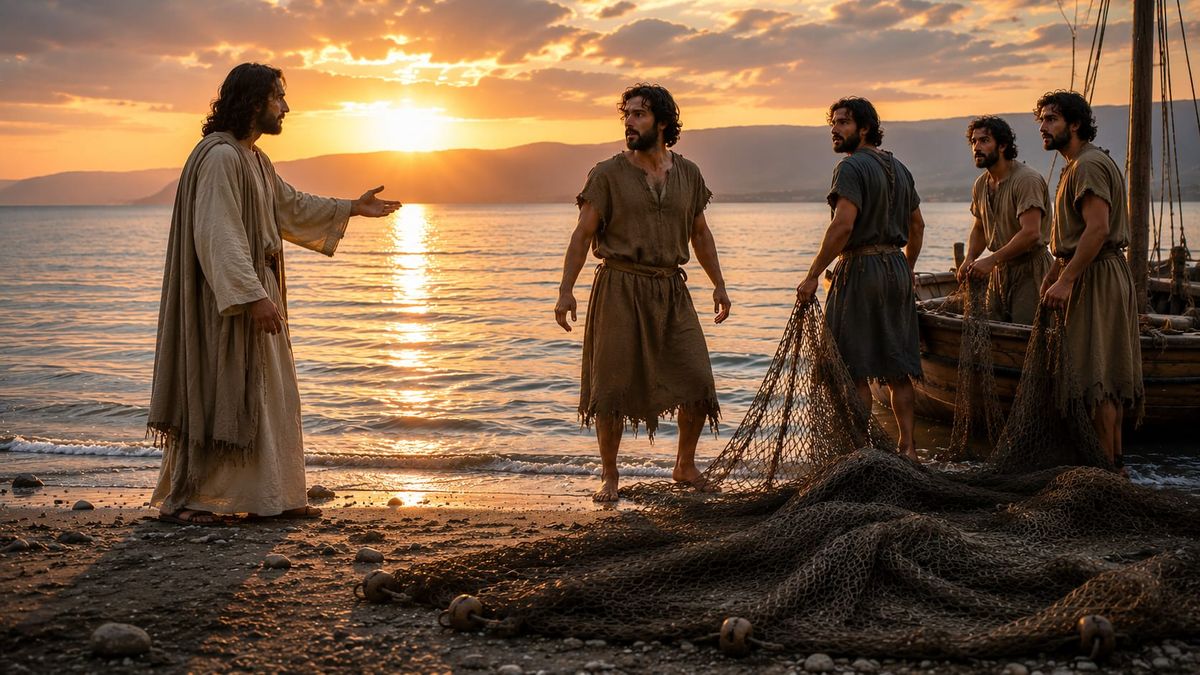
The appointed Gospel for this feast is Matthew 4:18–22, the Synoptic calling account. Jesus is walking beside the Sea of Galilee and sees Simon and Andrew casting their nets: “And he said to them, ‘Follow me, and I will make you fishers of men.’ Immediately they left their nets and followed him.” (Matthew 4:19–20, ESV) The collect draws directly from this verse: “grace to follow him without delay.” The Greek word Matthew uses is eutheōs — immediately, the same word that marks Mark’s Gospel throughout. Andrew did not go home to consider the offer. He left the nets. The collect asks that the same quality of response would characterize the Church’s hearing of the Gospel.
Andrew appears three more times in John’s Gospel beyond the initial calling, and each appearance follows the same pattern. In John 6:8–9, when Jesus asks how the crowd is to be fed, it is Andrew who finds the boy with five loaves and two fish and brings him forward: “There is a boy here who has five barley loaves and two fish, but what are they for so many?” (John 6:9, ESV) He brings what little there is and presents it to Jesus. In John 12:20–22, when Greeks come to Philip wanting to see Jesus, Philip tells Andrew, and Andrew and Philip together bring the request to Jesus. Andrew is again the connector, the one who brings the outsider into the presence of the Lord. And in Mark 13:3, Andrew is among the four disciples who sit with Jesus on the Mount of Olives and hear the Olivet Discourse privately. He is always present, always bringing, always at the hinge between the world outside and the Lord within.
The Theological Significance
The propers for this feast are found on page 730 of the BCP 2019: Deuteronomy 30:11–14, Psalm 19 or 19:1–6, Romans 10:8b–18, and Matthew 4:18–22. The appointed Old Testament reading, Deuteronomy 30:11–14, is the passage Paul quotes in the appointed Epistle to ground his argument about the universal accessibility of the Gospel: “For this commandment that I command you today is not too hard for you, neither is it far off... But the word is very near you. It is in your mouth and in your heart, so that you can do it.” (Deuteronomy 30:11, 14, ESV) Moses is speaking about the law, but Paul hears in these words the shape of the Gospel: the word of faith is near, accessible, requiring no heroic ascent or descent to obtain it. It is in your mouth and in your heart. This is the theological ground of Andrew’s ministry. He did not require his brother to climb to some elevated spiritual state before introducing him to Jesus. He simply said: we have found the Messiah, and brought him.
Romans 10:8b–18, the appointed Epistle, is Paul’s great missionary passage. He draws from Deuteronomy 30 to argue that the word of faith is near and available to all, regardless of background or prior standing with the covenant community. Then comes the passage that the feast of Andrew presses into present application: “How then will they call on him in whom they have not believed? And how are they to believe in him of whom they have never heard? And how are they to hear without someone preaching? And how are they to preach unless they are sent? As it is written, ‘How beautiful are the feet of those who preach the good news!’” (Romans 10:14–15, ESV) Andrew’s feet were beautiful in exactly this sense. He ran to his brother. He brought the boy with the loaves. He brought the Greeks to Philip and then to Jesus. The logic of Romans 10 is the logic of Andrew’s entire apostolate: they cannot hear unless someone brings the message, and someone brought it to Andrew, and Andrew brought it to everyone near to him.
Psalm 19 or 19:1–6, the appointed psalm, opens with the declaration that the heavens themselves preach: “The heavens declare the glory of God, and the sky above proclaims his handiwork.” (Psalm 19:1, ESV) Read on the feast of the apostle who was a fisherman — a man whose working life was lived under those heavens, reading weather and water — the psalm is an invitation to see Andrew’s calling in the context of a creation that has always been bearing witness. He was prepared to hear the call, in part, by a life already spent attending to what the created world was saying.
The BCP 2019 Collect and Preface
The BCP 2019 appoints the following collect for the feast on page 624: “Almighty God, you gave such grace to your apostle Andrew that he readily obeyed the call of your Son Jesus Christ, and brought his brother with him: Give us, who are called by your holy Word, grace to follow him without delay, and to bring those near to us into his gracious presence; who lives and reigns with you and the Holy Spirit, one God, now and for ever. Amen.” The collect does two things simultaneously. It honors what Andrew did — he readily obeyed, he brought his brother — and it turns both into a petition for the Church. Give us grace to follow without delay. Give us grace to bring those near to us into his gracious presence. The feast of Andrew is not primarily a commemoration of an apostle. It is a summons to apostolic obedience: hear the call, come immediately, bring someone with you.
The Preface of Apostles, found on page 155 of the BCP 2019, is used at the Eucharist for this feast as for all apostolic feasts: “Through the great shepherd of your flock, Jesus Christ our Lord, who after his resurrection sent forth his apostles to preach the Gospel and to teach all nations, and promised to be with them always, even to the end of the ages.” (BCP 2019, p. 155) The preface locates Andrew’s ministry within the resurrection commission. The fisherman who left his nets on the shore of Galilee was sent, after the resurrection, to teach all nations. The one who brought his brother to Jesus was sent by the risen Jesus to bring the whole world. The Feast of Saint Andrew is a feast of this expanding circle of introduction — from the shore of Galilee to the ends of the earth.
Andrew in Anglican Worship and History
Saint Andrew’s Day has been observed in the Church of England since the early medieval period. Andrew is the patron saint of Scotland, and his feast on November 30 is a national day of observance there — the saltire, the white diagonal cross on blue that forms the Scottish flag, is traditionally said to represent the X-shaped cross on which Andrew was martyred. Whether or not that tradition is historically precise, it reflects the ancient Church’s understanding of Andrew as an apostle who, like his Lord, went to his death without turning back.
Andrew’s placement at the end of the liturgical year is not only calendrically convenient — November 30 simply happens to fall near the end of the season — but theologically suggestive. The Church ends its year with the feast of the first-called apostle, the one who heard and came and brought others. It is a fitting note on which to close the long season of ordinary discipleship. The year has been about following and bearing witness. Andrew embodies both without fanfare, without a letter in the canon, without a Gospel bearing his name — only the repeated gesture of bringing someone to Jesus and stepping aside.
Observing This Feast
November 30 falls within the Season after Pentecost or immediately after Christ the King Sunday, at the very close of the liturgical year. When it falls on a Sunday, the feast may be observed on that Sunday or transferred to the nearest following weekday according to the rubrics on page 689 of the BCP 2019.
To observe the feast: pray the collect from BCP 2019, p. 624. Read Matthew 4:18–22 and notice the word immediately — the nets left without deliberation, the call answered without negotiation. Read John 1:35–42 and sit with Andrew’s first instinct after meeting Jesus: to go find his brother. Read Romans 10:8b–18 and hear Paul’s logic: they cannot believe unless they hear, they cannot hear unless someone brings the message, and Andrew brought it. Ask the question the collect raises: is there someone near to us we have not yet brought into his gracious presence? And let the Advent that follows this feast be shaped by Andrew’s answer to that question.
Conclusion
Andrew is the apostle of the first response and the immediate introduction. He heard the call and came without delay. He found his brother and brought him to Jesus. He found the boy with the loaves and brought him forward. He brought the Greeks who wanted to see Jesus. He is always at the hinge, always connecting the world outside with the Lord within, always stepping aside once the introduction has been made.
The collect prays that this grace would be ours — not Andrew’s remarkable quality of character, but the gift of God that produced it. “You gave such grace to your apostle Andrew.” Grace came first. Obedience followed. The Church that receives this collect on November 30 is asked to receive both: the grace that produces the response, and the response that brings others into the gracious presence of the one who gave it.
“He first found his own brother Simon and said to him, ‘We have found the Messiah.’ He brought him to Jesus.” (John 1:41–42, ESV)