Ascension Day: An Anglican Perspective
The Feast of the Ascension celebrates not the disappearance of Jesus, but his exaltation; and not his distance from us, but the new and greater intimacy of his priestly presence before the Father on our behalf. The Feast Day still presses its claims on us today.
Principal Feast, Thursday, the Fortieth Day of Easter
The Anglican calendar is ordered by a hierarchy of holy days, each carrying a different weight of observance. At the very top stand the seven Principal Feasts, the highest-ranking days of the liturgical year. Ascension Day is one of them, and the BCP 2019 directs that the Principal Feasts “take precedence over any other day or observance.” (BCP 2019, p. 688)Ascension Day therefore belongs to the highest rank of the Anglican calendar. It celebrates the bodily Ascension of the risen Jesus Christ into heaven, his exaltation to the right hand of the Father, his continuing reign and intercession, the mission of his Church in the power of the Holy Spirit, and the promise that he will come again.
Ascension Day falls on Thursday, the fortieth day of Easter. Acts tells us that after his Resurrection Jesus presented himself alive to the apostles “during forty days” and spoke about the Kingdom of God. (Acts 1:3, ESV) At the conclusion of those Resurrection appearances, he was visibly taken from their sight and received into heaven.
The Ascension is sometimes treated as though it were merely the moment Jesus left, an awkward interval between the greater celebrations of Easter and Pentecost. The Church’s calendar says otherwise. Easter proclaims that the crucified Christ has risen. Ascension proclaims that the risen Christ is exalted and reigning. The one who died and rose in our humanity has ascended in that same humanity, sits at the right hand of the Father, intercedes for his people, rules over all things, sends his Church into the world, and from the Father pours out the Holy Spirit upon his Church. He will come again in glory.
The Biblical Event
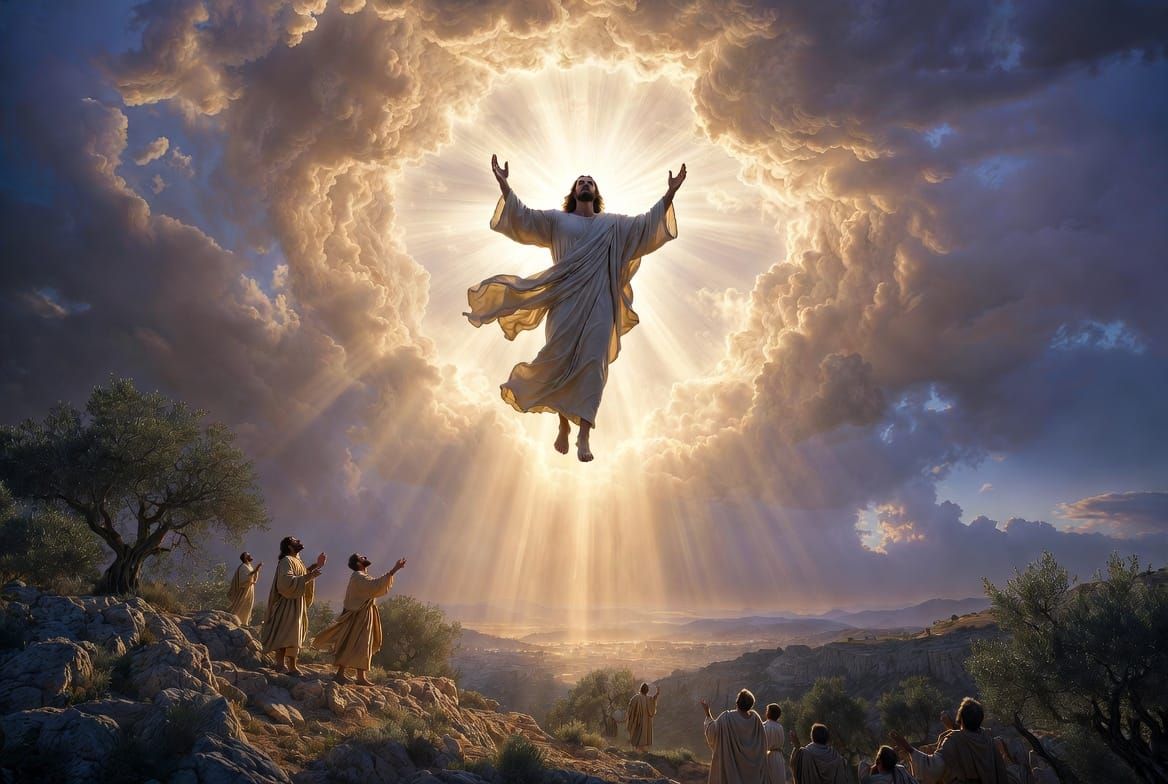
The Ascension is narrated most fully in two New Testament passages, both written by Luke. His Gospel concludes with Jesus leading the disciples toward Bethany. There, “lifting up his hands he blessed them. While he blessed them, he parted from them and was carried up into heaven.” (Luke 24:50–51, ESV) The detail that Jesus is blessing them as he ascends is worth noticing. The final visible posture of the risen Lord toward his disciples is not withdrawal, disappointment, or abandonment. His hands are raised in blessing.
That image should not be sentimentalized into the idea that the physical act of Ascension somehow continues indefinitely, but neither should it be forgotten. The Lord who ascends is still the Lord who blesses his people. His visible earthly ministry reaches its appointed conclusion, but his gracious work toward his Church does not.
Acts gives the fuller narrative. Jesus promises the apostles, “You will receive power when the Holy Spirit has come upon you, and you will be my witnesses in Jerusalem and in all Judea and Samaria, and to the end of the earth.” (Acts 1:8, ESV) Then, “as they were looking on, he was lifted up, and a cloud took him out of their sight.” (Acts 1:9, ESV) The Ascension is visible and bodily. Jesus does not merely disappear, become an idea, or cease appearing because the disciples have reached sufficient spiritual maturity. The risen Lord is taken from their sight before their eyes.
The cloud belongs to the biblical imagery of divine glory. Throughout Scripture, the cloud repeatedly accompanies the presence and majesty of God, from Sinai and the wilderness to the Temple and the Transfiguration. Luke therefore describes more than movement upward through the atmosphere. The risen Son is received from their sight into the glory of heaven, where Scripture confesses him enthroned at the Father’s right hand.
The apostles remain looking toward heaven until two men in white robes say, “Men of Galilee, why do you stand looking into heaven? This Jesus, who was taken up from you into heaven, will come in the same way as you saw him go into heaven.” (Acts 1:11, ESV) The Ascension is therefore inseparable from the Second Coming. The same Jesus who ascended will return. Christian hope is not that history will gradually evolve beyond the need for Christ’s personal return, nor that the Church will bring the final Kingdom into existence by her own efforts. The ascended King himself will come again.
He Ascended in Our Humanity
The bodily character of the Ascension is essential to Christian doctrine. The Son of God did not discard his humanity after completing his earthly work. The human nature he assumed from the Virgin Mary, in which he suffered, died, and rose, is the humanity in which he ascended.
Article IV of the Thirty-Nine Articles states the point with unusual clarity: Christ “did truly rise again from death, and took again his body, with flesh, bones, and all things appertaining to the perfection of Man’s nature; wherewith he ascended into Heaven, and there sitteth, until he return to judge all Men at the last day.” The Ascension therefore belongs to the Church’s confession of the permanent reality of the Incarnation. The eternal Son became man and remains truly God and truly man.
We should speak carefully here. Christ does not somehow carry all redeemed human beings bodily into heaven at the moment of his Ascension. Yet something astonishing is nevertheless true: human nature is now present in heaven in the person of Jesus Christ. The humanity the eternal Son assumed has passed through death, been raised incorruptible, and been glorified.
This gives the feast extraordinary dignity. Human nature, once subjected through sin to misery and death, has in Christ passed through death, been raised in glory, and entered the heavenly presence. The Ascension therefore points not only to Christ’s present glory but toward the promised destiny of those united to him. Where the Head has gone, the members of his Body are promised finally to follow, not by escaping creatureliness but through resurrection and participation by grace in the glory of their Lord.
Seated at the Right Hand of the Father
The Ascension leads directly into one of the most familiar statements of the Creeds: Christ “ascended into heaven, and is seated at the right hand of the Father.” The language of the right hand does not require us to imagine the Father as possessing a physical body seated upon a spatial throne. Scripture uses royal language to confess Christ’s exaltation, authority, and reign.
Psalm 110 gives this theology its great Old Testament foundation: “The LORD says to my Lord: ‘Sit at my right hand, until I make your enemies your footstool.’” (Psalm 110:1, ESV) The New Testament repeatedly applies this Psalm to Jesus. The Messiah who was crucified and raised is enthroned. To be seated is not to be inactive. It is the biblical posture of enthroned rule.
Ephesians 1, appointed for Ascension Day, expands the vision. God raised Christ from the dead and seated him at his right hand “far above all rule and authority and power and dominion, and above every name that is named.” (Ephesians 1:21, ESV) Christ’s reign is not waiting to begin at some future political turning point. The Messiah reigns now.
That present reign does not mean every enemy has already disappeared or that the world has entered its final state. The New Testament holds Christ’s accomplished enthronement and the future consummation of his Kingdom together. He reigns until every enemy is placed beneath his feet, with death itself finally destroyed. The King is already enthroned, while the full and visible manifestation of his victory still lies ahead.
This gives Christians a very different way of looking at history. Christ is not campaigning for a throne. He possesses it. Governments rise and fall, cultures change, nations boast, powers contend, and the Church herself passes through seasons of strength and weakness, but none of these developments alters the basic Christian confession: Jesus Christ is Lord.
Our Great High Priest
The Ascension is royal, but it is also priestly. Christ enters the heavenly sanctuary not as a retired Savior whose saving work belongs only to the past, but as the living High Priest who represents his people before the Father.
Hebrews says that Christ has entered “into heaven itself, now to appear in the presence of God on our behalf.” (Hebrews 9:24, ESV) The Lord who offered himself once for all upon the Cross now appears before the Father for us. His sacrifice is complete and never repeated; his priestly intercession continues.
Hebrews elsewhere describes Christian hope as “a sure and steadfast anchor of the soul” entering behind the curtain, “where Jesus has gone as a forerunner on our behalf, having become a high priest forever.” (Hebrews 6:19–20, ESV) The word forerunner matters. Christ has gone before his people into the heavenly presence.
Paul gives the same assurance in Romans: “Christ Jesus is the one who died, more than that, who was raised, who is at the right hand of God, who indeed is interceding for us.” (Romans 8:34, ESV) The sequence is the Gospel in miniature: death, Resurrection, enthronement, intercession.
The ascended Christ is therefore no absentee King. He reigns and intercedes. Christians pray with confidence not because they can make themselves worthy to enter heaven’s court, but because their great High Priest is already there on their behalf. Our access rests upon him.
Not the Feast of Christ’s Absence
It is tempting to describe the Ascension by saying that Jesus became more present, or that his bodily departure allowed him to become everywhere present. Such language may be intended to protect the truth that Christ has not abandoned his Church, but it can blur an important Christological distinction.
According to his divine nature, the eternal Son was never confined to Galilee, Jerusalem, or any other place. As God, he fills all things. According to his true human nature, the risen Jesus bodily ascended into heaven. The Ascension does not dissolve his humanity into divine omnipresence. Christ remains truly human as well as truly divine, and Article IV confesses that he has ascended into heaven and there sits until he returns.
Yet this does not make Ascension the feast of abandonment. Before his Passion, Jesus promised that he would not leave his disciples as orphans. He promised the Holy Spirit. After his Resurrection he promised, “I am with you always, to the end of the age.” (Matthew 28:20, ESV) The ascended Lord remains with his Church according to his promise, through the Holy Spirit and through the means he has appointed for the life of his people.
The Collect for the Sunday after Ascension expresses the balance beautifully. It asks God not to leave us comfortless but to send the Holy Spirit to strengthen us and exalt us to the place where our Savior Christ has gone before. The BCP appoints the Proper Preface of the Ascension for that Sunday as well. (BCP 2019, pp. 613–614) Christ has truly gone to the Father, and Christ has truly not abandoned his people. Christian doctrine requires both truths.
The Church Is His Body
Ephesians 1 moves directly from Christ’s enthronement to the Church. God “put all things under his feet and gave him as head over all things to the church, which is his body, the fullness of him who fills all in all.” (Ephesians 1:22–23, ESV)
The Church is therefore not merely an association of people who admire an absent religious founder. She is the Body whose Head is the ascended Christ. Her life, authority, mission, and hope come from him. Her authority is ministerial and received, never independent or self-originating.
That does not mean the institutional Church can identify her own preferences or decisions with the rule of Christ. The Church remains accountable to her Head. She is not sovereign. She receives the apostolic Gospel, teaches the Scriptures entrusted to her, administers the Sacraments Christ instituted, and carries out the mission he has commanded.
This gives the Church both dignity and humility. Christ has chosen to work through his people, but the power remains his. The apostles do not devise the mission after watching Jesus ascend. Christ commissions them, promises the Spirit, and sends them. He is the first mover: Christ reigns, Christ sends, Christ gives the Spirit, and the Church responds in faith and obedience.
Ascension and Mission
Acts places the missionary commission immediately before the Ascension. Jesus tells his disciples that they will receive power when the Holy Spirit comes upon them and will be his witnesses “to the end of the earth.” (Acts 1:8, ESV) The Ascension therefore does not remove Christ’s concern from the world. It prepares the next stage of his mission through the Spirit-empowered witness of his Church.
The order is important. Jesus does not tell the disciples to generate sufficient enthusiasm and begin expanding a movement they have inherited. They are commanded to wait. The mission belongs to Christ before it belongs to them, and the power required for it must be given.
The disciples therefore return to Jerusalem and devote themselves to prayer. Acts names the apostles and Mary the mother of Jesus among those waiting together. (Acts 1:12–14) The Church between Ascension and Pentecost is neither inactive nor self-starting. She prays because she has received a promise.
That pattern remains instructive. Christian mission involves preaching, courage, planning, sacrifice, travel, money, organization, and human labor. Yet none of these things creates spiritual life. The ascended Christ builds his Church through the Holy Spirit, working through the Word, the Sacraments, and the witness entrusted to his people. Christian labor is real, but its fruitfulness remains dependent upon God.
Ascension and Pentecost
Ascension Day is the fortieth day of Easter, while Pentecost is the fiftieth. The interval between them has therefore long provided a natural period of prayer for the work and empowering of the Holy Spirit because Acts portrays the disciples gathered in prayer while they await what Jesus promised.
The Ascension must not be separated from Pentecost. Peter explains at Pentecost that Jesus, “being therefore exalted at the right hand of God, and having received from the Father the promise of the Holy Spirit,” has poured out what the crowd sees and hears. (Acts 2:33, ESV) Pentecost is therefore evidence of Christ’s Ascension and enthronement.
This guards against treating the Holy Spirit as a substitute sent because Jesus is now unavailable. The Father pours out the Spirit through the exalted Son. The mission of the Spirit belongs to the continuing work of the risen and ascended Christ.
The days between Ascension and Pentecost are therefore days of confident expectation rather than uncertainty. The Church already knows that Christ reigns. She waits because the enthroned Lord has made a promise.
The Appointed Readings
Ascension Day has the same appointed readings in all three years of the BCP 2019 lectionary: Acts 1:1–11, Psalm 47 or Psalm 110:1–5, Ephesians 1:15–23, and Luke 24:44–53 or Mark 16:9–20.
Acts gives the event itself: the forty days, the promise of the Spirit, the commission to witness, the visible Ascension, and the promise of Christ’s return. Psalm 47 gives the feast its language of royal triumph: “God has gone up with a shout, the LORD with the sound of the trumpet.” (Psalm 47:5, ESV) Psalm 110 gives the theology of enthronement: the Messiah sits at God’s right hand while his enemies are placed beneath his feet.
Ephesians 1 reveals the cosmic scope of what the disciples witnessed. Jesus has not simply traveled from one ordinary earthly place to another. The risen Christ is exalted above every rule, authority, power, dominion, and name and is given as Head over all things to the Church.
Luke 24 returns us to the final blessing, while Mark 16 joins Ascension to the mission of the apostles. Together the readings show why the feast cannot be reduced to departure. The Lord ascends as King, Priest, Head of the Church, sender of witnesses, giver of the Spirit, and the one who will return to judge the living and the dead.
The BCP 2019 Collect and Proper Preface
The BCP appoints the Collect for Ascension Day on page 613:
“Almighty God, whose only-begotten Son our Lord Jesus Christ ascended into heaven: May our hearts and minds also there ascend, and with him continually dwell; who lives and reigns with you and the Holy Spirit, one God, for ever and ever. Amen.” (BCP 2019, p. 613)
The Collect does not ask the Church to imagine herself escaping from the created world. It asks that our hearts and minds be ordered toward the place where Christ reigns. Paul gives the same exhortation: “If then you have been raised with Christ, seek the things that are above, where Christ is, seated at the right hand of God.” (Colossians 3:1, ESV)
To seek the things above is not to despise earthly vocation, work, family, neighbor, body, or creation. The incarnate and ascended Lord himself prevents such a conclusion. Rather, the Church is called to live earthly life under heavenly allegiance. Our deepest loyalty, hope, identity, and destiny are determined by the enthroned Christ rather than by the passing powers of the present age.
The BCP appoints the Proper Preface of the Ascension for Ascension Day. It gives thanks through Jesus Christ, “who after his most glorious resurrection appeared to his Apostles, and in their sight ascended into heaven to prepare a place for us; that where he is, there we might also ascend, and reign with him in glory.” (BCP 2019, p. 154) The same Proper Preface is appointed for the Sunday after Ascension.
The Prayer Book also provides an important extension of the feast: “The Collect for Ascension Day, with the corresponding psalm and lessons, also serves for the Friday and Saturday following, except as otherwise appointed.”(BCP 2019, p. 613) The Thursday remains Ascension Day itself, but its propers may continue to shape the following two days.
The Preface gathers Resurrection, Ascension, and Christian destiny into one act of thanksgiving. Its promise is not that Christians become divine by nature or cease to be creatures. It is that those united to Christ will share by grace in the glory of his Kingdom. He has gone before us, and our hope is anchored where he is.
The Ancient Feast
The Church’s observance of the Ascension is ancient. Around AD 400, Augustine refers to the annual solemn commemoration of the Lord’s Passion, Resurrection, Ascension, and the descent of the Holy Spirit as observances received throughout the Church. By that period, the Ascension clearly held an established and widespread place in Christian worship.
The exact early development of a distinct forty-day feast should nevertheless be stated with care. The surviving evidence does not require us to claim that every local church distinguished Ascension and Pentecost in precisely the later form from the apostolic age onward. Nor need we claim that the apostles themselves instituted an annual Ascension Thursday observance. What is certain is more than sufficient: the Ascension belongs to the apostolic Gospel itself, is confessed in the Creeds, and had become an established annual solemnity throughout the Church by late antiquity.
Its place in the Anglican calendar therefore reflects far more than inherited custom. The feast preserves something the Nicene Creed itself requires Christians to confess: the Lord who “rose again in accordance with the Scriptures” also “ascended into heaven and is seated at the right hand of the Father.”
Ascension Day in Anglican Worship
The liturgical color is white, expressing the festal joy, victory, glory, and exaltation of the risen Christ. Ascension remains within the Great Fifty Days of Easter, which continue through Pentecost.
The Paschal Candle likewise remains part of the Easter season. The BCP directs that it “should be lit for all principal services throughout the season of Easter.” (BCP 2019, p. 595) Some Western ceremonial traditions extinguish the Paschal Candle after the Ascension Gospel as a symbol of Christ’s visible departure, but this is custom rather than the direction of the BCP 2019. Under the Prayer Book’s rubric, the Candle continues bearing witness to the Resurrection throughout Eastertide.
The Eucharist stands naturally at the center of Ascension Day. The Church gathers on earth around the Sacrament instituted by the Lord who now reigns in heaven. We should maintain the distinction without creating separation: the Christ truly given and received in the Sacrament according to his promise is the same incarnate, crucified, risen, and ascended Lord who sits at the Father’s right hand.
Ascension therefore gives Anglican sacramental worship a particularly helpful horizon. The Church does not repeat the once-for-all sacrifice of Christ or summon an otherwise absent Savior back from heaven. She receives the gifts of the Lord who has already accomplished redemption, reigns at the Father’s right hand, intercedes for his people, and has promised to be with his Church.
Ascension Day Is Thursday
The Thursday observance of Ascension Day is not an arbitrary weekday assignment. It arises directly from the chronology of Acts and is built into the structure of the Paschal season.
This deserves some care because congregations sometimes commemorate the Ascension on the following Sunday for pastoral reasons. The BCP 2019, however, does not provide a general rubric transferring Ascension Day to the Sunday after Ascension. The Prayer Book lists Ascension Day among the Principal Feasts, while the Sunday after Ascension has its own Collect and its own three-year lectionary. The normative Prayer Book observance of the Principal Feast therefore remains Thursday.
This distinction matters precisely because Ascension is one of the seven Principal Feasts. A Thursday celebration may require more deliberate effort than a Sunday observance, but the Christian calendar is sometimes meant to interrupt ordinary schedules. Keeping the fortieth day preserves the biblical movement from Resurrection through Ascension and then into the prayerful waiting that culminates at Pentecost.
If a parish or diocese makes an additional pastoral commemoration on another day, that should be described as an accommodation rather than as the Prayer Book’s ordinary observance of Ascension Day.
The Ascension and Christian Hope
The Ascension directs Christian hope upward without making it escapist. Paul says that our citizenship is in heaven, “and from it we await a Savior, the Lord Jesus Christ, who will transform our lowly body to be like his glorious body.”(Philippians 3:20–21, ESV) Heaven is presently where Christ is, but the final Christian hope is not permanent disembodiment in heaven. It includes Christ’s return, the resurrection of the body, judgment, and the life of the world to come.
This prevents two opposite mistakes. Christianity does not teach that salvation consists merely in escaping earth as disembodied souls. The same Jesus who ascended bodily will return, and the Creed teaches us to confess “the resurrection of the dead and the life of the world to come.” Yet Christianity does not collapse its hope into the progressive improvement of the present world either. Christ is truly ascended, history still awaits its consummation, and the Church awaits her Lord from heaven.
The Ascension therefore gives history a direction. Christ’s enthronement is already true. His return is still future. Christians live between those realities, obeying a reigning King whom they do not presently see and expecting the appearing of the King whom one day every eye will behold.
This should steady the Church whenever the powers of the present age appear overwhelming. Ascension does not promise that Christian faithfulness will always enjoy cultural influence, political favor, or visible success. It tells us something more fundamental: none of those powers occupies the highest throne. Jesus does.
Observing This Feast
Ascension Day is one of the seven Principal Feasts and is observed on Thursday, the fortieth day of Easter. The Collect is found on page 613, the Proper Preface of the Ascension on page 154, and the appointed readings in the BCP 2019 lectionary.
Read Acts 1:1–11 and notice the sequence. Jesus teaches about the Kingdom, redirects the disciples away from speculation about times and seasons, promises the Holy Spirit, commissions them as witnesses, ascends before their eyes, and promises to return. The disciples are not told to stare upward indefinitely. They have been given both a mission and a promise.
Read Ephesians 1:15–23 and allow Paul to interpret what Acts describes. The man the apostles watched ascend is seated above every rule, authority, power, dominion, and name. Pray Psalm 110 and remember that the Christ who appeared powerless before Pilate now reigns at the right hand of God.
Read Luke 24:44–53 and linger over the final image of Christ blessing his disciples. Then allow the days between Ascension and Pentecost to become days of intentional prayer. The Church does not pretend that Pentecost has not happened or that the Holy Spirit has not been given. Rather, she inhabits the apostolic posture of prayerful dependence, continually asking God to strengthen, sanctify, renew, and empower his people by the Spirit whom the ascended Christ has poured out.
Finally, pray the Collect as an examination of allegiance. Ask what presently occupies the place in your heart and mind that belongs to the reigning Christ. To confess the Ascension is to confess that the decisive throne in the universe is already occupied, and therefore that every lesser loyalty must take its proper place beneath the Lordship of Jesus.
Conclusion
Ascension Day is not the feast of Christ’s disappearance. It is the feast of his exaltation. The risen Jesus ascends bodily in the humanity he assumed for our salvation. He sits at the right hand of the Father as reigning King and interceding High Priest. His Church lives under his headship, his Spirit has been poured out, and he will come again in glory.
The disciples who watched him ascend were therefore not abandoned. Luke tells us that they returned to Jerusalem with great joy. They had a commission, a promise, and a King. The Lord whose hands were raised in blessing had passed from their sight, but he had not ceased to be for them. He had gone before them.
That remains the Church’s hope. Christ is where our salvation has already reached its goal. Our humanity is glorified in him, our great High Priest appears before the Father on our behalf, and our King reigns while we await his return. The Proper Preface looks beyond the Ascension itself toward the destiny of those united to Christ: “that where he is, there we might also ascend, and reign with him in glory.” (BCP 2019, p. 154) The Collect gives the feast its proper response: “May our hearts and minds also there ascend, and with him continually dwell.” (BCP 2019, p. 613)