Called By Name: Easter Day 2026 (John 20:1-18)
On Easter morning, Mary came weeping in darkness, grieving and hopeless. The risen Jesus met her there, called her by name, and turned her tears into testimony: “I have seen the Lord.” He is calling your name too. Hear. Respond.
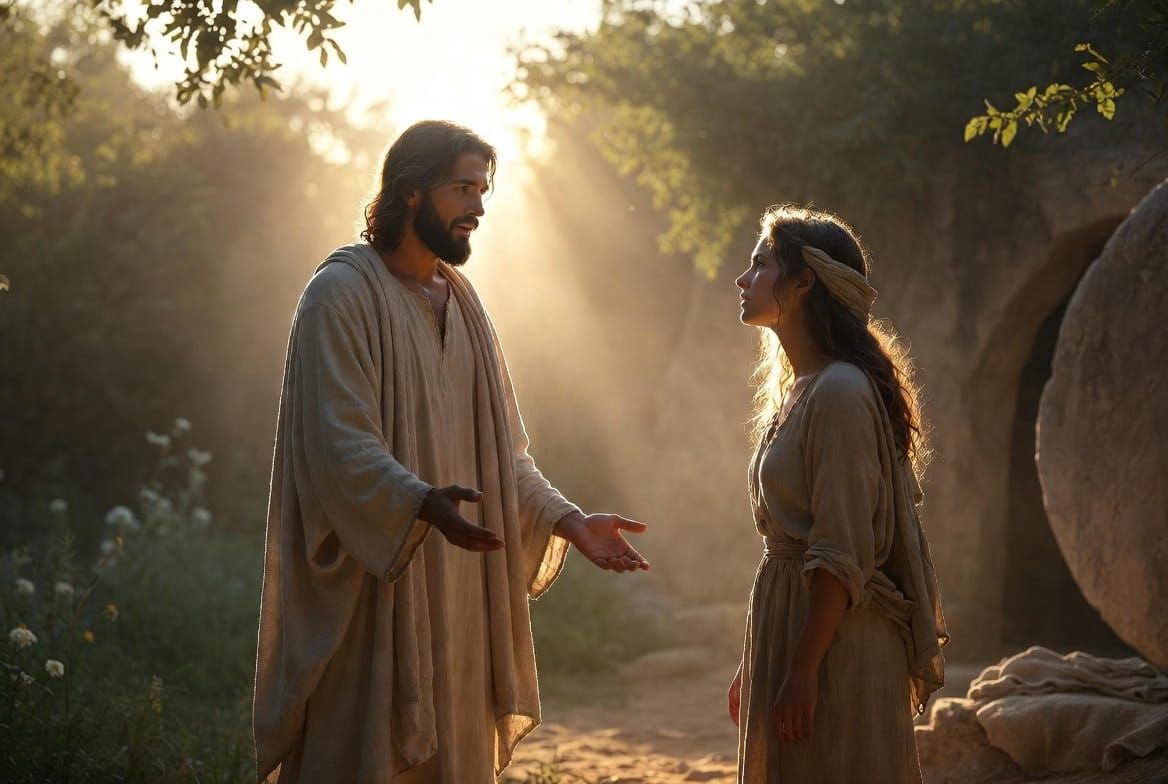
April 5, 2026, Year A, Easter Day, Principal Feast, Season of Easter
John 20:1–18, Psalm 118:14–17, 22–24, Exodus 14:10–14, 21–31, Colossians 3:1–4
Alleluia! Christ is risen!
Grace, mercy, and peace from God our Father and the Lord Jesus Christ be with you on this most holy morning, the Feast of the Resurrection of our Lord Jesus Christ.
We are here. We made it.
Six weeks ago, on Ash Wednesday, we knelt in silence and received the ashes on our foreheads. We heard the plain, unsparing words: “Remember that you are dust, and to dust you shall return.” (Genesis 3:19, ESV) No pretending. No performance. Just the honest truth of what we are apart from God. Lent began right there, with a sober acknowledgment of our frailty. We are dust. We are hungry. We are dry bones scattered in a valley. And then, slowly, Sunday by Sunday, the wilderness began to do its quiet work in us.
This morning we arrive at the place the wilderness was always leading us toward. The long journey through repentance and reflection finds its fulfillment here, in the bright light of Resurrection.
Mary Magdalene comes to the tomb while it is still dark. John notes this detail with deliberate care. She does not arrive in the soft first light of morning. She comes in the deep darkness, in the hour when grief feels most raw and unguarded, when there is no crowd to hold her together and the weight of loss presses down fully.
She has come, as mourners often do, simply to be near what remains of the one she loved. She is not expecting Resurrection. For her, the story ended on Friday when Jesus bowed his head and gave up his spirit on Golgotha. She had watched it all. She stood near the Cross with the other women, among the few who did not run. She knows exactly what death looks like. She is not confused about what has happened. And then she finds the stone rolled away.
Her first instinct is not joy or faith, but fear: grave robbery. Verse 2 tells us, “They have taken the Lord out of the tomb, and we do not know where they have laid him.” (John 20:2, ESV) Notice what she still calls him, even in the grip of grief: “the Lord.” She has lost him. She does not know where his body is. Yet she still calls him Lord. That is what genuine faith can look like in the dark, not warm feelings or settled certainty, but a name that refuses to leave our lips even when everything else has collapsed around us.
Peter and the beloved disciple, John, hear her report and run to the tomb. John outruns Peter but stops at the entrance and peers inside. Peter, true to form, goes straight in. John sees the linen cloths lying there and the face cloth that had been on Jesus’ head folded up in a place by itself. Grave robbers do not stop to tidy the scene. This does not look like a body hastily stolen in the night. Something entirely different has happened here. And verse 8 simply says of the beloved disciple: “he saw and believed.” (John 20:8, ESV) They go home, but Mary stays.
Before we move deeper into John 20, we need to listen to the Old Testament voices that were already waiting for this day. Moses stood on the edge of the Red Sea with Pharaoh’s chariots thundering behind him and an impassable sea in front. The people did what people so often do when the way forward looks impossible and the way back is unthinkable: they panicked. “Is it because there are no graves in Egypt that you have taken us away to die in the wilderness?” (Exodus 14:11, ESV) This was their cry after the plagues, after the Passover blood on the doorposts. They were still convinced they were going to die.
Moses gave them one of the most important words ever spoken in a moment of crisis: “Fear not, stand firm, and see the salvation of the LORD, which he will work for you today… The LORD will fight for you, and you have only to be silent.”(Exodus 14:13–14, ESV) Stand firm. See the salvation. The LORD will fight for you. And then the sea opened, not because Israel had finally mustered enough faith, not because they had stopped complaining, but because God is who he says he is. His purposes cannot be drowned by circumstances. The same waters that became the path of salvation swallowed Pharaoh’s army whole. “The LORD saved Israel that day.” (Exodus 14:30, ESV) Not helped, saved. The deliverance was entirely his doing.
This is the deep memory standing behind Easter morning. The God who split the sea for a frightened, complaining, often faithless people is the same God who has already acted before Mary understands what she sees. She arrives while it is still dark, and the stone has been taken away. The pattern is the same. The power is the same. The grace is the same.
The psalmist understood this reality as well. Psalm 118 carries the testimony of someone backed against every wall who nevertheless passed through to the other side: “The LORD is my strength and my song; he has become my salvation.”(Psalm 118:14, ESV) And then the verse that has echoed through countless Easter mornings: “I shall not die, but I shall live, and recount the deeds of the LORD.” (Psalm 118:17, ESV) “The stone that the builders rejected has become the cornerstone.” (Psalm 118:22, ESV) “This is the day that the LORD has made; let us rejoice and be glad in it.” (Psalm 118:24, ESV)
This is the day the Lord has made, not a day that simply arrived on its own, not something produced by human faith or courage, but a day deliberately fashioned by God from the foundations of the world. The splitting of the sea was its foreshadowing. The Passover lamb was its preview. The manna in the wilderness was its provision for a people not yet ready to see the full reality. All of it was pointing to this moment: a garden outside Jerusalem on the third day, a rolled-away stone, linen cloths left behind, and a woman standing outside the tomb weeping.
Mary is still standing there, weeping. Verse 11 tells us that she stoops to look into the tomb and sees two angels, one at the head and one at the feet where Jesus’ body had lain. They ask her, “Woman, why are you weeping?” She gives them the same answer she gave the disciples: they have taken him away, and she does not know where.
Then she turns and sees Jesus standing there, but she does not recognize him. This is no minor detail. The Resurrection is not merely the reanimation of a corpse. The risen Jesus is the same Jesus who was crucified, bodily raised and yet transformed, no longer subject to death. Mary Magdalene, who had followed Jesus and stood near his Cross, looks directly at him and mistakes him for the gardener.
Jesus asks her the same question the angels asked: “Woman, why are you weeping? Whom are you seeking?” Still thinking he is the gardener, she asks if he has taken the body and where he has put it. And then Jesus speaks one single word: “Mary.”
In that moment, everything collapses and rebuilds itself. She turns and says, “Rabboni!” Teacher. The good shepherd calls his own sheep by name, and they know his voice. Jesus had said in John 10, “The sheep hear his voice, and he calls his own sheep by name.” Death has not changed that promise, and nothing ever will.
Mary did not come to the tomb full of faith and expectation. She came in grief, without hope, assuming the worst. She was not in the right spiritual posture. Her theology was not sorted out. She was weeping when perhaps she should have remembered his words. None of that prevented him from coming to her. He spoke first. He called her name before she could do anything right.
This is the shape of grace. It was the shape of grace at the Red Sea for a panicking, complaining people. It was the shape of grace in the wilderness when manna fell for ungrateful wanderers. It was the shape of grace on Maundy Thursday when Jesus broke bread for the very men who would soon betray and abandon him. On Thursday, he gave himself to them. On Friday, from the Cross, he declared the work complete: tetelestai, it is finished. And now, on Easter morning, the One who gave himself and finished the work stands alive and calls Mary by name. Grace always moves first. The initiative is always his.
And that same risen Christ is doing this very thing this morning. Through the reading and proclamation of his Word and the quiet work of the Holy Spirit, he is calling names. He is standing before people who may not yet fully recognize him and asking, “Whom are you seeking?”
Some of us have walked with Christ for many years. This morning feels like a joyful homecoming and a deep renewal of what we already know and love. But others are here more like Mary was at the tomb, present out of habit, obligation, curiosity, or lingering grief, carrying questions they have not been able to resolve, feeling the distance between where they are and where they think real faith should be.
Hear this clearly: he is not waiting for you to resolve all your questions, clean up your life, or reach the right spiritual condition before he speaks your name. Mary was weeping, confused, and wrong about almost everything when he called her. The question he asks is not, “Have you attained enough faith?” The question is simply, “Whom are you seeking?” If something in you is turning toward him, then listen to his voice and respond. Faith is not heroic achievement. It is receiving the Christ who comes to us, trusting the One who died and rose again.
Paul puts it with beautiful simplicity in Romans 10: “If you confess with your mouth that Jesus is Lord and believe in your heart that God raised him from the dead, you will be saved.” (Romans 10:9, ESV) The confession and the Resurrection belong together. They are standing right in front of you this morning.
You do not have to wait. The stone is already rolled away. The sin debt has been stamped tetelestai, paid in full. The life laid down on Friday was laid down for you, your name included, your sins included, your death included. What remains is the turning, the outstretched hand of faith that simply receives what has already been freely and fully given.
Because of this, Paul can write to the Colossians with such confidence: “If then you have been raised with Christ, seek the things that are above, where Christ is, seated at the right hand of God.” (Colossians 3:1, ESV) Not, “If you eventually reach some spiritual plateau,” but, “If then you have been raised with Christ.” By grace, through faith, we already share the resurrection life of Christ. In Baptism we have been joined to his death and Resurrection, even as we still await the resurrection of our bodies at the last day. We are already on the other side of the Red Sea in Christ, even though we still live in a world where sin and death have not yet disappeared.
Paul continues, “For you have died, and your life is hidden with Christ in God.” (Colossians 3:3, ESV) Hidden, safe, secured. The sin account marked tetelestai on Good Friday has been closed forever. The death we deserved, he died. The risen life he now lives, he shares with us. And one day, as Paul says in the next verse, “When Christ who is your life appears, then you also will appear with him in glory.” (Colossians 3:4, ESV)
That is why the Collect appointed for this morning is so fitting. We pray to the God who, through his only-begotten Son Jesus Christ, “overcame death and opened to us the gate of everlasting life,” and we ask that by his life-giving Spirit we may be “delivered from sin and raised from death.” Christ has acted first. He has overcome death. He has opened the gate. And because his victory is real, we ask that his risen life would be worked in us now and brought to completion when he raises us from death at the last day.
This is the destination the entire Lenten journey has been moving toward. Ash Wednesday named our true condition: we are dust without God. The wilderness exposed the cost of living in a broken world and showed us what Jesus willingly entered for our sake. Every story, from Nicodemus needing to be born from above, to the woman at the well receiving living water, to the blind man given sight, to Lazarus called out of the tomb, to Palm Sunday, Maundy Thursday, and the long shadow of Good Friday with its final tetelestai, all of it was leading here. Now comes the morning the Lord has made, the full breaking of light after the long night.
Back to John. Jesus gives Mary a commission in verse 17: “Go to my brothers and say to them, ‘I am ascending to my Father and your Father, to my God and your God.’” (John 20:17, ESV) He calls them brothers, even after their betrayal, denial, and flight. The Resurrection opens the door wide.
Mary does not wait to compose herself. Verse 18 tells us that she goes and announces, “I have seen the Lord.” (John 20:18, ESV) Five simple words. John gives us the testimony of someone who has encountered the risen Jesus and cannot keep the news to herself. Jesus chose Mary to carry the news first, in a world where a woman’s testimony was often discounted. Grace has always worked this way.
We come into this service the same people who knelt on Ash Wednesday, still dust, still in need of grace, still carrying the weight of our own wilderness seasons. The weight many of us carry is real. But the stone is rolled away. The darkness that fell on Maundy Thursday and deepened through Good Friday has not had the final word. It never does. The God who fights for his people, who opens seas, who calls the dead by name, and who brings light out of darkness has not changed.
If you have never truly made that turning toward him, if something is stirring in your heart this morning, do not leave without responding to the One who is speaking your name. You can do it quietly in your pew right now. You can speak with one of us afterward. Do not let the rolled-away stone remain merely an interesting historical fact. Let it be the fact that changes everything.
And if you have known the risen Christ, hear again the words of Paul: “Your life is hidden with Christ in God.”(Colossians 3:3, ESV) Safe. Secured. Live from that secure place. Seek the things that are above. Let this Resurrection morning reorder the ordinary Monday that is coming, the relationships, ambitions, and fears that wait for you beyond these doors.
“I shall not die, but I shall live.” That is our psalm today. Not because we earned it. Because he rose. Because he called our names. Because the voice that spoke creation into being, that called Lazarus from the tomb, and that said “Mary” in the garden on the third morning has called us too, and he does not take back what he gives.
Alleluia! Christ is risen! The Lord is risen indeed! Alleluia!
Now go and tell someone.
In the Name of the Father, and of the Son, and of the Holy Spirit. Amen.