Come, Holy Spirit: Pentecost Sunday 2026 (Acts 2:1-21)
The same Spirit who hovered over the waters at creation, who breathed life into dry bones, who fell like wind and fire in Jerusalem — has been given to us. Not as a memory. As a present reality. Pentecost is not history. It is where we live.
May 24, 2026, Year A, The Day of Pentecost
Acts 2:1–21, Psalm 104:24–35, John 14:8–17
Alleluia! He is risen!
Grace, mercy, and peace from God our Father and the Lord Jesus Christ be with you on this Day of Pentecost, Whitsunday.
The word Pentecost comes from the Greek name for the Jewish Festival of Weeks, fifty days after Passover, originally appointed as a celebration of the firstfruits of the wheat harvest. By the rabbinic period, Jewish tradition had come to associate this feast with the giving of the Law at Sinai. This makes what happens in Acts 2 all the more striking: on the very day the Jewish world remembered the Law written on stone, the Spirit is poured out and the New Covenant begins to write the Law on human hearts. These are the firstfruits of a harvest of salvation that is still being gathered in.
Today is also a hinge point in the liturgical calendar. Pentecost is the fiftieth and final day of the Easter season, its crown and culmination, and it also launches something. This is the birthday of the Church in its public, Spirit-empowered life. Next Sunday, Trinity Sunday, the Season after Pentecost, also known as the Season after Trinity, begins, carrying us through to Advent. Pentecost stands at the seam: the last day of one thing and the new creation breath of everything that follows.
We began this Easter season with Mary Magdalene weeping outside an empty tomb. No hope. No expectation. Just grief, and a stone rolled away. And then, a voice. One word: her name. And everything turned.
Since that Easter morning we have followed the risen Christ as he found his people, one encounter at a time. A locked room on Easter evening, frightened disciples, crushed by guilt and grief, and Jesus coming through anyway, speaking peace, breathing new creation life into dry bones. Two disciples on the Emmaus road with past-tense hope, hearts burning before they recognized who was walking beside them. One gate. One way. One vine, and the word that ran through eleven verses of John 15 ten times was abide: stay, remain, dwell, do not leave the vine. And on the Seventh Sunday of Easter, the Sunday after Ascension Day, we were not the audience of the longest recorded prayer of Jesus in any of the Gospels; we were the subject. Jesus lifted his eyes to heaven and prayed for us: "Holy Father, keep them in your name." (John 17:11, ESV)
Then he ascended. The disciples returned to the Upper Room and they waited. The one who prayed for them is now, as Paul tells us, at the right hand of the Father, still interceding: "Christ Jesus is the one who died, more than that, who was raised, who is at the right hand of God, who indeed is interceding for us." (Romans 8:34, ESV) He has not gone silent. He has not forgotten the prayer of John 17. Today is the day that prayer is answered visibly.
Our passage this morning is Acts 2:1–21. Before we unpack it fully, let us begin in our Gospel reading, John 14, where the Spirit was promised, because promises mean the most when we can see them being kept.
We have been in the Farewell Discourse since the Fifth Sunday of Easter, John 14, 15, and 16, then the High Priestly Prayer of John 17, all of it spoken on Maundy Thursday night, Jesus preparing his disciples for all that was coming. We have been sitting with those disciples in the Upper Room for three Sundays now, and this morning the lectionary returns us to John 14, just past where we were on the Fifth Sunday of Easter, the Sunday when Jesus declared, "I am the way, and the truth, and the life." (John 14:6, ESV)
That Sunday we lingered over a promise in John 14:12: "Whoever believes in me will also do the works that I do; and greater works than these will he do, because I am going to the Father." (John 14:12, ESV) Jesus is plain about what makes the greater works possible, his going to the Father, which means the sending of the Spirit. Greater not in power, but in reach and number: the Gospel carried to every nation by a Spirit-filled Church. Today, with three thousand coming to faith in a single day, we see it being fulfilled.
Philip had asked Jesus to show them the Father, and Jesus told him there was nothing behind him to look for: "Whoever has seen me has seen the Father." (John 14:9, ESV) And then came the promise of verses 16 and 17: "And I will ask the Father, and he will give you another Helper, to be with you forever, even the Spirit of truth, whom the world cannot receive, because it neither sees him nor knows him. You know him, for he dwells with you and will be in you." (John 14:16–17, ESV)
Another Helper. The word in Greek is Paraclete, one called alongside to help, an advocate, a comforter, a counselor. He says another Helper: of the same kind as himself, doing the same work, but now from the inside rather than the outside. When Jesus breathed on the disciples on Easter evening and said "Receive the Holy Spirit," (John 20:22, ESV) he was commissioning them as his sent ones, formally establishing the apostolic mission and sealing their peace and place with God.
But what comes at Pentecost is different in kind: not a quiet breath behind closed doors, but an empowering, the same Spirit now poured out without measure, propelling the commissioned Church into its public mission. Jesus said in Acts 1:8: "you will receive power when the Holy Spirit has come upon you, and you will be my witnesses." (Acts 1:8, ESV) The commissioning was Easter evening. The empowering is today.
The Spirit is also called the Spirit of truth. He illuminates God's Word and brings it back to us at exactly the right moment, not with new revelation, but applying what has already been given. As Jesus promises in John 14:26: "the Holy Spirit, whom the Father will send in my name, he will teach you all things and bring to your remembrance all that I have said to you." (John 14:26, ESV) What Jesus promised that Maundy Thursday night in the Upper Room, the disciples are about to experience for the first time in the streets of Jerusalem. What they experienced, we inherit.
After the Ascension, the disciples gathered in the Upper Room, the eleven, the women, Mary the mother of Jesus, about one hundred and twenty in all (Acts 1:13–15). Mary Magdalene, who wept alone on Easter morning, is now part of this praying community, waiting alongside the very ones who locked the door on Easter evening. Ten days of prayer and waiting. Jesus told them to wait, and so they wait.
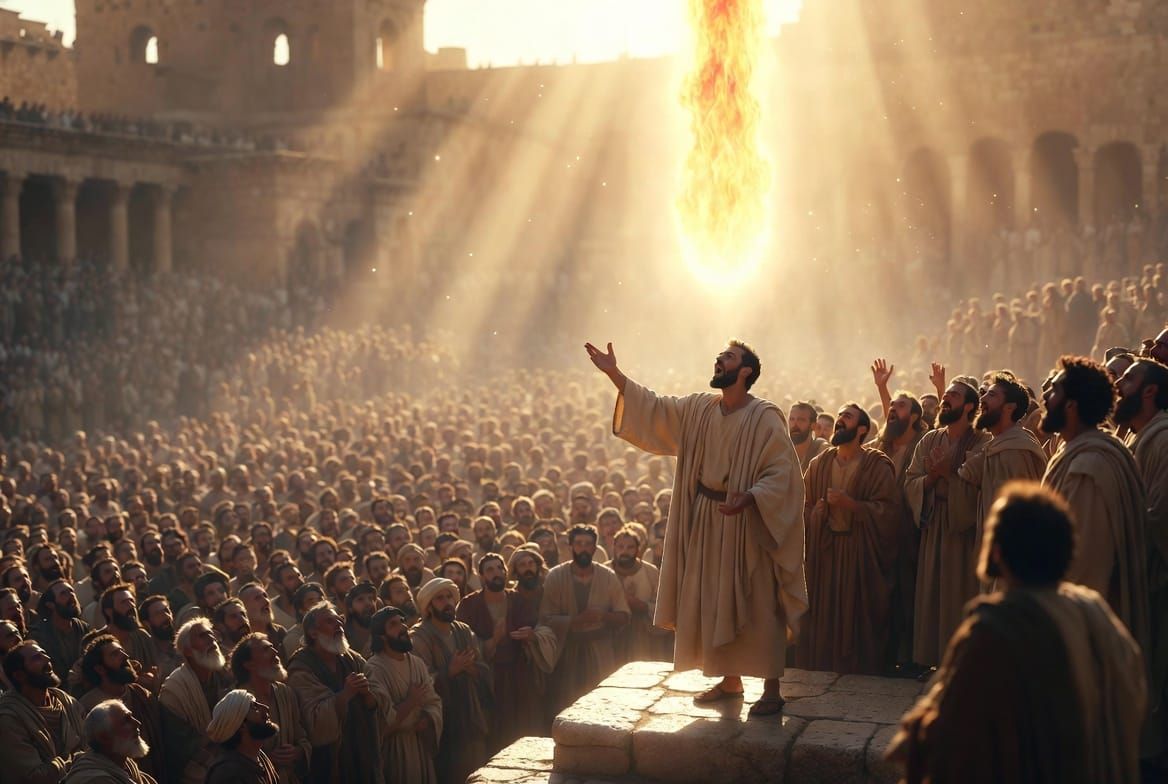
When the Day of Pentecost arrives in verse 1, they are "all together in one place" (Acts 2:1, ESV); still together, still waiting, still in one accord. Many scholars believe they have moved from the Upper Room to somewhere nearer the Temple courts, which would explain how thousands gathered so quickly around them. Whatever the exact location, verse 2 leaves no room for ambiguity: "suddenly there came from heaven a sound like a mighty rushing wind, and it filled the entire house where they were sitting." (Acts 2:2, ESV) Divided tongues as of fire. Every person present filled with the Holy Spirit. The empowering Jesus promised has arrived.
The sign of it is the languages. Devout Jews from every nation under heaven, Parthians, Medes, Elamites, visitors from Rome, Cretans and Arabians, every one of them hears the disciples speaking in the language of home: "we hear them telling in our own tongues the mighty works of God." (Acts 2:11, ESV)
To understand what this means, we need to go back to Genesis. At the plain of Shinar, the children of men built a tower to make a name for themselves, and God scattered them and confused their language. The fracture of Babel, nation divided from nation, tongue from tongue, has been running through human history ever since.
But Pentecost is new creation. The Spirit who hovered over the waters in Genesis 1:2, who breathed life into Adam, who filled the valley of dry bones in Ezekiel 37, who breathed new creation breath on the disciples behind locked doors on Easter evening, that Spirit is now poured out on all flesh, gathering what was scattered. Not by erasing differences, but by speaking into each one. Every nation still hears in its own tongue. The unity of Pentecost is not the unity of Babel, achieved through human will and pride. It is the unity Jesus prayed for on the Sunday after Ascension Day: "that they may be one, even as we are one." (John 17:11, ESV)
Psalm 104 appointed for this morning ties it all together. It is a creation psalm, and it arrives at the verse that explains Pentecost: "When you send forth your Spirit, they are created, and you renew the face of the ground." (Psalm 104:30, ESV) The Spirit is the power by which God creates and renews. What we see at Pentecost is exactly that, the face of the ground being renewed, one life at a time, beginning in Jerusalem and moving toward the ends of the earth.
And then Peter stands up.
Sit with that for just a moment. On Maundy Thursday night, the same night Jesus spoke the Farewell Discourse, the night of the arrest, Peter was standing outside a charcoal fire in the courtyard of the high priest. A servant girl asked whether he was one of Jesus' disciples. He said no. Three times. The man who drew a sword in Gethsemane just hours before could not hold through one night in a courtyard. He denied the name three times before the rooster crowed, just as Jesus said he would.
Fifty-three days later, the same man is on his feet in the streets of Jerusalem, before a crowd of thousands, proclaiming the very name he denied. The Spirit does not wait for Peter to feel sufficiently recovered. The Spirit falls, and Peter stands. This is what it looks like when a branch has been abiding long enough, through failure and grief, through ten days of prayer, for the fruit to come in its season. The branch does not produce fruit by trying harder; it produces fruit by staying connected. Peter is the proof of it.
In verse 17, Peter preaches from Joel, and the words he quotes gather the whole arc of the Easter season into a single declaration: "And in the last days it shall be, God declares, that I will pour out my Spirit on all flesh, and your sons and daughters shall prophesy, and your young men shall see visions, and your old men shall dream dreams." (Joel 2:28, ESV; cited in Acts 2:17, ESV) This is not a distant prediction. Peter is saying: this is it. What Joel saw, we are living. The age of the Spirit has arrived.
And Peter's sermon closes with the line that gathers the entire Easter season into one sentence. In verse 21: "And it shall come to pass that everyone who calls upon the name of the Lord shall be saved." (Joel 2:32, ESV; cited in Acts 2:21, ESV)That is the culmination. That is where fifty days of Easter have been heading.
That number, three thousand, is worth pausing over. At Sinai, when Moses came down from the mountain and found the people worshipping the golden calf, the Levites took up the sword and three thousand men fell that day under the judgment of the Law (Exodus 32:28). On the Day of Pentecost, the Spirit is poured out, Peter preaches the name of Jesus, and three thousand come to faith and are baptized. The same number. The opposite outcome. Paul, writing after Pentecost, names this contrast in 2 Corinthians 3:6–8: the ministry of the Law brought death, but the ministry of the Spirit brings life. What the Law could not do, the Spirit does. Three thousand fall at Sinai. Three thousand rise at Pentecost. This too is the new creation answering the old.
The name. On the Sunday after Ascension Day, Jesus prayed: "I have manifested your name to the people whom you gave me out of the world." (John 17:6, ESV) He prayed they would be kept in it, be one in it, and that the world would come to believe through it (John 17:11, 21). Now the man who denied the name three times is preaching it in the streets, and the prayer of John 17 is being answered in real time. There is the answer to John 14:12. Not greater in power, greater in reach. Three thousand souls in a single day. Jesus' earthly ministry was confined to one region and one generation. The Spirit-filled Church carries the Gospel to every nation, tongue, and tribe, beginning right here, in Jerusalem, on the Day of Pentecost.
Which brings us to where we actually live. We believe Christ has won. We believe the Spirit has been poured out. And then we look around, at our families, at our own hearts, at the world outside these walls, and wonder if any of it is real.
We named this tension last week on the Sunday after Ascension Day, the already and the not yet, the in between. The victory is real, and the rubble is real at the same time. We are like people in war-torn Europe on VE Day. The war was over, the enemy had surrendered, but his forces still occupied the land. The victory was real, and the rubble was real at the same time. We see the wreckage of broken families. We grieve the loss of people we love. We cough through the settling dust of our own sin. We fear. We doubt. The enemy is still in the land, and he has not stopped his propaganda.
But here is what Pentecost declares: we have not been left to rebuild alone. The same Spirit who fell like wind and fire on that first Pentecost morning, who gave Peter his voice, who gathered three thousand in a single day, who has sustained the Church through twenty centuries of rubble and renewal, that Spirit has been given to us. Not as a memory of something that happened long ago in Jerusalem. As a present reality, dwelling in us, praying in us when we cannot find words, forming us into the body of Christ in this place, at this Table, in this town.
So what does this mean for us, here, in Hiawassee, this morning? Let us carry three things into the week.
First: the Spirit has been poured out on all flesh, including ours. Joel said: our sons and daughters, our young men, our old men, our male servants and female servants. The Spirit of God is not rationed by age, by energy, by how many years we have left, or by how many times we have failed. If we have called upon the name of the Lord, the Spirit of God dwells in us. That is not a feeling; it is a fact, as certain as the resurrection that made Pentecost possible. If we are still breathing, the Spirit is still at work. God is not finished with us yet.
Second: the Spirit of truth will bring God's Word back to us when we need it most. When we are tempted toward fear or unbelief, the Spirit calls us back to the promises of Scripture, to the history of God's mighty acts, to our baptism, to our death and burial and resurrection with Christ, to this Table where the bread is broken and the cup is poured. We are not a people without a history. We have been called by name. We have been kept in a name. And the Spirit will not let us forget it.
Third: we are not waiting for the new creation to begin; we are already living in its continuation. As we said on the Sunday after Ascension Day, that changes Monday morning. When we go to work, care for a neighbor, sit with someone who is suffering, speak a word of truth in a conversation that could go either way, we are not killing time until Jesus returns. We are participating in the continuation of something he started and has promised to complete. The new creation breath that filled a locked room on Easter evening has been moving outward through this entire season: onto the Emmaus road, through the gate, along the way, into the vine, through the prayer of John 17, and now here, wind and fire, poured out into the ordinary week that lies ahead of us. Keep doing the next right thing.
Mary Magdalene wept alone at the beginning of this season. She was called by name. She went and told. By the time we reach Acts 2, she is gathered with the whole community, praying with them, waiting with them, filled with the same Spirit poured out on all flesh. The woman who met the risen Christ alone in a garden is now part of a body on fire. The arc of Easter does not end with a private encounter. It ends with a community sent.
The collect for Whitsunday, or Pentecost, in our Book of Common Prayer prays it as well as it can be prayed. Let us hear it again: "Almighty God, on this day, through the outpouring of the Holy Spirit, you revealed the way of eternal life to every race and nation: Pour out this gift anew, that by the preaching of the Gospel your salvation may reach to the ends of the earth; through Jesus Christ our Lord, who lives and reigns with you, in the unity of the Holy Spirit, one God, for ever and ever. Amen."
That is our prayer, offered not in uncertainty, but in confidence, because the Spirit has already been poured out, the name has already been proclaimed, and the King who ascended is already at the right hand of the Father, interceding for the very people he left in the world.
The name of Jesus has not changed. We have seen it all season. We have been prayed over by Jesus himself on the Sunday after Ascension Day: keep them in your name. And now proclaimed in the streets of Jerusalem by the man who once denied it, to people from every nation under heaven. The name that restored one woman in a garden is now available to everyone who calls. The prayer of John 17 has not stopped. The Spirit he promised is here. This is the arc of Easter. This is Pentecost.
So let the fire fall. Let the wind move. Stay in the name. Call upon the Lord.
"And it shall come to pass that everyone who calls upon the name of the Lord shall be saved." (Acts 2:21, ESV)
In the Name of the Father, and of the Son, and of the Holy Spirit. Amen.