Do You Begrudge My Generosity? (Matthew 20:1-16)
Last week the problem was receiving mercy and refusing to extend it. This week the problem is receiving grace and then resenting God when he gives grace to somebody else. We are comfortable with grace until grace interferes with our accounting.
September 20, 2026, Year A, Proper 20, Seventeenth Sunday after Pentecost, Season after Pentecost
Matthew 20:1-16, Psalm 145, Jonah 3:10-4:11
Grace, mercy, and peace from God our Father and the Lord Jesus Christ be with you on this Seventeenth Sunday after Pentecost.
Last Sunday Jesus confronted the ledger we keep against those who owe us. Peter had asked how many times he had to forgive a brother who sinned against him, and Jesus answered with the parable of a servant whose king canceled a debt he could never repay. That servant gladly received mercy and then refused mercy to someone who owed him far less. The question at the heart of the parable was, “Should not you have had mercy on your fellow servant, as I had mercy on you?” (Matthew 18:33, ESV) We saw that before we are people commanded to forgive, we are sinners who have been forgiven.
This morning Jesus confronts another ledger, the one we keep of what we think God owes us. Last week the problem was receiving mercy and refusing to extend it. This week the problem is receiving grace and then resenting God when he gives grace to somebody else. We are comfortable with grace until grace interferes with our accounting.
Before we get into the parable itself, though, we need to go back to the end of Matthew 19. Our primary text this morning is Matthew 20:1-16.
Chapter divisions were added long after Matthew wrote his Gospel, and the first word of our reading is important. In verse 1 Jesus says, “For the kingdom of heaven is like a master of a house who went out early in the morning to hire laborers for his vineyard.” (Matthew 20:1, ESV) That word “for” connects the parable directly to what Jesus has just said.
At the end of Matthew 19, a rich young man comes to Jesus asking what he must do to have eternal life. He is the sort of man people naturally put near the front of the line: wealthy, morally serious, and respectable. Yet when Jesus exposes the hold his possessions have upon him, he walks away sorrowful. The disciples are astonished, and Peter asks the question that sets up our parable. In verse 27 he says, “See, we have left everything and followed you. What then will we have?” (Matthew 19:27, ESV)
Peter is not wrong that the disciples have sacrificed. Jesus does not answer by pretending faithfulness means nothing. He promises that those who have followed him will not finally lose by following him, and then in verse 30 he adds a warning: “But many who are first will be last, and the last first.” (Matthew 19:30, ESV) The vineyard parable follows immediately, and when it ends Jesus says almost the same thing again in Matthew 20:16: “So the last will be first, and the first last.” Those two sayings stand like bookends around the story. Jesus is explaining what he means by the reversal of first and last, and he is warning disciples who may begin to think, “We came earlier. We sacrificed more. Surely that gives us a greater claim.”
There is no dependable correlation between earthly position and heavenly approval. Wealth, reputation, influence, longevity, and even years of Christian service can become spiritually dangerous when we turn them into reasons God should prefer us. Scripture teaches that God sees and rewards faithfulness, but there is no simple equation in which the length of earthly labor determines the size of heavenly reward. God does not run the Kingdom by a celestial seniority system. Faithfulness matters, but tenure does not put God in our debt.
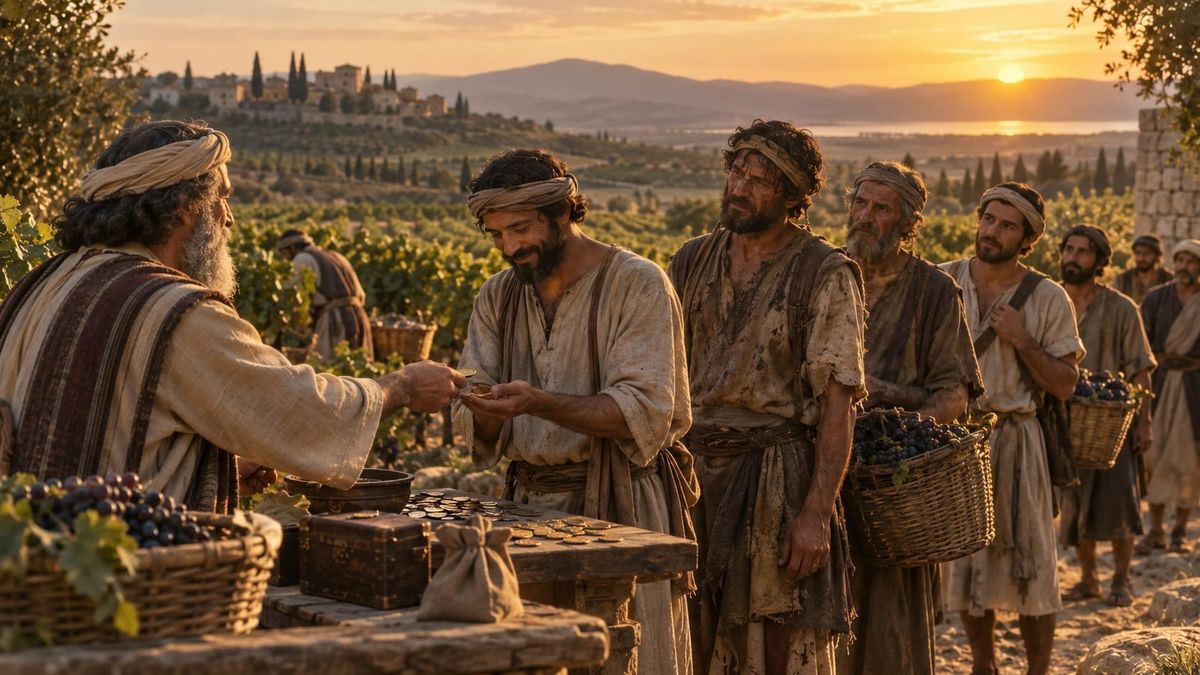
In verses 1 and 2 of Matthew 20, the master goes out early, agrees with the first workers for a denarius, and sends them into his vineyard. Then in verses 3 through 7, he keeps going out: at the third, sixth, ninth, and finally the eleventh hour, when there is barely an hour left in the working day. To the next group he simply says in verse 4, “You go into the vineyard too, and whatever is right I will give you.” (Matthew 20:4, ESV) By the eleventh hour, there is no discussion of wages at all. In verse 7 the workers explain why they are still standing there: “Because no one has hired us.” The master answers, “You go into the vineyard too.” (Matthew 20:7, ESV)
Notice throughout the story that the master is the one who keeps going out. None of these workers hires himself. None creates his own place in the vineyard. The master goes looking, the master calls, and the master sends. Even the people who begin at dawn are there because the master came and gave them work. Before any of us can compare how long we have served Christ, we ought to remember who came looking for us. We did not climb into the Kingdom by superior judgment. God called us, forgave us, gave us faith, and sustained us. Even our years of faithfulness are lived inside a grace we did not create.
Then evening comes, and in verse 8 the owner tells his foreman to call the laborers and pay them, “beginning with the last, up to the first.” (Matthew 20:8, ESV) The order matters because Jesus wants the first workers to see what happens. In verse 9, those hired at the eleventh hour each receive a denarius. That is extraordinary generosity. They worked perhaps an hour, yet the master gives them what a man would ordinarily need for an entire day. Then verse 10 tells us that when the first workers come, “they thought they would receive more.” (Matthew 20:10, ESV)
The master never promised them more. Nothing about their agreement has changed. But the generosity shown to somebody else changes what they think they deserve. Before the eleventh-hour workers were paid, a denarius was fair. The first workers had agreed to it. Once they saw grace poured out on someone else, what had been fair suddenly felt insulting. That is what comparison can do to the heart.
We know that temptation in ordinary church life. Someone newer is noticed for gifts we have exercised quietly for years. A younger Christian is invited into leadership. A person returns after years away and is warmly welcomed, while nobody seems particularly excited that we have been there every Sunday for thirty years. Someone tells a dramatic conversion story while our testimony is simply that God kept us from many of those disasters. We may sincerely say, “I am glad for them,” and then add one revealing word: “but.” I am glad for them, but I have been here longer. I am glad God blessed them, but after the choices they made, why are things going so well for them? That “but” can reveal the vineyard worker in us.
In verses 11 and 12, the workers finally say what is bothering them. Jesus tells us, “And on receiving it they grumbled at the master of the house, saying, ‘These last worked only one hour, and you have made them equal to us who have borne the burden of the day and the scorching heat.’” (Matthew 20:11-12, ESV) Their grievance is not that the master broke his word. He did not. Their grievance is, “you have made them equal to us.” Grace becomes hardest to celebrate when God gives it to someone we think deserves less than we do.
That is why Jonah is such a perfect companion to this parable. Jonah preached to Nineveh, a city he despised and a people with every reason to expect judgment. Nineveh repented, and God relented from the disaster he had threatened. Jonah should have celebrated one of the most astonishing responses to prophetic preaching in Scripture. Instead, Jonah becomes angry. He tells God, in effect, “This is why I did not want to come. I knew what you were like.” Jonah knew that God was gracious and merciful, slow to anger, and abounding in steadfast love. He knew God might forgive the Ninevites, and that possibility offended him.
In Jonah 4:4, God asks him, “Do you do well to be angry?” Jesus’ landowner asks almost the same question in another form. In verse 13, he answers one of the grumblers, “Friend, I am doing you no wrong. Did you not agree with me for a denarius?” (Matthew 20:13, ESV) Then in verses 14 and 15 he says, “Take what belongs to you and go. I choose to give to this last worker as I give to you. Am I not allowed to do what I choose with what belongs to me? Or do you begrudge my generosity?” (Matthew 20:14-15, ESV)
That final question is the heart of the sermon. The expression carries the idea of an evil eye because the master is good. Has his goodness toward another person become a reason for us to look at him with suspicion? Are we angry because God has failed to be gracious, or because he has been gracious to the wrong person?
Our Collect this morning asks God to pour into our hearts “that most excellent gift of charity,” because without love “all our deeds are worth nothing.” That prayer belongs beside this parable. The first workers have done real work. They have borne the burden of the day and the scorching heat. But faithful service without love has curdled into resentment. The problem is not that they labored too long. It is that they can no longer rejoice in the goodness of the master when that goodness reaches someone else.
The question becomes especially searching when we consider someone whose sins genuinely horrify us. Suppose a man commits murder, is convicted, sentenced to death, and near the end of his life truly repents and trusts in Jesus Christ. His conversion does not undo the crime, remove the grief of the victim’s family, or erase lawful earthly consequences. Earthly justice and heavenly mercy are not the same question. But if his repentance and faith are genuine, is he forgiven? Does Christ receive him? Does he inherit eternal life by the same grace that saves a woman who has followed Jesus faithfully for seventy years? The Gospel says yes.
If something in us immediately says, “But that is not fair,” then Jesus has brought us into the vineyard. The lifelong Christian may have served Christ faithfully for decades, while the murderer comes at the eleventh hour with almost nothing left to offer. Yet Jesus does not give him one-twentieth of a Savior. If the repentance and faith are real, Christ receives him fully. That does not make the two earthly lives morally equivalent. It means neither sinner stands before God on the basis of comparative moral superiority.
The thief crucified beside Jesus shows us the same thing. He has almost no time left. He cannot build a record of decades of Christian service. He cannot go back and repair most of the damage of his life. Yet after he confesses his guilt and turns toward Jesus, Luke 23:42 tells us that he says, “Jesus, remember me when you come into your kingdom.” Then in verse 43 Jesus answers, “Truly, I say to you, today you will be with me in paradise.” (Luke 23:42-43, ESV) That is an eleventh-hour worker.
But this parable also corrects the lifelong Christian. We can imagine that the eleventh-hour convert somehow got the better bargain, while we bore the heat of the day. But was knowing Christ for sixty years a burden we wish we had avoided? Was receiving his forgiveness, hearing his Word, coming to his Table, being carried through grief, and surrounded by his Church somehow a bad deal? The person converted at eighty did not beat the system. He lost decades in which he might have known the Lord.
The tragedy of the first workers is that comparison turns the privilege of spending the whole day in the vineyard into evidence that they have been cheated. Years of faithfulness ought to make us more grateful, not more entitled. We can move from saying, “How gracious God has been to keep me all these years,” to saying, “After all these years, God owes me better than this.” Even the privilege of walking with him for years is grace.
Psalm 145 teaches us the response Jonah and the vineyard workers have forgotten. In verses 8 and 9, the psalmist praises the LORD as “gracious and merciful, slow to anger and abounding in steadfast love,” and says, “The LORD is good to all, and his mercy is over all that he has made.” (Psalm 145:8-9, ESV) Jonah knows those attributes and resents what they mean for Nineveh. The vineyard workers experience that generosity and grumble. The psalmist sees the grace of God and worships. The question is whether God’s generosity will make us angry or grateful.
The elder brother in the parable of the prodigal son shows the same danger. When his brother comes home, he complains in Luke 15:29 that he has served the father for years without disobeying him. The father answers in verse 31, “Son, you are always with me, and all that is mine is yours.” (Luke 15:31, ESV) The elder brother has forgotten that being with the father was itself the gift. Jesus is not condemning long faithfulness. He is warning us not to turn long faithfulness into leverage against grace.
He is not telling Peter that leaving everything to follow him does not matter. It matters. He is telling Peter not to take what Christ graciously promises and convert it into a claim that limits what Christ may graciously give someone else. That means obedience cannot become a bargain. We do not say, “Lord, I have been faithful, so my children must turn out the way I want,” or, “I served the Church, so you owe me health,” or, “I avoided those sins, so I deserve an easier life.” We do not say, “I have been here longer, so my opinion should matter more.” Obedience is not currency with which we purchase control over God. It is the grateful fruit of grace.
And that brings us back to last Sunday. The unforgiving servant received mercy and then treated mercy as though it were scarce. The vineyard workers receive generosity and then act as though the master’s generosity toward someone else takes something away from them. But grace is not scarce. The welcome given to the prodigal does not remove the elder brother’s place in the father’s house. The denarius given to the eleventh-hour worker does not take the denarius from the first. The mercy God shows another sinner does not diminish the mercy available to us.
Tomorrow the Church remembers Saint Matthew, Apostle and Evangelist. Matthew knew something about unlikely people being called into the vineyard. He was sitting at a tax booth when Jesus said, “Follow me.” He was not the man respectable religious people would have selected, yet Christ called him and Matthew rose and followed. The man who preserved this parable knew what it was to have people wonder why Jesus would want a man like that.
The right response to grace is not, “Why him?” It is gratitude that the Lord still goes into the marketplace, calls people others have overlooked, and brings sinners into his Kingdom by grace. Thank God the thief could turn toward Jesus and hear the promise of Paradise. Thank God a prisoner awaiting execution can discover that the blood of Christ is sufficient even for him. And thank God that none of us stands before God asking for what our sins deserve.
The good news is that Jesus Christ did not come to pay righteous people wages they had earned. He came to save sinners. He bore our sins on the Cross, rose victorious from the grave, and calls us to repent and believe the Gospel. We do not enter the Kingdom because our record is better than another sinner’s. We enter because the King is merciful. The lifelong saint needs that mercy, and the eleventh-hour convert needs that mercy. Christ is sufficient for both.
So when grace comes to someone we think deserves it less, let us rejoice. When a prodigal comes home, celebrate. When an old sinner comes to Christ, praise God. When a new Christian discovers gifts, encourage them. When someone else receives a blessing we wanted, resist the urge to keep score. And if we have walked with Christ for many years, thank him for every one of those years. The Master has been with us in the vineyard.
In verse 16 Jesus closes where he began: “So the last will be first, and the first last.” (Matthew 20:16, ESV) Earthly position does not determine heavenly approval. Length of service does not put God in our debt. Grace overturns our rankings because grace begins with the generosity of God rather than the merit of the worker. The question Jesus leaves us with is not whether God has been fair to us. In Christ he has given us infinitely more than fairness. The question is whether we can rejoice that he is generous.
In verse 15, the master asks, “Do you begrudge my generosity?” May the generosity of God toward sinners become not the cause of our grumbling, but the reason for our praise, and may we rejoice every time the Master goes out once more and brings another worker into his vineyard.
In the Name of the Father, and of the Son, and of the Holy Spirit. Amen.