I Chose You Out of the World: Saint Simon and Saint Jude, Apostles (John 15:17–27)
That is the pattern of the Gospel itself. Christ does not wait for sinners to make themselves useful and then recruit the best candidates. He calls. He chooses. He forgives. He forms. He sends. Whatever faithfulness follows is the fruit of grace that came first.
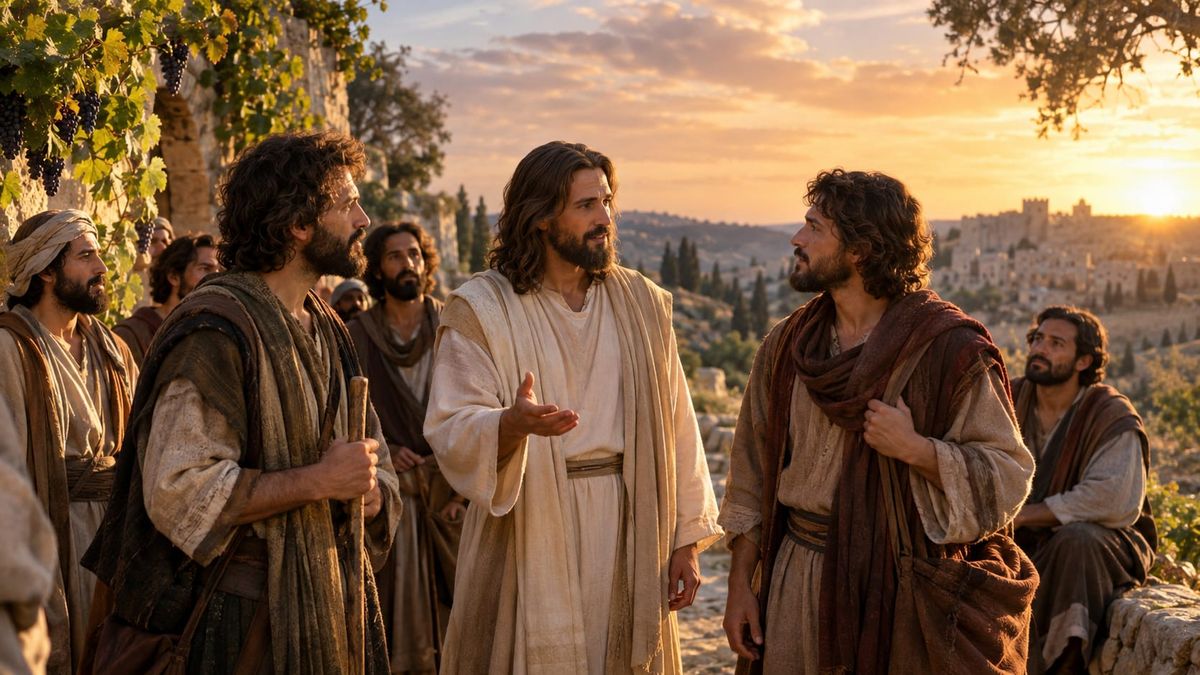
October 28, 2026, Saint Simon and Saint Jude, Apostles, Red-Letter Holy Day, Season after Pentecost
John 15:17–27; Psalm 119:89–96; Ephesians 2:13–22; Deuteronomy 32:1–4
Grace, mercy, and peace from God our Father and the Lord Jesus Christ be with you on this Feast of Saint Simon and Saint Jude, Apostles.
Saint Simon and Saint Jude are among the apostles we know least about. Their names appear in the lists of the Twelve, but Scripture gives us very little about what happened to them afterward. We do not have a long account of Simon’s preaching. We do not have a missionary diary from Jude. We do not have chapters of Acts devoted to their journeys. The Church remembers later traditions about where they may have gone and how they may have died, but much of their earthly ministry has disappeared from our sight. Yet Jesus knew exactly whom he had chosen.
That is where our primary text begins to open this feast for us. In verse 19 Jesus says to his disciples, “you are not of the world, but I chose you out of the world.” Before Simon is remembered for zeal, Christ chooses him. Before Jude speaks a word of apostolic witness, Christ chooses him. Before either man is sent out in mission, before either man suffers anything for the Gospel, before either man does anything the Church will remember, Jesus says, “I chose you.” The first and decisive action belongs to Christ.
That is the pattern of the Gospel itself. Christ does not wait for sinners to make themselves useful and then recruit the best candidates. He calls. He chooses. He forgives. He forms. He sends. Whatever faithfulness follows is the fruit of grace that came first.
That matters especially on a feast like this one because Simon and Jude could easily become little more than names on a calendar. We know Peter. We know John. We know Thomas and his doubt. We know Matthew at the tax booth. We know something of Philip and Andrew. But Simon and Jude stand before us with much less detail. Jesus did not know them less because we know less about them, and their lives were not less significant because history preserved fewer details. Verse 19 tells us why their significance is secure: “I chose you out of the world.”
That is the beginning of Christian vocation too. None of us belongs to Christ because we managed to become sufficiently impressive. We belong to him because he has acted in mercy toward us. He has called us through the Gospel. He has brought us near. He has joined us to himself. He has made us members of his household.
Ephesians 2, appointed for this feast, says that those who were once far off “have been brought near by the blood of Christ.” (Ephesians 2:13) Paul then says that we are “fellow citizens with the saints and members of the household of God,” built on the foundation of the apostles and prophets, with Christ Jesus himself as the cornerstone (Ephesians 2:19–20).
Notice again where the weight falls. Christ is the cornerstone. His blood brings us near. His Cross makes peace. His grace creates the household. Even the apostles stand beneath him. Simon and Jude are part of the apostolic foundation, but they are not the cornerstone. Their importance comes from the Lord who called them and the Gospel he entrusted to them. The Church does not finally rest on Simon’s zeal or Jude’s courage. The Church rests on Jesus Christ.
That becomes especially important when we come to the harder words of John 15. Jesus tells his disciples that the world will hate them. Verse 18 says, “If the world hates you, know that it has hated me before it hated you.” Then in verse 20 he reminds them, “A servant is not greater than his master.” Jesus is not giving the apostles a promise of admiration. He is preparing them for opposition.
We should hear that carefully because Christians can mishandle these words in more than one direction. We can be tempted to soften Christian witness until there is nothing left that anyone could possibly oppose. Or we can become combative, provoke hostility through our own pride or foolishness, and then call every negative reaction persecution. Jesus gives us neither option.
The hatred he describes comes because the servant belongs to the Master. The world hates Christ, and those who bear faithful witness to Christ may share in that rejection. The issue is not that Christians have managed to become irritating. The issue is allegiance to Jesus. There is no virtue in being disliked because we are cruel, arrogant, careless, or needlessly offensive. If people recoil because our speech is vicious or because we have treated them with contempt, we should not baptize our bad behavior as faithfulness. But neither may we surrender the truth of Christ in order to make Christian witness harmless.
Jesus is Lord. Sin is real. Repentance is necessary. Mercy is found in Christ. The Cross is not optional. Resurrection is not metaphor. Human beings do not save themselves. The Church does not have authority to reinvent the faith according to the preferences of every generation. Faithful witness will sometimes cost us something because Christ himself remains a contradiction to the world’s claims about who has the right to rule our lives.
That brings us naturally to Simon. Luke calls him “Simon who was called the Zealot.” Scripture does not tell us precisely what that title meant in his life before Jesus called him, and we should not invent a political biography Scripture does not give us. But the language of zeal remains attached to his name.
The Collect for today picks that language up and asks God that, as Simon and Jude were “faithful and zealous in their mission,” we may “with ardent devotion make known the love and mercy of our Lord and Savior Jesus Christ.” There is a great difference between zeal and Christian zeal.
We know something about ordinary zeal. People can be intensely devoted to politics, causes, personalities, movements, grievances, careers, hobbies, institutions, and arguments. Zeal itself proves almost nothing. We can be passionately wrong. Saint Paul speaks in Romans about people who have “a zeal for God, but not according to knowledge.” (Romans 10:2) Strong feeling does not make something true, and aggressive certainty is not the same thing as courage.
The Collect therefore joins zeal to faithfulness. Christian zeal must be governed by the truth of Christ, shaped by the character of Christ, and directed toward the mission of Christ. The Collect does not ask God to make us louder. It asks him to make us faithful and zealous so that we may make known “the love and mercy of our Lord and Savior Jesus Christ.”
That gives us a good question to ask ourselves: What is our zeal actually making known? When we speak about the things that matter most to us, do people encounter the love and mercy of Jesus Christ, or mostly our anger? When we defend the faith, are we trying to make Christ known, or are we enjoying the feeling of defeating someone? When we speak truth, are we willing to speak it clearly without turning another person into an enemy to be humiliated? When the culture around us moves in directions we believe are wrong, do we respond as people whose confidence rests in the reign of Christ, or as people who panic whenever we are not in control?
Whatever zeal once meant in Simon’s earlier life, Christ became the center. That is what Christian conversion does to every loyalty. Christ does not necessarily erase every conviction, interest, temperament, or responsibility we had before, but he refuses to share the throne. Political commitments must bow to Christ. Family loyalties must bow to Christ. Personal ambitions must bow to Christ. Our resentments must bow to Christ. Even our zeal must bow to Christ.
That is where Simon’s place among the Twelve becomes especially interesting. Matthew had been a tax collector, tied to the Roman revenue system and despised by many of his countrymen. Simon bore a title associated with zeal. Whatever details we cannot reconstruct, these are not men we would naturally expect to choose one another. Jesus chose both.
Their unity did not begin in shared politics, shared background, shared temperament, or shared social standing. Their unity began in Christ. That is a word the Church continually needs. Christian unity does not require us to pretend disagreements do not matter. It does not require everyone to have the same temperament, the same political analysis, or the same judgment about every earthly question. But it does require us to remember which confession is ultimate: Jesus is Lord. Nothing else may become a rival creed.
Ephesians 2 says Christ has broken down the dividing wall of hostility and made one new humanity through the Cross. The Church is therefore not supposed to reproduce every hostility of the surrounding world and then merely attach Christian vocabulary to it. We belong to one household, and Paul says that peace was accomplished “through the cross, thereby killing the hostility.” (Ephesians 2:16) Christian unity is expensive because it was purchased by the blood of Christ.
That means the person beside us in Christ cannot simply be reduced to a voting pattern, a social category, an old wound, a personality conflict, or the worst opinion they have ever expressed. We may need difficult conversations. We may need correction. Sometimes boundaries are necessary. But the Cross changes the terms on which Christians encounter one another. Christ is our peace.
Then Jesus moves in our Gospel from opposition to witness. Verse 26 says, “When the Helper comes, whom I will send to you from the Father, the Spirit of truth, who proceeds from the Father, he will bear witness about me.” Then verse 27 adds, “And you also will bear witness, because you have been with me from the beginning.”
That order matters just as much as verse 19. The Spirit bears witness, and the apostles bear witness. Apostolic mission is not self-generated religious energy. Simon and Jude are not sent into the world with nothing but personality and determination. The Spirit of truth bears witness to Christ, and the apostles are drawn into that divine work.
Christian witness is therefore dependent from beginning to end. We need grace to belong to Christ. We need grace to remain faithful to Christ. We need the Holy Spirit to bear witness to Christ. We need grace to speak with courage and with love. We need grace to endure opposition without becoming bitter.
The Collect understands this. It begins, “Grant, O God.” Grant faithfulness. Grant zeal. Grant ardent devotion. Even the qualities we admire in the apostles must be given by God.
That should be liberating for those of us who hear words like witness and immediately think we are being told to manufacture a religious personality we do not have. Most Christians are not called to stand before enormous crowds. Most will not write books that survive for centuries. Most will not become famous missionaries or public theologians. Most Christian witness happens in places history will never record, and Simon and Jude are good saints for remembering that.
Faithful witness may look like teaching a child to pray when no one outside the house sees it. It may look like caring for a husband or wife through a long illness. It may mean sitting with an aging parent who asks the same question for the fifth time. It may mean refusing to join in cruel gossip at work, telling the truth when dishonesty would be easier, inviting someone to church, praying faithfully for a neighbor, serving week after week in ways almost no one notices, or speaking the name of Jesus in a conversation when we would rather remain safely silent.
None of that is small because Christ sees it.
Psalm 119 says, “Forever, O LORD, your word is firmly fixed in the heavens. Your faithfulness endures to all generations.” (Psalm 119:89–90) Simon and Jude passed from this world, but God’s Word did not. That is part of the freedom of Christian ministry. We do not have to make ourselves unforgettable. We are called to be faithful.
The world teaches us to measure significance by visibility. How many people saw it? How many people shared it? How many people know our name? How much influence did we accumulate? Even the Church can absorb those measures without noticing. Simon and Jude quietly expose how shallow that can be. Two men can belong to the Twelve apostles of Jesus Christ, help bear the foundational witness of the Church, and still leave behind almost no biography that history can confidently reconstruct.
They were known to Christ, and that is what mattered. This does not mean laziness. Obscurity is not an excuse for burying gifts God has given us. Simon and Jude were sent. Christian faithfulness acts, speaks, serves, and bears witness. But faithfulness is different from self-promotion.
The goal is not that people remember us. The goal is that we make known “the love and mercy of our Lord and Savior Jesus Christ.” That love and mercy are not vague kindness. They have a shape. The love of Christ took him to the Cross. The mercy of Christ addresses real sin. The risen Christ gives life to the dead. The reigning Christ calls us to repentance, faith, obedience, and hope. That is the apostolic Gospel, and it is the Gospel entrusted to the Church still.
So perhaps the feast of two apostles about whom we know comparatively little gives us a simple set of questions. Where has Christ called us to be faithful when almost no one is watching? Where has zeal become anger rather than devotion to Christ? Where has some earthly loyalty begun demanding a place that belongs only to Jesus? Where are we tempted to remain silent because faithful witness might cost us something? And where have we begun believing that our work matters only if someone notices?
John 15 gives us the answer beneath all those questions. Christ chose. The Spirit bears witness. We bear witness. The first action is his, the sustaining power is his, and the Gospel is his.
That means we can serve without needing applause. We can speak without needing to control the outcome. We can endure rejection without imagining that Christ has lost his throne. We can work faithfully in places history will never notice because the Lord of history sees.
Saint Simon and Saint Jude remind us that the Church is built not by celebrity but by apostolic faithfulness beneath the lordship of Christ. Some servants are remembered in great detail. Others leave us little more than a name. But Christ knows every one of his own. He knew Simon. He knew Jude. He chose them out of the world, sent them as witnesses, and gave them a place in the foundation of his Church.
The same Lord who chose the apostles has called us through the Gospel, brought us near by his blood, and given us work to do. So let us ask God for what the Collect teaches us to ask: not fame, not recognition, not influence for its own sake, but faithfulness, holy zeal, and ardent devotion.
May he grant us courage when witness is costly, humility when zeal runs hot, love when disagreement is real, perseverance when our work seems hidden, and confidence that his Word will remain long after our names have been forgotten. For the servants pass from view, but Jesus Christ remains the cornerstone. His Spirit still bears witness. His Word is firmly fixed forever. And his love and mercy are still the message the Church has been given to proclaim.
In the Name of the Father, and of the Son, and of the Holy Spirit. Amen.