I Have Seen the Lord: Saint Mary Magdalene (John 20:11-18)
Feast of Mary Magdalene, July 22. She came to the tomb in the dark, wept, asked where the body had been taken. Then Jesus spoke one word: Mary. The risen Lord’s first word on Easter morning was a proper name. She recognized him. And she said: "I have seen the Lord".
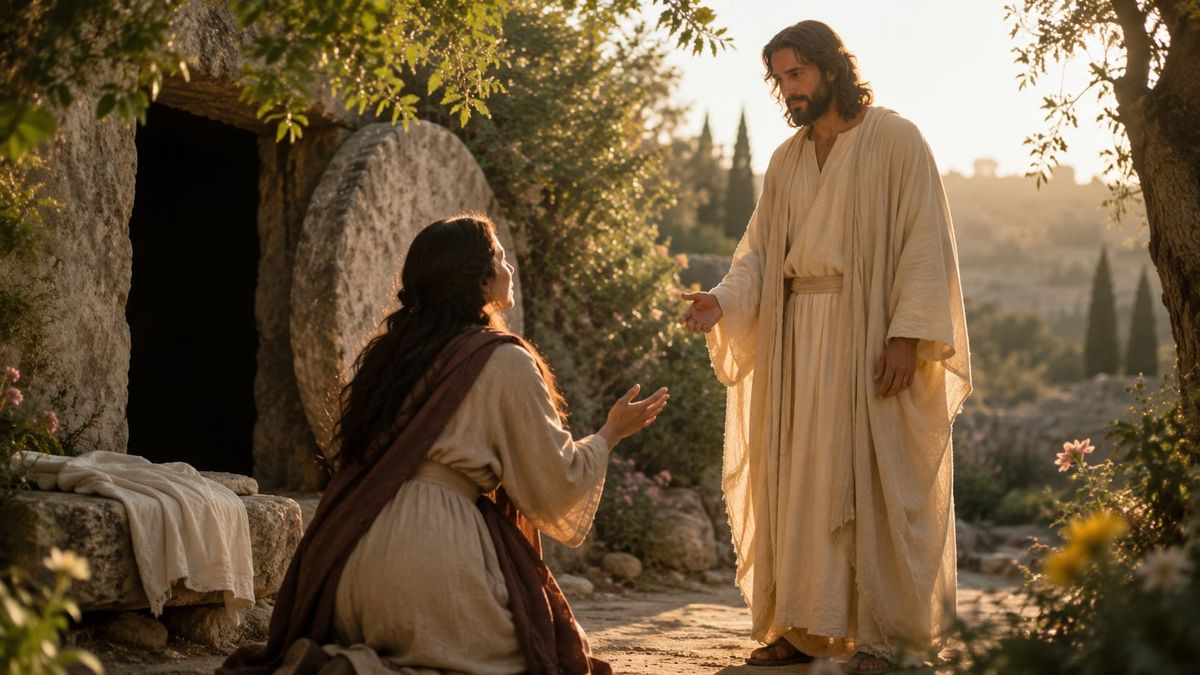
July 22, 2026, Saint Mary Magdalene, Red-Letter Holy Day, Season after Pentecost
John 20:11-18, Psalm 42:1-7, 2 Corinthians 5:14-20a, Judges 4:4-10
Grace, mercy, and peace from God our Father and the Lord Jesus Christ be with you on this feast of Saint Mary Magdalene.
Three days ago, on Proper 11, the parable of the wheat and the tares invited us to wait. Let both grow until the harvest. The Son of Man will send his angels at the close of the age. The harvest belongs to him and to his timing, not to us. It was a word for a long season: patient, faithful, groaning alongside creation for what has not yet fully come.
Today the feast of Saint Mary Magdalene interrupts that patience with an announcement. The harvest has already begun. The Season after Pentecost is the long season of the Church’s formation, the field with wheat and tares growing together. But in the middle of that long season, on July 22, a woman who came to a tomb in grief says four words that change everything: “I have seen the Lord.” (John 20:18, ESV) The empty tomb she found is the sign that the new creation has already started. The harvest of the resurrection has already begun. The wheat and tares still grow together in the world, but in the risen Christ the firstfruits have appeared. In John’s account, Mary is the first person shown encountering the risen Lord, and today we hear her testimony: “I have seen the Lord.”
Scripture tells us almost nothing about Mary’s life before she encountered Jesus, and what it tells us is stark. Luke 8:2 introduces her in a single clause: “Mary, called Magdalene, from whom seven demons had gone out.” (Luke 8:2, ESV) Seven demons. The number is not explained. The nature of the affliction is not spelled out. We are only told that they were many, and that they were gone. She had been their captive; she was captive no longer. And from that day of healing forward, she followed Jesus. The collect for this feast keeps exactly the same proportion as Scripture: God’s Son restored her to health of body and of mind, and called her to be a witness of his resurrection. Two things: the healing and the calling. The collect does not speculate about what she had been. It states plainly what she became.
What we know about the season between her healing and the Crucifixion can almost be stated in a single phrase: she followed Jesus. She was among the women who traveled with him and supported his ministry from their own means. And as the Passion unfolds, the Gospels keep placing Mary near Jesus. She is named among the women at the Crucifixion. She is connected with his burial. When the Sabbath is over, she comes again to the tomb. The shape of her story is simple: she had been delivered, she followed, and she remained. We might put it even more simply: she stayed. Not because staying was safe, but because the one who had delivered her had become the one she could not leave. And even here grace remains first. The woman who stayed is first the woman whom Christ had found and set free.
Judges 4 gives us an Old Testament companion to Mary’s story. Deborah is a prophetess and judge of Israel who summons Barak to lead the army against Sisera and is willing to go with him when he refuses to go without her. She is present when Barak hesitates. She speaks the word God has given her, and when the victory comes, the victory belongs to the Lord. Mary’s calling is different, but the pattern is worth noticing: in a moment of crisis, a faithful woman receives a word from God and carries it where it must go.
The connection is not that Deborah and Mary occupy the same office or play the same role. It is that neither woman creates the victory she announces. Deborah does not defeat Sisera by the power of her own word, and Mary does not make the Resurrection happen by believing strongly enough. God acts. The messenger receives what God has done and faithfully carries the word. In both stories, the woman goes. In both stories, the victory belongs to God alone.
Psalm 42 is the prayer appointed for this feast, and it is Mary Magdalene at the tomb before she knows why the tomb is empty. “As a deer pants for flowing streams, so pants my soul for you, O God. My soul thirsts for God, for the living God. When shall I come and appear before God?” (Psalm 42:1-2, ESV) The psalmist is in a place of desolation. The presence he once knew is gone. He remembers what it was to worship, and the remembering is its own grief. But he does not let go. He pants. He thirsts. He keeps asking when he will see the face of God again. Mary at the tomb is this psalm in a person. She is not resigned to the absence. She weeps, she looks, she asks the angels, she asks the man she supposes to be the gardener: where have they laid him? She will not accept that he is simply gone. She keeps looking for the one she loves.
And the one she is looking for is already there.
In verses 14 through 16, Mary turns and sees Jesus standing there, but she does not recognize him. He asks why she is weeping and whom she is seeking. She supposes him to be the gardener. She asks where the body has been taken. She will go and get him herself if she must. And then comes the single word on which the whole passage turns: “Mary.” (John 20:16, ESV) He speaks her name. She turns again. She recognizes him, not by sight, but by sound: the voice of the one she loves, speaking the name that belongs to her and to no one else. Her answer is the Aramaic word for Teacher: Rabboni (rah-BOH-nee). One word for his one word. The risen Lord has spoken. The Resurrection is no longer only an empty tomb, folded cloths, or angels in white. It is a voice. It is a name. It is the one she has been looking for, standing in front of her, alive.
It is worth sitting with this moment before moving past it. Mary has spoken with two angels and still does not understand what has happened. She has looked directly at the risen Lord and has not recognized him. She is looking for a dead body, not a living person. And the recognition begins when Christ addresses her personally. The correction does not begin with a lecture. It begins with the Shepherd calling one of his sheep by name. He says, “Mary,” and she knows.
Notice how personal the risen Christ is in this scene. The tomb is empty. The angels are there. Jesus himself is standing before her. The evidence is not absent; Mary simply has not yet understood what it means. What finally breaks through her grief is the Shepherd’s voice. The Lord who has conquered death does not treat her as an anonymous witness in a crowd. He calls her by name.
John 10 said it in advance: “The sheep hear his voice, and he calls his own sheep by name and leads them out.” (John 10:3, ESV) Then verse 4 adds, “the sheep follow him, for they know his voice.” (John 10:4, ESV) Mary gives us a vivid Easter instance of that promise. The Good Shepherd has laid down his life. He has taken it up again. And now he calls one of his sheep by name: “Mary.” She knows his voice. She turns.
Then in verse 17 he sends her: “Go to my brothers and say to them, ‘I am ascending to my Father and your Father, to my God and your God.’” (John 20:17, ESV) The one who had been healed, who had followed, who had remained near through the Passion, and who had come again to the tomb is now commissioned. Christian tradition came to honor Mary with the Latin title apostola apostolorum (ah-POS-toh-lah ah-pos-toh-LOR-um), “apostle to the apostles.” The title does not make Mary one of the Twelve or place her in the apostolic office in the same sense as Peter or Paul. It honors the extraordinary commission John actually records: the risen Christ sends her to his disciples with the news that he is alive.
And in verse 18 the proclamation she carries is not merely a theory about an empty tomb. It is testimony: “I have seen the Lord.” (John 20:18, ESV) Not: I believe something remarkable has occurred. Not: the tomb appears to be empty. I have seen the Lord. First-person singular. Past tense. Personal. She is testifying to what she herself has seen. Christian witness is not less than argument, evidence, or persuasion; the apostles themselves reason, explain, and persuade. But at its heart Christian witness bears testimony to what God has done. We do not invent the Gospel. We receive news. Christ died. Christ is risen. Christ reigns. Before Peter preached at Pentecost, before Paul wrote his letters, before any council or creed, John shows Mary standing before the disciples with these words: “I have seen the Lord.” In John’s telling, for that first moment of proclamation to the disciples, the Easter news comes through her testimony. She had been healed. She had followed. She had remained. Now she was sent.
Paul writes in 2 Corinthians 5:17-18: “Therefore, if anyone is in Christ, he is a new creation. The old has passed away; behold, the new has come. All this is from God, who through Christ reconciled us to himself and gave us the ministry of reconciliation.” (2 Corinthians 5:17-18, ESV) What Mary carried to the disciples that morning was not only news about a tomb. It was news of the new creation: the crucified Jesus is alive, death has been broken, and the age to come has broken into the present age. Mary stands at the threshold of the garden and says: “I have seen the Lord.”
The feast therefore does not pull us away from the long work of Christian formation in the Season after Pentecost. It tells us what makes that work possible. We wait for the final harvest because the firstfruits have already appeared. We endure the mixed field because death itself has already been breached. Mary’s four words do not cancel the waiting of Proper 11. They give that waiting its hope: the Lord for whom we wait has already conquered the grave.
And notice Paul’s order: “All this is from God.” Grace remains first. Mary does not free herself from bondage; Christ delivers her. She does not reason herself into Resurrection faith; Christ stands before her and speaks her name. She does not invent a mission for herself; Christ sends her. Gift before response. Grace before witness. Christ first from beginning to end.
It is worth noting what Mary’s commission means for the community to which she carries the word. Luke tells us that the women’s report “seemed to them an idle tale, and they did not believe them.” (Luke 24:11, ESV) John adds that even after Peter and the beloved disciple saw the empty tomb for themselves, “as yet they did not understand the Scripture, that he must rise from the dead.” (John 20:9, ESV) Faithful witnesses do not control the response to their witness. Mary is told to go, and she goes. The apostles will later do the same. The Spirit opens hearts; our calling is to bear faithful witness to Christ.
The one who spoke Mary’s name in the garden speaks still. The Collect for this feast moves from Mary’s story to ours in the characteristic Anglican way: the historical action of God becomes the ground of present petition. He restored her to health of body and of mind; now we ask: “Mercifully grant that, by your grace, we may be healed from all our infirmities and know you in the power of his unending life.” (BCP 2019, p. 630) Her healing is not only something to admire from a distance. It sends us to the same Lord with our own need. Mary’s seven demons were not a metaphor for ordinary emotional difficulty. Scripture describes real spiritual bondage, and Christ delivered her from it. The Collect’s language of restoration to health of body and mind does not explain that bondage away; it tells us how comprehensive Christ’s restoration was. Whether our need is illness of body, darkness of mind, addiction, grief, doubt, sin, or spiritual oppression, none of it lies outside the reach of the living Lord. Heal us. Call us. Send us.
There is a final word from this feast for everyone who has prayed the long prayer of Psalm 42, who has thirsted for the living God in a season when his presence seemed absent, who has come to the place where we expected to find him and asked where the Lord has gone. Saint Mary Magdalene says: keep looking. The one she was looking for was already there. The same Lord who spoke her name in the garden on Easter morning is alive.
We do not all come to faith in the same darkness or at the same hour. Some of us know long seasons when the presence we once felt seems absent, when we come to the place where we expected to find the Lord and find only the folded cloths of what used to be. Mary’s story does not shame that grief or answer it with a technique. She wept. She asked. She kept looking. Jesus came to her in the midst of it. He was already at the tomb when she arrived. He spoke her name before she recognized him. The recognition came not because she found him but because he found her.
The Collect ends with a remarkable phrase: “know you in the power of his unending life.” Not merely know about him. Not merely know the facts of his biography or the claims of his Resurrection. Know him. The risen Christ is not an idea to be mastered but the living Lord who knows his sheep, calls them, restores them, and sends them. To know him in the power of his unending life is to hear his Word, trust his promise, turn when he calls, and go where he sends. Mary’s witness begins with grace. So does ours.
Saint Mary Magdalene therefore gives the Church an annual invitation to stand at the threshold of the empty tomb and hear again the testimony entrusted to her: “I have seen the Lord.” The Lord who delivered her is alive. The Lord who called her by name is alive. The Lord who sent her is alive.
And because he is alive, we may repent, believe, rise when he calls, and bear witness to the grace we have received.
In the Name of the Father, and of the Son, and of the Holy Spirit. Amen.