Kept in Your Name (John 17:1-11)
Jesus doesn't pray for his people to be taken out of the world. He prays for them to be kept in his name and sent into it. The new creation is underway and we are part of it through kingdom work — and he is still praying for us at the right hand of the Father.
May 17, 2026, Year A, The Sunday after Ascension Day, Eastertide
John 17:1-11, Psalm 68:1-20, 1 Peter 4:12-19
Alleluia! He is risen!
Alleluia! He is risen!
Grace, mercy, and peace from God our Father and the Lord Jesus Christ be with you on this Sunday after Ascension Day.
This is the seventh Sunday of the Easter season, the last Sunday before Pentecost, still within the fifty days the Church takes to celebrate the resurrection. We began with Mary Magdalene weeping outside an empty tomb, and the risen Lord speaking her name. Since then we have been in a locked room breathing new creation life, on the Emmaus road with burning hearts, through the gate and along the way, abiding in the vine. Seven Sundays, and this is where the season brings us: not to another resurrection appearance, not to another encounter on a road or in a locked room, but to a prayer, spoken on Maundy Thursday night, the night before the crucifixion, where Jesus lifts his eyes to heaven and prays for his people.
Next Sunday is Pentecost. The Spirit will come, the Church will be born into its public life, and the Season after Pentecost will begin. But today we are in the gap, between Ascension and Pentecost, between the departure of the Son and the arrival of the Spirit, in the place the disciples occupied in that Upper Room on the day of Ascension when they watched him go up and then stood there looking at the sky until the angels told them to stop. We are in the between. And this is where John 17 meets us.
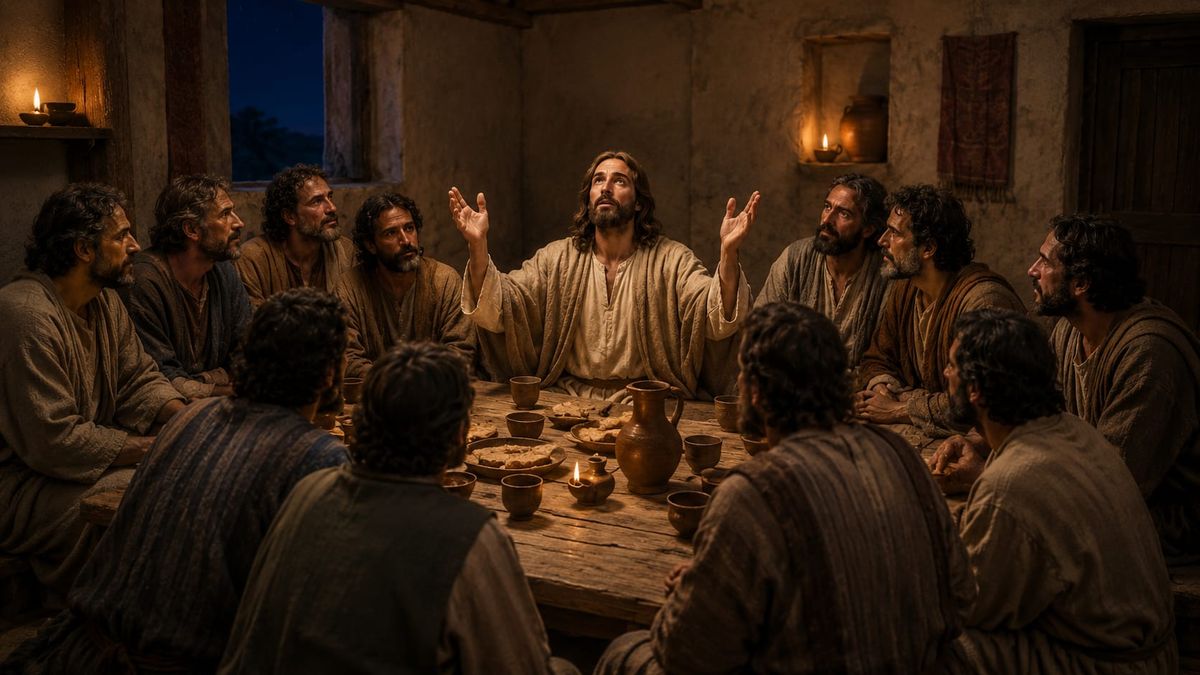
We are still in the Farewell Discourse, still on Maundy Thursday night. Whether Jesus prayed these words in the Upper Room or on the road to Gethsemane, John places this prayer in the hours before the arrest, before the cross. But something has shifted. John 14 was instruction. John 15 was invitation. John 16 was warning and comfort. Now in John 17 Jesus stops talking to the disciples and turns to the Father. What we are reading is not a teaching. It is a prayer, the longest recorded prayer of Jesus in any of the Gospels. We are not the audience. We are the subject.
Jesus opens in verse 1 with words that would have landed with enormous weight on that particular night: "Father, the hour has come; glorify your Son that the Son may glorify you." (John 17:1, ESV) The hour. Throughout John's Gospel, whenever anyone has tried to seize or harm Jesus, John notes that his hour had not yet come, John 2:4, John 7:30, John 8:20. Now it has. The cross is hours away. And what Jesus asks for in that moment is not deliverance but glorification, and not for his own sake but so that the Son may glorify the Father.
This is not a request for the cross to be removed. It is a request that the cross would accomplish what it was sent to accomplish. We know Jesus did pray for the cup to pass, later that same night, in Gethsemane, he would pray in Matthew 26:39: "if it is possible, let this cup pass from me; nevertheless, not as I will, but as you will." (Matthew 26:39, ESV) That prayer is real, and it tells us everything about the full humanity of Jesus, he did not want to suffer, and he said so.
But it is not a contradiction of John 17. It is its complement. The prayer of glorification and the prayer of anguish are both true, spoken by the same person on the same night, and together they show us a Savior who walked into the darkness with his eyes open and his will submitted. The glory Jesus speaks of in John 17 is the glory of the new creation breaking in, the hour of the cross and resurrection as the turning point of all history, the moment when the old creation's bondage to sin and death is broken and new creation begins its inauguration.
That word matters: inauguration. The cross and resurrection do not complete the new creation. They inaugurate it. They are the first act, the decisive victory, the planting of the flag.
What follows is the continuation of the new creation through the Spirit, through the Church, through the proclamation of the Gospel to every nation. The sequence has been running through this entire Easter season: Easter inaugurates new creation, the Ascension enthrones its king, Pentecost pours out its power, and we, the agents of its continuation, are sent into the world with the work unfinished, waiting for the one who will finish it. That is where we live. Not in the completion, but in the continuation.
Let's move on to verse 3: "And this is eternal life, that they know you, the only true God, and Jesus Christ whom you have sent." (John 17:3, ESV) This is one of the most important definitions in all of Scripture, and it is easy to read past it. Eternal life is not just about duration, not just living forever. It is about relationship. To know the only true God, and Jesus Christ whom he sent. The knowing here is the intimate knowledge of relationship, not the intellectual knowledge of information. It is the same knowing that a branch has of a vine when it has been abiding long enough for the sap to flow. It is the knowing that comes from being kept in a name.
The Easter season has been teaching us this all along. Every encounter with the risen Christ, Mary, the disciples, Thomas, the Emmaus pair, was an encounter with the living God in the person of Jesus. Every time we said stay in the room, stay at the table, stay in the conversation, stay on the vine, we were describing the shape of eternal life. Not a future state to be achieved but a present relationship to be inhabited. Eternal life begins now, in the knowing.
In verse 4 Jesus says something remarkable: "I glorified you on earth, having accomplished the work that you gave me to do." (John 17:4, ESV) He says this before the cross. The prayer is spoken on Maundy Thursday night, before Gethsemane, before the arrest, before Good Friday. And yet he speaks as if the work is done. This is not a mistake. It is the confidence of the Son who knows the Father so completely that what has been determined is already counted as accomplished. The hour has come. The work will be done. It is, in the deepest sense, already finished, which is why he will be able to cry "It is finished" (John 19:30, ESV) from the cross and mean it.
Then in verse 6 the prayer turns to include the disciples: "I have manifested your name to the people whom you gave me out of the world. Yours they were, and you gave them to me, and they have kept your word." (John 17:6, ESV)
The name. This is the thread that has run beneath the entire Easter season without always being named. Easter Sunday: Mary called by her name in the garden. The Second Sunday: peace spoken in the name of the one who breathed new creation. The Third Sunday: the burning hearts of disciples who heard the Word opened by one whose name they did not yet know.
The Fourth Sunday: the shepherd who calls his sheep by name. The Fifth Sunday: the I AM statements, bread, light, gate, way, truth, life, the name of God made visible in the acts of the Son. The Sixth Sunday: the vine and the branches, the name flowing through the sap. And now in John 17 (paraphrase): "I have manifested your name. I have made known who you are. And I am praying that they would be kept in it."
This is what the entire Easter season has been: the revelation of the name. And here, on this Sunday, Jesus prays that his people would not lose what they have been given.
Then comes verse 11, the petition at the center of this passage, the prayer Jesus actually makes: "Holy Father, keep them in your name, which you have given me, that they may be one, even as we are one." (John 17:11, ESV)
Keep them. Not take them out of the world; Jesus is clear about that later in the chapter. Keep them in the name, in the world, for the world. The disciples are not being removed from danger. They are being entrusted to the Father's keeping while they remain in it.
The Ascension has not left them alone; it has left them praying, as Jesus prayed, in the name the Father gave the Son. And the prayer for unity, that they may be one, even as we are one, is not merely an ecclesiastical aspiration. It is the mark of the new creation in the world. A community that is one as the Father and Son are one is a community that bears visible witness to the God who is love.
Psalm 68 has been singing about this moment for centuries. The psalm opens with the great Ascension cry: "God shall arise, his enemies shall be scattered; and those who hate him shall flee before him!" (Psalm 68:1, ESV) And it arrives in verse 18 at the line Paul quotes in Ephesians 4 as a description of the Ascension: "You ascended on high, leading a host of captives in your train and receiving gifts among men, even among the rebellious, that the LORD God may dwell there."(Psalm 68:18, ESV)
The king has gone up. He has not abandoned his people. He has gone to the place of authority, and from that place, instead of receiving gifts, he gives gifts, the Spirit, the Word, the community of the new creation, to the people left on the ground.
And then the psalm does something unexpected. It turns from the triumph of the ascended king to the care of the vulnerable: "Father of the fatherless and protector of widows is God in his holy habitation. God settles the solitary in a home; he leads out the prisoners to prosperity." (Psalm 68:5–6, ESV) The enthroned king is not distant. He is the father of the fatherless. The one who ascends is the one who stoops. This is always the movement of the Gospel, the glory of God made visible not only in the enthronement of the Son but in the care of the least.
This is where 1 Peter 4 enters, and enters hard. Peter writes to people who are not experiencing triumph; they are experiencing the fiery trial. "Beloved, do not be surprised at the fiery trial when it comes upon you to test you, as though something strange were happening to you. But rejoice insofar as you share Christ's sufferings, that you may also rejoice and be glad when his glory is revealed." (1 Peter 4:12–13, ESV)
Do not be surprised. What they are going through is not a sign that the new creation has failed or that God has abandoned them. It is participation, sharing in the sufferings of the one who went first, the one who prayed to be glorified through the cross, the one whose glory was revealed precisely in the place where it seemed most absent. The disciples in Peter's letter are living in the continuation of the new creation, and the continuation involves the cross as well as the resurrection. The vine is pruned. The branches bear the marks of the vinedresser's work. The glory is unfolding, but it is not yet complete.
Peter says, "Therefore let those who suffer according to God's will entrust their souls to a faithful Creator while doing good." (1 Peter 4:19, ESV)
Entrust. That is the posture of the between. Not grasping, not demanding the resolution now, not requiring that the story make sense before the last chapter. Entrusting the soul to a faithful Creator, the one who started the new creation and has promised to complete it, while doing good in the meantime. This is what it looks like to be kept in the name.
So where does this leave us, right here, this morning, in the between? I have three places for us to contemplate this week.
First: what are we holding that needs to be entrusted? Peter says "entrust your souls to a faithful Creator while doing good." (1 Peter 4:19, ESV) Entrusting is not the same as giving up. It is releasing our grip on the outcome while remaining faithful in the work.
Think about the thing we cannot stop turning over, the health situation that has no resolution yet, the relationship that is broken and won't be fixed by next week, the financial pressure that has no easy answer, the grief that has no timeline. We have been carrying it as if the carrying were our job. It is not. The in between is not a place of white-knuckled self-sufficiency. It is a place of deliberate entrusting, naming the thing, laying it before a faithful Creator, and then getting up and doing the next right thing. That is the posture of the between.
Second: where is the unity Jesus prayed for being tested among us, and where could we be building it? "That they may be one, even as we are one" (John 17:11, ESV) is not a prayer for uniformity or the absence of disagreement. It is a prayer for the kind of unity that exists between the Father and the Son, a unity rooted in love, in shared purpose, in the mutual giving of each to the other.
That unity is visible. It is the Church's testimony to the world that the new creation is real. Think about the person in this congregation you find most difficult. The one you avoid, or disagree with, or have written off in some quiet corner of your heart. Jesus prayed for our unity with that person with the same breath he prayed for his glorification. The new creation is not built by people who agree about everything. It is built by people who love each other across the things they disagree about, because the love of the Father and the Son is flowing between them.
Third: we are not waiting for the new creation to begin. We are already living in its continuation. That changes Monday morning.
When we go to work, when we care for a neighbor, when we raise our children, when we go about our daily work, we are not killing time until Jesus returns. We are participating in the continuation of something he started and will complete. The resurrection breath that filled the locked room on Easter evening has been moving outward through this entire season, onto the Emmaus road, through the gate, along the way, into the vine, out to the nations, and now here, into the ordinary week ahead of us.
We are not standing on the sideline watching. We are branches on the vine, kept in the name, sent into the world, doing good while we wait. That is not a small thing. That is the work of the between.
And so the Easter season nears the end, in this posture: not with a triumphant resolution but with a prayer and a commission. Jesus prays for his people to be kept. He sends them into the world. The Spirit is one week away. The new creation is underway and unfinished. And we are the agents of its continuation, kept in the name, sent into the world, praying in the name Jesus revealed, waiting for the king who ascended to return and complete what he started.
Mary was called by name in the garden on Easter morning. Seven Sundays later, Jesus is praying to the Father to keep her, and all of us, in that name. The name has not changed. The prayer has not stopped. He who began this good work will bring it to completion.
"Holy Father, keep them in your name." (John 17:11, ESV) He is still praying that prayer. For us. Right now. At the right hand of the Father. Stay in the name. Stay in the conversation. The one who ascended is coming back.
In the Name of the Father, and of the Son, and of the Holy Spirit. Amen.