Looking Steadfastly: The Feast of Stephen, Deacon & Martyr: (Acts 6:8-7:2a, 51-60)
Stephen’s last prayer: Lord, do not hold this sin against them. His Lord’s: Father, forgive them. The first martyr dies the way his Lord died: forgiving. Saul is standing nearby, holding the cloaks. The seed planted that day will grow into the Damascus road.
December 26, 2025, Feast of Stephen, Deacon and Martyr, Season of Christmas
Acts 6:8–7:2a, 51–60, Psalm 31:1–6, Matthew 23:29–39, Jeremiah 26:1–15
Grace, mercy, and peace from God our Father and the Lord Jesus Christ be with you on this feast of Stephen, Deacon and Martyr.
Yesterday was Christmas. The Preface of Christmas, which we use at the Eucharist both yesterday and today, gives us the reason for the season in a single sentence: “Because you gave Jesus Christ, your only Son, to be born for us; who, by the Holy Spirit and the Virgin Mary his mother, was made truly man, yet without the stain of sin, that we might be cleansed from sin and given the right to become your children.” (BCP 2019, p. 152) The Church does not pause between Christmas and today. It moves directly from the feast of the Incarnation to the feast of the first martyr, using the same preface for both. The theological statement is deliberate: the cradle and the stones belong together. The Word became flesh in a world that would resist and reject him, and the first person to die for that Word did so within twenty-four hours of the calendar’s celebration of his birth. The Incarnation was never going to be safe.
The days immediately following Christmas have always been days on which the Church honors those who bore witness to the child born on December 25. Stephen comes first, December 26; then John the Apostle, December 27; then the Holy Innocents, December 28. The sequence is the calendar’s quiet theology: the Incarnation gathers a company of the willing, prepared to spend themselves for the Word made flesh. The cradle and the stones are not in tension. They are the same story told in two keys.
Our passage today is Acts 6:8 through 7:60.
Stephen appears in Acts 6, introduced as one of seven men chosen to serve the Jerusalem church in its daily distribution of food. A complaint had arisen: the Hellenistic Jewish widows were being overlooked in the distribution. The apostles propose a solution, seven men of good repute, full of the Spirit and of wisdom, appointed to this practical service. Stephen is named first, described as “a man full of faith and of the Holy Spirit.” (Acts 6:5, ESV) His office is diaconal, the Greek diakonos (dee-AH-ko-nos): servant, table-waiter. He has been appointed to ensure that no widow is overlooked at the daily meal. But Acts 6:8 moves immediately past the table: “And Stephen, full of grace and power, was doing great wonders and signs among the people.” (Acts 6:8, ESV) The man appointed to wait on tables is doing miracles. His diaconal appointment does not limit him; it grounds him. The feast of Stephen rebukes any division between the practical and the spiritual: Stephen does not graduate from table service to real ministry. He brings the same fullness of Spirit to the distribution of bread and to his testimony before the Sanhedrin. The fullness of character is one.
His opponents cannot withstand the wisdom and Spirit with which he speaks. They bring him before the Sanhedrin on charges of speaking against the temple and the law, the same charges brought against Jesus. And as he stands before the council, before he has spoken a word: “All who sat in the council saw that his face was like the face of an angel.” (Acts 6:15, ESV) The Spirit has already made his presence visible in him. The speech that follows in Acts 7 is the longest in the book of Acts, a panoramic retelling of salvation history from Abraham through Moses through David and Solomon. Stephen does not defend himself. He does not argue for his innocence. He proclaims what God has done, arriving at the indictment of verses 51 through 53: “You stiff-necked people, uncircumcised in heart and ears, you always resist the Holy Spirit… you who received the law as delivered by angels and did not keep it.” (Acts 7:51, 53, ESV) He is not standing before the Sanhedrin as a defendant. He is standing before them as a witness. The same Spirit that made his face like an angel’s is the Spirit that shapes his words: not self-preservation but proclamation.
Our Gospel reading from Matthew 23 places Stephen in the long line of those who were killed for that kind of witness. Jesus names the pattern with grief as much as judgment: “O Jerusalem, Jerusalem, the city that kills the prophets and stones those who are sent to it! How often would I have gathered your children together as a hen gathers her brood under her wings, and you were not willing!” (Matthew 23:37, ESV) The longing in those words is real. The one who names the pattern of prophet-killing is the one who would have prevented it if they had been willing. Jeremiah 26 gives us the Old Testament form of the same moment: Jeremiah standing before the priests and prophets who want him killed, answering them with “Truly the Lord sent me to you to speak all these words in your ears.” (Jeremiah 26:15, ESV) Stephen’s posture is identical. He did not choose this message; he was sent with it. Stephen enters the pattern Jesus described, the next faithful witness rejected by Jerusalem’s religious establishment.
It is worth noting what Stephen does not do in his speech. He does not plead innocent. He does not soften the message for the audience. He traces God’s faithfulness from Abraham to Moses to David to Solomon, demonstrating at each point that God has always been faithful and that Israel has always been tempted to resist him. The argument ends not with a conciliatory appeal but with an indictment: you have now murdered the Righteous One himself. Luke tells us the council was enraged even while he was speaking. They ground their teeth at him. Stephen does not trim his message to survive his audience. He says what he was given to say.
Matthew 23:34 is worth dwelling on: “Therefore I send you prophets and wise men and scribes, some of whom you will kill and crucify, and some you will flog in your synagogues and persecute from town to town.” (Matthew 23:34, ESV) Jesus is not only predicting; he is naming himself as the sender. Stephen is sent. He goes knowing, as Jeremiah knew, that this is how the sent ones tend to be received. He goes anyway. That willingness, informed by the Spirit that drove Jesus toward Jerusalem, is the mark of the martyr.
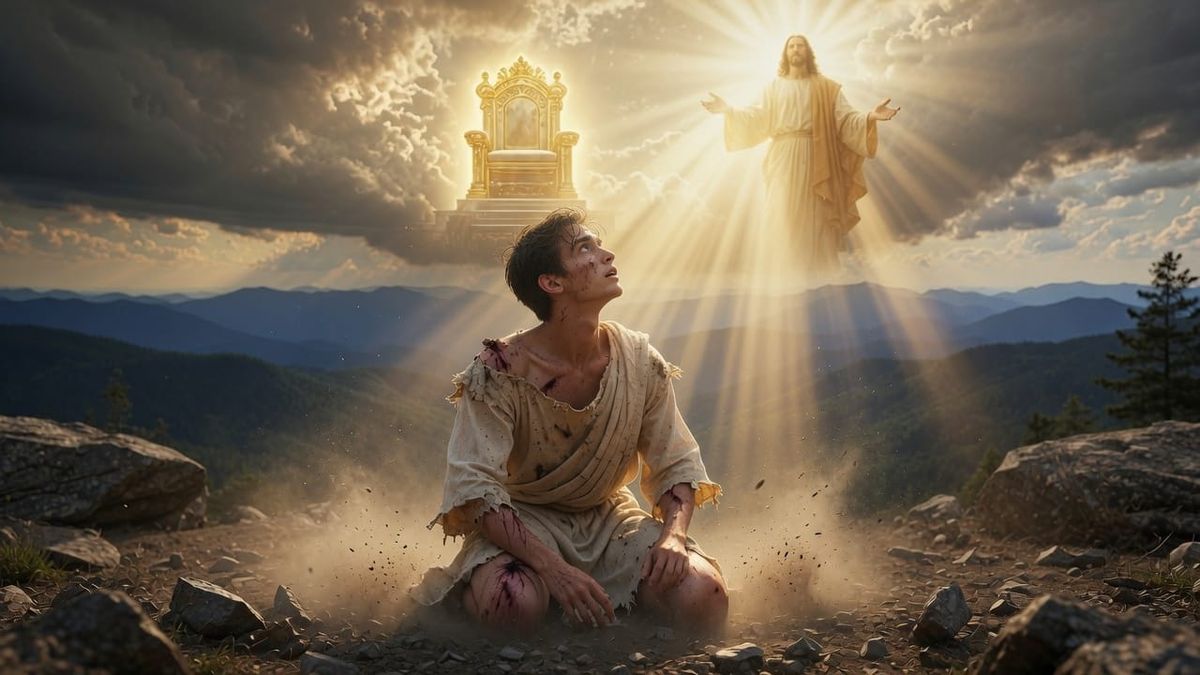
When the council hears Stephen’s indictment, the response is fury. Acts 7:57: “They cried out with a loud voice and stopped their ears and rushed together at him.” (Acts 7:57, ESV) They do not dispute the content of his speech. They cannot bear the claim. They drag him outside the city to stone him. And in the moment before the stoning begins, Stephen’s vision breaks open the scene: “But he, full of the Holy Spirit, gazed into heaven and saw the glory of God, and Jesus standing at the right hand of God. And he said, ‘Behold, I see the heavens opened, and the Son of Man standing at the right hand of God.’” (Acts 7:55–56, ESV) Standing. Everywhere else in the New Testament, the risen and ascended Christ is described as seated at the right hand of the Father. Here, and here alone, he stands. Many interpreters have seen in this standing a deliberate gesture: the Son of Man rising to receive the first martyr, as if to honor with his own posture the testimony of the one who is dying for him. Stephen announces the vision aloud, and the announcement is what breaks the council’s restraint. His final testimony is not his speech, impressive as it is. It is what he sees in the moment before he dies: faith becomes sight, and the one who had seemed absent from the stoning is revealed to be watching it.
The connections between Stephen’s death and Jesus’ death in Luke’s account are deliberate and numerous. Luke is the author of both the Gospel and Acts. When he places Psalm 31:5 on both pairs of lips, when he records both men praying for their killers in nearly identical words, and when he describes both deaths in language of peaceful surrender, he is making a theological argument: the martyr’s death participates in the death of the Lord. Stephen does not merely imitate Jesus; he is caught up in the same pattern of faithfulness and sacrifice. The witness who dies for the Gospel does not die alone.
The standing Christ deserves a moment. The session at the right hand of the Father is the posture of completion: it is finished. The standing is something else. When Jesus rises at Stephen’s death, he rises to receive a testimony. The one who sends also receives. The sent one is welcomed home by the one who sent him.
Psalm 31, which we prayed together today, provides the thread that ties Stephen’s death to his Lord’s. Verse 5: “Into your hand I commit my spirit; you have redeemed me, O Lord, faithful God.” (Psalm 31:5, ESV) This is the verse Jesus quotes from the cross in Luke 23:46: “Father, into your hands I commit my spirit.” (Luke 23:46, ESV) Acts 7:59 records Stephen’s dying prayer: “Lord Jesus, receive my spirit.” (Acts 7:59, ESV) The same psalm; the same surrender of the spirit into the Lord’s hands. And then Acts 7:60, Stephen’s last words: “Lord, do not hold this sin against them.” (Acts 7:60, ESV) The echo of the cross is exact. Jesus: “Father, forgive them, for they know not what they do.” (Luke 23:34, ESV) The first martyr dies forgiving, the way his Lord died. The psalm Jesus prayed as he died is the psalm Stephen prays as he dies.
There is one more detail from the stoning scene that must not be lost. Acts 7:58 and 8:1 introduce a young man named Saul standing at the edge of the crowd, holding the cloaks of those doing the stoning, giving his official approval: “And Saul approved of his execution.” (Acts 8:1, ESV) He will later describe himself as the chief of sinners, and this moment is part of what he means. The face like an angel, the vision of the opened heavens, the prayer for the killers: all of it goes into Saul’s memory and conscience. And on the Damascus road, the one Stephen called Lord stops him and says: “Saul, Saul, why are you persecuting me?” (Acts 9:4, ESV) The seed planted at Stephen’s death will grow, over years and a blinding light, into the apostolate that carried the Gospel to the Gentile world. The stones do not end the story. They begin it.
The presence of Saul at the stoning raises a question Acts does not answer: what did Saul make of the face like an angel’s? What did he make of a man who prayed for his killers while they were killing him? We only know that he was there, that he consented, and that his persecution of the Church intensified immediately after. And then the Damascus road. God does not waste the witness he plants, even when the one who received it fights against it with everything he has.
One final detail from Acts 7:60: after his dying prayer, Stephen “fell asleep.” (Acts 7:60, ESV) Luke uses the same word for death that Paul will use throughout his letters for the deaths of believers. It is not the language of violent annihilation but of rest: a person who has finished the day’s work and laid it down. The stones landing on him do not get the last word about what is happening. What is happening is that the first martyr is finishing his shift, and the Lord he served is standing to receive him.
The feast of Stephen carries a particular word for congregations that have known conflict, loss, or betrayal within the household of faith. Stephen was not killed by strangers. He was killed by people who knew the Scriptures and believed they were defending God. That is a specific kind of wound, and the Church has carried versions of it across twenty centuries. The collect does not paper over it. It names it honestly: in all our sufferings. It then gives the only adequate direction: look up. Not because looking up makes the wound disappear, but because the one at the right hand of the Father is the one who intercedes for us and who himself was handed over by the religious establishment of his own day. He knows the shape of this particular suffering from the inside.
The collect for this feast is built on two things Stephen did at his death: he looked up to heaven, and he prayed for his persecutors. The petition asks the Church for both. “Grant that in all our sufferings here upon earth we may love and forgive our enemies, looking steadfastly to Jesus Christ our Lord, who sits at your right hand and intercedes for us.” (BCP 2019, p. 624) The grammar of the collect matters. The looking comes before the forgiving, and both come while the suffering is still happening. We are not asked to forgive after we have arrived at a place of emotional peace. We are asked to love and forgive enemies in all our sufferings, by the same method Stephen used: fixing our eyes on the one who forgives. Looking steadfastly at Christ is what makes it possible to pray for those who are throwing the stones.
For those who find forgiveness difficult, and that is most of us, this feast gives us the right frame. Stephen does not forgive from a place of personal magnanimity or emotional equilibrium. He forgives while the stones are landing on him, because his eyes are on someone other than the people throwing them. The collect does not ask us to manufacture a forgiveness we do not feel. It asks us to look at the one who intercedes for us at the right hand of the Father. Looking steadfastly is the path. The forgiveness follows the looking.
Most of us are not facing physical persecution. But we know something about suffering at the hands of people who should have treated us better, about wounds from within the community of faith, about opposition that feels inexplicable. The stones Stephen died under were not thrown by pagans who had never heard the Gospel. They were thrown by people who knew the Scriptures, who prayed, who kept the law, who believed they were serving God. The collect does not minimize that kind of pain. It gives it the only adequate response: look up. Stephen does not forgive from a place of emotional equilibrium. He forgives while the stones are landing on him, because his eyes are on someone other than the people throwing them. The Spirit that sustained him is the same Spirit given to us in Baptism, and the one who stood to receive the first martyr stands ready to receive us.
The feast of Stephen is Christmas arriving at its destination. The Christmas Preface says the Son was born for us that we might be cleansed from sin and given the right to become children of God. Stephen shows us what that looks like when it is fully expressed in a human life: full of faith, full of the Holy Spirit, full of grace and power, dying with his Lord’s psalm on his tongue and his Lord’s prayer on his lips, his eyes fixed on the opened heavens. The life fully given to the one who gave his life fully for us.
In the Name of the Father, and of the Son, and of the Holy Spirit. Amen.