Matthias the Apostle: An Anglican Perspective
February 24 is the Feast of Saint Matthias. He followed Jesus from the beginning, witnessed the resurrection, was chosen by lot, and is never mentioned again in the New Testament. The feast of the faithful unknown — a Red-Letter Day for the man no one remembers.
Feast Day: February 24
The Anglican calendar is ordered by a hierarchy of holy days, each carrying a different weight of observance. At the top sit the seven Principal Feasts — the highest days of the liturgical year. Below them are the Red-Letter Holy Days, appointed in the BCP 2019 with their own collects, propers, and lectionary readings, listed on page 688. They are called Red-Letter Days because, in the tradition of printing church calendars, these days appear in red ink, distinguished from the Optional Commemorations which appear in ordinary type. The Feast of Saint Matthias the Apostle, observed on February 24, is one of these Red-Letter Holy Days.
Matthias is, in many ways, the most anonymous of all the apostles. He appears in a single passage of the New Testament — Acts 1:15–26 — is chosen to replace Judas, and is never mentioned again. He wrote no letter. He is not the hero of any miracle story. No Gospel carries his name. The tradition that assigns him to missions in Judea or Ethiopia or elsewhere is interesting but not documented in Scripture. What we know about Matthias is almost entirely what Acts 1 tells us: he had been a faithful follower of Jesus from the beginning, he was present throughout the ministry, he witnessed the resurrection, and when the lot fell on him he became the twelfth apostle. That is a remarkably small biographical footprint for a Red-Letter Holy Day. And yet the feast exists, and the Church is right to observe it.
What makes Matthias especially striking is that, unlike most of the other apostles, he has almost no extra-biblical legends or traditions attached to him. While later stories grew up around Peter, John, Thomas, and others, Matthias remains largely silent in the historical record. This absence is itself part of his witness: the faithful unknown, whose life and ministry were hidden with Christ in God.
The anonymity of Matthias is itself a theological statement. The feast of February 24 is not primarily a feast about a remarkable individual. It is a feast about the structure of the apostolic college, the criteria for apostolic authority, and the way God fills the gaps left by human failure. It is also, in the collect’s own words, a feast about the Church’s ongoing need for faithful and true pastors — a need as urgent now as it was in the Upper Room in Jerusalem in the days before Pentecost.
The Biblical Event
The account is in Acts 1:15–26, from the propers appointed on page 730 of the BCP 2019. The disciples have returned to Jerusalem after the Ascension and are gathered in the Upper Room — approximately one hundred and twenty of them. The eleven remaining apostles are present, but the Twelve are incomplete. Judas Iscariot has betrayed the Lord, and his death has left a vacancy that, in Peter’s reading of Scripture, must be filled. Peter rises to address the gathered community, citing Psalm 69:25 and Psalm 109:8 as the scriptural warrant: “For it is written in the Book of Psalms, ‘May his camp become desolate, and let there be no one to dwell in it’; and ‘Let another take his office.’” (Acts 1:20, ESV) The Greek word for “office” here is episkopēn — from which we get the word episcopal. The vacancy is not merely structural. It is a vacancy in the oversight of the flock, and it must be filled.
Peter then states the criteria for the replacement. The candidate must have accompanied the disciples throughout the entire earthly ministry of Jesus, from the baptism of John to the day of the Ascension, and must be a witness of the resurrection. In verse 21–22: “So one of the men who have accompanied us during all the time that the Lord Jesus went in and out among us, beginning from the baptism of John until the day when he was taken up from us — one of these men must become with us a witness to his resurrection.” (Acts 1:21–22, ESV) These are not arbitrary qualifications. They define what an apostle is: someone who has been present for the whole story and can testify to its culminating event. An apostle is not merely a leader or an administrator. An apostle is a witness — one who has seen and can therefore speak with the authority of direct testimony.
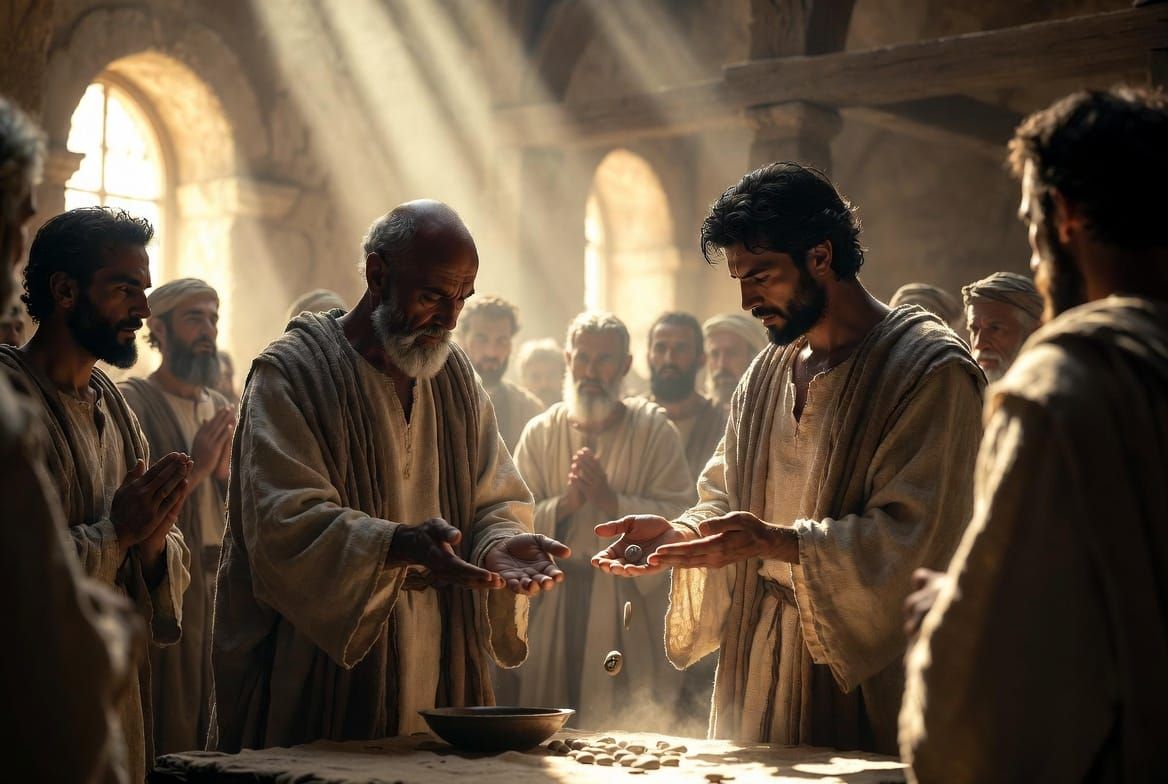
Two candidates meet these criteria: Joseph called Barsabbas, and Matthias. The community prays — “You, Lord, who know the hearts of all, show which one of these two you have chosen to take the place in this ministry and apostleship from which Judas turned aside to go to his own place” (Acts 1:24–25, ESV) — and then casts lots. The lot falls on Matthias, and he is numbered with the eleven. The word translated “numbered” is synkatepsephisthē, a compound word that carries the sense of being counted together, enrolled alongside, added to the number. Matthias does not replace Judas. He fills the vacancy left by Judas. He is numbered with the eleven, not in the place of one who failed.
The casting of lots deserves a brief note. In the Old Testament, casting lots was a recognized means of discerning God’s will — used at the division of the land in Joshua, at the identification of Achan’s sin in Joshua 7, and throughout the priestly and prophetic traditions. The Greek word for lot is klēros, from which the English word “clergy” derives. This is the last recorded use of the lot in the New Testament. After Pentecost, the Spirit guides the Church’s discernment directly. The casting of lots is not a primitive or superstitious practice in Acts 1 — it is a deliberate act of prayer-shaped discernment, placing the final decision in God’s hands rather than in the community’s preferences.
The Theological Significance
The selection of Matthias raises a question that the feast of February 24 presses on the Church in every generation: what does it take to be entrusted with the apostolic ministry? The answer Acts 1 gives is not giftedness, not charisma, not administrative ability, not theological training, and not popular support. It is faithfulness over time and witness to the resurrection. Matthias had been present from the beginning. He had followed Jesus through the obscure Galilean years before the crowds arrived, through the controversies and misunderstandings, through the suffering and the confusion of Holy Week. He was not a latecomer who arrived after the movement had demonstrated its success. He was a witness to the whole of it.
Psalm 15, the appointed psalm, describes the person of integrity who may dwell on God’s holy hill: “O Lord, who shall sojourn in your tent? Who shall dwell on your holy hill? He who walks blamelessly and does what is right and speaks truth in his heart; who does not slander with his tongue and does no evil to his neighbor.” (Psalm 15:1–2, ESV) The psalm is the character profile of the one qualified for holy service. Matthias’s long, faithful, unrecorded accompaniment of Jesus is the living embodiment of Psalm 15 — the man who walks blamelessly and speaks truth, whose integrity is not public performance but sustained private fidelity. He was faithful when nobody was writing it down. That faithfulness is what qualified him.
Philippians 3:12–21 gives the apostolic posture in Paul’s own words — and it is the posture of Matthias as well: “Not that I have already obtained this or am already perfect, but I press on to make it my own, because Christ Jesus has made me his own. Brothers, I do not consider that I have made it my own. But one thing I do: forgetting what lies behind and straining forward to what lies ahead, I press on toward the goal for the prize of the upward call of God in Christ Jesus.” (Philippians 3:12–14, ESV) Matthias was not the front-runner. He was one of two finalists, and the choice between him and Barsabbas was made by lot rather than by human judgment. He did not achieve his apostolate by outperforming the competition. He received it. And having received it, the apostolic calling is the same for him as for every other: press on, forget what lies behind, strain toward what lies ahead.
The appointed Gospel is John 15:1–16, and it contains the verse that is the theological crown of the entire feast: “You did not choose me, but I chose you and appointed you that you should go and bear fruit and that your fruit should abide, so that whatever you ask the Father in my name, he may give it to you.” (John 15:16, ESV) You did not choose me, but I chose you. This is true of every apostle, but it is peculiarly visible in Matthias. He did not campaign for the position. He did not put himself forward. The community proposed him as a candidate, and the Lord chose him through the lot. The initiative was entirely from above. The fruit that followed — wherever Matthias went and whatever he did, largely unrecorded — was fruit that abides, because the vine that produced it is not the apostle but the Lord who chose him.
The BCP 2019 Collect and Preface
The BCP 2019 appoints the following collect for the feast on page 627: “Almighty God, who in the place of Judas chose your faithful servant Matthias to be numbered among the Twelve: Grant that your Church, being delivered from false apostles, may always be guided and governed by faithful and true pastors; through Jesus Christ our Lord, who lives and reigns with you, in the unity of the Holy Spirit, one God, now and for ever. Amen.” The collect is honest about the context in a way that is worth pausing over. Matthias was chosen “in the place of Judas” — not because Judas’s seat was simply empty, but because Judas had betrayed the Lord and gone to destruction. The vacancy was created by catastrophic failure, and the Church needed to fill it. The petition that follows takes this context seriously: grant that the Church may be delivered from false apostles and always guided by faithful and true pastors. The feast of Matthias is not a celebration of institutional succession for its own sake. It is a prayer that the Church would never again have to mourn the kind of leadership failure that made the selection of Matthias necessary.
The Preface of Apostles, found on page 155 of the BCP 2019, is used at the Eucharist for this feast as for all apostolic feasts: “Through the great shepherd of your flock, Jesus Christ our Lord, who after his resurrection sent forth his apostles to preach the Gospel and to teach all nations, and promised to be with them always, even to the end of the ages.” (BCP 2019, p. 155) The preface is well chosen: the risen Christ who sent forth the apostles is the same risen Christ to whose resurrection Matthias bore witness as a qualification for the apostolate. His testimony to the resurrection and his commission by the risen Lord are not two separate events but one continuous reality.
Matthias in Anglican Worship
The Feast of Saint Matthias has been observed in the Church of England since the medieval period. In the traditional calendar it was observed on February 24, except in leap years when it moved to February 25. The BCP 2019 retains February 24 as the fixed date.
The feast falls within the season of Epiphany, between the Presentation of Christ in the Temple (February 2) and Joseph the Guardian of Jesus (March 19). Its placement in late February means it often falls near or during the approach to Ash Wednesday and Lent, and its themes of examined faithfulness, the removal of false leadership, and the quiet integrity described in Psalm 15 are fitting preparation for the penitential season ahead.
The collect’s prayer against false apostles and for faithful and true pastors is among the most practically urgent petitions in the entire BCP. Every generation of the Church has known the devastation of unfaithful leadership and the grace of faithful leadership, and the feast of Matthias is the calendar’s appointed moment to pray explicitly for the latter and guard against the former. The anonymity of Matthias is, in this light, a gift: the feast is not about admiring a remarkable individual but about the Church examining its own leadership and asking God to govern it well.
Observing This Feast
February 24 falls within the season of Epiphany. When it falls on a Sunday, it may be observed on that Sunday or transferred to the nearest following weekday according to the rubrics on page 689 of the BCP 2019. In a leap year, when February has 29 days, some calendars have historically moved the feast to February 25, though the BCP 2019 designates February 24 as the fixed date.
To observe the feast: pray the collect from BCP 2019, p. 627. Read Acts 1:15–26 carefully, noting both Peter’s scriptural argument and the qualifications he articulates for apostolic ministry. Read John 15:1–16 and let verse 16 — “you did not choose me, but I chose you” — reframe your understanding of every ministry you have received. Pray Psalm 15 as an examination of conscience: am I the person described here? Am I walking blamelessly, speaking truth in my heart, doing no evil to my neighbor? Let the feast close with the collect’s prayer: that the Church would be delivered from false apostles and always guided and governed by faithful and true pastors. Pray it by name for the clergy and leaders who serve this parish and this diocese.
Conclusion
The Feast of Saint Matthias is the feast of the faithful unknown — the man who followed from the beginning without recognition, witnessed the resurrection without recording it in any text that survived, was chosen by lot without campaigning, and served without leaving a trace in the New Testament beyond the single passage of his selection. That faithfulness, unremarked and unrecorded, is honored by the Church every February 24 as a Red-Letter Holy Day.
The collect’s final petition is the feast’s lasting gift to the Church: that we would always be guided and governed by faithful and true pastors. Not brilliant pastors. Not famous pastors. Not innovative pastors. Faithful and true. The Church that has been hurt by unfaithful leadership knows exactly what it is asking for when it prays these words. And the Church that has been shaped by faithful leadership knows exactly what it is thanking God for. Both prayers belong on February 24, before the throne of the one who chose Matthias and who is still choosing, still filling vacancies, still naming and numbering those who have followed from the beginning. “You did not choose me, but I chose you.” (John 15:16, ESV)