Our Hearts Revealed: Maundy Thursday 2023 (John 13:1-15)
On Maundy Thursday, Jesus rises from the table, removes his outer garments, and washes the feet of the disciples who will soon abandon him. Knowing his hour had come, knowing what it would cost, he loved them to the end. A reflection on John 13 and the heart of servanthood.
April 6, 2023, Year A, Maundy Thursday, Holy Week, Season of Lent
John 13:1–15
Grace, mercy, and peace be to you from God our Father, and our Lord Jesus Christ on this Maundy Thursday.
Chapter 13 is a transition point in the Gospel of John. In chapters 1–12, we have the chapters which have been called the Book of Signs, the miracles. The seven signs in particular, that John has singled out, that portray the identity of Jesus as the Son of God.
But now, in chapter 13, we have moved to the Upper Room. This is now the Book of Glory. Jesus largely veiled himself from the world but now discloses something of his glory, something of the relationship he has with his Father in heaven, to his disciples. Calvin says in his commentary on John's Gospel, "If the other Gospels show us Christ's body, John shows us his soul."
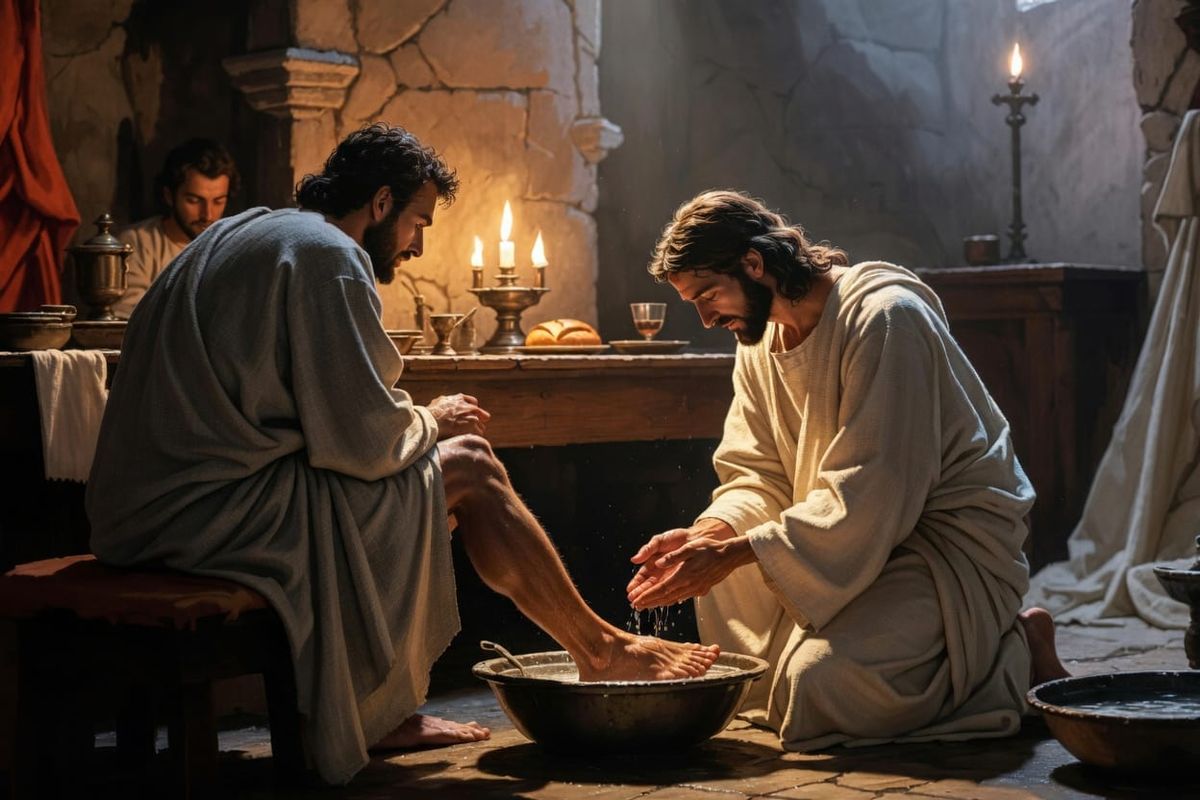
It was the slave's task, the servant's task, on arrival at a house to wash someone's feet. It would happen upon entry. You would sit and your sandals would be taken off and left at the door just as they would in Middle Eastern countries to this day. And no one has done it, so Jesus rises, divests himself of his outer garments, wraps a towel around himself, gets a bowl of water and begins to wash the disciples' feet.
And you understand that as this particular incident is described, it becomes a lesson in something far greater than just washing feet. It becomes symbolic of what Jesus has come to do. It becomes symbolic of the very heart of a disciple, the very heart of a servant. The Greek word for this kind of service is diakonia (pronounced dee-ah-koh-NEE-ah), the root from which we get "deacon," a word meaning humble, practical service to another's need. That is precisely what Jesus does here.
And what we have here is what Paul gives expression to in Philippians speaking of Jesus, who, "though he was in the form of God, did not count equality with God a thing to be grasped, but emptied himself, by taking the form of a servant, being born in the likeness of men. And being found in human form, he humbled himself by becoming obedient to the point of death, even death on a cross." (Philippians 2:6–8, ESV)
And that is what we have: a description of what "taking the form of a servant" (Philippians 2:7, ESV) actually looks like. I want us to see three things that are on Jesus' mind this first Maundy Thursday.
The first thing is that he knows his death is near, as John puts all three of these things right up at the heading of this incident: "when Jesus knew that his hour had come…" (John 13:1, ESV) Earlier in John's Gospel, we have read things like, "His hour had not yet come." (John 7:30, 8:20, ESV) He withdraws sometimes from the public because his hour had not yet come, but now his hour has come; his time is at hand. Very shortly, he will be betrayed, arrested, tried and crucified. That kind of foreknowledge concentrates the mind.
Jesus was going to face pain of unimaginable proportions. When we are facing pain, is it not at such times that we justify our concentration on ourselves? Is it not at such times when we usually want to say to ourselves, "This is time for others to show their love and respect and sympathy to me"?
I want us to see the heart of Jesus though: on the threshold of his own pain, he has the needs of the disciples on his mind. He has this simple, humbling gesture of the need for their feet to be washed. These men are tired, Jesus too, and Jesus ministers to them anyway, knowing that his hour has come.
Sometimes we are called to serve others when we are blinded by our own tears. Sometimes we are called to serve others when we cannot see the way forward, when there is darkness all around us, when we are pressed by our own difficulties. And at that time, we, like Jesus, can still be called upon to serve others. And we should.
Is it not tempting to say at such times, "Can't you see that I'm busy? Can't you see my pain? Can't you see my needs? Can't you see my burdens?" Is it not tempting for us to say, "I've got to concentrate on myself now"? Surely you have said such things. I certainly have.
It may be in our relationships with our spouses, our children, or our most intimate of settings. And Jesus is saying, "My hour has come. I know what is before me. I see it clearly now." And he does this astonishing act. He is thinking about others, and he is thinking about his disciples, and he is thinking about their needs, and he divests himself of his outer garments, wraps a towel around himself, gets a bowl of water and begins to wash the disciples' feet.
And then secondly, not only does he know that his hour has come, but we are told that he loved his disciples even to the end. He never gives up on them.
Think about it. These twelve, including Judas, who are so slow to believe, who are so unteachable, who are so uncomprehending, whose vision is so earthbound, who are so self-centered, and as their crisis will deepen, they will deny him and they will flee from him and they will run. Jesus knows this.
At the time of his crucifixion, there will barely be a disciple present, just John, and Jesus loves them. Fleeting as their faith is, he loves them. It is not a pretty sight. There is something profoundly disappointing about these men. And yet, he loves them to the end.
His love is not blind; he loves these men. He chose these men. He has been with them for three years and he calls them friends. He knows them better than they know themselves. He knows all about them. He knows them at their worst. He knows what they are capable of doing.
He gives a prediction about two of them here in this upper room, about Judas and Peter. He sees them in their worst possible light and he still loves them. He knows what they are capable of. He is going to deny himself and he is going to lay down his life and he is going to die for them.
But there is a deeper meaning here. He loved them, we are told, to the end, not just the end of his earthly life, but he loved them to the extreme limit in that sense. He loved them, knowing what that love was going to cost him. He will become sin. He will identify with sin on their behalf, and on ours.
Can you imagine? No, we cannot imagine what it means for pure holiness to identify with sin, the revulsion of it. He will be dealt with as sin deserves. Sin will be condemned in his body and cursed in his person.
Jesus will cry upon the cross, "My God, my God, why have you forsaken me?" (Matthew 27:46, ESV) In that cry we hear the full weight of what he bears for us, abandonment, desolation, the curse of sin laid upon the sinless one. And yet, "having loved his own who were in the world, he loved them to the end." (John 13:1, ESV)
As he reclined in that upper room to partake of the Passover meal with his disciples, with all of that before him within hours, we tremble at the very thought of it. But what does he do? He divests himself of his outer garments, wraps a towel around himself, gets a bowl of water and begins to wash the disciples' feet.
But there is a third thing that he is conscious of that John brings to our attention. He knows his divine origin and purpose. He does all of that in the full consciousness of his own deity, knowing "that his hour had come to depart out of this world to the Father." (John 13:1, ESV)
In verse 3, John says, "Jesus, knowing that the Father had given all things into his hands and that he had come from God and was going back to God." (John 13:3, ESV) What a wonderful statement of the deity of Christ, that he is conscious that he has come from God and that he is going back to God; that he sat at the same table as his Father in heaven and that he is going back there.
And in the full consciousness of who he is, in the full consciousness of his native glory and deity, he divests himself of his outer garments, wraps a towel around himself, gets a bowl of water and begins to wash the disciples' feet.
And what does that say to us? It says that the impulse to serve in love lies at the very heart of God: God the Father serving the Son, the Son serving the Father. And it is traced right back to the Trinity itself, and Peter is amazed. Peter says, "You shall never wash my feet." (John 13:8, ESV) And Jesus reminds him, "What I am doing you do not understand now, but afterward you will understand." (John 13:7, ESV)
How true that was, because it is John who makes that understood for us. And what was it that Jesus was demonstrating in the full consciousness of his deity? It was several things.
First of all, Jesus turns this into a parable, and when Peter says, "You'll never wash my feet" (John 13:8, ESV), Jesus says to him in the same verse, "If I do not wash you, you have no share with me." (John 13:8, ESV) Loosely translated: "Unless you are willing to bow before me and allow me to wash away your sin, you have no part with me. You have no fellowship with me, you have no union with me." That is what he is saying.
But then Jesus turns it into something a little more than that, because Peter, having uttered those two words which cannot go together, "Never, Lord," says, "Lord, not my feet only but also my hands and my head!" (John 13:9, ESV) And so Jesus turns it now into another parable and says, "You are clean." (John 13:10, ESV)
He is referring, of course, to the custom that before you went and ate the Passover meal you would have bathed, you would have washed, so that when you got there the only thing that you would need to do would be to wash your feet because of the dust that would accumulate upon your bare feet and sandals.
Jesus says, "The one who has bathed does not need to wash, except for his feet, but is completely clean." (John 13:10, ESV) He is probably alluding to the difference between justification and sanctification. They are already clean, justified, not all of them as he says, because of Judas. Not all of them were clean. But Peter, the eleven, were clean, and all that they needed was to have their feet washed, sanctified.
The thing Jesus wants them to understand, as he tells us in verse 15, is "For I have given you an example, that you also should do just as I have done to you." (John 13:15, ESV) That at the heart of discipleship, that at the heart of what it means to be a Christian, is a willingness to humble ourselves even as Jesus humbled himself.
Now, the Church took this foot-washing literally. In the seventh century in Spain and Gaul, this was introduced as almost a sacrament into the Church, because like baptism and the Lord's Supper, Jesus appeared to have commanded it. The Mennonites and the Seventh Day Adventists still practice foot-washing as part of the ritual of their church. But that is to miss the point. Jesus' command was not to wash feet, but that was an example of what Jesus said in verse 34, which we did not read tonight: "A new commandment I give to you, that you love one another: just as I have loved you, you also are to love one another." (John 13:34, ESV) That is the commandment.
The point of what Jesus is saying here is the point that Peter himself understood when he writes his first epistle and says in chapter 5, verse 5, "Clothe yourselves, all of you, with humility toward one another, for God opposes the proud but gives grace to the humble." (1 Peter 5:5, ESV)
So what does this mean for us tonight?
First, it means that no need is too lowly for our attention. If the Lord of glory knelt to wash feet caked with the dust of the road, then there is no task of service, no act of care for another, that is beneath us. The dishes, the diapers, the bedside vigil, the patient listening, all of these are the basin and the towel in our hands.
Second, it means that love which knows the full truth about us is not thereby diminished. Jesus washed the feet of Peter, who would deny him within hours, and of Judas, who would betray him within the hour. He loved them anyway, to the end. We are not loved because Christ is unaware of what we are. We are loved in spite of full and complete awareness.
Third, it means that we cannot make ourselves clean. Peter wanted to do more, "not my feet only but also my hands and my head," and Jesus corrected him. The washing he offers is not a project we complete but a gift we receive. Sanctification follows justification; it does not produce it.
Fourth, it means that the command to love one another is not optional or aspirational. "A new commandment I give to you… just as I have loved you, you also are to love one another" (John 13:34, ESV). The standard is not generic kindness. The standard is the cross.
I wonder tonight, in the face of the cross, in the face of the enormity of the love Christ has for us, is there anything that we are not willing to do for our brother or sister?
And Jesus is saying, "Get off your self-centered pedestal and do as I did to you. If I am willing to go to the end for you, what is it that you are not willing to do for one another?"
And that is such a profound and humbling lesson, and there lies our sin. And there is our heart revealed. And may God have mercy upon us and enable us to do as Jesus did, denying ourselves for the sake of one another and for the sake of Jesus Christ.
In the Name of the Father, and of the Son, and of the Holy Spirit. Amen.