Palm Sunday: An Anglican Perspective
On Palm Sunday, the Church greets the humble King with palms and praise, only to confront the cost of his kingship in the Passion Gospel. Drawing on Scripture and early Christian processions from Jerusalem, this day invites us to walk the way of the cross that leads to life.
Sunday in Holy Week
The Anglican calendar is ordered by a hierarchy of holy days, each carrying a different weight of observance. At the top sit the seven Principal Feasts. Below them are the Red-Letter Holy Days. Woven throughout the calendar are also the Days of Discipline, Denial, and Special Prayer and the solemn observances of Holy Week. Palm Sunday is the Sunday that opens Holy Week, the final and most solemn week of the Season of Lent. Holy Week is not an unrelated season inserted after Lent but the culmination toward which the forty days of penitential preparation have been moving.
Palm Sunday is unique in the BCP 2019 in having two Gospel readings and two interconnected liturgical movements. The Prayer Book provides a distinctive Liturgy of the Palms, including a procession when circumstances permit, beginning with the triumphal entry and moving deliberately toward the Passion. The day therefore holds together what Christians are always tempted to separate: the acclaim of the King and the suffering of the Cross. The Prayer Book itself explains that the procession recalls the triumphal entry of Jesus, our Lord and King, into Jerusalem, while the Passion Gospel anticipates the saving events of the week that follows.
The name itself carries the tension. Palm Sunday begins with branches, procession, and Hosanna. It does not remain there. The Passion narrative is proclaimed on the same day, pressing the congregation into the full weight of Holy Week at its very beginning. The Church does not allow triumph to be heard without the Cross, because the King who enters Jerusalem comes precisely to give himself for the life of the world.
A Day of Contrasts
Palm Sunday captures the Gospel in a series of profound contrasts. Jesus is hailed as King and yet moves toward rejection. He enters Jerusalem amid acclamation and will soon be led outside the city to crucifixion. The BCP 2019 names the spiritual danger in the juxtaposition directly when it warns that those who hail Jesus as King may in the next moment deny him and even join the cry for his crucifixion. (BCP 2019, p. 553)
The city that welcomed Jesus with cries of Hosanna would, within days, hear cries demanding his death. We need not insist that every person belonged to both crowds to feel the force of the contrast, and there may well have been people present for both. Palm Sunday deliberately places those cries beside one another because they reveal something painfully true about the human heart. We can welcome Christ when he seems to fulfill our hopes and resist him when his kingship confronts our sin, overturns our expectations, or demands something from us that we would rather withhold.
That is why the movement from Hosanna to Crucify him should not be explained away. It is part of the spiritual picture Palm Sunday gives us. The problem is not merely the fickleness of an ancient crowd. The same divided allegiance can live in us. We can praise Christ with our lips while resisting his lordship with our lives, and the liturgy refuses to let us stand comfortably outside that contradiction.
Jesus enters as the promised King, but his kingship is not fulfilled through ordinary political conquest. He comes in humility, fulfilling Zechariah’s vision: “Behold, your king is coming to you; righteous and having salvation is he, humble and mounted on a donkey.” (Zechariah 9:9, ESV) His victory will be accomplished through sacrificial death.
Hosanna comes from the Hebrew hoshi‘ah na (ho-SHEE-ah nah), meaning “save, please” or “save us, we pray.” By the time of Jesus it had also become a liturgical acclamation of praise. The cry is therefore both petition and proclamation. The crowd asks for salvation while welcoming the one through whom God will save, though the manner of that salvation will exceed their expectations.
Palm branches carried associations of festal joy and victory and could also evoke Israel’s hopes for deliverance. On Palm Sunday they become signs of a victory unlike the victories of earthly kings. Christ conquers not by avoiding death but by passing through it.
The Liturgy of the Palms
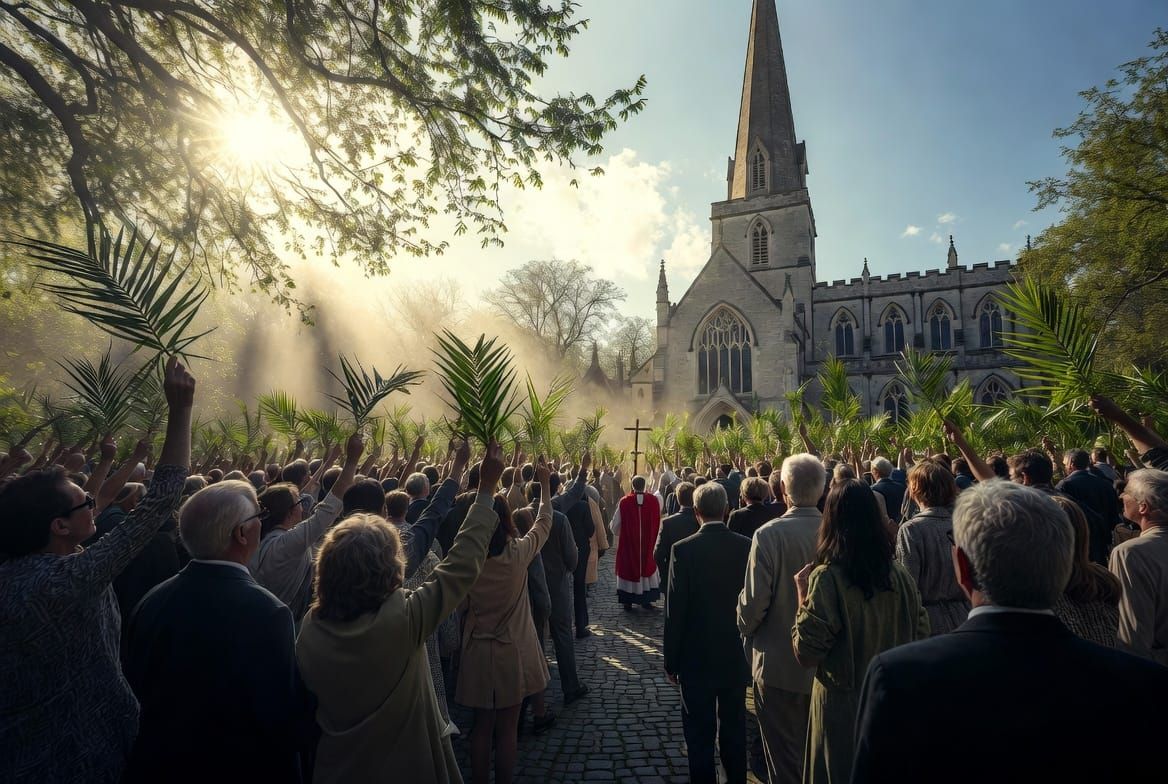
When circumstances permit, the BCP provides that the congregation may gather at a place apart from the church so that all may enter in procession. Palms or other branches may be distributed, and the celebration begins by acclaiming Jesus as the Son of David and King of Israel.
The celebrant’s introduction frames the entire day within the Paschal mystery. The Church has been preparing through Lent, and now she greets Jesus as King while already knowing the shape of his kingship: his crown will be thorns and his throne the Cross. The congregation is then invited to follow him through Holy Week from triumphal entry, through suffering and death, to the glory of his Resurrection. (BCP 2019, pp. 554–555)
The Collect for the Liturgy of the Palms asks God to assist his people as they enter with joy upon the contemplation of the mighty acts through which he has given life and immortality. The prayer establishes the proper tone immediately. Palm Sunday is solemn, but it is not hopeless. The Church enters the contemplation of the Passion knowing already that these are the acts through which God has given life.
The triumphal-entry Gospel is then proclaimed: Matthew 21:1–11 in Year A, Mark 11:1–11a in Year B, and Luke 19:28–40 in Year C. Psalm 118:19–29 accompanies the procession, giving the Church the scriptural language of gates, salvation, and the blessed one who comes in the Name of the Lord.
The palms may then be blessed with the Prayer Book’s petition that they become signs of Christ’s victory and that those who bear them would hail him as King and follow him in the way that leads to eternal life. The point is not the branch itself but the discipleship it signifies.
As the procession moves, the Church may pray that, as God’s Son did not go up to joy before suffering pain or enter glory before being crucified, those who walk in the way of the Cross may discover it to be the way of life and peace. (BCP 2019, p. 556)
That prayer names the pattern governing the whole week. The Cross is not an unfortunate interruption on the way to glory. It is the road by which Christ accomplishes our salvation. The glory of the King is revealed precisely in his willing self-offering.
Palms are sometimes taken home and later burned to provide ashes for the following Ash Wednesday. The BCP itself notes that the ashes are traditionally made from the palms of the previous Palm Sunday. The branches carried in acclamation become the ashes of repentance, linking the beginning and end of the Lenten journey with a physical reminder that both point toward the death and Resurrection of Christ.
From the Palms to the Passion
After the procession, the liturgy turns toward the Passion. At the Eucharist, the Collect of the Day prays:
“Almighty and everlasting God, in your tender love for us you sent your Son our Savior Jesus Christ to take upon himself our nature, and to suffer death upon the Cross, giving us the example of his great humility: Mercifully grant that we may walk in the way of his suffering, and come to share in his resurrection; through Jesus Christ our Lord, who lives and reigns with you and the Holy Spirit, one God, for ever and ever. Amen.” (BCP 2019, pp. 557, 607)
The appointed readings are Isaiah 52:13–53:12, Psalm 22:1–22 or Psalm 22:1–11 or Psalm 31:10–18, and Philippians 2:5–11. Isaiah’s Suffering Servant is one of the Old Testament passages most deeply woven into the New Testament’s understanding of Christ’s suffering and death. Psalm 22 gives the language Jesus himself takes upon his lips from the Cross, while Psalm 31 gives another biblical voice of distress and trust. Philippians presents the movement of the day in theological form: Christ humbles himself, becomes obedient to death, even death on a cross, and therefore is highly exalted.
The Passion Gospel follows: Matthew (26:36–75) 27:1–54 (55–66) in Year A, Mark (14:32–72) 15:1–39 (40–47) in Year B, and Luke (22:39–71) 23:1–49 (50–56) in Year C. The customary responses before and after the Gospel are omitted, marking the exceptional solemnity of what is being proclaimed.
The Passion may be read or chanted by clergy and lay persons, with individual roles assigned and the choir or congregation taking the part of the crowd. When the congregation speaks those words, the point is not theatrical effect. The Church is being taught to hear its own voice within the Passion. We are not merely watching the sins of people long ago. The sins displayed there are recognizably our own: denial, cowardice, betrayal, self-protection, envy, fear, cruelty, and resistance to the lordship of Christ.
Peter denies. Judas betrays. The disciples flee. The leaders conspire. Pilate yields. The soldiers mock. The crowd cries for death. We may not have stood in Jerusalem or driven the nails, but Christ goes to the Cross for sins like ours and for sinners like us. Isaiah does not leave the Passion safely in the third person: “he was pierced for our transgressions; he was crushed for our iniquities.” (Isaiah 53:5, ESV) The Church therefore hears the Passion penitentially. We do not simply ask what was wrong with them. We are brought to confess the sin in ourselves for which the Son of God willingly gave his life. The BCP’s own Good Friday introduction makes this same theological identification, reminding the faithful of the role their own sin played in Christ’s suffering as he took sin upon himself in obedience to the Father.
The Prayer Book also gives special bodily directions for the Passion. The congregation may sit during the first portion and stands when the reading reaches Golgotha. At the verse announcing Christ’s death, all may kneel in silence. Body and soul alike are drawn into reverence before the death of the Lord.
The Theological Depth of the Day
Palm Sunday holds the entry and the Passion together because they belong to one saving work. The one who rides into Jerusalem on a donkey is the one who will be lifted upon the Cross. His royal identity is not contradicted by his suffering. His willing self-offering reveals what kind of King he is.
The cry Hosanna is answered, though not according to ordinary expectations of victory. The people cry, “Save us,” and God does. The salvation for which they pray comes through the self-offering of Christ. The King enters Jerusalem not simply to receive acclamation but to give his life.
Isaiah 52:13–53:12 ensures that the Passion is heard as fulfillment rather than as the collapse of God’s plan. The Cross is certainly an act of terrible human injustice. Jesus is betrayed, falsely accused, mocked, scourged, and crucified. Human sin is fully responsible for what it does. Yet the Cross is not merely a tragedy that God later turns to good. Christ willingly gives himself according to the saving purpose of God. The evil of those who crucify him does not frustrate divine providence. The instrument of shame becomes the place where the Servant bears sin and where redemption is accomplished.
Philippians explains why the humble entry and the Cross belong together. Paul writes that Christ “humbled himself by becoming obedient to the point of death, even death on a cross. Therefore God has highly exalted him.” (Philippians 2:8–9, ESV) The eternal Son does not cease to be divine or surrender his equality with the Father. He takes the form of a servant and humbles himself in willing obedience. His kingship is therefore displayed not through self-preservation but through obedient, self-giving love.
Palm Sunday consequently refuses both a glory without the Cross and a Cross without Resurrection. The humble King is exalted, the crucified Lord rises, and the one whom soldiers mock is the one before whom every knee will bow.
The BCP 2019 Collect and Proper Preface
The BCP 2019 appoints the Palm Sunday Collect on page 607 and also places it within the special Palm Sunday liturgy on page 557. The prayer holds together Incarnation, Passion, discipleship, and Resurrection. Christ takes our nature and suffers death upon the Cross, and the Church asks for grace to walk in the way of his suffering and come to share in his Resurrection.
The Proper Preface of Holy Week is appointed beginning with Palm Sunday. It proclaims that Christ was lifted high upon the Cross for our sins, that he might draw the whole world to himself, and that by his suffering and death he became the author of eternal salvation for all who put their trust in him. (BCP 2019, p. 153)
The Preface echoes Jesus’ words in John: “And I, when I am lifted up from the earth, will draw all people to myself.”(John 12:32, ESV) The shameful lifting of crucifixion becomes the saving exaltation by which Christ draws sinners to himself. Palm Sunday begins Holy Week by telling us plainly where salvation is found: in the crucified Christ.
Palm Sunday in Anglican Worship and History
Palm Sunday has ancient roots in Christian worship. The BCP itself notes that the procession with palms was already observed in fourth-century Jerusalem. The pilgrim Egeria, writing in the late fourth century, describes Christians gathering on the Mount of Olives, hearing the Gospel of Christ’s entry, and then processing toward Jerusalem with palms and olive branches while singing.
Western churches later developed Palm Sunday processions of their own, and the commemoration of the triumphal entry became joined with the solemn proclamation of the Passion. The BCP 2019 explains that these were originally distinct liturgical movements: the palms were blessed and the triumphal-entry Gospel was read outside the church before the congregation entered.
The present rite allows that history to become visible. The congregation moves, branches are carried, the King is acclaimed, and then the Passion is proclaimed. The liturgy bodily enacts the movement from Jerusalem’s gates toward Golgotha.
Red is customary for Palm Sunday, fitting the Passion and the blood of Christ while also carrying a royal resonance appropriate to the King who enters Jerusalem. It marks a striking visual transition from the purple of the preceding Lenten Sundays into Holy Week’s concentrated attention upon Christ’s saving death. Where local Anglican custom differs in ceremonial details, the theological center of the day remains the same.
Palm Sunday is among the most participatory liturgies of the Anglican year. The procession, branches, Scripture, bodily posture, and proclamation of the Passion are meant to form the Church in faith and repentance. We are being taught not merely what happened but who Jesus is, who we are, and what it cost for this King to save us.
Observing This Day
Palm Sunday always falls on a Sunday, begins Holy Week, and retains its proper observance. It remains within the Lenten journey even as it opens its final and most solemn week.
To observe the day fully, gather for the Liturgy of the Palms when it is offered and enter the procession attentively. The movement itself proclaims something: the Church follows Jesus toward Jerusalem knowing where the road leads. Carry the palm not merely as a souvenir but as a sign of the King whose victory is revealed through the Cross.
Pray the Collect of the Day from BCP 2019, page 557 or 607. Read Isaiah 52:13–53:12 and hear the Passion as the fulfillment of God’s saving purpose. Pray one of the appointed Psalms and read Philippians 2:5–11, noticing that Christ’s humility is not weakness but willing obedience.
Then hear the appointed Passion Gospel in full. Resist the temptation to divide the story neatly between faithful disciples and evil opponents. Peter denies. Judas betrays. The disciples flee. The religious leaders conspire. Pilate yields to pressure. Soldiers mock. Crowds demand death. Human sin gathers around Jesus in all its forms, and the liturgy teaches us not to stand outside the story. Christ moves deliberately through it for our salvation.
Let the week unfold as the liturgy has prepared you for it: the Last Supper and commandment of love on Thursday, the Cross on Friday, the silence of Holy Saturday, and the Resurrection at Easter. Holy Week is not a collection of unrelated services. Its observances lead the Church through the one saving work of Jesus Christ.
Conclusion
Palm Sunday stands at the threshold of Holy Week and holds together truths the Church must never separate. Jesus is truly King, and his road leads to the Cross. The people truly cry for salvation, and salvation comes through suffering they do not yet understand. Human beings acclaim, deny, betray, flee, condemn, mock, and crucify, while Christ remains obedient to the Father and gives himself willingly for sinners.
The contrast between Hosanna and Crucify him is therefore not merely a curiosity about two ancient crowds. Palm Sunday brings both cries into the same liturgy because the spiritual truth reaches much closer to home. Some who welcomed Jesus may indeed have joined the later cry against him, but the deeper point is that the same divided heart can live in us. We are capable of praising Christ with our lips while resisting his lordship with our lives. We can rejoice in the King we want and recoil from the King who confronts our sin.
That is why the congregation does not hear the Passion as spectators. We stand within it penitentially. The sin that surrounds Jesus at the Cross is not foreign to us, and the Savior who goes there does so for us. We need the King we so often misunderstand, resist, and fail to follow, and he willingly gives himself for sinners like us.
Palm Sunday therefore does not end by asking us merely to feel sorrow over what happened. It calls us to repentance, faith, and discipleship as we follow the crucified King through the week ahead. The processional prayer gives the day its proper final petition: that as Christ did not enter glory before he was crucified, we who walk in the way of the Cross may find it to be none other than the way of life and peace.