Rachel Weeping: The Feast of the Holy Innocents (Matthew 2:13-18)
December 28: the Feast of the Holy Innocents. The Church holds Christmas joy and the slaughter of children in the same season, because that is where they belong. Rachel weeping for her children. She refused to be comforted. The prophet allows the grief its full weight before the promise arrives.
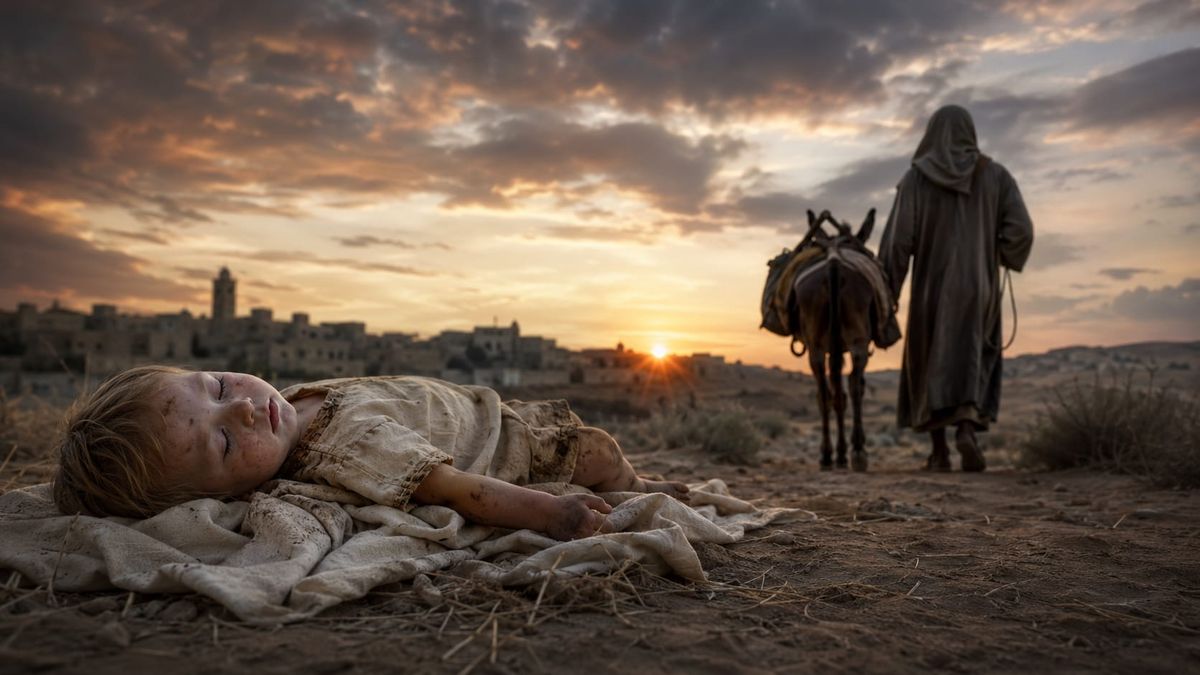
December 28, 2025, The Feast of the Holy Innocents, Season of Christmas
Matthew 2:13–18, Jeremiah 31:15–17, Psalm 124, Revelation 21:1–7
Grace, mercy, and peace from God our Father and the Lord Jesus Christ be with you on this Feast of the Holy Innocents.
It is the fourth day of Christmas. The season has barely begun. And the Church opens the lectionary to Matthew 2 and assigns us a massacre.
The calendar calls this a feast day. In the liturgical tradition, a feast is simply a day the Church sets apart with its own collect, readings, and solemn observance: a day she stops and names what happened and places it before God. Not every feast is a celebration. Christmas is a feast. The Holy Innocents is also a feast. The word covers both: days of joy and days of lamentation held before the same Lord.
This is not an accident. The Church does not place this feast here because she ran out of gentler material. She places it here because this is where it belongs: four days after the angels sang, in the middle of the Christmas season, while the joy is still ringing. The birth of the Savior provoked Herod's murderous rage, and these deaths followed. The Incarnation, entering history in a specific town in a specific year under a specific king, immediately drew the murderous rage of the powerful against the helpless. December 28 holds the Christmas story and the slaughter of children in the same season because they are part of the same story.
Matthew’s account in chapter 2 is brief and does not attempt an explanation. When Herod realizes the Magi have not returned to tell him where the child is, he acts: “He sent and killed all the male children in Bethlehem and in all that region who were two years old or under, according to the time that he had ascertained from the wise men.” (Matthew 2:16, ESV) One sentence. No theology of why. No angel intervening on behalf of these children the way an angel intervened for Joseph and the family. Jesus escapes to Egypt. The others do not. The asymmetry is stark and Matthew does not resolve it. He simply records it, and then reaches for a prophet.
Matthew gives us one more detail we must not overlook. After recording the massacre in a single sentence, he notes that the family’s flight to Egypt fulfills the words of Hosea: “Out of Egypt I called my son.” (Matthew 2:15, ESV; Hosea 11:1) Jesus is the true Israel. As Israel was called out of Egypt in the Exodus, so God’s Son is called out of Egypt. They die in the land of Israel while the true Israel flees to Egypt. When Jesus returns, Matthew presents him as beginning the new and greater Exodus, the deliverance God had promised from a bondage deeper than Pharaoh’s. The angel had already declared why this child was born: “he will save his people from their sins.” (Matthew 1:21, ESV) Herod’s tyranny is real, but it is only one expression of the greater tyranny of sin and death from which Christ has come to redeem his people. The children of Bethlehem are not a footnote to that story.
They stand at the beginning of the story of redemption Christ came to accomplish.
The verse Matthew finds is Jeremiah 31:15: “A voice was heard in Ramah, weeping and loud lamentation, Rachel weeping for her children; she refused to be comforted, because they are no more.” (Matthew 2:18, ESV) Rachel is the mother of Joseph and Benjamin, buried near Bethlehem according to ancient tradition. In Jeremiah’s original context she weeps for the children of Israel being led into exile past Ramah. Matthew hears in her weeping the voice of every mother in Bethlehem who lost a son to Herod’s soldiers.
Notice what Matthew does not do. He does not follow the quotation with an explanation. He does not say: but God was in control, or this served a greater purpose, or take comfort. He quotes the lamentation and moves on. The word of God, in the hands of Matthew, does not require the sufferers to stop weeping before it is willing to speak. Rachel refuses to be comforted, and Matthew does not correct her.
Jeremiah 31:15 is not the end of the passage. Two verses later the prophet adds: “Keep your voice from weeping, and your eyes from tears, for there is a reward for your work, declares the Lord, and they shall come back from the land of the enemy. There is hope for your future, declares the Lord.” (Jeremiah 31:16–17, ESV) The hope is present in the Scripture. But the prophet does not rush it. He allows the lamentation its full weight before the promise arrives. The BCP’s appointed reading for this feast includes verses 16 and 17. The Church includes the hope. She simply does not let it come too soon.
It is worth sitting with the three-day sequence the Church has appointed for December 26, 27, and 28. Stephen chose his martyrdom in the most direct sense: he stood before the council and preached Christ, knowing what would follow, and it followed. John endured across a long life of exile and suffering, bearing witness without the final cost that Stephen paid. The Holy Innocents had neither Stephen’s choice nor John’s endurance: they were two years old and under. They could not confess, could not choose, could not even understand what was happening. They are the witnesses who could not speak.
The ancient Church called them martyrs, and the instinct is sound. Martyrdom is defined by the cause for which one dies, not by the consciousness of that cause. These children died in his place, in his town, at the same age, under the same king who was trying to destroy him. The Church honors them in the same week, with the same weight, in red vestments, as martyrs, because that is what they are. The sequence says something about what the Church believes: that God receives those who die in his cause, whether or not they knew it was his cause. That the Kingdom of God belongs to such as these.
Psalm 124 is assigned for this feast. It is the song of those who escaped: “If it had not been the Lord who was on our side when people rose up against us, then they would have swallowed us up alive.” (Psalm 124:2–3, ESV) Yet on the feast of the Holy Innocents, the Church sings this psalm on behalf of those who were not delivered.
We do not know why the angel came to Joseph and not to the fathers of Bethlehem. We are not given that answer. On this feast, the Church takes that psalm of deliverance and sings it over those for whom the waters did not recede. What we are given is the psalm: the same Lord who is on our side is on their side. The psalm’s final verse carries the weight of the whole feast: “Our help is in the name of the Lord, who made heaven and earth.” (Psalm 124:8, ESV) Even when the escape does not come.
For those among us who have lost a child, whether in infancy, through miscarriage, through illness, through violence, this feast belongs to you in a particular way. The Church does not defer this grief to another season or place it outside the liturgical year. She holds it here, in Christmas, because the one born in Bethlehem knows what Bethlehem lost because Herod sought his life. He is not indifferent to it. He did not escape to Egypt and forget what was left behind in the town of his birth. The Innocents’ feast is his annual acknowledgment: this grief is real, it is named, it is held.
The eschatological answer to Rachel’s weeping is Revelation 21. The Church appoints it for this feast not to rush past the grief but to name its destination. John writes: “He will wipe away every tear from their eyes, and death shall be no more, neither shall there be mourning, nor crying, nor pain anymore, for the former things have passed away.” (Revelation 21:4, ESV) Every tear, not some tears. Death shall be no more: not reduced, not managed, but abolished. The mourning of Bethlehem belongs to the former things that will pass away. The weeping of Ramah belongs to the former things. Rachel’s grief, and every grief like it, belongs to the former things. And former things pass away.
This is the promise of the one born in Bethlehem. Not that grief will be explained, not that the asymmetry will be resolved in terms we can understand in this age, but that it belongs to the former things, and that the one who escaped to Egypt is the same one who has promised that every tear will be wiped from every eye. The weeping is real, and its end is also real.
It is a striking thing that the Church reads Revelation 21 in December. It is a chapter appointed for the end of all things, and we read it four days after the beginning: four days after the angels, the shepherds, the manger, the Word made flesh. But that is exactly the point. The child born in Bethlehem and the one who says “Behold, I am making all things new,” (Revelation 21:5, ESV) are the same person. Christmas is not the end of the story; it is the beginning of the story that ends in Revelation 21. The Innocents are part of that story. Their deaths are not a footnote.
They are held in the arms of the one whom Herod sought to destroy, and the promise of every tear wiped away is his promise to them as much as to anyone.
The collect appointed for this day turns the Innocents’ witness toward us. It asks God to “mortify all that is evil within us, and so strengthen us by your grace, that we may glorify your holy Name by the innocence of our lives and the constancy of our faith even unto death.” (BCP 2019, p. 625) The children of Bethlehem had innocence by nature; they had no opportunity for anything else. The collect asks that we would have it by grace. They had no chance to choose constancy of faith; we do. Their involuntary witness becomes the occasion for our voluntary one. The feast of those who died without choosing is the day we ask to be made faithful in our choosing.
What, then, does this feast ask of us? Three things the day presses.
First: it asks us to sit with grief that has not been resolved. We live in a culture that moves quickly to the fix, the lesson, the silver lining. The Holy Innocents do not offer a silver lining. Matthew does not provide one. The feast asks us to resist the instinct to explain away what cannot be explained, to honor grief its full weight before we speak of hope. There are people in every congregation who are carrying losses for which there is no explanation: the child who died, the prayer that was not answered in the way they asked, the escape that did not come. The feast of December 28 tells them that the Church knows this kind of grief exists, that the word of God does not require them to stop weeping before it speaks to them, and that Rachel’s refusal to be comforted is not a failure of faith. It is honest. It is, in fact, the beginning of the conversation the prophet is willing to have. The lamentation is not the end of Jeremiah 31; it is the opening. The hope that comes in verses 16 and 17 is addressed to the one who has wept fully, not to the one who has been persuaded to stop early.
Second: it asks us to speak for those who cannot speak for themselves. The Holy Innocents were voiceless. They died without being able to name what was happening to them or cry out to anyone who could help. The collect’s petition for innocence of life and constancy of faith is not merely personal piety; it is a posture toward the vulnerable. Herod’s massacre was a political act: a king eliminating a perceived rival, the vulnerable destroyed in the service of the powerful. The Church has always known that pattern does not belong only to ancient history. Every generation has its version of it: the voiceless, the expendable, those whose lives are forfeit to someone else’s ambition or fear. The Church that observes this feast is the Church that refuses to look away, that names what it sees, that prays and acts on behalf of those who have no advocate. Because Christ identifies himself with the helpless, entering the world as an infant in a specific town under a king who wanted him dead, the Church that bears his name cannot ignore those who have no voice. To pray the collect of December 28 is to align ourselves with the voiceless rather than the powerful. This is what innocence of life looks like in practice.
Third: it asks us to live toward the promise. Revelation 21 is not a consolation prize. It is the destination of the new Exodus Christ came to accomplish, the end toward which he is leading his people, including the grief of Bethlehem and every grief like it. To live toward that promise is to take it seriously enough to let it shape how we live now: with the knowledge that death is not the final word, that the former things will pass away, that every tear will be wiped by the hand of the one who knows what grief costs because he entered a world under the tyranny of sin and death. We are not waiting for nothing. We are waiting for the one who said “I am making all things new.” (Revelation 21:5, ESV) And the feast of the Holy Innocents, held in the middle of Christmas, is the Church’s annual act of faith that he means it.
“A voice was heard in Ramah, weeping and loud lamentation, Rachel weeping for her children; she refused to be comforted, because they are no more.” And then, when the weeping has been given its full weight: “There is hope for your future, declares the Lord.” (Jeremiah 31:15, 17, ESV)
In the Name of the Father, and of the Son, and of the Holy Spirit. Amen.