Rest for Your Souls (Matthew 11:25-35)
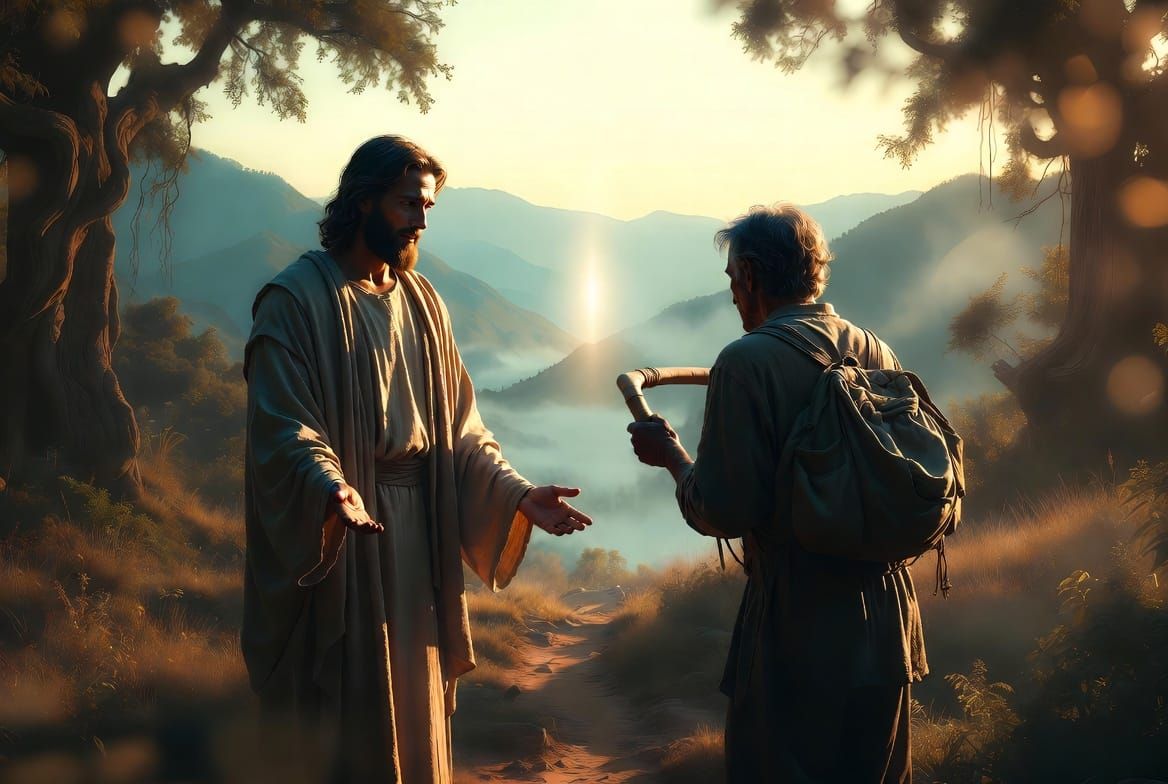
Matthew 11:29: take my yoke upon you. The yoke is not effortless but good, kind, well-fitting, shaped for the one who wears it. The burden of Christ is light not because following costs nothing but because he carries it alongside us.
July 5, 2026, Proper 9, Year A, The Sixth Sunday after Pentecost
Matthew 11:25–30, Psalm 145:1–13, Zechariah 9:9–12
Grace, mercy, and peace from God our Father and the Lord Jesus Christ be with you on this Sixth Sunday after Pentecost.
Three weeks ago we started Movement I of our summer in Matthew. The Mission Discourse, which occupied Proper 6 through Proper 8, gave us the harvest and the sending, the cost of speaking, the sword and the cup of cold water, the cross and the surrendered psyche (SOO-khay). Movement I described what it looks like to be sent out as sheep among wolves into a world that does not always receive the Gospel well. This morning Movement II begins, and it opens with the most tender six verses in the Gospel of Matthew.
Our passage this morning is Matthew 11:25–30. But, before we enter the passage, we need to feel the context in which Jesus speaks these words. Matthew 11 is a chapter of rejection and disappointment. John the Baptist, sitting in prison, has sent messengers to ask whether Jesus is the one who is to come or whether they should look for another. Jesus responds, but he does not send rescue. He sends a report. And then he begins to denounce the towns where he has done most of his miracles: Chorazin, Bethsaida, Capernaum. They have seen. They have not repented. And then, in the very next breath, verse 25: “I thank you, Father, Lord of heaven and earth, that you have hidden these things from the wise and understanding and revealed them to little children.” (Matthew 11:25, ESV) The sophisticated have rejected him. The cities with the most exposure have responded with the least repentance. And Jesus gives thanks. He gives thanks because the pattern of revelation is not the pattern of human wisdom, and this is, as he says, his Father’s gracious will (Matthew 11:26).
The word translated little children is the Greek nepioi (NAY-pee-oy): infants, those who cannot yet speak for themselves, those who are entirely dependent. This is not a celebration of ignorance. It is an observation about receptivity. Those who have sufficient understanding to evaluate and sufficient pride to conclude that they do not need what is being offered will not receive it. The nepioi have no such defenses. They receive because they know they cannot rely upon themselves. The disciples are among the nepioi of Matthew 11: they have left boats and tax booths and followed, while the cities of Galilee with the most exposure to Jesus have repented the least. And by extension, every believer who comes to Christ with empty hands rather than a prepared argument is a nepios. The Kingdom comes not to those who have worked out whether they need it, but to those who know they do.
Verse 27 deepens the picture: “All things have been handed over to me by my Father, and no one knows the Son except the Father, and no one knows the Father except the Son and anyone to whom the Son chooses to reveal him.” (Matthew 11:27, ESV) This is one of the most remarkable Christological claims in Matthew’s Gospel, and it stands in the middle of the passage often overlooked because it comes just before the famous invitation of verse 28. The knowledge of the Father is not available through general revelation, wisdom, philosophical inquiry, or sufficient religious effort. The Old Testament reveals the Father, but here in Matthew 11 everything the Law and the Prophets revealed about God finds its fullest expression in the Son. The wise and religious of the day believed their tradition gave them adequate knowledge of God; Jesus is saying that the Father as he has now fully revealed himself comes through the Son alone, and that the Son gives that knowledge to whom he chooses.
That verse 27 is placed here, between the prayer of thanksgiving in verse 25 and the invitation in verse 28, is not accidental. It establishes the authority of the one who is about to issue the invitation. "Come to me" is not the plea of a religious teacher who has found a better method. It is the summons of the one who has received all things from the Father, who holds the fullest knowledge of the Father, and who chooses to share that knowledge with those to whom he reveals it. The invitation of verse 28 carries the full weight of verse 27 behind it.
And then the invitation: “Come to me, all who labor and are heavy laden, and I will give you rest.” (Matthew 11:28, ESV) These may be the most widely quoted words in the Gospel. They have been spoken over the dying, painted on the walls of hospitals and shelters, whispered in moments of private collapse. They have not lost their force through familiarity. Notice who is invited: not the righteous, not the worthy, not those who have prepared themselves adequately, but those who labor and are heavy laden. The invitation is addressed specifically to the burdened. This is not a general welcome to come and learn. It is a specific summons to those who are carrying too much.
What are the burdens? The immediate context strongly suggests the burden includes the weight of religious obligation accumulated by the Pharisaic interpretation of Torah: the tradition that had added fence upon fence around the law until the law itself was nearly invisible beneath the weight of its protections. The rabbis spoke of taking on 'ol malkhut shamayim (OL mal-KHOOT sha-MAY-yim), the yoke of the kingdom of heaven, meaning the acceptance of God’s reign through the observance of his commandments. Rabbinic teachers often spoke of the yoke of Torah, and different teachers interpreted that yoke differently. And Jesus, who has just identified himself as the one to whom all things have been handed over by the Father, offers his yoke as an alternative. But the burden Jesus has in mind is broader than the religious burden of first-century Judaism. It is every burden that presses a person down: the burden of guilt that will not dissolve, the burden of grief that does not lift, the burden of a body that is failing, the burden of a life that has not gone as hoped, the burden of simply having lived long enough to accumulate loss upon loss.
The invitation goes out to all of them. There is no burden so specific that it falls outside the scope of the invitation, and no burden so heavy that it disqualifies the bearer from coming.
And then verse 29, which contains the most important words in the passage: “Take my yoke upon you, and learn from me, for I am gentle and lowly in heart, and you will find rest for your souls.” (Matthew 11:29, ESV) Take my yoke. This is not an offer to remove the yoke. It is an offer to replace it. The yoke of Christ is not the absence of obligation but a different obligation, carried alongside the one who shoulders it. And the one who offers it describes himself: gentle, the Greek praus (PRAH-oos), the word used in the Beatitudes for the meek who will inherit the earth, often described as strength expressed through gentleness; and lowly in heart, humble, not self-promoting, not demanding. The God of heaven and earth who has received all things from the Father describes himself as meek and lowly. The yoke he offers is shaped by who he is.
And his yoke, verse 30, is not simply easy in the sense of effortless. The word is better rendered good, kind, serviceable, well-fitting: the image suggests a yoke made for the animal that will wear it, shaped to its neck, not rubbing or chafing or adding its own weight to the load. The burden of Christ is light not because following him requires nothing but because the one who asks us to carry it carries it alongside us and has shaped it to who we are.
The rest Jesus promises in verse 28 and the rest in verse 29 are worth distinguishing. Verse 28: “I will give you rest” is the rest of relief, the immediate setting-down of what has been carried too long. Verse 29: “you will find rest for your souls” is something deeper. The word translated souls is psyche (SOO-khay), the word we encountered in Proper 8 when Jesus spoke of losing the psyche to find it.
When Jesus promises rest for the psyche, he echoes Jeremiah 6:16: “walk in it, and find rest for your souls.” (Jeremiah 6:16, ESV) Jeremiah called a people refusing God’s ancient paths back to the place of rest. Jesus now locates that promised rest in himself. The rest for the psyche is not merely relief from a specific burden; it is the settled peace of a person who has come home, who has found the place and the relationship in which the psyche is finally at rest. Augustine described the human heart as restless until it rests in God. The promise of verse 29 is that the psyche can find that rest in Christ.
Our Old Testament reading from Zechariah 9 illuminates exactly who is speaking these words. The prophet writes: “Rejoice greatly, O daughter of Zion! Shout aloud, O daughter of Jerusalem! Behold, your king is coming to you; righteous and having salvation is he, humble and mounted on a donkey, on a colt, the foal of a donkey.” (Zechariah 9:9, ESV) This is the verse the Gospels quote at the Triumphal Entry, when Jesus rides into Jerusalem five days before his crucifixion. The king who comes is righteous and saving, and he is humble: he does not ride a war horse; he rides a donkey, the animal of a working man.
This King speaks peace to the nations, and then verse 11: “As for you also, because of the blood of my covenant with you, I will set your prisoners free from the waterless pit.” (Zechariah 9:11, ESV) Prisoners released from a waterless pit: the image is of a cistern with no water in it, a place of dry imprisonment where there is nothing to sustain life. And verse 12 gives those prisoners their identity: “Return to your stronghold, O prisoners of hope.” (Zechariah 9:12, ESV) Prisoners of hope. The phrase appears nowhere else in the Hebrew Bible. A prisoner of hope is someone held in a place of deprivation who has not let go of the promise. Their defining characteristic is not their imprisonment but their hope. And the humble king on the donkey is coming to release them.
The connection is striking. The meek and lowly king of Zechariah 9 is the one who says: come to me, all who are heavy laden. The prisoners of hope are the ones who labor under burdens they cannot set down themselves. The waterless pit is every dry and airless circumstance from which there is no obvious exit. And the invitation of Matthew 11:28 is the fulfillment of Zechariah’s promise: the humble king has come, and he is releasing prisoners.
Psalm 145, which we prayed together today, gives us the character of this king in the language of Israel’s praise. “The Lord is gracious and merciful, slow to anger and abounding in steadfast love. The Lord is good to all, and his mercy is over all that he has made.” (Psalm 145:8–9, ESV) The psalmist is not describing an abstract deity. He is describing the same one Zechariah calls righteous and saving and humble, the same one Matthew quotes saying: "I am gentle and lowly in heart." The character of God as Israel’s poets saw it and as the prophets announced it is confirmed in the self-description of Jesus in the passage before us. This is who he is. This is the one issuing the invitation.
One verse in Psalm 145 deserves particular attention alongside Matthew 11:28. Verse 14: “The Lord upholds all who are falling and raises up all who are bowed down.” (Psalm 145:14, ESV) All who are falling. All who are bowed down. This is the psalm appointed for the Sunday when Jesus says: "Come to me, all who labor and are heavy laden." The God who upholds the falling is the God who invites the heavy laden. The God who raises the bowed down is the God who promises rest.
The collect for this Sunday arrives at the same destination by a different road: “Grant us, O Lord, we pray, the spirit to think and do always those things that are right, that we, who can do no good thing apart from you, may by you be enabled to live according to your will.” (BCP 2019, p. 617) We who can do no good thing apart from you. That is the posture of the nepios, the dependent one, the person without the resources to evaluate and decide whether he needs what is being offered. The collect is not a prayer of despair. It is a prayer of clarity: we cannot do this on our own, and knowing that is not a weakness to be overcome but a truth to be received. The very thing that qualifies a person to hear the invitation of Matthew 11:28 is the honest acknowledgment of verse 29’s collect: we can do no good thing apart from him.
For those of us who have been carrying heavy things for a long time, the invitation of Matthew 11:28 is not a promise of the removal of the burden. Many of us will carry our burdens out of this building today and carry them again tomorrow. The rest Jesus promises is not the cessation of difficulty but the transformation of how it is carried. The yoke of Christ means the burden is shared; the one who described himself as meek and lowly is in it with us. The rest for our souls that verse 29 promises is not the rest of a bed but the rest of a secure foundation: the solid ground beneath that allows us to carry what we carry without being crushed by it. Prisoners of hope hold on not because the waterless pit has become pleasant but because they know the humble king is coming and has already come.
The invitation of verse 28 is unconditional in its scope: all who labor and are heavy laden. All. The only condition is the burden itself. And this is the consistent pattern of how Jesus issues invitations in Matthew’s Gospel: he calls the tax collector from his booth without asking about his balance sheets. He heals the leper before requiring any proof of worthiness. He feeds the five thousand without taking an attendance record. The invitation of Matthew 11:28 fits the same pattern. It is addressed to those who need it, not to those who have earned it.
What does it look like in practice to come to Jesus with a heavy burden? It does not look like a dramatic crisis moment, though it may include one. For most of us, most of the time, it looks like ordinary acts done with honest intent. It looks like showing up for worship when the burden is heavy enough that staying home would be easier. It looks like bringing the actual burden to prayer rather than a tidied version of it: saying honestly, Lord, this grief has not lifted; this body is not recovering; these years of faithfulness have been long and I am tired.
The yoke of Christ does not require us to pretend the burden is lighter than it is. It requires us to bring it to the one who already knows its weight. He said: learn from me. The invitation is not to a single transaction but to an ongoing relationship of trust, a daily practice of returning to the one who is gentle and lowly in heart and finding that his burden, carried with him, is genuinely light.
For those among us who have carried the faith through long and unwitnessed years, who have served quietly in ways no one thought to commend, who sit here carrying grief or illness or the particular exhaustion of old age, bring what you carry. Take the yoke that has been shaped for you. He upholds all who are falling. He raises up all who are bowed down.
The thread running through all three readings today comes to a point here: the King we longed for is the King who stoops low enough to lift us up. Zechariah promised a king on a donkey rather than a war horse. Psalm 145 praised a God who raises the bowed down and upholds the falling. And Matthew 11 gives us the fulfillment of both promises in one sentence: "Come to me, all who labor and are heavy laden, and I will give you rest." The world expects kings who demand service. This King serves. The world expects rulers who add to the burden. This one lifts it.
Take the yoke that is shaped to fit you, carried by the one who made you, and find that his burden is good, kind, well-fitting, and light. The collect for this Sunday begins there, at the only honest starting place: we who can do no good thing apart from him. That acknowledgment is not the conclusion of a failed life. It is the beginning of a rested one. The prisoners of hope hold on not because the pit has become pleasant but because the humble king has come and is still coming. Rest for your souls is what he promises. It is what he gives.
In the Name of the Father, and of the Son, and of the Holy Spirit. Amen.