That Which We Have Seen and Heard: The Feast of John, Apostle and Evangelist (John 21:9-25)
Feast of John, December 27. Three days of Christmas: Stephen the willing martyr, John the confessor who lived long, the Holy Innocents who died without choice. John’s witness was slow, sustained, written down for the Church forever.
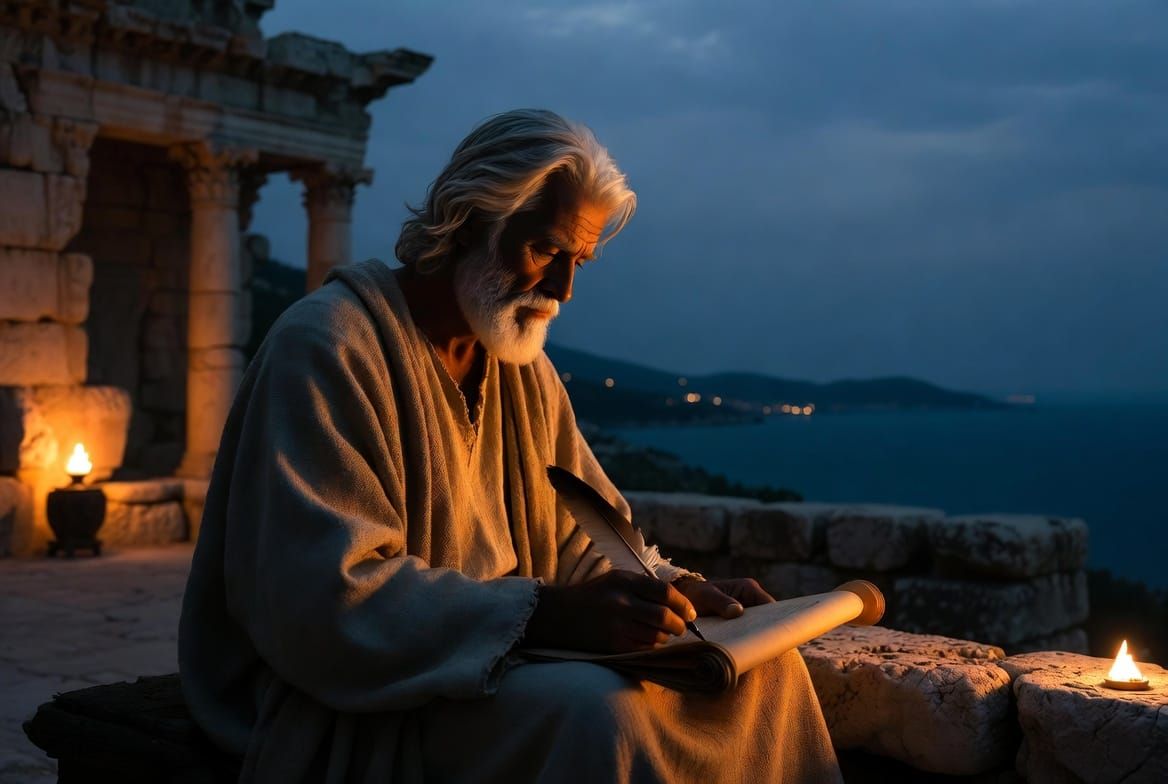
December 27, 2025, Feast of Saint John, Apostle and Evangelist, Season of Christmas
John 21:9–25, Psalm 92:1–4, 1 John 1:1–10, Exodus 33:18–23
Grace, mercy, and peace from God our Father and the Lord Jesus Christ be with you on this feast of Saint John, Apostle and Evangelist.
Yesterday was Stephen. The day before was Christmas. Tomorrow will be the Holy Innocents. The three days following Christmas present the Church with three kinds of witness to the child born on December 25: Stephen the willing martyr, who chose death for the faith; John the confessor, who suffered for the faith and was not killed and spent his long life writing down what he saw; and the Holy Innocents, who died for the child without any choice at all. The Church has always placed John here, in the middle of this triad, because his kind of witness is the most sustained and most ordinary of the three: not the flash of martyrdom, not the innocence of the slaughtered, but the long, faithful, daily labor of one who was there and never stopped saying what he saw.
John son of Zebedee is introduced in the Gospels as a fisherman, called alongside his brother James from their boat on the Sea of Galilee. Jesus gives the brothers a name in Mark 3:17: Boanerges (boh-ah-NEHR-gays), Sons of Thunder. The name suggests a temperament that the years of discipleship will gradually reshape. The same man who would one day write “God is love,” (1 John 4:8, ESV) and mean it with the full weight of a life lived in that knowledge. He is one of three who form the inner circle: present at the Transfiguration, present at Gethsemane, present when Jairus’s daughter is raised. In John’s own Gospel, he never names himself directly. He refers to himself only as the disciple whom Jesus loved, and the anonymity is itself a theological act: John’s identity is defined by the relationship, not by the name.
The arc of John’s character across his lifetime is itself a kind of testimony. The man who wanted to call down fire on a Samaritan village became the man who wrote “Beloved, let us love one another, for love is from God.” (1 John 4:7, ESV) The man whom Jesus surnamed Son of Thunder became the man the early Church called the Apostle of Love. This did not happen quickly. It happened over fifty or sixty years of following the risen Christ, building the community at Ephesus, caring for the aged Mary, suffering under Domitian, writing and rewriting the same essential message: God is love, the Word became flesh, and we have seen him. The transformation of John is the parable of what the word does when it finds good soil and is tended across a whole life. John is what it looks like when the seed takes root and is given nearly seventy years to grow.
Our Epistle reading gives us the clearest account of what John understood his own vocation to be. First John 1:1–3: “That which was from the beginning, which we have heard, which we have seen with our eyes, which we looked upon and have touched with our hands, concerning the word of life, the life that was made manifest, and we have seen it and testify to it and proclaim to you the eternal life that was with the Father and was made manifest to us, that which we have seen and heard we proclaim also to you.” (1 John 1:1–3, ESV) Heard. Seen. Looked upon. Touched. John accumulates the verbs of physical witness with deliberate insistence. This is not mystical vision or theological speculation. It is the testimony of a man who heard the voice at the Last Supper, saw the face in the upper room and on the shore of Tiberias, and was, with Thomas, among those who could have touched the wounds of the risen Christ. The word looked upon is the Greek theaomai (theh-AH-oh-my): to gaze, to contemplate, to behold something carefully and at length. John is not claiming a quick glance. He is claiming the sustained sight of the one who stayed close and paid attention.
It is worth asking why John piles up these physical verbs so insistently at the opening of his letter. He is not simply being thorough. He is arguing. These are not abstract concerns or anticipations of later theological debates. John is writing directly against teachers he knows in his own communities at Ephesus: those who deny that Jesus Christ has come in the flesh, whom he elsewhere calls antichrists (1 John 4:2; 2 John 7). Docetism, the teaching that Christ only seemed to have a body, was already circulating in John’s lifetime. Against this denial, he asserts the physical reality of the Incarnation with every verb at his disposal. Heard. Seen. Looked upon. Touched. Each verb narrows the distance between the witness and the thing witnessed. The one who claims only to have speculated about Christ or received a mystical impression of him cannot say these things. The eyewitness can. This is John’s credential, and it is the credential the whole Church stands on: the word of life was not a spiritual impression but an embodied person who made physical contact with physical human beings and left physical evidence.
The Old Testament reading from Exodus 33 gives us the background against which John’s testimony is staggering. Moses asks God for the thing Israel has always wanted and never quite received: “Please show me your glory.” (Exodus 33:18, ESV) And the answer is the answer of the Old Covenant: no one can see my face and live. God places Moses in the cleft of the rock and covers him with his hand as the glory passes by. Moses will see God’s back, not his face. The full sight of God’s glory is precisely what Israel’s greatest prophet is denied in the most intimate encounter between God and a human being in the Old Testament. And then John 1:14, three paragraphs from the opening of John’s Gospel: “And the Word became flesh and dwelt among us, and we have seen his glory, glory as of the only Son from the Father, full of grace and truth.” (John 1:14, ESV) What Moses was denied, the beloved disciple received. The Word became flesh. In Christ, God disclosed himself as fully as a creature can receive him. What Moses glimpsed from behind, John gazed upon in the face of a man from Nazareth: the fullest self-disclosure God has made in human history, though even here the divine mystery is not exhausted. The cleft of the rock and the upper room are two moments in the same story, and the story arrived at Christmas.
Our Gospel reading is John 21:9–25, the closing scene of John’s Gospel. Seven disciples have gone back to the water after the resurrection, perhaps because they did not know what else to do, and they have fished all night and caught nothing. A stranger on the shore tells them to cast the net on the right side. They haul in 153 fish, and John is the first to recognize the stranger: “It is the Lord.” (John 21:7, ESV) When they reach shore, Jesus has a charcoal fire going with fish and bread. Verse 13: “Jesus came and took the bread and gave it to them, and so with the fish.” (John 21:13, ESV) The verb “gave” echoes the feeding of the five thousand and the Last Supper: the same risen Lord who broke bread with his disciples in the upper room is here presiding at the table on the shore. The patristic tradition read this breakfast as a post-resurrection Eucharist, and for good reason. The meal on the shore is the risen Christ giving himself to his people as he always has and always will. This detail in John’s Gospel is never incidental. The last charcoal fire in John’s Gospel was the one in the high priest’s courtyard where Peter warmed himself while he denied the Lord three times. Now there is another charcoal fire. And after breakfast, Jesus restores Peter with three questions that answer three denials.
John is present for all of this. He does not speak in the scene; he watches. He is the one who recognized Jesus from the boat; he is the one following when Peter turns to ask about him in verse 21. And Jesus’ answer to Peter’s question about John becomes the closing movement of the Gospel: “If it is my will that he remain until I come, what is that to you? You follow me!” (John 21:22, ESV) A rumor spreads among the disciples that John would not die before the Lord returned. The Gospel takes care to correct it: Jesus did not say he would not die; he said if it is my will that he remain. And then the passage that gives the whole Gospel its final framing: “This is the disciple who is bearing witness about these things, and who has written these things, and we know that his testimony is true.” (John 21:24, ESV) The Gospel of John closes by pointing to its own author and certifying his testimony. The community around John is saying: this man was there. We know him. His testimony is true.
The certification of John’s testimony in verse 24 is worth pausing on. “We know that his testimony is true.” The “we” here is the Johannine community, the circle of disciples that John had gathered and formed over decades in Ephesus. They are not simply taking his word for it; they are the people who knew him, who had sat under his teaching, who had watched him bear the same witness year after year without contradiction or retraction. The eyewitness has witnesses. The community around him has watched him live the same testimony he wrote. And their certification reaches forward through the centuries. We are the generation that receives it and, by believing, joins the chain.
And then the last verse of the Gospel, one of the most remarkable sentences in the New Testament: “Now there are also many other things that Jesus did. Were every one of them to be written, I suppose that the world itself could not contain the books that would be written.” (John 21:25, ESV) John has written four chapters of prologue, twenty chapters of ministry and passion, and a closing epilogue, and at the end of all of it he says: I have not begun to exhaust what there is to say. The witness’s final word is not I have told you everything but there is so much more than I could write. The inexhaustibility of the subject is the last thing he wants us to know.
Psalm 92, appointed for this feast, is the psalm of one who has lived long enough to see God’s faithfulness confirmed across a lifetime: “It is good to give thanks to the Lord, to sing praises to your name, O Most High; to declare your steadfast love in the morning, and your faithfulness by night.” (Psalm 92:1–2, ESV) The psalmist has grounds for gratitude that stretch across years; his praise is not the enthusiasm of a new convert but the settled conviction of someone who has seen enough to know that the Lord is faithful. This is John’s psalm: the man who outlived every other apostle, who built the community at Ephesus, who in old age was still writing and still saying the same thing he said at the beginning. The morning and the evening, the steadfast love and the faithfulness: these are the coordinates of a whole life spent in one direction.
The morning and the evening are not incidental details in Psalm 92. They are the rhythm of a whole life oriented toward God: declaring his steadfast love in the morning, his faithfulness by night. John’s life had this rhythm. He was exiled to the island of Patmos under the emperor Domitian, and it was there, in imprisonment, that he received the visions recorded in the Book of Revelation. Revelation 1:9: “I, John, your brother and partner in the tribulation and the kingdom and the patient endurance that are in Jesus, was on the island called Patmos on account of the word of God and the testimony of Jesus.” (Revelation 1:9, ESV) Released after Domitian’s death, he returned to Ephesus. Most of his decades were spent in the ordinary work of a pastor: teaching, baptizing, visiting the sick, writing letters, gathering the community around the word and the table. The steadfast love declared in the morning is what sustains the faithfulness declared at night. And for those of us who have been doing this a long time, who have had the same morning prayer for fifty or sixty years and the same faithfulness to the same community through the same long stretch of years, Psalm 92 is the psalm that says: this is what it looks like. A life oriented toward God across all its mornings and evenings is the good soil producing its quiet hundredfold.
The contrast between yesterday’s feast and today’s is intentional and important. Stephen died at the hands of the Sanhedrin within months of the resurrection, the first martyr, his witness sudden and violent and immediately glorified. John died in old age in Ephesus, surrounded by the community he had formed, the last of the apostles to go. The calendar places them on consecutive days because the Church needs both kinds of witness. The martyrs show us what faith looks like when it costs everything at once. The confessors show us what faith looks like when it costs everything gradually, across the long years of service and teaching and writing that no one particularly notices until it is over. Stephen’s witness was the flash. John’s was the sustained flame.
The collect for this feast gathers all of this under the image that runs through John’s entire apostolate. “Shed upon your Church, O Lord, the brightness of your light; that we, being illumined by the teaching of your apostle and evangelist John, may so walk in the light of your truth, that at length we may attain to the fullness of eternal life.” (BCP 2019, p. 625) John’s own language: “God is light, and in him is no darkness at all.” (1 John 1:5, ESV) The Word that became flesh was the light of men: “The light shines in the darkness, and the darkness has not overcome it.” (John 1:5, ESV) The collect is praying John’s own theology back to God and asking that the Church would live inside it. And John himself tells us what walking in the light looks like in practice. First John 1:7: “If we walk in the light, as he is in the light, we have fellowship with one another, and the blood of Jesus his Son cleanses us from all sin.” (1 John 1:7, ESV) Walking in the light is not a solitary achievement; it is a communal one. It produces fellowship, mutual accountability, and the ongoing cleansing that comes from honest confession. Illumined by John’s teaching, walking in the light of God’s truth, arriving at the end of the road at the fullness of eternal life.
For a congregation that has been walking in the light for many years, this feast carries a particular word. We are the recipients of John’s testimony. We did not hear the voice at the supper table. We did not see the face on the shore of Tiberias. We did not gaze at the glory that the Word made flesh carried among us. What we have is John’s word that these things happened, his accumulation of the verbs of physical witness, his lifetime of insisting that what he saw was real. The Gospel of John and the letters of John and the Book of Revelation: this is the man’s life’s work, and it was undertaken for us, so that we who did not see might believe.
The collect’s petition is not only about receiving John’s testimony but about walking in the light it gives. “May so walk in the light of your truth.” Walking is not a dramatic act. It is the daily, ordinary movement in a direction. For those who have been walking in the light for fifty or sixty years, the question is not whether to begin but whether to continue: whether the morning prayer still goes up, whether the Scripture still opens, whether the community of the Church is still the place where the light is kept and shared. John walked in the light until he could no longer walk. He wrote about the light until he could no longer write. The tradition holds that in his very old age, when he was carried into the assembly at Ephesus and could say little else, he repeated one phrase: “Little children, love one another.” It is not certain this is historical. What is certain is that it is exactly what the testimony of his whole life said. Walking in the light, at the end, looks like that.
John 20:29, which we read on the feast of Thomas, applies here as well: “Blessed are those who have not seen and yet have believed.” (John 20:29, ESV) That blessing is addressed to us. We are the generation of the not-seen, and John’s testimony is the ground of our faith. The man who was there, who saw the glory and heard the voice and gazed upon the Word made flesh, spent his entire long life writing it down for us.
John’s collect asks that we walk in the light of God’s truth. Walking is not a dramatic act. It is the daily, unremarkable movement of a life oriented in one direction. For those who have been walking in this light for fifty or sixty years, the Feast of John is not a call to begin but a confirmation that continuing is itself the witness. The same God who met John at the beginning, who named him Son of Thunder and then spent decades reshaping him into the apostle of love, is the God who has been walking with this congregation through its own ordinary years. The light he carried, John gave. The light we have received, we carry. And the collect’s promise is that walking in it, even in the smallest and most unnoticed ways, is the path toward the fullness of eternal life.
In the Name of the Father, and of the Son, and of the Holy Spirit. Amen.