The Circumcision and Holy Name: An Anglican Perspective
The world begins its new year with resolutions. The Church begins it with a name. January 1 is the Feast of the Circumcision and Holy Name of Our Lord — the eighth day of Christmas, when the infant Jesus was circumcised and given the name that means salvation. Not a resolution. A person.
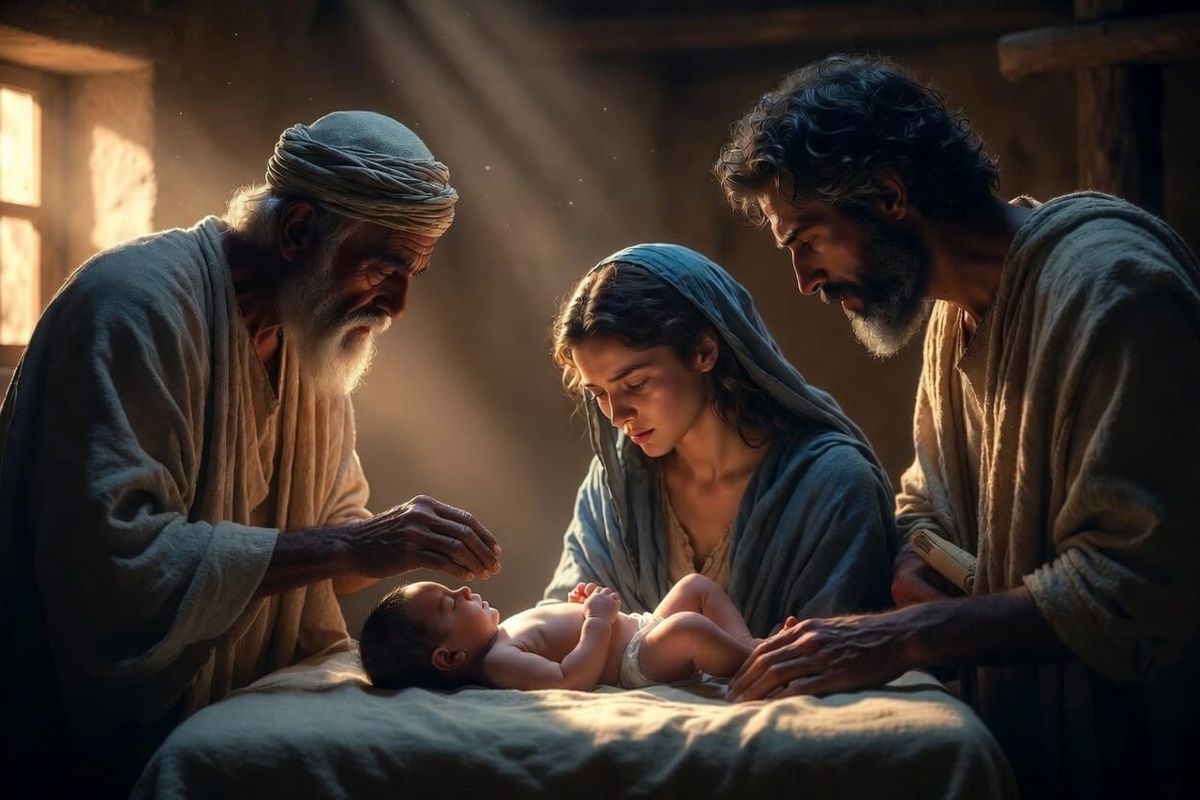
Feast Day: January 1
The Anglican calendar is ordered by a hierarchy of holy days, each carrying a different weight of observance. At the top sit the seven Principal Feasts — the highest days of the liturgical year. Below them are the Red-Letter Holy Days, appointed in the BCP 2019 with their own collects, propers, and lectionary readings. They are called Red-Letter Days because, in the tradition of printing church calendars, these days appear in red ink, distinguished from the Optional Commemorations which appear in ordinary black type. The Circumcision and Holy Name of Our Lord Jesus Christ, observed on January 1 and listed among the Holy Days on page 688 of the BCP 2019, is one of these Red-Letter Holy Days — and one that the secular world has largely claimed for its own purposes.
January 1 is, in most of the Western world, the celebration of a new year. It is a day of resolutions, of hangovers, of looking forward with a mixture of hope and anxiety at the year ahead. The Church does not ignore this. It simply refuses to let the day belong entirely to the calendar of secular time. On January 1, the eighth day after Christmas, the Church gathers around two events that happened in the life of the infant Jesus: his circumcision, and the giving of his name. These are not decorative details in the nativity narrative. They are theologically charged acts that say everything about who this child is and why he came.
The Eighth Day
Luke 2:21, our appointed Gospel reading for this feast, is a single sentence: “And at the end of eight days, when he was circumcised, he was called Jesus, the name given by the angel before he was conceived in the womb.” (Luke 2:21, ESV) One sentence. Two events. The eighth day after birth was, according to the Law of Moses, the day appointed for the circumcision of every male child in Israel. The command goes back to Abraham: “He who is eight days old among you shall be circumcised.” (Genesis 17:12, ESV) This was the sign of the covenant, the physical mark that identified a male child as belonging to the people of God, as a son of Abraham, as an heir of the promises. By submitting to circumcision, the infant Jesus entered into that covenant on behalf of his people. He did not need it for himself — he is the one in whom all the promises are fulfilled. He underwent it for us.
This is the theological pattern that will govern his entire life: he who needed nothing submitted to everything we need, so that in him we might receive what we could not earn. He was baptized, though he had no sin to wash away. He was tempted, though he could not be overcome. He was crucified, though he deserved no death. And on the eighth day of his earthly life, he bore in his flesh the sign of the covenant he had come to fulfill.
The number eight carries its own significance in the biblical imagination. Seven is the number of completion — the seven days of creation, the Sabbath rest. Eight is the day beyond the week, the day of new beginning, the day of resurrection. Jesus rose on the first day of the week, which is also the eighth day. The circumcision on the eighth day is therefore a whisper of what is coming: the one who sheds his blood on the eighth day of his life will shed it finally on the cross, and the covenant sealed in both will be opened for all who believe. Paul writes in Colossians 2:11: “In him also you were circumcised with a circumcision made without hands, by putting off the body of the flesh, by the circumcision of Christ.” (Colossians 2:11, ESV) The sign has been fulfilled in the reality. The physical rite pointed to the spiritual transformation that Christ alone accomplishes.
The Name That Is Above Every Name
The circumcision and the naming are inseparable in Luke’s account, and they deserve to be held together. The name given to this child was not chosen by Joseph or Mary. It was given by the angel before his conception: “You shall call his name Jesus, for he will save his people from their sins.” (Matthew 1:21, ESV) The name Jesus is the Greek form of the Hebrew Yeshua, which is itself a contraction of Yehoshua — Joshua — meaning “the Lord saves” or “the Lord is salvation.” It is not a decorative name or a family name. It is a theological declaration. Every time his name is spoken, it speaks of what he came to do.
Paul’s great Christological hymn in Philippians 2 moves from the humility of the incarnation to the exaltation of the resurrection and ascension, and it culminates in the Name: “Therefore God has highly exalted him and bestowed on him the name that is above every name, so that at the name of Jesus every knee should bow, in heaven and on earth and under the earth, and every tongue confess that Jesus Christ is Lord, to the glory of God the Father.” (Philippians 2:9–11, ESV) The name given at circumcision is the name before which every created thing will finally bow. The infant of eight days, crying in Bethlehem, carries the name that will one day fill all of creation with its claim.
Acts 4:12 presses this further: “And there is salvation in no one else, for there is no other name under heaven given among men by which we must be saved.” (Acts 4:12, ESV) In a world of competing names and competing claims, the Church observes January 1 as a quiet but confident act of theological resistance. The new year does not belong to luck or fate or human determination. It belongs to the one whose name means salvation.
The Appointed Readings
The propers for this feast are found on page 730 of the BCP 2019. The Old Testament reading is Exodus 34:1–9, Moses’ encounter with God on Sinai after the breaking of the first tablets. In verse 6, the Lord proclaims his own name before Moses: “The Lord, the Lord, a God merciful and gracious, slow to anger, and abounding in steadfast love and faithfulness.” (Exodus 34:6, ESV) The proclamation of the divine name at Sinai is the Old Testament counterpart to the giving of the name Jesus. God declared his character in his name then; he declares it in the person of his Son now. The Name above every name is the name of the God who is merciful, gracious, and abounding in steadfast love.
Psalm 8 is the appointed psalm, and it is perfectly chosen. It opens and closes with the same refrain: “O Lord, our Lord, how majestic is your name in all the earth!” (Psalm 8:1, ESV) The psalm meditates on the strangeness of human dignity — that the God who made the heavens should be mindful of creatures as small as we are — and arrives at the exaltation of the Son of Man. Hebrews 2:5–9 reads Psalm 8 as a prophecy of the incarnation: the one who was made a little lower than the angels, who was crowned with glory and honor. The psalm appointed for the circumcision and naming of Jesus is, in the hands of the New Testament, a prophecy about him.
The Epistle reading is Romans 1:1–7, the opening of Paul’s great letter. Paul identifies himself as set apart for the Gospel of God, “concerning his Son, who was descended from David according to the flesh and was declared to be the Son of God in power according to the Spirit of holiness by his resurrection from the dead, Jesus Christ our Lord.” (Romans 1:3–4, ESV) The name Jesus Christ appears in verse 4 as the crown of Paul’s christological statement. He is the Son who was descended from David, the one through whom Paul received grace and apostleship, “to bring about the obedience of faith for the sake of his name among all the nations.” (Romans 1:5, ESV) The mission of the Church is the mission of the Name.
The Holy Name in Anglican Worship
The feast of the Circumcision and Holy Name has ancient roots in the Western Church, appearing in early liturgical calendars as a counter to the pagan celebrations of the new year. The Church chose to fill January 1 with the Name of Jesus rather than leave it empty for other claims to fill. Anglicanism inherited this feast through the medieval English calendar and the Reformation, and the BCP 2019 appoints it as a Red-Letter Holy Day with full propers.
The BCP 2019 appoints the following collect for the feast on page 600: “Almighty God, your blessed Son fulfilled the covenant of circumcision for our sake, and was given the Name that is above every name: Give us grace faithfully to bear his Name, and to worship him with pure hearts according to the New Covenant; who lives and reigns with you, in the unity of the Holy Spirit, one God, now and for ever. Amen.” The collect holds both events together — the covenant fulfilled and the Name given — and then turns them into a petition: give us grace to bear his Name faithfully, and to worship him with pure hearts. This is the Anglican response to January 1. Not resolutions. Not the anxiety of a fresh start. Grace to bear his Name. Purity of heart in his worship.
The preface appointed for this feast is the Preface of the Presentation, found on page 153 of the BCP 2019, shared with the Presentation of Christ in the Temple on February 2. It is sung or said at the Sursum Corda in the Eucharist, leading into the Sanctus: “Because in the mystery of the Word made flesh, you have caused a new light to shine in our hearts, to give the knowledge of your glory in the face of your Son Jesus Christ our Lord.” (BCP 2019, p. 153) The preface places the circumcision and naming of the infant Jesus within the larger mystery of the Incarnation: the Word made flesh, causing a new light to shine. It is fitting that this preface is shared with the Presentation, for both feasts concern the same mystery from different angles. What begins in blood and naming at eight days ends in the arms of an old man in the temple, who declares that his eyes have seen the Lord’s salvation, a light for revelation to the Gentiles, and for glory to his people Israel. The circumcision, the naming, and the presentation form a single theological arc: the incarnate Son entering fully into the covenant life of Israel so that Israel’s covenant might be opened to the whole world.
Observing This Feast
In 2026, January 1 falls on a Thursday. It does not displace any Sunday observance. For those building the rhythm of observing Red-Letter Days beyond Sunday, New Year’s Day is an unusually natural occasion: the secular world is already marking the day, and the Church simply claims it for a different and deeper reason.
To observe the feast: pray the collect from BCP 2019, p. 600. Read Luke 2:21 — the single sentence that holds the whole day. Read Exodus 34:1–9 for the Old Testament proclamation of the divine name. Pray or sing Psalm 8 — “O Lord, our Lord, how majestic is your name in all the earth!” — and let it be the prayer with which you begin the new year. Consider reading Philippians 2:5–11, the great hymn of the Name, as a confession of faith for the year ahead.
The world begins its new year with resolutions and hope placed in human effort. The Church begins it with a name. Not a resolution, but a person. Not a plan, but a covenant. Not the hope that this year will be different, but the confession that the one whose name means salvation is the same yesterday, today, and forever — and that his name is above every name the new year will bring.
Conclusion
The collect for this feast closes with the petition that we would bear his Name faithfully and worship him with pure hearts. Those two requests are the whole of the Christian life in miniature. To bear his Name is to live in such a way that his character is visible in ours — that when people encounter us, they encounter something of the one who is merciful, gracious, and abounding in steadfast love. To worship him with pure hearts is to come to him without the pretense that we have earned our place at the table, without the Pharisee’s confidence in our own righteousness, with the same honest need that the infant Jesus met when he bore in his flesh the sign of the covenant. We are the people of the Name. We carry it into every new year, not because we are worthy of it, but because he fulfilled the covenant for our sake.
“O Lord, our Lord, how majestic is your name in all the earth!” (Psalm 8:9, ESV)