The Conversion of Paul the Apostle: An Anglican Perspective
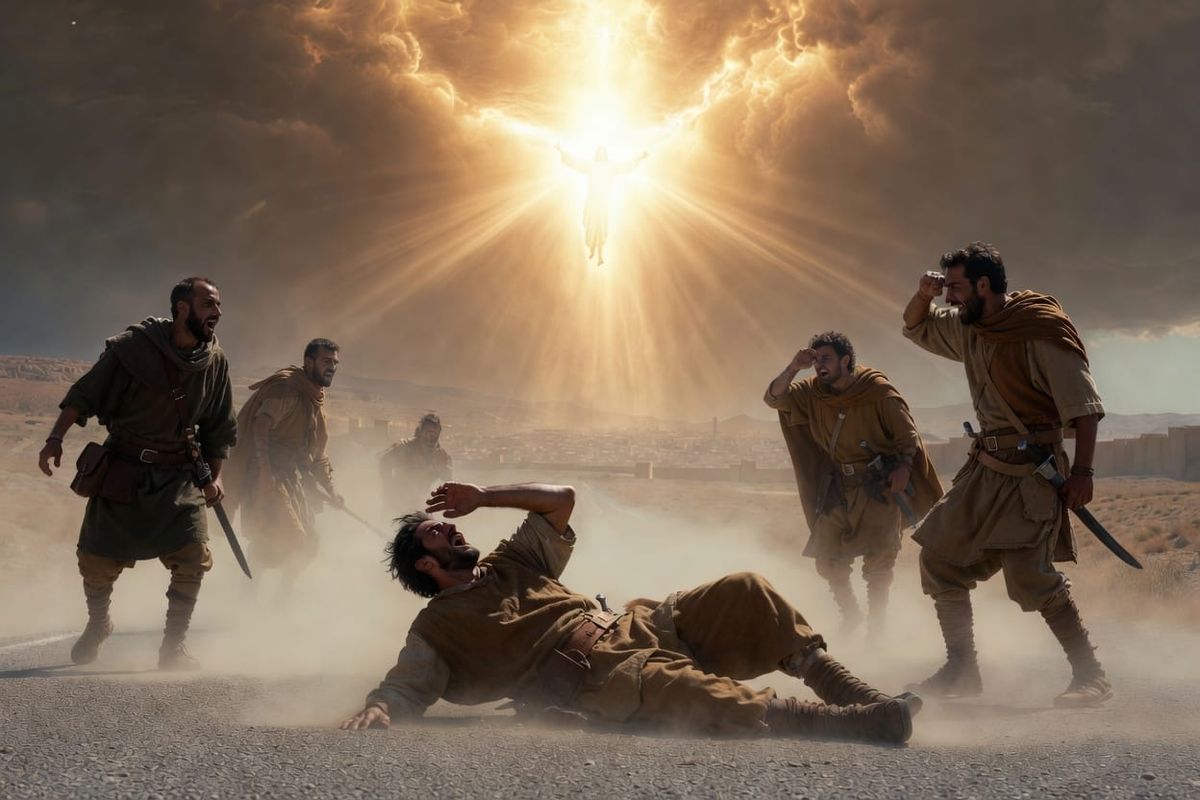
Feast of the Conversion of Paul, January 25. The risen Christ asked: why are you persecuting me? To persecute the Church is to persecute Christ himself. The man who came to Damascus to close eyes was sent to open them. The reversal is total.
Feast Day: January 25
The Anglican calendar is ordered by a hierarchy of holy days, each carrying a different weight of observance. At the top sit the seven Principal Feasts — the highest days of the liturgical year. Below them are the Red-Letter Holy Days, appointed in the BCP 2019 with their own collects, propers, and lectionary readings, listed on page 688. They are called Red-Letter Days because, in the tradition of printing church calendars, these days appear in red ink, distinguished from the Optional Commemorations which appear in ordinary type. The Feast of the Conversion of Saint Paul the Apostle, observed on January 25, is one of these Red-Letter Holy Days. It is the only feast in the Anglican calendar that commemorates not a birth, a death, a martyrdom, or a miraculous act, but a moment of divine interruption — the moment when the most dangerous enemy of the early Church was stopped in his tracks on the road to Damascus and became its most prolific apostle.
The feast is also, in its own way, a feast of the Gospel’s reach. Paul was not seeking Christ. He was hunting Christians. He was not waiting for a religious experience. He was carrying letters authorizing arrest. And into that mission of violence, the risen Christ appeared — blinding, naming, questioning, commissioning. The conversion of Paul is the Church’s most dramatic evidence that the grace of God observes no boundaries, respects no resistance, and can arrest the most committed opponent of the faith in the middle of his opposition. The feast of January 25 exists to make sure the Church never forgets this.
The Road to Damascus
Paul’s conversion is recorded three times in the book of Acts — in chapters 9, 22, and 26 — and Paul himself refers to it in his letters, most directly in Galatians 1 and Philippians 3. The appointed reading for this feast is Acts 26:9–21, Paul’s defense before King Agrippa, which is the most theologically developed of the three accounts. Paul begins by acknowledging who he was: “I myself was convinced that I ought to do many things in opposing the name of Jesus of Nazareth. And I did so in Jerusalem. I not only locked up many of the saints in prison after receiving authority from the chief priests, but when they were put to death I cast my vote against them.” (Acts 26:9–10, ESV) This is not the retrospective confession of a man minimizing his past. Paul is speaking before a king, and he is being precise. He was not a passive bystander to the persecution. He voted for executions. He had authority. He used it.
And then the Damascus road. In verses 13 through 15: “At midday, O king, I saw on the way a light from heaven, brighter than the sun, that shone around me and those who journeyed with me. And when we had all fallen to the ground, I heard a voice saying to me in the Hebrew language, ‘Saul, Saul, why are you persecuting me? It is hard for you to kick against the goads.’ And I said, ‘Who are you, Lord?’ And the Lord said, ‘I am Jesus whom you are persecuting.’” (Acts 26:13–15, ESV) Three details deserve attention. First, the light is brighter than the midday Syrian sun — this is not a vision or a dream but an overwhelming external reality. Second, the voice speaks in Hebrew, the sacred language of Paul’s rabbinic formation — Jesus meets him in the tradition he has weaponized against the Church. Third, the question: “why are you persecuting me?” The risen Christ identifies himself with the Christians Paul is arresting. To persecute the Church is to persecute Christ himself.
The commission follows immediately in verses 16 through 18: “But rise and stand upon your feet, for I have appeared to you for this purpose, to appoint you as a servant and witness to the things in which you have seen me and to those in which I will appear to you, delivering you from your people and from the Gentiles — to whom I am sending you to open their eyes, so that they may turn from darkness to light and from the power of Satan to God, that they may receive forgiveness of sins and a place among those who are sanctified by faith in me.” (Acts 26:16–18, ESV) The man who came to Damascus to close eyes is sent to open them. The persecutor becomes the sent one. The one who handed Christians over to prison is commissioned to deliver people from the power of Satan. The reversal is total, and it is the risen Christ who accomplishes it.
Paul’s Own Account
The appointed Epistle reading is Galatians 1:11–24, Paul’s own account of what happened after Damascus. He insists from the outset that the Gospel he preaches did not come from human tradition or apostolic instruction: “For I would have you know, brothers, that the gospel that was preached by me is not man’s gospel. For I did not receive it from any man, nor was I taught it, but I received it through a revelation of Jesus Christ.” (Galatians 1:11–12, ESV) This claim is the foundation of Paul’s entire apostolic authority. He did not sit at the feet of the Twelve and learn what they knew. He received the Gospel directly from the risen Christ on the Damascus road and in the period that followed. His apostolate is not derivative. It stands on the same footing as that of Peter and James — a direct commission from the Lord himself.
Paul then narrates what happened after the Damascus encounter: he went into Arabia for a period of reflection and preparation, returned to Damascus, and only after three years went up to Jerusalem to visit Peter, staying with him fifteen days and seeing no other apostle except James. He is insistent that his Gospel was not formed in conversation with the Jerusalem church: “And I was still unknown in person to the churches of Judea that are in Christ. They only were hearing it said, ‘He who used to persecute us is now preaching the faith he once tried to destroy.’ And they glorified God because of me.” (Galatians 1:22–24, ESV) The churches of Judea — the very communities Paul had been terrorizing — heard what had happened and glorified God. The persecutor’s conversion was not a private religious experience. It was a public, verifiable act of God that the whole Church recognized and praised.
The Appointed Readings
The propers for this feast are found on page 730 of the BCP 2019. The four appointed readings illuminate the conversion from different angles and together build a remarkably coherent picture of what divine grace looks like when it reaches the most unlikely recipient.
Psalm 67 is the appointed psalm, and it is the missionary psalm of the Psalter: “May God be gracious to us and bless us and make his face to shine upon us, that your way may be known on earth, your saving power among all the nations.” (Psalm 67:1–2, ESV) Paul’s entire apostolic mission is the answer to this psalm’s prayer. The light that shone on the Damascus road — brighter than the midday sun — is the face of God shining upon the nations. The Gentile churches Paul planted across Asia Minor, Greece, and Rome are the nations coming to know God’s saving power. Psalm 67 ends with the vision of all the ends of the earth fearing God — and Paul spent his life walking toward those ends.
The appointed Gospel is Matthew 10:16–25, the middle section of the commissioning discourse in which Jesus prepares the Twelve for what they will face: “Behold, I am sending you out as sheep in the midst of wolves, so be wise as serpents and innocent as doves.” (Matthew 10:16, ESV) This is a deliberately sobering text for a feast of apostolic calling. Jesus does not promise safety or success. He promises opposition: arrests, floggings, trials before governors and kings, hatred from all nations for his name’s sake. Paul’s biography is the fulfillment of every warning in this passage. He was flogged five times, beaten with rods three times, stoned once, shipwrecked three times, and finally executed in Rome. He was sent as a sheep among wolves, and he knew it, and he went anyway. Verse 24 applies directly: “A disciple is not above his teacher, nor a servant above his master.” (Matthew 10:24, ESV) Paul’s sufferings were not a sign that his apostolate had failed. They were a sign that it had followed the pattern of the one who sent him.
The BCP 2019 Collect and Preface
The BCP 2019 appoints the following collect for the feast on page 626: “O God, by the preaching of your apostle Paul you have caused the light of the Gospel to shine throughout the world: Grant, we pray, that having his wonderful conversion in remembrance, we may show ourselves thankful to you by following his holy teaching; through Jesus Christ our Lord, who lives and reigns with you, in the unity of the Holy Spirit, one God, now and for ever. Amen.” The collect does two things simultaneously: it celebrates what God accomplished through Paul — the light of the Gospel shining throughout the world — and it turns that celebration into a demand. Gratitude for Paul’s conversion is expressed not by admiring it at a distance but by following his holy teaching. The feast is not a commemoration of someone else’s experience. It is a summons to inhabit the same obedience.
The Preface of Apostles, found on page 155 of the BCP 2019, is used at the Eucharist for this feast as for all apostolic feasts: “Through the great shepherd of your flock, Jesus Christ our Lord, who after his resurrection sent forth his apostles to preach the Gospel and to teach all nations, and promised to be with them always, even to the end of the ages.” (BCP 2019, p. 155) The preface is especially fitting here: Paul’s commission came precisely from the risen Christ, the great shepherd who sent forth his apostles after his resurrection. The Damascus road encounter is not a separate track of apostolic authority. It is the same risen Christ, extending the same commission, to the one who had been the most violent opponent of that commission.
Paul’s Apostolic Standing in the Anglican Calendar
Paul was not one of the original Twelve. He was not present in the Upper Room, was not among those who witnessed the earthly ministry of Jesus, and was not chosen by lot like Matthias. His apostolic claim rests entirely on his encounter with the risen Christ on the Damascus road and the direct commission he received there. He defends this claim explicitly in 1 Corinthians 9:1: “Am I not an apostle? Have I not seen Jesus our Lord?” (1 Corinthians 9:1, ESV) The vision of the risen Christ is, for Paul, the ground of apostolic authority. He is, as he describes himself in 1 Corinthians 15:8, “one untimely born” — the last of the apostles, the least of them, and yet by the grace of God the one who worked harder than all of them. The Anglican calendar honors this by giving Paul his own feast day rather than subsuming him entirely within the joint feast of Peter and Paul on June 29. The Conversion of Paul on January 25 is the feast of his specific, extraordinary, undeniable encounter with the risen Lord.
Observing This Feast
January 25 falls within the season of Epiphany. On Sundays, Red-Letter Holy Days such as this one may take precedence or be combined with the Sunday readings, depending on local custom. It may also be transferred to the nearest following weekday if the Sunday propers are retained.
The two feasts — Peter’s confession on January 18 and Paul’s conversion on January 25 — bracket a single week. Together they give the Church two apostolic portraits in seven days: the fisherman who confessed Christ by revelation, and the Pharisee who encountered Christ by interruption. Both are called. Both are sent. Both are given a commission larger than anything they could have anticipated.
To observe the feast: pray the collect from BCP 2019, p. 626. Read Acts 26:9–21 and sit with Paul’s account of the Damascus road before Agrippa — notice the precision with which he describes his own violence before describing the light. Read Galatians 1:11–24 for Paul’s own theological account of what the encounter meant and how it shaped his apostolic independence. Pray Psalm 67 as Paul’s missionary vision put to song. And ask the question the collect raises: how are we showing ourselves thankful for the Gospel by following Paul’s holy teaching — not only reading it, but living inside it?
Conclusion
The Conversion of Paul is the feast of God’s sovereign freedom in the calling of his servants. Paul did not choose Christ. Christ chose Paul — on a road, at midday, in the middle of his opposition, in the midst of letters authorizing arrest. The grace that reached him there was not the reward of spiritual searching. It was the interruption of spiritual hostility. And that interruption became the occasion for the most extensive apostolic mission the Church has ever known.
The collect prays that we would remember this — and then, in remembering it, follow Paul’s holy teaching. His teaching is not separable from his conversion. Everything he wrote about grace, about the cross, about justification by faith, about the mystery of the Gentiles as fellow heirs — all of it flows from that moment on the Damascus road when the light shone brighter than the sun and a voice said: “I am Jesus whom you are persecuting.” (Acts 26:15, ESV) To follow his holy teaching is to live inside the grace that found him on that road. It is available to all. It found him. It can find anyone.