The Epiphany: An Anglican Perspective
January 6 is the Epiphany — one of the seven Principal Feasts of the Anglican year. Where Christmas celebrates the Word becoming flesh, the Epiphany celebrates his manifestation to the nations. The Magi were not the destination of the Gospel. They were its first sign.
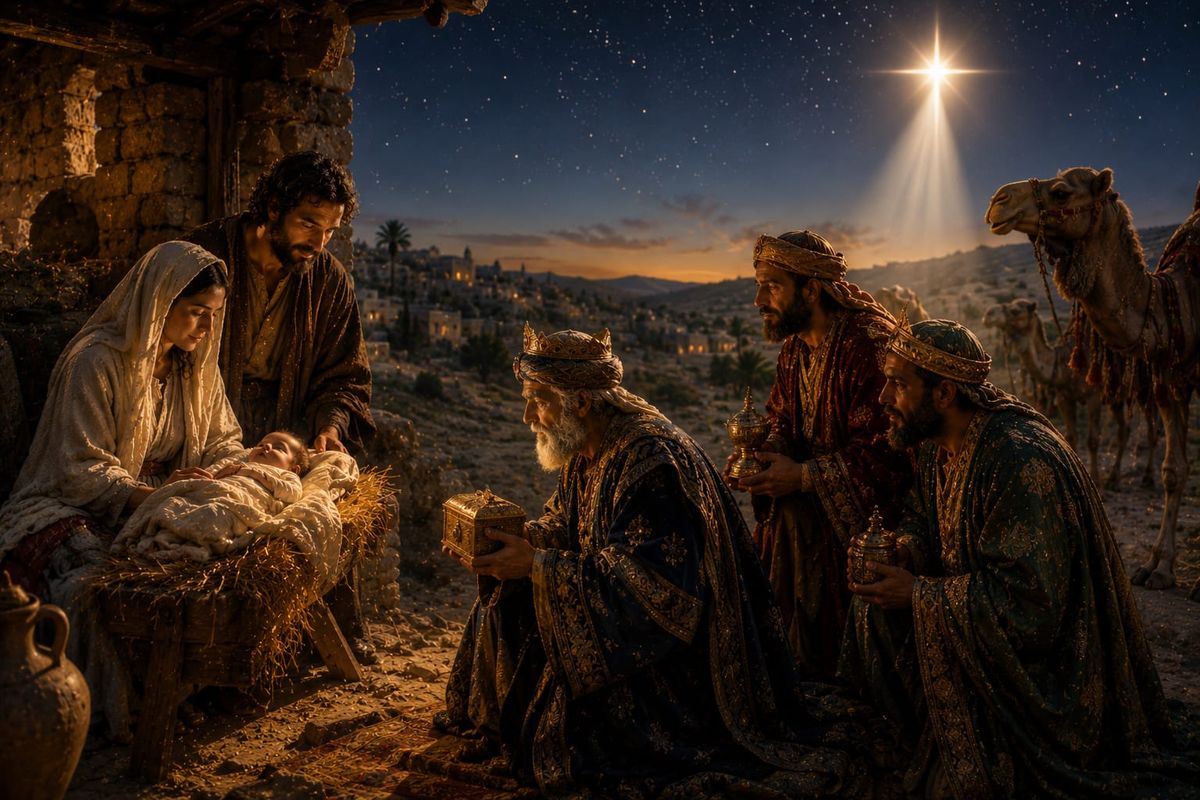
Principal Feast: January 6
The Anglican calendar is ordered by a hierarchy of holy days, each carrying a different weight of observance. At the very top sit the seven Principal Feasts, the highest days of the liturgical year, taking precedence over every other day or observance. They are Easter Day, Christmas Day, Ascension Day, the Day of Pentecost, All Saints' Day, Trinity Sunday, and the Epiphany. These feasts are listed on page 688 of the BCP 2019, and they are, in the language of the Prayer Book, non-negotiable: no other day or commemoration can displace them. The Epiphany of Our Lord Jesus Christ, observed on January 6, stands in this highest company, not as a minor addition to the Christmas season, but as a feast of equal theological weight to Christmas itself. Where Christmas celebrates the Incarnation, the Word becoming flesh, the Epiphany celebrates the Manifestation: the moment when that Word made flesh was revealed to the world beyond Israel.
The word "epiphany" comes from the Greek epiphaneia (pronounced eh-pee-FAH-nay-ah), meaning an appearing, a shining forth, a manifestation. The BCP 2019 names the feast precisely: The Manifestation of Christ to the Gentiles. This is the theological heart of January 6. The child born in Bethlehem was the fulfillment of Israel's long hope. But the Epiphany announces that his arrival was never only for Israel. From the moment the Magi came from the East to worship him, it was clear that the light of this child was meant for all peoples, all nations, all the darkened corners of the world. The Epiphany is Christmas extended to its full cosmic horizon.
The Biblical Event
The appointed Gospel for the Epiphany is Matthew 2:1–12. In verse 1: "Now after Jesus was born in Bethlehem of Judea in the days of Herod the king, behold, wise men from the east came to Jerusalem, saying, 'Where is he who has been born king of the Jews? For we saw his star when it rose and have come to worship him.'" (Matthew 2:1–2, ESV) These wise men, the Greek is magoi (pronounced MAH-goy), from which we get the word Magi, were almost certainly court astrologers or astronomers from the Persian or Babylonian tradition. They were Gentiles. They were outsiders to the covenant of Israel. And yet it is they, not the scribes and chief priests of Jerusalem, who come to worship. Matthew's point is as sharp as it is quiet: the ones who should have recognized the King did not come; the ones who had no covenant claim on him did.
It is worth pausing on what the text does not say. Matthew does not tell us there were three Magi. He tells us there were three gifts, gold, frankincense, and myrrh, and tradition has supplied three visitors to match them. He does not name them Caspar, Melchior, and Balthasar. He does not call them kings. These are later additions from tradition and medieval imagination, beautiful in their own way but not found in the text. What Matthew does tell us is that they came from the East, that they followed a star, that they worshipped, and that they brought gifts whose significance the Church has pondered ever since: gold for a king, frankincense for a priest, myrrh for one who will die.
The star that led them is the hinge of the narrative. It rose in the East, it moved before them, and it stopped over the place where the child was. Whatever its astronomical nature, and there has been no shortage of theories, its theological significance is clear: God was using the language of the heavens to speak to people whose education had taught them to read the heavens. He met the Magi where they were, in the categories they understood, and led them to the one who transcends all categories. This is the pattern of the Epiphany: God reaching beyond the boundaries of the covenant community to call those who had no reason to expect a call.
When they arrive at the house, note that Matthew says house, not manger; the Holy Family has moved by this point, Matthew records their response in verse 11: "And going into the house, they saw the child with Mary his mother, and they fell down and worshiped him. Then, opening their treasures, they offered him gifts, gold and frankincense and myrrh."(Matthew 2:11, ESV) They fell down and worshiped. These men, who had traveled perhaps a thousand miles following a star, who had disturbed a king's court and alarmed a city, arrive at an ordinary house in Bethlehem and fall on their faces before a child. It is one of the most astonishing moments of reverence in the entire New Testament.
The Theological Significance
The appointed Old Testament reading for the Epiphany is Isaiah 60:1–9, and its opening verses are the theological declaration that the feast embodies: "Arise, shine, for your light has come, and the glory of the Lord has risen upon you. For behold, darkness shall cover the earth, and thick darkness the peoples; but the Lord will arise upon you, and his glory will be seen upon you. And nations shall come to your light, and kings to the brightness of your rising." (Isaiah 60:1–3, ESV) Isaiah's vision of nations streaming toward the light of God's glory is fulfilled in the Magi's journey. They are the firstfruits of the nations coming to the brightness of his rising. The Epiphany is not an add-on to Christmas. It is its prophetic fulfillment.
The Epistle reading from Ephesians 3:1–13 gives the Epiphany its deepest theological grounding. Paul calls the inclusion of the Gentiles a mystery, not in the sense of something puzzling, but in the biblical sense of something hidden in God and now revealed: "This mystery is that the Gentiles are fellow heirs, members of the same body, and partakers of the promise in Christ Jesus through the gospel." (Ephesians 3:6, ESV) Fellow heirs. Members of the same body. Partakers of the same promise. This is what the Magi's arrival in Bethlehem was the beginning of. The long story of God's particular covenant with Israel was always, in God's intention, moving toward this: a family from every nation, tribe, and tongue, gathered around the one King. The Epiphany is the announcement that this has begun.
Psalm 72, the appointed psalm, is a royal psalm that prays for a king whose dominion will extend to the ends of the earth: "May he have dominion from sea to sea, and from the River to the ends of the earth… May the kings of Tarshish and of the coastlands render him tribute; may the kings of Sheba and Seba bring gifts!" (Psalm 72:8, 10, ESV) The Magi's gifts of gold, frankincense, and myrrh are the first installment of what this psalm anticipates, the tribute of the nations brought to the King of kings. Every Epiphany the Church reads this psalm and sees, in the Magi kneeling before the child, the beginning of the answer to one of the most ancient prayers of Scripture.
The Twelve Days of Christmas and the Epiphany Season
The Epiphany falls on January 6, the thirteenth day of Christmas, the day after the twelve days of Christmastide that run from Christmas Day through January 5. This is why the counting of the twelve days matters: the season of Christmas is not the weeks before December 25 but the twelve days after it, and the Epiphany is the crown that closes and completes the Incarnation cycle.
The day itself opens a season, the Season of Epiphany, or Epiphanytide, which extends from January 6 through the Last Sunday of Epiphany, also called Transfiguration Sunday. Throughout this season, the lectionary traces successive manifestations of Christ's glory: his baptism in the Jordan where the Father's voice declares him Son, his first miracle at the wedding in Cana where he manifests his glory, his calling of the disciples, his teaching and healing, and finally his Transfiguration on the mountain where his face shines like the sun. The whole season is an extended meditation on the question the Epiphany raises: who is this child, and what does his light mean for the world?
When the Epiphany falls on a Sunday, the following Sunday is the First Sunday of Epiphany, the Baptism of Our Lord. The Epiphany collect, with the psalm and lessons appointed for the day, also serves for the weekdays between the Epiphany and the following Sunday.
The BCP 2019 Collect, Preface, and Propers
The Epiphany is a Principal Feast listed on page 688 of the BCP 2019. The BCP appoints the following collect for the feast on page 601: "O God, by the leading of a star you manifested your only Son to the peoples of the earth: Lead us, who know you now by faith, to your presence, where we may see your glory face to face; through Jesus Christ our Lord, who lives and reigns with you and the Holy Spirit, one God, now and for ever. Amen." The collect moves from the historical event, the leading of a star, the manifestation of the Son, to the present petition: lead us who know you by faith to your presence, where we may see your glory face to face. The Magi followed a star to see the child. We follow faith to see the glory. The Epiphany is not merely a past event to commemorate; it is a present journey to undertake.
The Preface of the Epiphany, found on page 153 of the BCP 2019, is sung or said at the Sursum Corda in the Eucharist, leading into the Sanctus: "Through Jesus Christ our Lord, who took on our mortal flesh to reveal his glory; that he might bring us out of darkness and into his own glorious light." (BCP 2019, p. 153) The preface names the movement that defines the feast: from darkness to glorious light. The Magi came out of their Eastern darkness, following a star. The nations come out of the thick darkness Isaiah describes, drawn by the brightness of his rising. And the faithful come out of the darkness of sin and death, brought by the one who took on mortal flesh precisely so that we might share in his immortal glory.
The propers for the feast are found on page 718 of the BCP 2019. The appointed readings are Isaiah 60:1–9, Psalm 72 or 72:1–11, Ephesians 3:1–13, and Matthew 2:1–12. These readings are the same across all three years of the lectionary cycle, the Epiphany is given a fixed set of propers rather than rotating readings, because its theology is too concentrated and too specific to distribute across the three-year cycle. The Church returns to Isaiah 60, Psalm 72, Ephesians 3, and Matthew 2 every January 6 without variation.
The Epiphany in Anglican Worship
The Epiphany has been observed in the Church of England since antiquity, and its place as a Principal Feast in the Anglican calendar reflects the historic weight of the day. In earlier centuries, Epiphany was actually the more prominent celebration, it was the day on which gifts were exchanged in many European cultures, and the day on which kings and nobles made their offerings to the Church, a practice that gave the feast its association with royalty and treasure.
Anglicanism's missional instinct finds its liturgical foundation in the Epiphany. The feast declares that the Gospel was never the possession of one people but was always destined for all. Every evangelistic effort, every cross-cultural mission, every act of carrying the light of Christ beyond the familiar boundaries of the community, all of it is rooted in what happened when the Magi knelt before the child in Bethlehem. The Epiphany is the feast of the Great Commission before the Great Commission was given.
The season of Epiphany is better understood as the season of manifestation, a sustained meditation on the identity of the one revealed to the Magi, traced through his baptism, his teaching, his miracles, and his transfiguration. The green vestments of the season do not signal ordinariness but growth: the light that broke in at Christmas and was manifested at Epiphany is now spreading, filling the world, drawing all nations toward its source.
Observing This Feast
As a Principal Feast, the Epiphany takes precedence over the weekday on which it falls but does not displace any Sunday. For those who observe only Sunday services, the themes of the Epiphany are carried into the First Sunday of Epiphany, the Baptism of Our Lord. For those building the rhythm of the full liturgical calendar, January 6 is a day worth marking with intention.
To observe the feast: pray the collect from BCP 2019, p. 601. Read Matthew 2:1–12 slowly, noticing what Matthew does and does not say. Read Isaiah 60:1–9 and let the prophet's vision of nations streaming toward the light interpret what the Magi's arrival means. Read Ephesians 3:1–13 and sit with Paul's declaration that the inclusion of the Gentiles, of us, in the people of God is the mystery hidden for ages and now revealed. Consider the gifts: gold for a King, frankincense for a Priest, myrrh for one destined to die. And ask the question the Epiphany always asks: what darkness am I still living in, and am I following the light toward the one who took on mortal flesh to bring me out of it?
Conclusion
The collect for the Epiphany closes with a petition worth praying every day of the year: lead us, who know you now by faith, to your presence, where we may see your glory face to face. The Magi's journey ended at the feet of the child. Ours has not yet ended. We know him now by faith, by the light of Scripture, by the grace of the sacraments, by the testimony of the saints who came before us. But the feast of the Epiphany holds before us the promise that this knowledge by faith is moving toward something: the presence of God, the glory face to face. The star led the Magi home by a different route. The light that began at Bethlehem leads us, by a route we could not have predicted, to the same destination.
"Arise, shine, for your light has come, and the glory of the Lord has risen upon you." (Isaiah 60:1, ESV)