The Holy Innocents: An Anglican Perspective
December 28: Feast of the Holy Innocents. Four days after the angels sang, children are dead in Bethlehem. The Church does not move this grief to a more convenient time. It places it here, in the middle of Christmas, because that is where it actually belongs.
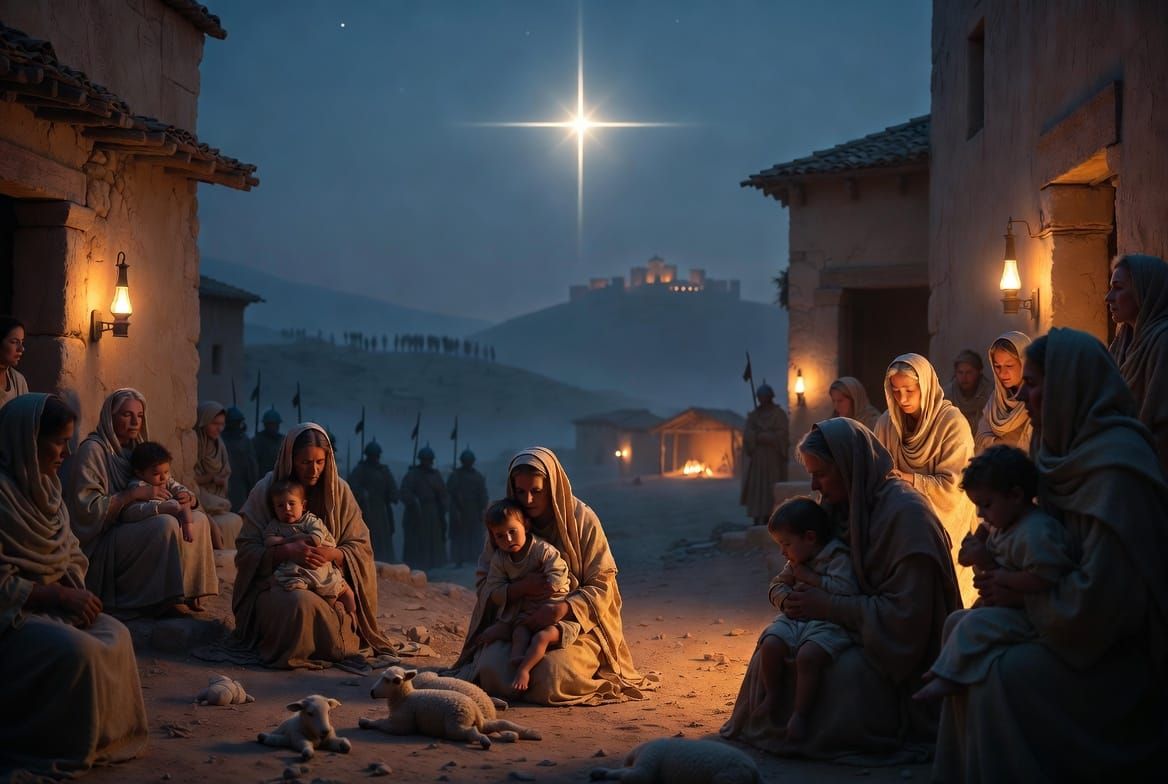
Feast Day: December 28
The Anglican calendar is ordered by a hierarchy of holy days, each carrying a different weight of observance. At the top stand the seven Principal Feasts, the highest-ranking days of the liturgical year. Below them are the Red-Letter Holy Days appointed in the BCP 2019. The Feast of the Holy Innocents, observed on December 28, is one of these Red-Letter Holy Days. The Prayer Book appoints the Collect on page 625 and the Preface of Christmas at the Eucharist. The appointed readings are Jeremiah 31:15–17, Psalm 124, Revelation 21:1–7, and Matthew 2:13–18. The calendar places the feast on the fourth day of Christmas, immediately after Saint Stephen on December 26 and Saint John on December 27.
The placement is startling. The angels have only just sung of peace, the shepherds have only just returned glorifying God, and the Church opens Matthew 2 and gives us a massacre. This is not an interruption of Christmas. It belongs within Christmas because the Incarnation entered actual human history, in a particular place under a particular ruler, and the coming of the true King immediately provoked the murderous rage of a false one. Herod could not reach the Child he feared, so he struck the children he could reach. The joy of Bethlehem and the grief of Bethlehem therefore stand beside one another within the same season.
The word feast can sound strange on such a day, but in the liturgical tradition a feast is not necessarily an occasion of uncomplicated celebration. It is a day the Church sets apart for solemn remembrance before God. Christmas Day is a feast filled with rejoicing. The Holy Innocents is a feast filled with lamentation. The calendar is spacious enough for both because both are held before the same Lord.
Herod and the Child
Matthew 2 begins with Magi arriving in Jerusalem and asking where the King of the Jews has been born. Herod hears the question as a threat. After consulting the chief priests and scribes, he learns that the Messiah is to be born in Bethlehem and secretly asks the Magi when the star appeared. He sends them to find the Child and report back, pretending that he also wishes to worship him.
God warns the Magi not to return to Herod. An angel then appears to Joseph in a dream and commands him to take the Child and his mother and flee to Egypt because Herod is about to search for Jesus in order to destroy him. Joseph obeys, departing by night.
When Herod realizes that the Magi have not returned, Matthew records the result with terrible brevity: “He sent and killed all the male children in Bethlehem and in all that region who were two years old or under.” (Matthew 2:16, ESV)Matthew does not describe the soldiers, the homes, the parents, or the cries. He gives one sentence and then reaches for the prophet Jeremiah.
The asymmetry is difficult, and Matthew does not explain it. An angel warns Joseph; no angel warns the fathers of Bethlehem. Jesus escapes; the other children do not. Christians should resist pretending Scripture answers a question it leaves unanswered. Matthew does not offer a theory explaining why divine providence permitted one family to flee while others suffered.
What Matthew does tell us is why the children died. Herod was seeking Jesus. Their deaths were bound directly to the tyrant’s attempt to destroy the newborn King. That makes the massacre more than a general example of human cruelty. It belongs specifically to the world’s opposition to the reign of Christ. Herod has heard that Israel’s King has come, and his response is not worship but violence.
Herod and the Historical Setting
Matthew’s description is entirely consistent with the Herod known from other ancient sources. Herod the Great was a ruler capable of ruthless violence whenever he perceived a threat to his throne. Josephus records the executions of members of Herod’s own family and numerous other acts of political brutality.
Josephus does not record the massacre at Bethlehem. That silence should neither be hidden nor exaggerated. Bethlehem was a small settlement, and Matthew gives no number for the children killed. Later traditions sometimes imagined very large numbers, but those figures have no basis in the Gospel. A localized killing of a relatively small number of children would have been tragically consistent with Herod’s known behavior and could easily have gone unmentioned in a historical account concerned with larger political events.
The historic Christian claim therefore does not depend upon inventing thousands of victims or pretending that every ancient writer recorded the event. The Church receives Matthew’s testimony as Holy Scripture and remembers the children he describes, however few or many they were, as real victims of a real ruler’s attempt to destroy Christ.
Out of Egypt I Called My Son
Immediately before the massacre, Matthew interprets the Holy Family’s flight through Hosea: “Out of Egypt I called my son.” (Matthew 2:15, ESV; Hosea 11:1) In Hosea, the son is Israel. Matthew sees Israel’s history recapitulated in Jesus, the faithful Son who embodies Israel and fulfills her calling.
The movement is striking. Israel once went down into Egypt and was brought out by God. Jesus likewise goes down into Egypt and is called out again. Matthew will continue presenting Jesus in ways that echo Israel’s story: through the waters, into the wilderness, and toward the fulfillment of God’s covenant purposes.
The Holy Innocents belong within that larger biblical pattern, though they must not be reduced to pieces in a theological scheme. They are actual children killed by an actual ruler. Yet Matthew’s typology shows that Herod’s violence cannot derail what God is doing. The true Son will return from Egypt and accomplish the deliverance for which he has come.
There is an almost terrible reversal in the story. Bethlehem becomes, for a moment, a place of oppression from which the Son must flee. The King who comes to save his people is pursued by a king who kills his own subjects in order to preserve his throne. The new Exodus begins under the shadow of a new Pharaoh.
The comparison also keeps Herod’s evil from becoming the final interpretive word. Herod acts, but God is carrying forward the history of redemption. The Child whom Herod cannot destroy will one day pass through death itself and emerge victorious.
Rachel Weeping
Matthew interprets the massacre through Jeremiah 31: “A voice was heard in Ramah, weeping and loud lamentation, Rachel weeping for her children; she refused to be comforted, because they are no more.” (Matthew 2:18, ESV)
Rachel, the beloved wife of Jacob and mother of Joseph and Benjamin, becomes in Jeremiah a maternal figure for Israel. In the prophet’s original setting, she weeps over descendants carried away into exile. Ramah was associated with the gathering of captives before deportation to Babylon, and Jeremiah’s image gives Israel’s national grief the voice of a mother mourning her children.
Matthew hears that lamentation again in Bethlehem as mothers grieve children taken by Herod’s violence. He is not suggesting that Jeremiah was originally describing Herod’s massacre in a simple one-to-one prediction. He hears the grief of Israel’s exile reaching a new and terrible expression within the story of the Messiah.
The important thing is what Matthew allows the verse to do. He does not immediately correct the weeping. He does not interrupt Rachel with a theological explanation or tell her to look on the bright side. She “refused to be comforted,” and Matthew leaves the lament standing.
That does not mean Scripture offers no hope. The BCP wisely appoints Jeremiah 31:15–17 rather than verse 15 by itself. In Jeremiah, Rachel’s lament stands within a chapter saturated with restoration. God tells her to restrain her weeping because the exiles will return and declares, “There is hope for your future.” (Jeremiah 31:17, ESV) The hope is real, but it does not erase the tears that precede it.
There is pastoral wisdom in that order. Christians sometimes become so eager to defend the goodness of God that they speak consolation before they have listened to grief. Jeremiah does not do that. Matthew does not do that. The Bible gives Rachel room to weep. Faith does not require grieving Christians to pretend that death is less terrible than it is. Christianity can name death as an enemy precisely because Christ has come to destroy it.
Why the Church Calls Them Martyrs
From ancient times the Church has honored the children of Bethlehem as martyrs. Their martyrdom is unique because they did not consciously confess Christ, understand why they were being killed, or knowingly choose suffering for his sake. They were infants and very young children.
Their witness is therefore unlike Stephen’s. Stephen knowingly bears witness to Jesus before the council and dies praying for those who stone him. John bears apostolic witness through a long life. The Holy Innocents neither understand the conflict nor speak within it. They die because Herod is trying to reach Christ.
The ancient Church nevertheless recognized something real in calling them martyrs: they were killed on account of Christ. Their lives were taken because the true King had entered the world and Herod sought to destroy him. They did not choose martyrdom, but their deaths were drawn directly into the conflict surrounding Christ’s coming.
They may therefore fittingly be remembered as witnesses who could not speak. Their witness is not a confession made with the lips but the place their deaths occupy within the Gospel story.
This also makes the sequence of December 26, 27, and 28 especially powerful. Stephen knowingly bears witness unto death. John bears apostolic witness through endurance and teaching. The Holy Innocents are too young either to confess Christ or to understand the cause of their deaths, yet they too are caught within the world’s hostility to him. Three very different forms of witness are held within Christmastide because all three are interpreted by the coming of Jesus Christ.
The feast’s martyr language should therefore be received as part of the ancient Church’s theological reading of Matthew rather than forced into the narrower pattern of a conscious adult confession before execution.
Innocent, but Not Innocent by Nature
The title Holy Innocents also requires theological care. Christian tradition calls these children innocent because they were blameless with respect to the crime committed against them. They had done nothing to threaten Herod, nothing to deserve punishment, and nothing to participate knowingly in the political struggle he imagined.
That is not the same thing as saying that they were outside the fallen condition shared by humanity. Classical Anglican teaching does not treat children as belonging to an unfallen class of human beings. Article IX of the Thirty-Nine Articles teaches that the corruption flowing from Adam belongs to human nature after the Fall.
The innocence commemorated by this feast therefore concerns their blamelessness before Herod and the injustice of their deaths. They possessed neither the understanding nor the agency involved in the conflict that cost them their lives.
This distinction also helps us read the Collect correctly. When the Church asks God that we may glorify his Name “by the innocence of our lives and the constancy of our faith even unto death,” it is not asking to recover a supposed state of natural sinlessness. It is asking God to mortify evil within us and form lives increasingly marked by purity, integrity, and faithful obedience.
Psalm 124: The Psalm of Those Who Escaped
Psalm 124 is one of the most surprising appointed readings for this feast. It is a song of deliverance sung by people who survived danger: “If it had not been the LORD who was on our side,” their enemies would have swallowed them alive. (Psalm 124:1–3, ESV)
The difficulty is obvious. The Holy Innocents were not delivered in that way.
This gives the Psalm unusual force on December 28. The Church takes a song sung by those who escaped and prays it on a feast for those who did not. Joseph receives warning and carries Jesus into Egypt; the families of the murdered children receive no such escape. The appointed Psalm refuses to resolve that difference and nevertheless teaches the Church to confess that the Lord remains our help.
The closing verse says, “Our help is in the name of the LORD, who made heaven and earth.” (Psalm 124:8, ESV) On many occasions God’s help includes visible rescue from danger. Scripture gives countless examples of such deliverance. But Psalm 124 cannot mean on this feast that God’s people are always spared temporal suffering, because the very people being commemorated were not spared.
The Christian confession must therefore reach deeper. The Lord’s faithfulness is not disproved when earthly escape does not come. Those who belong to him are not finally lost even when death reaches them.
We do not know why the angel came to Joseph and not to the fathers of Bethlehem. Scripture does not tell us. What it gives us instead is the God who made heaven and earth, the Savior who entered death and conquered it, and the promise that even those whom earthly rescue does not reach are not beyond his keeping.
The Grief of Parents
The Feast of the Holy Innocents has particular resonance for parents who have lost children through miscarriage, stillbirth, infancy, illness, accident, or violence. The circumstances differ greatly, and the children of Bethlehem should not be made into a simplistic explanation for every parental grief. Yet the calendar does something pastorally important by placing the death of children within the Church’s public prayer.
This grief is not pushed outside Christmas because it feels too dark for the season. The Church gives it a day in the middle of Christmastide. The Child born in Bethlehem knows the sorrow of the world into which he came. Jesus was carried away into Egypt, but the slaughter left grieving families behind. The Gospel does not record that Christ later returned to those particular homes or explained why one child escaped while another died. It simply refuses to erase them from his story.
That makes December 28 a day on which the Church can stand with parents whose loss cannot be explained into submission. Rachel’s tears remain in Scripture. Lament is not treated as defective faith. Christian consolation begins not by explaining why every death was permitted but by confessing who has entered death and what he has promised to do about it.
Revelation 21 and the End of the Weeping
The appointed reading from Revelation 21 gives the feast its eschatological horizon. John sees a new heaven and a new earth, the holy city descending from God, and the dwelling place of God with humanity. God declares that death, mourning, crying, and pain belong to the order that is passing away.
The promise is astonishingly concrete: “He will wipe away every tear from their eyes.” (Revelation 21:4, ESV) Every tear matters. The tears of Bethlehem matter. Rachel’s tears matter. The tears of parents whose children have died matter. Revelation does not tell us that grief was an illusion or that the losses were too small to remember once eternity arrives. It promises that God himself will bring mourning to an end.
Death will not merely become less frequent or easier to endure. Scripture says that death will be no more. The final Christian hope is not learning to make peace with death but the destruction of death through the victory of Jesus Christ.
This is why Revelation 21 belongs on December 28. The Church does not read it in order to rush Rachel past her tears. She reads it to name where the tears are going.
The Child born in Bethlehem is the same Lord who declares, “Behold, I am making all things new.” (Revelation 21:5, ESV) Christmas therefore contains within itself the beginning of the story that ends in new creation. The Incarnation is not merely God’s sympathetic entrance into human suffering; it belongs to God’s saving action by which sin, death, and all their works will finally be destroyed.
The mourning of Bethlehem belongs to what Revelation calls the former things. Those former things are real, terrible, and worthy of lament. They are also temporary.
The BCP 2019 Collect and Preface
The Collect appointed for the Holy Innocents is found on page 625. It addresses Almighty God as the one who manifests his truth “out of the mouths of children” and who, through the death of the Holy Innocents at the hands of evil tyrants, shows his strength in human weakness. It then asks God to “mortify all that is evil within us” and to strengthen us by grace so that our lives may glorify his Name through innocence and constancy of faith even unto death.
The Collect makes an important move. It does not leave Christians merely observing Herod’s evil from a safe historical distance. It asks God to mortify the evil within us. The feast condemns tyranny, but its prayer does not allow us to imagine that evil belongs only to obvious tyrants.
That is deeply consistent with classical Anglican teaching about sin and sanctification. Sin is not simply a political arrangement external to us. The same fallen nature that can flower monstrously in Herod must be put to death within every Christian. The Church therefore remembers innocent victims by asking God to destroy what is sinful in us and make us faithful.
The prayer is also thoroughly gracious. It does not ask Christians to imitate the Innocents through unaided moral effort. God must strengthen us by his grace. The constancy for which the Church prays is God’s gift before it becomes our obedience.
The Collect’s language about the “innocence of our lives” should therefore be heard morally and sanctifyingly rather than as a claim to sinlessness. Christians ask God to mortify evil and form lives marked increasingly by purity, integrity, and faithfulness.
The Preface of Christmas is appointed for the Eucharist on this feast. It gives thanks for the Incarnation of the Son, who was made truly man for us and for our salvation. Its use on December 28 makes the relationship between Christmas Day and the Holy Innocents explicit: the Incarnation remains the theological center of the feast.
The Child whose birth the Church has just celebrated is the Child Herod is trying to kill in Matthew’s Gospel. Yet Herod’s violence cannot prevent the saving purpose announced at Christmas. The Son will live, offer himself for sinners, rise from the dead, and bring his people into the household of God.
Herod and the Powers of This World
Herod’s massacre is intensely political. A ruler hears of a possible rival and responds by using state violence against those who cannot resist him. Children become expendable because power is frightened.
The feast therefore has an unavoidable public dimension. It teaches the Church to recognize the perennial temptation of power to preserve itself at the expense of the vulnerable. Christian history and human history provide more than enough evidence that Herod’s pattern is not confined to one ancient king.
Yet the feast should not be reduced to whatever contemporary political issue happens to dominate the moment. Herod belongs first within Matthew’s theological account of the world’s resistance to Christ. Every later application must flow from that center.
The Church’s responsibility is nevertheless clear. Christians who commemorate children destroyed by a powerful ruler cannot be indifferent to children and other vulnerable people endangered by violence, neglect, exploitation, abandonment, or political convenience. The feast trains Christian attention toward those who possess little power to defend themselves.
That concern arises not from a generic humanitarian impulse but from Christ himself. The King whom Herod fears comes among us in vulnerability, receives little children, identifies himself with the least of his brothers, and establishes a kingdom whose greatness is revealed in service rather than domination.
A Feast Within Christmas
The liturgical color is red, fitting the Anglican remembrance of the Holy Innocents as martyrs. Red appears here in the middle of the white Christmas season, just as it appeared for Saint Stephen on December 26.
The color change tells the truth visually. Christmas joy is not erased, but it is marked by blood. The Word became flesh in a world where flesh can be wounded and killed. This does not make Christmas bleak. It makes Christmas substantial. A joy that can exist only where grief has been excluded is too fragile for Christianity. The joy announced by the angels is strong enough to stand beside Rachel’s lament because its foundation is God’s saving action rather than the absence of suffering.
The Feast of the Holy Innocents has ancient roots. The children of Bethlehem were honored among the martyrs very early, and a Western feast is securely attested by the early fifth century. December 28 appears as the feast’s established Western date by the early sixth century. Its enduring place immediately after Saint Stephen and Saint John shows how firmly the Church came to understand Herod’s massacre as belonging to the Nativity story itself rather than as an unfortunate appendix.
Christmas proclaims not an Incarnation insulated from human evil but the coming of the true King into a world already resisting his reign.
Observing the Feast
To observe the Holy Innocents, begin with Matthew 2:13–18 and resist the urge to make the story less troubling than it is. Notice the angelic warning, the nighttime flight, Herod’s rage, and the stark difference between the Child who escapes and the children who do not. Scripture permits us to see that asymmetry without pretending to explain it.
Then read Jeremiah 31:15–17 in full. Hear Rachel weeping before hearing God’s promise. Do not skip from lamentation directly to resolution. The Word of God itself gives grief room to speak and then declares that grief does not possess the future.
Pray Psalm 124 as the Church prays it on behalf of the Innocents. Let the fact that it is a song of escape deepen rather than flatten the feast. Confess that “our help is in the name of the LORD” even when the help we hoped for does not arrive in the form of temporal rescue. (Psalm 124:8, ESV)
Read Revelation 21:1–7 slowly. Its promise is not that Christians will eventually become accustomed to loss. God is making all things new. Death itself will disappear, and God will wipe away the tears of his people.
The day is also fitting for prayer for children: for those suffering war, abuse, abandonment, exploitation, hunger, disease, or other forms of violence; for unborn children and their mothers; for families grieving miscarriage, stillbirth, or the death of a child; and for those whose grief is largely invisible to others. Such prayer should remain concrete without turning the feast into a partisan slogan. Herod reminds the Church what happens when vulnerable human lives become expendable before fear and power.
Finally, pray the Collect and allow it to turn the feast inward. Ask God to mortify what is evil in us. Ask him to form innocence of life and constancy of faith by grace. The children of Bethlehem could neither understand what was happening nor consciously confess the Christ for whom they died; we can confess him, and the Collect asks that our confession become a life faithful even unto death.
Conclusion
The Holy Innocents are the Church’s witnesses who could not speak. They were too young to understand Herod, too young knowingly to confess Christ, and too young deliberately to embrace martyrdom. Yet they died because Herod feared the Child born in Bethlehem, and the ancient Church rightly refused to let their deaths disappear into the margins of the Christmas story. Their feast gives prayer, Scripture, and liturgical memory to children whom Matthew himself leaves unnamed.
The BCP holds their deaths before God without confusing their blamelessness before Herod with freedom from fallen human nature. Its Collect turns remembrance into prayer, asking not that we recover some imagined natural innocence but that God mortify the evil within us, strengthen us by grace, and form lives of innocence and constancy. Jeremiah lets Rachel weep, Psalm 124 confesses God’s help even when earthly escape does not come, and Revelation 21 promises that the final answer to Bethlehem is not explanation but resurrection and new creation.
The fourth day of Christmas therefore tells the truth about the world into which Christ came and about the future his coming has secured. Herod kills, Rachel weeps, parents bury children, and some questions remain unanswered in this age. But Herod is not king forever, death is not lord forever, and grief is not the final state of God’s creation. The Child who escaped into Egypt is the crucified and risen Lord who declares that he is making all things new. The Church remembers the Holy Innocents because the weeping is real, and because, in Jesus Christ, its end is real too.