The King in His Beauty: The Feast of the Transfiguration (Luke 9:28-36)
Today the Church celebrates the Feast of the Transfiguration. On a mountain in Galilee, the face of Jesus shone like the sun. Moses and Elijah appeared. A voice spoke from the cloud. The same Jesus who healed the sick and bore the cross blazed with the glory that was always his.
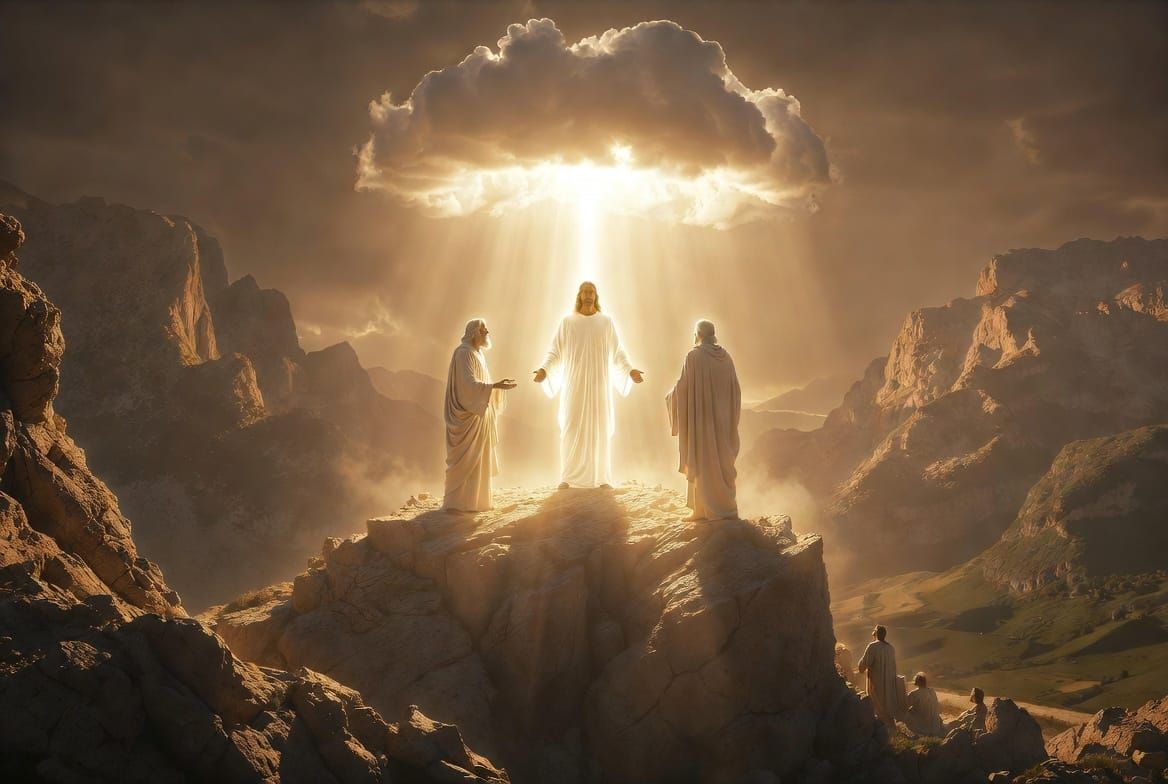
August 6, 2026, The Feast of the Transfiguration of Our Lord Jesus Christ, Season after Pentecost
Luke 9:28–36, Exodus 34:29–35, Psalm 99, 2 Peter 1:13–21
Grace, mercy, and peace from God our Father and the Lord Jesus Christ be with you on this Feast of the Transfiguration of Our Lord.
August 6 interrupts the long green season of Pentecost with a mountain. The weeks of the Season after Pentecost stretch out on either side of this feast, the slow patient work of formation that occupies most of the Church’s year. And then, on a Thursday in the middle of summer, the lectionary takes us up a mountain in Galilee, where three disciples wake from sleep to see the face of Jesus shining like the sun. We have come to this feast for the gift the collect names: to be delivered from the disquietude of this world, and to behold, by faith, the King in his beauty.
The Transfiguration occurs at a hinge point in Luke’s Gospel. Eight days before the mountain, in Luke 9:22, Jesus has told the disciples plainly that the Son of Man must suffer many things, be rejected by the elders and chief priests and scribes, be killed, and on the third day be raised. The disciples are not yet prepared to understand what these words will mean. And in verse 28, Luke tells us: about eight days after these sayings, Jesus takes Peter and John and James and goes up the mountain to pray.
This sequence is not accidental. The glory is given after the passion prediction. The vision on the mountain does not replace the cross; it precedes it and interprets it. The disciples who will sleep in Gethsemane and scatter at the arrest are given this first, so that they will have something to hold onto when what is coming arrives. Luke is showing us the shape of how God prepares his people: the mountain before the valley, the vision before the cost, the King in his beauty before the King on his cross.
Luke tells us that Jesus goes up the mountain to pray, and that the Transfiguration happens in the midst of prayer. The appearance of his face is altered, his clothing becomes dazzling white, while he is praying. This is not a spectacle arranged for the disciples. It is an overflow of communion made visible: the eternal communion of the Son with the Father, briefly and deliberately disclosed to three witnesses on a hillside in Galilee. The glory was always his. Prayer became the occasion on which that glory was briefly disclosed.
Moses and Elijah appear with him in glory. Luke alone tells us what they spoke about: his departure, his exodon (ex-OH-don), the departure he was about to accomplish at Jerusalem. The Greek word is the same as the one used for Israel’s exodus from Egypt. The conversation on the mountain of glory is about the cross. Moses and Elijah, the law and the prophets, Israel’s two great pillars, are standing with Jesus in dazzling light discussing his death. This is the subject the mountain cannot avoid: the glory and the passion belong to the same story.
Moses brings with him the long shadow of Sinai. Exodus 34 tells us of Moses descending from the mountain with his face shining, not knowing that his face shone because he had been speaking with God. Aaron and the people were afraid to come near him. Moses put a veil over his face to spare them from the radiance. But his radiance was reflected and it faded. He had been in the presence of God, and the light was given to him from outside himself, and it diminished when the source was no longer before him. Moses’ face shone because he had been with God. Jesus’ face shone because he is God. The radiance of the Transfiguration proceeds from within; it is not borrowed light and it does not fade.
Elijah brings the prophetic witness. It was Elijah who prayed down fire from heaven on Carmel, who fed on what the angels provided, who heard the still small voice in the cave when the thunder and the earthquake had passed. The prophets pointed toward something they could see only from a distance, a coming one whose exodus would accomplish what the Red Sea crossing could only foreshadow. On the mountain in Galilee, the one they pointed toward is standing before them in glory, and they are speaking with him face to face.
Psalm 99, appointed for this feast, names what the Transfiguration enacts: “The Lord reigns; let the peoples tremble! He sits enthroned upon the cherubim; let the earth quake!” (Psalm 99:1, ESV) And verse 7: “In the pillar of the cloud he spoke to them.” (Psalm 99:7, ESV) God speaks from the cloud to Moses and Aaron and Samuel. And on the mountain in Galilee, God speaks from the cloud to Peter and John and James. The same cloud. The same voice. A different mountain. A different and final name.
The disciples are weighed down with sleep when the vision begins. Luke tells us they become fully awake and see the glory. This detail is not incidental; it will happen again. In Gethsemane, the same three will sleep when the weight of what is happening exceeds what they can bear. The disciples who saw the Transfiguration are the disciples who will sleep through the agony. The vision was given to people who could not stay awake for it, and who would scatter when the hour came. The mountain was given to them not because they were ready, but because they were not, and God knew they would need it.
This is how God often prepares his people. The grace given on the mountain is not for the mountain. It is for the valley that comes after it. He gives today’s grace for tomorrow’s trial.
The mountain ends. The cloud lifts. The descent has already begun.
Peter, waking to the vision, does the human thing: he tries to make it permanent. “Master, it is good that we are here. Let us make three tents, one for you and one for Moses and one for Elijah,” knowing, Luke adds, what he was saying. (Luke 9:33, ESV) The impulse is understandable. When we encounter glory, we want to stay. We want to build something around it, to give it a permanent address, to keep it from passing. But the glory cannot be housed. The mountain is not the destination; it is the preparation. Jesus will not remain on the mountain. He will descend into the valley, where a demon-possessed boy and a helpless father and a crowd of failing disciples are waiting. The glory goes down.
Before Peter finishes speaking, the cloud comes. It overshadows them. In the Scriptures, the cloud is the presence of God: the pillar of cloud in the wilderness, the cloud that fills the tabernacle, the cloud on Sinai. The disciples enter the cloud and they are afraid. And out of the cloud comes the voice: “This is my Son, my Chosen One; listen to him.” (Luke 9:35, ESV) Not: listen to Moses. Not: listen to Elijah. The law and the prophets have done their work. They have pointed toward him, prepared the way, named the shape of the coming. Now the one toward whom they pointed is here, and the voice says simply: listen to him.
When the voice has spoken, Jesus is found alone. Moses and Elijah are gone. The cloud has lifted. The disciples keep silent and tell no one in those days what they have seen. Luke's account does not describe them falling on their faces as Matthew's does. But Matthew's account adds what happens after the falling: Jesus comes and touches them and says “Rise, and have no fear.” (Matthew 17:7, ESV) The touch after the glory. The word spoken into the terror. The same hands that will be nailed to a cross reach down to the disciples on the ground and tell them to rise. The Transfiguration and the passion are one story.
The second appointed reading is from 2 Peter 1. Peter is writing as a dying man, at the end of his life, looking back across the whole of his ministry, and he chooses to anchor everything he has proclaimed in a single memory: “For we did not follow cleverly devised myths when we made known to you the power and coming of our Lord Jesus Christ, but we were eyewitnesses of his majesty.” (2 Peter 1:16, ESV) We were there. We heard the voice. We were with him on the holy mountain. The feast of August 6 rests on this: not a symbol, not a theological framework, not a spiritual impression. A specific mountain, a specific voice, a specific day, and a dying apostle who will not let the Church forget what he saw.
Peter then moves from what he saw to what the prophets had written before the mountain: “And we have the prophetic word more fully confirmed, to which you will do well to pay attention as to a lamp shining in a dark place, until the day dawns and the morning star rises in your hearts.” (2 Peter 1:19, ESV) The Transfiguration confirms the prophecies. And the prophecies, now confirmed, function as a lamp shining in the dark place of the long season. The Season after Pentecost is long. The work of formation is slow. And in the middle of all of it, the Church has been given a lamp: the prophetic word pointing toward the one whose face shone on the mountain, whose glory the darkness cannot extinguish.
The preface appointed for this feast grounds the vision in the Incarnation: because the Word became flesh, because God took on a human face, the knowledge of God’s glory is now given in the face of Jesus Christ. The Transfiguration does not reveal a God previously hidden. It discloses the glory that was always present in the Word made flesh, briefly and deliberately unveiled before three chosen witnesses, so that the Church may know whose face it looks for in the ordinary darkness. The collect names it precisely: the King in his beauty. Isaiah 33:17 speaks the same promise: “Your eyes will behold the King in his beauty.” (Isaiah 33:17, ESV)That is the feast's gift. That is what August 6 is designed to do.
August 6 falls only twelve days after the Feast of James the Apostle. James was one of the three on the mountain. He saw the face of Jesus shining like the sun. He heard the voice from the cloud. He was with him on the holy mountain. He was also the first of the Twelve to drink the cup he claimed he could drink, the first apostle martyred, beheaded by Herod within fifteen years of the resurrection. August 6 honors what James saw before he drank that cup. The vision on the mountain is what the martyrs lived on when the valley required everything. The King in his beauty is not a comfort offered after the suffering; it is the ground on which the suffering is endured.
The collect appointed for today does not ask what the February collect asks. On Transfiguration Sunday in the spring, the collect asks for strength to bear the cross and to be changed from glory to glory. Today’s collect asks for something different: “Mercifully grant that we, being delivered from the disquietude of this world, may by faith behold the King in his beauty.” (BCP 2019, p. 630) Not strength but deliverance. Deliverance from the disquietude of this world: the agitation, the noise, the distraction, the accumulated weight of the season pressing on the soul. And in the place of the disquietude: beholding. The gift of seeing, by faith, what Peter and John and James saw on the mountain by sight. The King in his beauty.
We do not ascend the mountain. We behold by faith what the disciples saw by sight. But the beholding is real, and it is the Church’s inheritance. Every Sunday the congregation gathers around the word and the table and the one who promised to be present wherever two or three gather in his name. Week after week, in the ordinary parish, the one whose face shone like the sun on a mountain in Galilee is present. The long green season is not empty. It is full of the one the collect points us toward. The lamp shines in the dark place. The morning star will rise. And until it does, the Church has been given the Transfiguration to look at.
Three things the feast gives us.
First: the glory was always his. Moses’ radiance was borrowed and faded. The radiance of Jesus on the mountain was his own, proceeding from within, the eternal glory of the Word made flesh briefly disclosed. When we look at Jesus healing the sick, feeding the thousands, crossing the water, bearing the cross, we are looking at the same person whose face shone like the sun. The Transfiguration does not show us a different Jesus. It shows us the same Jesus, briefly unguarded, the veil of ordinary humanity momentarily lifted so that the disciples, and through them the Church, might know what is always and already present in the one they follow.
Second: the cloud and the voice govern everything. Peter wants to build tents. We want to build institutions and systems around the glory, to manage and contain and preserve it on our own terms. But the voice from the cloud interrupts all of that: listen to him. Not to our structures. Not to our best ideas about him. To him. The Transfiguration is the feast that reorients the Church to its only true north: the voice that spoke from the cloud on the mountain, the same voice that spoke in Galilee and Judea and Jerusalem, the same voice that speaks in the word proclaimed and the table set. Listen to him.
Third: the glory goes down into the valley. Jesus does not remain on the mountain. He descends. At the bottom of the mountain a man is there with his demon-possessed son whom the disciples could not heal, and Jesus heals him. The King in his beauty is not a vision for the mountaintop. He is the King who walks into the valley before us, into the ordinary need, the failed disciples, the suffering that fills the valley below the glory.
This is the shape of the Incarnation. The Word did not become flesh and dwell among us on a mountain. He came into the valley, into the ordinary, into the need. The King in his beauty is not a vision for the mountaintop. He is the one who descends.
The mountain ends. The cloud lifts. Moses disappears. Elijah disappears. Jesus is found alone. That is enough. The Church leaves this feast with one face before her eyes: the King in his beauty.
“O God, who on the holy mount revealed to chosen witnesses your well-beloved Son, wonderfully transfigured, in raiment white and glistening: Mercifully grant that we, being delivered from the disquietude of this world, may by faith behold the King in his beauty; who with you and the Holy Spirit lives and reigns, one God, for ever and ever. Amen.” (BCP 2019, p. 630)
In the Name of the Father, and of the Son, and of the Holy Spirit. Amen.