The Name Above Every Name: The Feast of the Circumcision and Holy Name of Our Lord Jesus Christ (Luke 2:15–21)
January 1: Feast of the Holy Name. On the eighth day after Christmas, the infant was circumcised and named. He bore the covenant sign for our sake. The name given to him is the name above every name. The new year begins here.
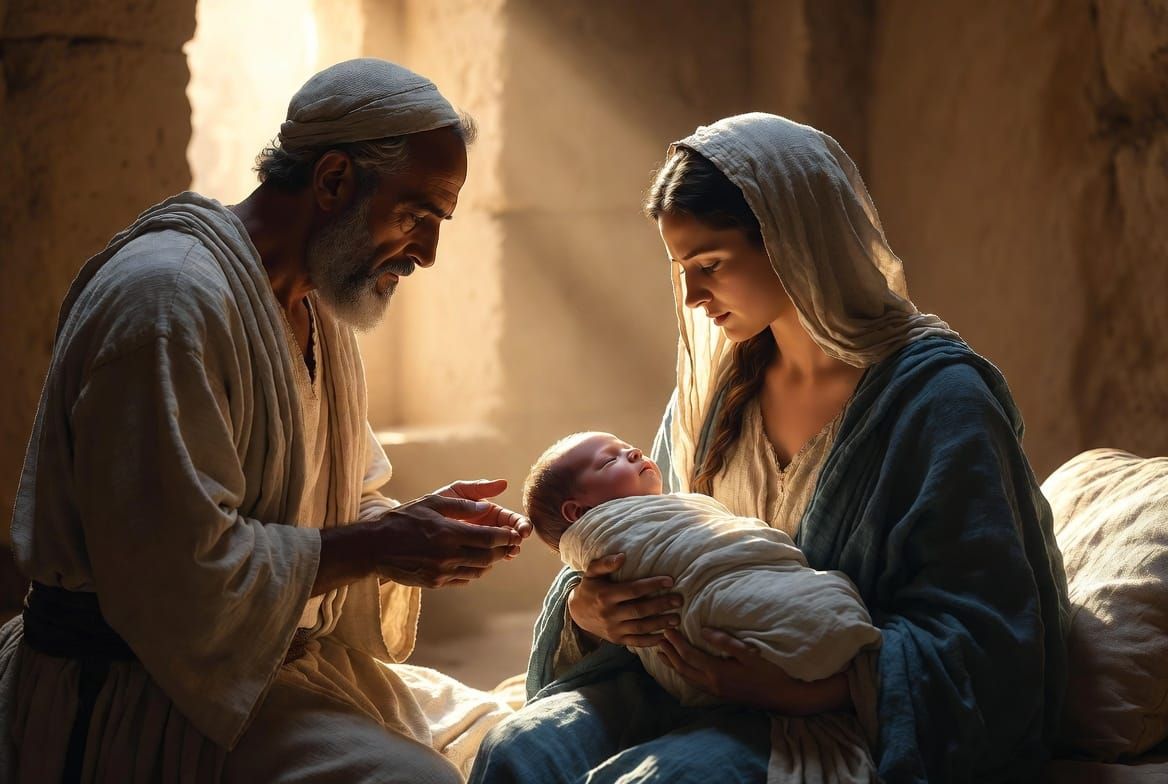
January 1, 2026, The Feast of the Circumcision and Holy Name of Our Lord Jesus Christ, Season of Christmas
Luke 2:15–21, Exodus 34:1–9, Psalm 8, Romans 1:1–7
Grace, mercy, and peace from God our Father and the Lord Jesus Christ be with you on this feast of the Circumcision and Holy Name of Our Lord Jesus Christ.
It is January 1. The world is marking the day in the way it always does: with resolutions, with hope placed in human effort, with the particular mixture of expectation and anxiety that comes with a new year. The Church is also marking the day. She is simply marking it for a different reason and with a different name. On January 1, the eighth day after Christmas, the infant Jesus was circumcised and given his name. The Church keeps this day not to compete with the world’s calendar but to remind us that every day belongs to Christ.
The appointed Gospel for this feast is Luke 2:15–21. The passage begins not with the infant but with the shepherds in motion. They had heard the angel’s announcement and gone with haste to Bethlehem; now they are returning, and they go back speaking: “When they saw it, they made known the saying that had been told them concerning this child.” (Luke 2:17, ESV) They could not be silent about what they had seen. They went back to the ordinary life of Galilean shepherds, glorifying and praising God. This is the first model of what it means to bear the Name: to take what we have witnessed back into ordinary life and speak of it.
Luke adds a note about Mary between the shepherds’ witness and the circumcision: “But Mary treasured up all these things, pondering them in her heart.” (Luke 2:19, ESV) She does not explain or proclaim. She keeps and ponders. Bearing the Name is not always immediate proclamation. Sometimes it is the long, quiet work of holding what we have received and letting it form us from within. The shepherds and Mary together give us the two movements of a life shaped by this Name: the going out and speaking, and the sitting still and pondering. Both are faithful. Every Christian life needs both.
Then verse 21, the single sentence that holds the feast: “And at the end of eight days, when he was circumcised, he was called Jesus, the name given by the angel before he was conceived in the womb.” (Luke 2:21, ESV) The eighth day was, according to the Law of Moses, the day appointed for the circumcision of every male child in Israel. The command goes back to Abraham: “He who is eight days old among you shall be circumcised.” (Genesis 17:12, ESV) This was the sign of the covenant, the physical mark that identified a son of Abraham, an heir of the promises. By submitting to circumcision on the eighth day, the infant Jesus willingly placed himself under the covenant obligations of Israel on behalf of his people. He did not need it for himself. He is the one in whom all the promises are fulfilled. He underwent it for us.
This is the theological pattern that will govern his entire life. He who needed nothing submitted to everything we need, so that in him we might receive what we could not earn. He was baptized, though he had no sin to wash away. He was tempted, though he could not be overcome. He was crucified, though he deserved no death. And on the eighth day of his earthly life, he bore in his flesh the sign of the covenant he had come to fulfill. The circumcision is the first act of a pattern that ends at the cross: he takes on what is ours so that we might receive what is his.
Already, only eight days into his earthly life, Christ is doing for us what we cannot do for ourselves. The number eight carries its own weight in the biblical imagination. Seven is the number of completion, the seven days of creation, the Sabbath rest. Eight is the day beyond the week, the first day of new beginning, the day of resurrection. Jesus rose on the first day of the week, which is also the eighth day. The circumcision on the eighth day of his earthly life whispers of what is coming: the blood of circumcision and the blood of the cross are shed by the same one, for the same people, for the same covenant purpose. Paul writes in Colossians 2:11 that in Christ we were “circumcised with a circumcision made without hands, by putting off the body of the flesh, by the circumcision of Christ.” (Colossians 2:11, ESV) The sign has been fulfilled in the reality. The physical rite pointed to the spiritual transformation that Christ alone accomplishes.
Then the name. The name given to this child was not chosen by Joseph or Mary. It was given by the angel before his conception: “You shall call his name Jesus, for he will save his people from their sins.” (Matthew 1:21, ESV) The name Jesus is the English form of the Greek Iēsous (ee-AY-soos), which translates the Hebrew Yeshua (yeh-SHOO-ah), itself from Yehoshua (yeh-ho-SHOO-ah), meaning the Lord saves or the Lord is salvation. It is not a family name or a decorative name. It is a theological declaration. Every time his name is spoken, it speaks of what he came to do.
The Old Testament appointed reading for this feast is Exodus 34:1–9, Moses’ encounter with God on Sinai after the breaking of the first tablets. What God does on that mountain is extraordinary: he proclaims his own name. “The Lord, the Lord, a God merciful and gracious, slow to anger, and abounding in steadfast love and faithfulness.” (Exodus 34:6, ESV) God declares his character through his name. What he says of himself there, he embodies fully in the person of his Son. The name Jesus is given to the one who is the fullness of that character: merciful, gracious, abounding in steadfast love. The Name above every name is the name of that God.
Psalm 8 is appointed for this feast, and it opens and closes with the same line: “O Lord, our Lord, how majestic is your name in all the earth!” (Psalm 8:1, ESV) The psalm meditates on the strangeness of human dignity, that the God who set the heavens in place should be mindful of creatures as small as we are, and arrives at the exaltation of the Son of Man. The writer of Hebrews reads Psalm 8 as a prophecy of the Incarnation: the one made a little lower than the angels, crowned with glory and honor. The psalm appointed for the circumcision and naming of Jesus is, in the hands of the New Testament, a psalm about him. And it is the right prayer with which to begin a new year: not a resolution, not a plan for self-improvement, but the confession that the name of the Lord is majestic in all the earth.
Paul’s great Christological hymn in Philippians 2 moves from the humility of the Incarnation to the exaltation of the resurrection and ascension, and it culminates in the Name: “Therefore God has highly exalted him and bestowed on him the name that is above every name, so that at the name of Jesus every knee should bow, in heaven and on earth and under the earth, and every tongue confess that Jesus Christ is Lord, to the glory of God the Father.” (Philippians 2:9–11, ESV) The name given on the eighth day of his earthly life is the name before which every created thing will finally bow. The infant crying in Bethlehem carries the name that will one day fill all of creation with its claim.
There is one more place the Name has been placed, and it is closer than Sinai or Bethlehem. At Baptism, God’s Name was placed upon us. We were baptized into the Name of the Father, and of the Son, and of the Holy Spirit. Today we remember the Name placed upon Christ in his circumcision, and the Name placed upon us at our Baptism: the covenant sealed in water and the Spirit that joins us to the one who was circumcised for us. The Name we bear as Christians is not one we chose or earned. It was given before we could ask for it, the same way his name was given before his conception. We carry a name that was placed upon us.
The Epistle reading for this feast, Romans 1:1–7, confirms the mission the Name carries. Paul sets apart his entire ministry for the Gospel “concerning his Son, who was descended from David according to the flesh and was declared to be the Son of God in power according to the Spirit of holiness by his resurrection from the dead, Jesus Christ our Lord.” (Romans 1:3–4, ESV) The name Jesus Christ appears as the crown of Paul’s christological statement. And Paul describes his apostleship as bringing about “the obedience of faith for the sake of his name among all the nations.” (Romans 1:5, ESV) The mission of the Church is the mission of the Name. This is what January 1 says: the year ahead is not primarily about what we will accomplish. It is about what the Name will do through us.
Acts 4:12 states it with the plainness it deserves: “There is salvation in no one else, for there is no other name under heaven given among men by which we must be saved.” (Acts 4:12, ESV) In a world of competing names and competing claims, the Church observes January 1 as a quiet act of theological confidence. The new year does not belong to luck or fate or human resolution. It belongs to the one whose name means salvation.
The collect appointed for this feast, on page 600 of the BCP 2019, turns the day’s theology into a petition. It asks God to give us grace “faithfully to bear his Name, and to worship him with pure hearts according to the New Covenant.” (BCP 2019, p. 600) Two requests. They echo the two movements of the passage we have just read. The shepherds went back to ordinary life and spoke: bear his Name. Mary kept and pondered: worship with pure hearts. The collect is not asking for two separate things. It is asking for the whole life, both its outward and inward dimensions, to be shaped by the Name.
To bear his Name faithfully begins with the shepherds. They did not change occupations after the manger. They went back to their flocks, to the cold hillside, to the ordinary rhythms of working life. But they went back different: glorifying and praising God. The Name we carry into the new year goes with us into the same ordinary places we have always inhabited. We do not have to announce it loudly. The shepherds did not preach a sermon; they glorified God. That quality of life, a life marked by gratitude and wonder and the willingness to speak of what we have seen, is itself a bearing of the Name.
The Name makes specific demands on how we live. The God who proclaimed his name on Sinai said: merciful, gracious, slow to anger, abounding in steadfast love. To bear the Name of that God is to be shaped by those qualities. Merciful when we have been wronged and the other person has not apologized. Gracious when someone has not earned our goodwill. Slow to anger when we have every reason to be angry, and the anger would be justified, and we hold it back. Abounding in steadfast love even in the seasons when we feel we have nothing left to give. The question the Name puts to us is not whether we are performing Christianity adequately, but whether his character is becoming more visible in ours. January 1 is a reasonable time to ask it honestly.
Mary’s movement is the other half. She treasured and pondered. We live in a culture that rewards immediate response, quick production, the appearance of having processed everything and arrived at a confident conclusion. Mary did none of that. She held what she had received and let it work in her quietly. To worship him with pure hearts involves this kind of pondering: sitting with the word, returning to the collect’s petition across the year, asking what it means in our specific circumstances to bear his Name and to worship him without pretense. The inner life of a Name-bearer is not empty. It is full of the things Mary was pondering: the angel’s words, the shepherds’ testimony, the child in the manger. These do not resolve quickly. They form us slowly.
To worship him with pure hearts is to come without the pretense that we have earned our place. We carry into the new year the weight of the previous one: the places we did not bear the Name well, the failures of mercy, the moments when patience ran out, the prayers that felt hollow. Pure hearts does not mean hearts that have no history. It means hearts that come without performing. Not the Pharisee’s confidence in his own righteousness, but the open hands of those who know that the covenant was fulfilled for them, not by them. The infant who bore the sign of the covenant on the eighth day offered no pretense, no self-assertion. He simply received what the Law required on our behalf. We receive the benefit of what he bore.
There is one more distinction worth naming between a resolution and a covenant. A resolution is a promise we make to ourselves. The covenant sealed in the Name of Jesus is a promise God made to us in the flesh of that infant, confirmed at the cross, announced at the resurrection. The difference is not merely semantic. When a resolution fails, and most do, we restart with diminished confidence. A resolution says: I will become a better person this year. The covenant says: Christ has already become for me everything I need. When we fail to bear the Name, as we will, we return to the one whose name means salvation, and he receives us. The covenant does not expire. The Name does not change. His mercies are new every morning (Lamentations 3:23, ESV) because his name is the same every morning: the Lord saves. That is what we are entering the new year under. Not a resolution. A person. Not a plan. A covenant.
The world will move through January with its resolutions and its anxiety. Some of those resolutions are good, and there is nothing wrong with the hope that a new year offers. But the Church begins the year with something more stable than a resolution. She begins it with a Name. “Jesus Christ is the same yesterday and today and forever.” (Hebrews 13:8, ESV) Above every name the new year will bring. The name the angel gave before conception. The name that means salvation. The name that an infant bore in his flesh on the eighth day of his life, so that we might bear it in ours.
The collect for this feast gathers both movements of the passage into its petition. The shepherds went and made known what they had heard: bear his Name faithfully. Mary treasured up all these things in her heart: worship him with pure hearts. The collect does not ask God to make the new year go well for us. It does not ask for health or prosperity or favor. It asks for grace to bear his Name faithfully and to worship him with pure hearts. This is what the Church offers to January 1: not the optimism of a fresh start, but the covenant of a Name that does not change with the calendar. The year ahead will contain difficulties we cannot anticipate and mercies we cannot predict. The Name carries us through both. He whose name means salvation is the same one who is merciful, gracious, slow to anger, and abounding in steadfast love. We enter the year under that Name.
“O Lord, our Lord, how majestic is your name in all the earth!” (Psalm 8:9, ESV)
In the Name of the Father, and of the Son, and of the Holy Spirit. Amen.