The Visitation: An Anglican Perspective
Why does the church observe a feast rooted in the Advent story on May 31st — right in the middle of Trinity season? The answer reveals something surprising about how the church orders time, and something beautiful about the scene at the heart of this feast.
Feast Day: May 31
The Anglican calendar is ordered by a hierarchy of holy days, each carrying a different weight of observance. At the top sit the seven Principal Feasts — the highest days of the liturgical year. Below them are the Red-Letter Holy Days, appointed in the BCP 2019 with their own collects, propers, and lectionary readings, listed on page 688. They are called Red-Letter Days because, in the tradition of printing church calendars, these days appear in red ink, distinguished from the Optional Commemorations which appear in ordinary type. The Visitation of the Virgin Mary to Elizabeth and Zechariah, observed on May 31, is one of these Red-Letter Holy Days, and it deserves more attention than it usually receives.
May 31 is positioned in the calendar between the Annunciation on March 25 and the Nativity of John the Baptist on June 24, giving it a narrative logic: the Visitation bridges the two great birth announcements, placing the encounter between the mothers of Jesus and John exactly where the story requires it. The feast honors not only what happened when Mary arrived at Elizabeth’s house, but what that arrival meant — and still means — for the Church.
The Biblical Event
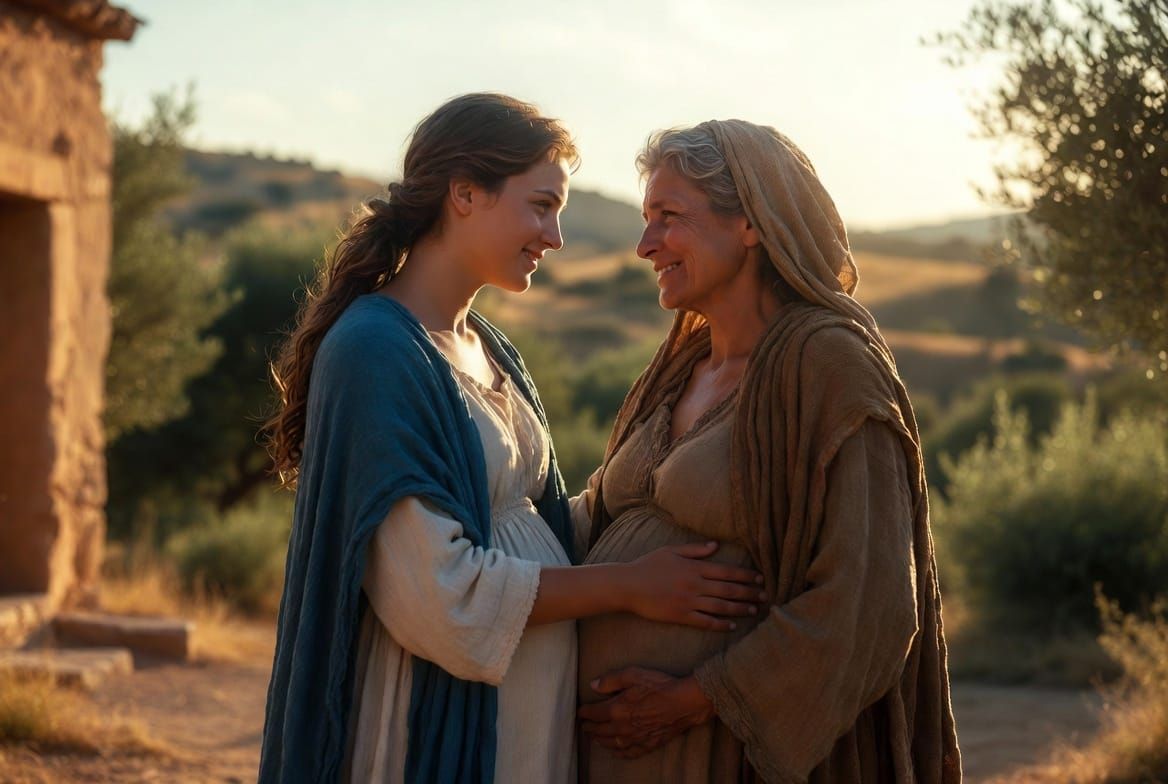
The story is told in Luke 1:39–56, and it is one of the most intimate and charged scenes in all of Scripture. Mary has just received the announcement from the angel Gabriel that she will conceive and bear the Son of God by the power of the Holy Spirit. The angel has also told her that her relative Elizabeth — long considered barren — is already six months pregnant. And so Mary sets out in haste for the hill country of Judea to visit Elizabeth and her husband Zechariah, a priest of the Jerusalem temple.
What happens when Mary arrives is extraordinary. The moment she greets Elizabeth, the child in Elizabeth’s womb — the one who will become John the Baptist — leaps. Elizabeth is filled with the Holy Spirit and cries out: “Blessed are you among women, and blessed is the fruit of your womb! And why is this granted to me that the mother of my Lord should come to me? For behold, when the sound of your greeting came to my ears, the baby in my womb leaped for joy.” (Luke 1:42–44, ESV) Elizabeth does not merely welcome Mary. Filled with the Holy Spirit, she confesses the identity of the child Mary carries. This is the first human confession of the Incarnation. Before Jesus has been born, before he has spoken a word or performed a miracle, his presence causes recognition, proclamation, and joy.
Mary responds with the Magnificat — Luke 1:46–55 — a song of such breathtaking theological depth that the Church has sung it at Evening Prayer ever since: “My soul magnifies the Lord, and my spirit rejoices in God my Savior, for he has looked on the humble estate of his servant.” (Luke 1:46–48, ESV) The Magnificat is not gentle sentiment. It is a declaration: God scatters the proud, brings down the mighty, lifts up the humble, fills the hungry, sends the rich away empty. The young woman who said fiat at the Annunciation now declares, with prophetic clarity, what the coming of this child means for the ordering of the world.
Zechariah is present in the household, though he plays no speaking role in this passage. He has been struck mute since his own encounter with Gabriel in the temple, when he doubted the angel’s announcement that Elizabeth would bear a son. His silence throughout the Visitation is itself a kind of theological statement: the Word is at work in the world, and human speech must sometimes give way to wonder.
The Theological Significance
The Visitation is not a pleasant scene of family reunion. It is packed with theological significance that the Church has pondered for two thousand years.
First, it is the first proclamation of the Gospel. Before Jesus has been born, before he has preached a word or performed a miracle, his presence causes joy. John leaps in the womb — an act of recognition, the forerunner already doing his work of pointing to the Christ. Elizabeth speaks under the inspiration of the Holy Spirit, declaring what the angel declared to Mary: that she is blessed, and that the child she carries is Lord. The Incarnation has begun its work in the world, and the world is already responding.
Second, the Visitation places two remarkable women at the center of the story of salvation. Elizabeth and Mary are both recipients of miraculous pregnancies, both filled with the Spirit, both given words of prophetic weight. Elizabeth’s greeting is one of the great confessions of faith in the New Testament. Mary’s Magnificat is a song of breathtaking theological depth. The Church does well to sit with these women and listen.
Third, the Visitation is a story about the sanctifying work of Christ. From the moment of the Annunciation, the incarnate Son of God is at work in the world, bringing the Holy Spirit wherever he goes. Elizabeth’s filling with the Spirit, John’s leaping for joy — these are the first fruits of the salvation that Christ has come to accomplish. Wherever Christ is present, life and joy follow.
The appointed Old Testament reading from the propers on page 730 is Zephaniah 3:14–18, the prophet’s great song of joy over the daughter of Zion: “Sing aloud, O daughter of Zion; shout, O Israel! Rejoice and exult with all your heart, O daughter of Jerusalem! The Lord has taken away the judgments against you; he has cleared away your enemies. The King of Israel, the Lord, is in your midst.” (Zephaniah 3:14–15, ESV) The Lord is in your midst. This is the prophetic vision the Visitation enacts: the King of Israel, the incarnate Lord, has come into the midst of his people — not yet publicly, not yet in the temple courts, but in the womb of a young woman visiting her cousin in the hill country of Judea. Zephaniah’s song of joy is Mary’s Magnificat before it was written.
The appointed Epistle is Colossians 3:12–17, Paul’s description of the life of the community that has put on Christ: “Put on then, as God’s chosen ones, holy and beloved, compassionate hearts, kindness, humility, meekness, and patience, bearing with one another and, if one has a complaint against another, forgiving each other; as the Lord has forgiven you, so you also must forgive.” (Colossians 3:12–13, ESV) And then verse 16: “Let the word of Christ dwell in you richly, teaching and admonishing one another in all wisdom, singing psalms and hymns and spiritual songs, with thankfulness in your hearts to God.” (Colossians 3:16, ESV) The Visitation is Colossians 3 enacted. Mary carried the word of Christ in her body and brought it to Elizabeth. The result was exactly what Paul describes: teaching, admonition, joy, and a song of praise that has not stopped being sung.
Why This Feast Is Observed on May 31
The date may puzzle those who know the biblical narrative. The Visitation almost certainly occurred in what we would call late March or early April, shortly after the Annunciation on March 25 — Mary travels to Elizabeth promptly after Gabriel’s departure, and Elizabeth is six months pregnant at the time. So why May 31?
The feast was instituted in 1389, originally observed on July 2. It appeared in earlier Anglican calendars on that date. In 1969, the Roman Catholic Church moved the feast to May 31, placing it between the Annunciation and the Nativity of John the Baptist, giving it a more logical narrative position in the calendar — a bridge between those two great birth announcements. The BCP 2019 follows this revised date.
It is worth being honest that May 31 is a liturgical and calendrical choice, not a historical one. The Church is not claiming that the Visitation occurred on that date. It is finding a fitting place in the calendar to pause and honor this event. The liturgical calendar has always been a theological ordering of time, not a strict historical timeline. May 31 places the Visitation exactly where the narrative logic requires it.
When May 31 falls on a Principal Feast — as it does when Trinity Sunday lands on that date — the Principal Feast takes precedence, as stated in the rubrics on page 688 of the BCP 2019: “These feasts take precedence over any other day or observance.” In such years the Visitation may be transferred to the nearest following weekday. The Trinitarian theology of the Principal Feast and the Incarnational theology of the Visitation are not in conflict; they are different facets of the same mystery.
The BCP 2019 Collect and Preface
The BCP 2019 appoints the following collect for the feast on page 628: “Almighty God, by whose grace Elizabeth rejoiced with the blessed Virgin Mary and greeted her as the mother of the Lord: Look with favor on your lowly servants, that, with Mary, we may magnify your holy Name and rejoice to acclaim her Son as our Savior; who lives and reigns with you, in the unity of the Holy Spirit, one God, now and for ever. Amen.” The collect holds together the two movements of the feast: the historical event — Elizabeth’s greeting, Mary’s joy — and the present petition — that we too might magnify God’s holy name and acclaim his Son as Savior. The Visitation is not something we merely commemorate at a distance. It is an event we are invited to enter. The same grace that filled Elizabeth and moved John in the womb is the grace we ask to receive.
The Preface of the Presentation, found on page 153 of the BCP 2019, is appointed for this feast — the same preface used for the Circumcision and Holy Name, the Presentation of Christ in the Temple, and the feast of Joseph. It is the preface of the Incarnation: “Because in the mystery of the Word made flesh, you have caused a new light to shine in our hearts, to give the knowledge of your glory in the face of your Son Jesus Christ our Lord.” (BCP 2019, p. 153) The preface names the mystery the Visitation embodies: the Word made flesh, already at work in the world, already causing a new light to shine. The light that shone on Elizabeth and John is the same light that shines in every heart where Christ is received.
The Visitation in Anglican Worship
The Magnificat, Mary’s song from Luke 1:46–55, has been sung at Evening Prayer in the Anglican tradition since Cranmer’s first Prayer Book in 1549. Every evening, in churches and homes across the Anglican Communion, Anglicans sing or say Mary’s words: my soul magnifies the Lord. In this sense, the Visitation never really ends. The Church is still arriving at Elizabeth’s door, still hearing the greeting, still finding the words to praise God for the salvation he has accomplished in his Son.
The feast is also a model of generous, incarnational service. Mary, newly pregnant, does not turn inward. She goes — in haste — to be with Elizabeth in her need. She carries Christ to someone who needs him, and the result is joy, prophecy, and praise. The Church is always called to this same movement: to bring Christ to those who need him, not by argument or imposition but by presence, love, and the willingness to arrive at someone else’s door.
The Visitation also reminds the Church that God’s work often happens quietly, between ordinary people, before the world takes notice. Two women in the hill country of Judea. One elderly, one young. Both pregnant in extraordinary circumstances. No crowds, no official announcement, no fanfare. Just a greeting, a leap, and a song. And yet this is where the history of salvation is unfolding.
Observing This Feast
May 31 falls within the season after Pentecost in most years, following Trinity Sunday. When it falls on a Sunday, it may be observed on that Sunday or transferred to the nearest following weekday, unless Trinity Sunday falls on May 31, in which case the Principal Feast takes precedence. Consult page 688 of the BCP 2019 for the full rubrics.
To observe the feast: pray the collect from BCP 2019, p. 628. Read Luke 1:39–56 — the whole passage, including the Magnificat. Pray or sing the Magnificat as Mary’s song and your own. Read Zephaniah 3:14–18 and hear the prophet’s joy fulfilled in Elizabeth’s greeting. Read Colossians 3:12–17 as the description of the community that carries Christ to the world. And consider how you might, like Mary, bring Christ’s presence to someone who needs him today — not by argument but by arrival, not by imposition but by love.
Conclusion
The Visitation is a feast that invites the Church to slow down and pay attention to what God is quietly doing. In a passage of Scripture full of joy, wonder, and prophetic speech, we see the Gospel beginning its work in the world — Christ already present, already sanctifying, already calling forth praise. The invitation is the same one Mary accepted when Gabriel departed: to say yes to what God is doing, to go where he sends us, and to let our souls magnify the Lord.
“My soul magnifies the Lord, and my spirit rejoices in God my Savior.” (Luke 1:46–47, ESV