To Equip the Saints: Friday of Autumn Embertide (Ephesians 4:11-16)
On Wednesday we learned that the Church is not ours. Today we learn what Christ intends his servants to do within the Church that belongs to him: not replace the saints, but equip them; not gather the Body around themselves, but help the whole Body grow into Christ.
September 18, 2026, Autumn Ember Day II, Friday of Autumn Embertide, Day of Discipline, Denial, and Special Prayer, Season after Pentecost
Matthew 9:35-38, Psalm 63:1-8, Ephesians 4:11-16, 1 Samuel 3:1-10
Grace, mercy, and peace from God our Father and the Lord Jesus Christ be with you on this second day of Autumn Embertide.
On Wednesday, Saint Paul reminded us that ministers are servants, not owners. Paul planted, Apollos watered, but God gave the growth. The field is God’s, the building is God’s, the Church is God’s, and the only foundation is Jesus Christ. Today Paul takes us one step further. If the Church belongs to Christ, then why does Christ give particular ministers to his Church at all? What are bishops, priests, deacons, pastors, and teachers for?
Ephesians 4 gives us a clear answer. Christ gives ministers so that the whole Church may be equipped, strengthened, matured, and built up in him. That matters especially on an Ember Day. The Prayer Book sets these days aside particularly for prayer for those called to Holy Orders, but it never asks us to think about ordained ministry in isolation from the rest of Christ’s Body. The question is not merely whether the Church has enough clergy. The deeper question is whether the ministers Christ gives are helping the whole people of God grow into maturity.
The opening words of verse 11 also reach back into the paragraph before our primary text. Paul has just been speaking about grace given according to Christ’s gift and about the ascended Lord giving gifts to his people. So when verse 11 says, “And he gave,” the giver is Christ himself. That matters because ministry is not the Church scrambling to fill vacancies or creating offices simply because an institution needs staff. The risen and ascended Christ provides gifts for the Body he purchased, and he remains Lord over the gifts he gives. Before we ask what a minister does, Paul wants us to remember who gives the minister and whose purposes that ministry must serve.
Our primary text begins in verse 11: “And he gave the apostles, the prophets, the evangelists, the shepherds and teachers.” (Ephesians 4:11, ESV) Notice where Paul begins. He does not begin with ambition, staffing needs, personality, or institutional survival. He begins with Christ giving. Christian ministry is first a gift before it is a position, and that keeps the order of grace before us. That does not mean every ministry Paul names maps neatly onto every later form of Holy Orders. Paul is speaking about ministries Christ gives for the life of his Body. But the governing principle is unmistakable: ministry originates in Christ’s generosity and lordship. The Church does not invent ministry for her own convenience, and no bishop, priest, or deacon stands over the Church as though they created the office they hold. A genuine vocation is received, discerned, tested, and entrusted under Christ.
That is where our Old Testament reading helps us. Samuel does not appoint himself. The word of the LORD comes to him before he fully understands what is happening. Three times he mistakes the voice for Eli’s. Finally Eli perceives that the LORD is calling the boy and teaches him how to answer: “Speak, LORD, for your servant hears.” (1 Samuel 3:9, ESV) Samuel listens before he speaks. Eli recognizes before Samuel is sent. God calls before either of them acts. That pattern matters because vocation can easily be confused with desire alone. A person may sincerely want ordained ministry and still need the Church to test doctrine, character, gifts, maturity, and fitness. On the other hand, a person may hesitate, underestimate what God has given, or fail to recognize a call without the help of mature Christians who can say, “I see something here. Have you considered what God may be asking of you?” Samuel needed Eli, but Eli did not manufacture Samuel’s call.
The Ember Collects hold those truths together. The first asks God to give grace to those called to office and ministry, filling them with the truth of his doctrine and clothing them with holiness of life. The second asks that the Church, under the guidance of the Holy Spirit, may choose suitable persons for the ministry of Word and Sacrament and uphold them in their work. God gives. The Spirit guides. The Church discerns and forms. Through her bishops, the Church ordains, and the Church continues to support those who are sent. The second Collect ends by naming Jesus “the great Shepherd and Bishop of our souls.” That title keeps every order of ministry beneath Christ. Bishops shepherd under the Shepherd. Priests preach a Word that is not theirs. Deacons serve in the name of the Servant who gave himself for us. Even the Church’s discernment of vocation is not an exercise in creating spiritual professionals. We are asking the risen Christ to provide servants for people who already belong to him.
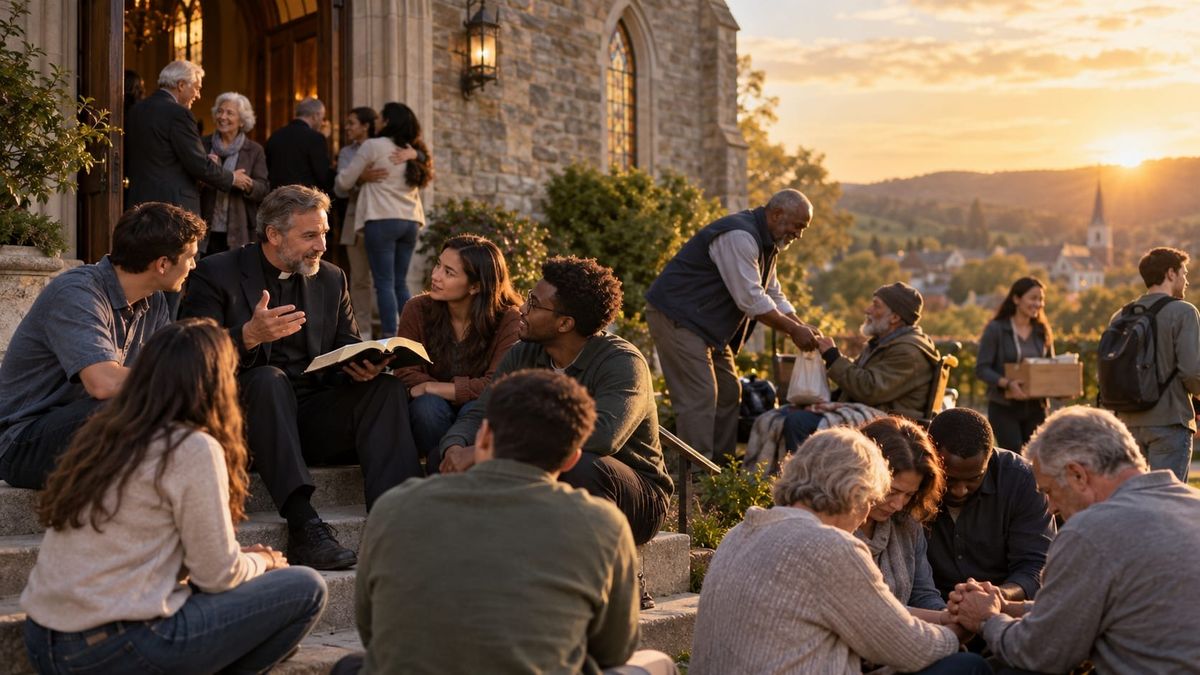
Then verse 12 tells us why Christ gives these ministers: “to equip the saints for the work of ministry, for building up the body of Christ.” (Ephesians 4:12, ESV) This verse corrects one of the most persistent misunderstandings of church life. The work of ministry does not belong only to the clergy. Christ gives particular ministers to equip the saints so that the whole Body serves. That means ordained ministry is not successful when everyone becomes dependent upon the ordained minister for everything. A priest is not called to become the congregation’s professional Christian while everyone else watches. A deacon is not given so that the rest of the Church can outsource mercy. A bishop is not given so that local churches can stop discerning, praying, and serving. Christ gives ministers so that his people are equipped. To equip means to prepare, restore, and make ready for useful service. Good ministry therefore gives something away: it teaches Scripture so others can know and speak the faith, forms Christians in prayer so they learn to pray, trains people to serve, encourages gifts, corrects error, strengthens the weak, and helps the whole congregation become more capable of faithful Christian life. That is why clericalism and anti-clericalism both miss Paul’s picture. Clericalism acts as though real ministry belongs almost entirely to clergy. Anti-clericalism acts as though ordered ministry is unnecessary or suspicious. Paul gives us something better. Christ gives ministers to his Church, and those ministers serve the whole Body by equipping the saints.
Verse 13 tells us the goal: “until we all attain to the unity of the faith and of the knowledge of the Son of God, to mature manhood, to the measure of the stature of the fullness of Christ.” (Ephesians 4:13, ESV) The destination is not a well-managed institution. It is maturity in Christ. That gives us a better way to think about church health. Numbers matter because people matter. Finances matter because stewardship matters. Buildings, schedules, and administration matter because the Church lives in the real world. But none of those things can finally tell us whether a congregation is becoming mature. Paul’s measure is Christ. Are we growing in knowledge of the Son of God? Are we becoming more stable in truth, more holy in life, more patient with one another, more willing to serve, more courageous in witness, more ready to forgive, and more dependent upon grace? That is what ministry is for.
Verse 14 tells us why maturity matters: “so that we may no longer be children, tossed to and fro by the waves and carried about by every wind of doctrine.” (Ephesians 4:14, ESV) An immature Church is vulnerable. Length of attendance is not the same thing as spiritual maturity. A person can sit in a pew for decades and still be easily shaken by every new idea, every charismatic voice, every online teacher, every outrage, or every doctrine that sounds appealing in the moment. That is one reason the first Ember Collect joins truth of doctrine with holiness of life. The Church needs both. A minister who knows doctrine but lacks holiness can wound the flock. A minister who appears holy but teaches error can mislead the flock. And the congregation needs both as well. Christian maturity is not merely having strong opinions. It is being so grounded in Christ and his Word that we can recognize truth, reject error, and remain teachable. That kind of maturity is especially urgent now because almost anyone can present himself as a teacher. A persuasive voice can reach thousands of people before anyone asks whether the teaching is true, whether the life behind it is trustworthy, or whether the person is accountable to anyone. The answer is not fear but maturity: a mature congregation listens carefully, tests what it hears, knows the Scriptures, receives the historic faith of the Church, and does not confuse confidence with truth.
But stability is not the final goal. Verse 15 says, “Rather, speaking the truth in love, we are to grow up in every way into him who is the head, into Christ.” (Ephesians 4:15, ESV) Truth without love can become cruelty. Love without truth can become sentimentality. Paul refuses to let us choose between them. The Church needs ministers who will tell the truth because they love the people entrusted to them, and people who are willing to hear the truth because they want to grow. Sometimes pastoral love comforts. Sometimes it corrects. Sometimes it says, “Christ has forgiven you.” Sometimes it says, “This path is destroying you.” In either case, the aim is the same: growth into Christ. And Christ remains the head. Ministers are gifts, but they are not the head. The Church is not meant to grow into the personality of a pastor, the culture of a congregation, or the preferences of a generation. We are to grow into Christ.
Verse 16 completes the picture: “from whom the whole body, joined and held together by every joint with which it is equipped, when each part is working properly, makes the body grow so that it builds itself up in love.” (Ephesians 4:16, ESV) The whole Body matters. Each part matters. And each part works properly under Christ. That is the opposite of passive church membership. A healthy congregation does not consist of a few exhausted people doing everything while everyone else receives. Nor does it consist of disconnected individuals each doing whatever seems right to them. The Body is joined together. Gifts are different, responsibilities are different, but the life is shared.
Our Gospel shows us why this matters so urgently. Matthew tells us that Jesus went through the cities and villages teaching, proclaiming the Gospel of the Kingdom, and healing. Then verse 36 says, “When he saw the crowds, he had compassion for them, because they were harassed and helpless, like sheep without a shepherd.” (Matthew 9:36, ESV) Jesus does not look at need with irritation. He sees people worn down and shepherdless, and compassion moves him. Then in verses 37 and 38 he says, “The harvest is plentiful, but the laborers are few; therefore pray earnestly to the Lord of the harvest to send out laborers into his harvest.” (Matthew 9:37-38, ESV) Notice again whose harvest it is. It is the Lord’s harvest, just as Wednesday reminded us that the field belongs to God. That is why we pray rather than panic.
We do not behave as though the future of the Church depends upon our recruiting skill, and we do not lower standards of doctrine or character because we are anxious about numbers. We ask the Lord of the harvest to send laborers. When he does, those laborers are sent to proclaim Christ, serve the flock, equip the saints, guard the faith, and help the whole Body mature. The command to pray also turns back upon the people praying. In the very next verse, Matthew 10:1, Jesus summons the Twelve and sends them. The disciples who hear the command to pray for laborers become laborers themselves. We should be careful not to turn that sequence into a mechanical promise that everyone who prays is called to Holy Orders, but the principle is important: sincere prayer for the Lord’s work makes us more available to the Lord of the work.
That brings us back to Samuel. Sometimes the answer to the Church’s prayer for laborers is a person who has not yet recognized the voice. Part of our work is to become Elis for one another, not manufacturing vocations, but helping people listen. A faithful church asks not only, “Who will serve us?” but also, “Whom might God be calling among us, and are we attentive enough to notice?” Psalm 63 takes us deeper still, beneath gifts, office, and ability to the heart of the servant: “O God, you are my God; earnestly I seek you; my soul thirsts for you.” (Psalm 63:1, ESV) Before anyone seeks ministry, that person should seek God. Before anyone desires a title, that person should desire Christ.
That question belongs to all of us. We can become very busy with church while becoming thin in prayer. We can teach, organize, visit, prepare liturgies, attend meetings, preach sermons, and still allow communion with God to weaken. Ministry cannot substitute for knowing God. Activity cannot substitute for prayer. Usefulness cannot substitute for love of Christ. And here the Gospel comes before every ministry. We do not serve in order to make ourselves acceptable to God. Christ has done for sinners what no ministry could do. He bore our sins on the Cross, rose from the dead, and calls us to repent, believe, and receive forgiveness by grace. Before Christ equips us for service, he saves us. Before we become useful members of the Body, we are helpless sinners brought into the Body by mercy.
The saints whom Christ equips are therefore not merely volunteers in a religious organization. They are people he has redeemed, joined to himself, and gathered into one Body. The order matters. Christ does not save us because we finally became useful enough to serve; he saves sinners by grace and then gives his redeemed people gifts and work. That grace-first order protects ministry from becoming another way to prove ourselves before God. Service is the fruit of belonging to Christ, not the price of admission into his favor.
So on this second Ember Day, let us pray first for laborers who know that grace. Let us pray for bishops, priests, and deacons whose ministries make Christ more visible rather than themselves; for ordinands and those in discernment; for teachers who love truth, shepherds who love the flock, evangelists who love the lost, and servants whose prayer life is deep enough to sustain the work Christ gives them. But let us also pray for a Church willing to be equipped. Sometimes we ask God for good ministers while resisting the very maturity those ministers are trying to cultivate. We want pastors to teach, but not if the teaching challenges us. We want clergy to equip us, but not if being equipped means responsibility. We want spiritual growth, but not always the repentance, discipline, patience, and service through which growth often comes. The Church must be willing not only to receive faithful ministers but to respond faithfully to their ministry.
On Wednesday we learned that the Church is not ours. Today we learn what Christ intends his servants to do within the Church that belongs to him: not replace the saints, but equip them; not gather the Body around themselves, but help the whole Body grow into Christ. Tomorrow we will hear what that stewardship costs when Paul charges the elders of Ephesus to finish the course, watch themselves and the flock, and guard what Christ has entrusted to them. For today, the pattern is clear: Christ gives, ministers equip, saints serve, the Body grows, and Christ remains the head.
So let us pray to the Lord of the harvest. Let us listen with Samuel. Let us thirst for God with the psalmist. Let us receive the ministers Christ gives, and let us refuse to remain passive when Christ is equipping us for the work of ministry. May we speak the truth in love, may every part work properly, may the whole Body be built up, and in all of it may we grow ever more fully into Christ, who alone is our head.
In the Name of the Father, and of the Son, and of the Holy Spirit. Amen.