Were Not Our Hearts Burning?(Luke 24:13-35)
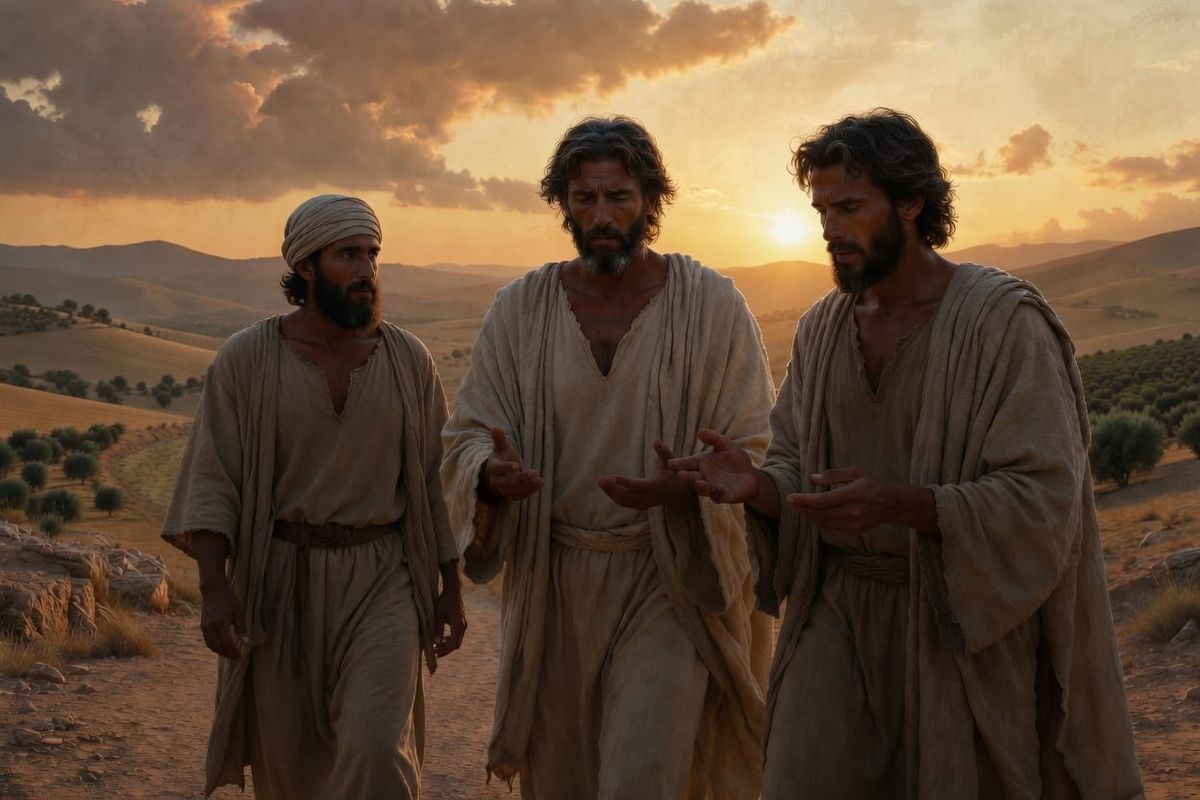
Two disciples walked away from Jerusalem on the day of the resurrection — grieving, confused, hopes shattered. Jesus drew near and walked with them before they knew who he was. He opened the Scriptures, broke the bread, and their eyes were opened. The road to Emmaus did not end in that village.
April 19, 2026, Year A, Third Sunday of Easter
Luke 24:13-35, Isaiah 43:1-12, Psalm 116:1-16
Alleluia! He is risen!
Grace, mercy, and peace from God our Father and the Lord Jesus Christ be with you on this Third Sunday of Easter.
Last Sunday we were in a locked room, disciples hiding, crushed by fear, guilt, and grief, with Jesus coming in anyway. He spoke peace and breathed new life into dry bones. The locked doors could not hold him then. They cannot hold him now.
This week he is not in a room at all. He is on a road, walking seven miles with two people who have no idea who he is.
Luke tells us this happens on the same day as the resurrection, the empty tomb, Mary's testimony, Peter and John finding the grave clothes. On that very day, two disciples are walking away from Jerusalem. They are not among the eleven. They are part of the wider circle of followers, and they are going the wrong direction.
Verse 14 tells us they are talking with each other about everything that had happened, the restless, circular conversation of people who cannot make sense of what they have experienced. They keep returning to it. They cannot set it down. This is what grief does.
Then Jesus himself draws near and goes with them. And their eyes, Luke says this carefully in verse 16, "were kept from recognizing him." (Luke 24:16, ESV) This is divine action, not a failure of sight. The same God who will open their eyes at the table keeps them closed on the road. The whole encounter is in his hands from the first step.
Jesus asks them what they are talking about. And they stand still, looking sad. Cleopas answers in verse 18 with a kind of incredulous grief: "Are you the only visitor to Jerusalem who does not know the things that have happened there in these days?" (Luke 24:18, ESV) The irony of this question is one of the disheartening moments in Scripture. The very one who is the subject of everything they are grieving is the one they are telling about it. He knows. He asks anyway. He wants them to say it.
So they do in verse 19. And what they say tells us everything about the shape of their grief. They describe Jesus as "a prophet mighty in deed and word." (Luke 24:19, ESV) Just a prophet. Not the Messiah. Not the Son of God. A prophet. You can hear the revision happening in real time. They had believed something larger, and the cross had forced a reduction. He could not be what they thought if he ended the way he ended.
And then comes verse 21, the most honest sentence in the passage: "But we had hoped that he was the one to redeem Israel." (Luke 24:21, ESV)
Past tense. Had hoped. The hope they had carried has been exposed as the wrong hope, a Messiah who would break Roman power, restore David's kingdom, give Israel her glory back. A political deliverer, a king who wins the way every other king wins. Jesus had ridden in on a donkey, allowed himself to be arrested, and died on a cross. So the hope collapsed, not because there was nothing to hope for, but because what happened did not fit the shape of the hope they had brought with them.
They even report the resurrection rumors with a kind of exhausted detachment. Some women said they saw angels. Some of the men checked the tomb. He wasn't there. But him they did not see. You can hear it, we've heard the story, we can't make anything of it, and we are going home. We are leaving the conversation.
This is where Jesus speaks, and what he says is striking in verse 25. "O foolish ones, and slow of heart to believe all that the prophets have spoken!" (Luke 24:25, ESV)
Foolish and slow of heart are not the words of someone tiptoeing around bruised feelings. He diagnoses the problem precisely in verse 26: "Was it not necessary that the Christ should suffer these things and enter into his glory?" (Luke 24:26, ESV) It is not that they lack evidence; it is that they have been slow to believe what the Scriptures have been saying all along. Jesus' suffering was not the contradiction of the promise. His suffering was the fulfillment of it.
That word necessary is load-bearing. Not accidental. Not a tragedy that derailed the plan. Necessary, woven into the purpose of God from the beginning, announced through Moses and the Prophets across centuries of patient preparation. The cross was not where the story ended. It was where the story arrived, and it will continue to unfold.
And then Jesus does something extraordinary. Beginning with Moses and all the Prophets, he walks them through the whole of Scripture. We are not told what specifically, but based on our Lenten readings, I can think of a few: Isaiah 53, the servant pierced for our transgressions; Zechariah 12:10, the one who would be looked upon and mourned; Psalm 22, the cry of dereliction; Psalm 16, which we read last week: "you will not abandon my soul to Sheol." (Psalm 16:10, ESV) All of it pointing here. All of it preparing eyes that are about to be opened.
This is where Isaiah 43 comes into the conversation, because of the deep grammar behind what Jesus is doing on that road. In verse 1 we read: "Fear not, for I have redeemed you; I have called you by name, you are mine. When you pass through the waters, I will be with you; and through the rivers, they shall not overwhelm you… For I am the LORD your God, the Holy One of Israel, your Savior." (Isaiah 43:1–3, ESV)
Those who were here through Lent will recognize that pattern. Week after week we saw it, God does not promise to remove the deep waters, or wildernesses, as we've called them. He promises to be present in them. Israel in Egypt, in the wilderness, in exile, the LORD walked with his people through it all. These two disciples are in exactly that place: deep waters, hope reduced to past tense, walking the wrong direction. And the LORD their God is walking beside them, present in the full weight of their grief before they know who he is. That is the wilderness promise being fulfilled step by step on a dusty road.
And Isaiah's horizon is wider still. God says in verse 6: "bring my sons from afar and my daughters from the end of the earth." (Isaiah 43:6, ESV) And in verse 21: "the people whom I formed for myself that they might declare my praise."(Isaiah 43:21, ESV) This is not a promise to ancient Israel alone. After Christ's ascension, it becomes a prophecy for spiritual Israel, new Israel, true Israel, the Christ-believing Jews and Gentiles that make up the New Testament Church. It reaches to every nation, tongue, and tribe. Within weeks, at Pentecost, the Spirit will be poured out and the Gospel will go out in every language to every nation represented in Jerusalem.
What began on that road, the Word opened, the bread broken, eyes opened, people turned around and sent, will carry to the ends of the earth until he returns (Acts 1:8) and gathers his believing sons and daughters from afar at last. That will be the complete fulfillment of Isaiah 43. The Emmaus road is not a private encounter. It is the first step of that mission.
They near the village. Jesus acts as if he is going farther. He does not force himself in. And in verse 29 they urge him strongly: "Stay with us, for it is toward evening and the day is now far spent." (Luke 24:29, ESV) So he goes in.
This is not a transaction. They are not earning the revelation by their hospitality. The whole road has already been grace, the drawing near, the questions, the opened Scriptures. Their urging him to stay is a response to grace already at work, the natural movement of hearts that have been warming for seven miles without knowing why. And now, still on his initiative, he takes the bread.
Verse 30 tells us: "When he was at table with them, he took the bread and blessed and broke it and gave it to them. And their eyes were opened, and they recognized him. And he vanished from their sight." (Luke 24:30–31, ESV)
The gesture is unmistakable. They have seen this before, this particular sequence, this way of taking and blessing and breaking and giving. And when he does it again, the eyes that have been kept closed all day are opened.
He is known to them in the breaking of the bread.
The vanishing is its own message: fellowship with the risen Christ does not depend on seeing him with physical eyes. We just read that in 1 Peter 1:8 last week. But it depends on the Word and the Table, the same means by which he has just revealed himself. Every Sunday when we gather here, this is what we are doing. We come with our grief, our confusion, our going-the-wrong-direction weeks. The Word is opened. The bread is broken. And by grace, our eyes are opened to who is present.
This is why we do not treat the liturgy as mere ceremony. When the Scriptures are read and proclaimed, Jesus is opening them to us, the same patient, deliberate opening he gave to two grieving disciples on a dusty road. When the bread is taken, blessed, broken, and given, he is doing what he has always done at the table. We are not observers of an ancient ritual. We are participants in an ongoing encounter. The Emmaus road did not end in that village. It runs through this room, every Sunday, for anyone willing to stay long enough for their eyes to be opened.
Then they ask each other the question that gives this sermon its name, in verse 32: "Did not our hearts burn within us while he talked to us on the road, while he opened to us the Scriptures?" (Luke 24:32, ESV)
Notice what they are realizing. The burning was already happening. All along the road, while they were still confused, while their eyes were still closed, while they were still describing Jesus in the past tense as someone who had been a prophet and whose death had shattered their hopes, their hearts were burning. Grace was at work before they knew it. The Word was doing something in them before recognition came. They only understood it in retrospect, after the breaking of the bread opened their eyes.
This is the pastoral word for everyone who has ever wondered whether anything is happening in them at all. The burning does not always feel like burning. Sometimes it feels like restlessness. Like a conversation we cannot stop having. Like a grief we cannot set down. Sometimes the grace is working long before the recognition comes. The eyes are opened in God's time, not ours.
So let me ask directly: what road are you on right now? What hope has gone to past tense in you, something you believed, something you prayed for, something you expected God to do that he has not done the way you expected? What conversation keeps circling back that you cannot resolve? That restlessness, that grief, that inability to set it down, do not be too quick to call it the absence of God. It may be the first faint burning of hearts that have not yet recognized who is walking beside them. It may be that the stranger has already drawn near and is already walking with you, already at work in you, and the eyes will be opened when the bread is broken.
The application for this sermon is not complicated. Stay on the road. Stay in the Word. Stay at the Table. Stay in the conversation. The two disciples on the Emmaus road had every reason to go home and stay there. They didn't know who was with them. They didn't understand what was happening. But they kept walking, kept talking, and when evening came they asked the stranger to stay. That is the whole of it. Show up. Stay. Let him open the Scriptures and break the bread. The recognition will come.
Psalm 116 is the psalm of someone who has come through exactly this kind of experience and has made it to the other side. In verses 1 and 6: "I love the LORD, because he has heard my voice and my pleas for mercy… I was brought low, and he saved me." (Psalm 116:1, 6, ESV) And then the response in verse 9: "I will walk before the LORD in the land of the living." (Psalm 116:9, ESV) The disciples on the Emmaus road are about to do exactly that, rise from the table, turn around, and walk back toward Jerusalem. Walking before the LORD in the land of the living. Not because they have earned it or resolved their grief or worked out their theology just yet. But because their eyes were opened, and now they cannot stay where they are.
In verse 33 Luke tells us: "They rose that same hour and returned to Jerusalem." (Luke 24:33, ESV) The same hour. It is evening. It has been an exhausting day. They have walked seven miles to get here. They walk seven miles back. We do not do that unless something has happened to us that we cannot contain.
And what they carry back is not a report about what they figured out. It is a testimony about what happened to them. In verse 35: "Then they told what had happened on the road, and how he was known to them in the breaking of the bread."(Luke 24:35, ESV)
This is the structure of Christian witness. Not "I have worked out an argument." Not "I have resolved all my doubts." But "Something happened to me on the road, and I cannot un-know it."
The arc that began on Easter Sunday is becoming clear. Mary Magdalene: "I have seen the Lord" (John 20:18, ESV); called by name in the garden. The disciples in the locked room: met in fear and guilt, breathed into life. Thomas: given the encounter he needed. And now these two, met in grief and wrong-direction walking, hearts burning before they knew why, eyes opened at the breaking of the bread. Every encounter has the same shape: Jesus takes the initiative, comes to where people are, meets the specific need. Grace goes first. And in every case, the person is turned around and sent.
This is still the shape of it. He still opens the Scriptures. He still breaks the bread. And when our eyes are opened, the only response is to rise and go tell what happened. This is new creation at work, not confined to a locked room on Easter evening, not limited to the eleven, but moving out into the roads and villages and grief-laden conversations of ordinary life, finding people going the wrong direction and turning them around. The resurrection breath that filled that upper room is now on the open road, and it will not stop until it reaches the ends of the earth.
Did not our hearts burn within us? Stay in the Word. Stay at the Table. Stay in the conversation, the one that continued through every wilderness Sunday, the one that Mary could not stop having after the garden, the one these two could not stop having on the road.
In the Name of the Father, and of the Son, and of the Holy Spirit. Amen.