According to Your Word: The Annunciation of our Lord Jesus Christ to the Virgin Mary (Luke 1:26-38)
At the Annunciation, God acts first: he sends, speaks, promises, and gives. Mary receives his Word in faith, and the eternal Son takes our human nature for the saving work that will lead through the Cross to the glory of the Resurrection.
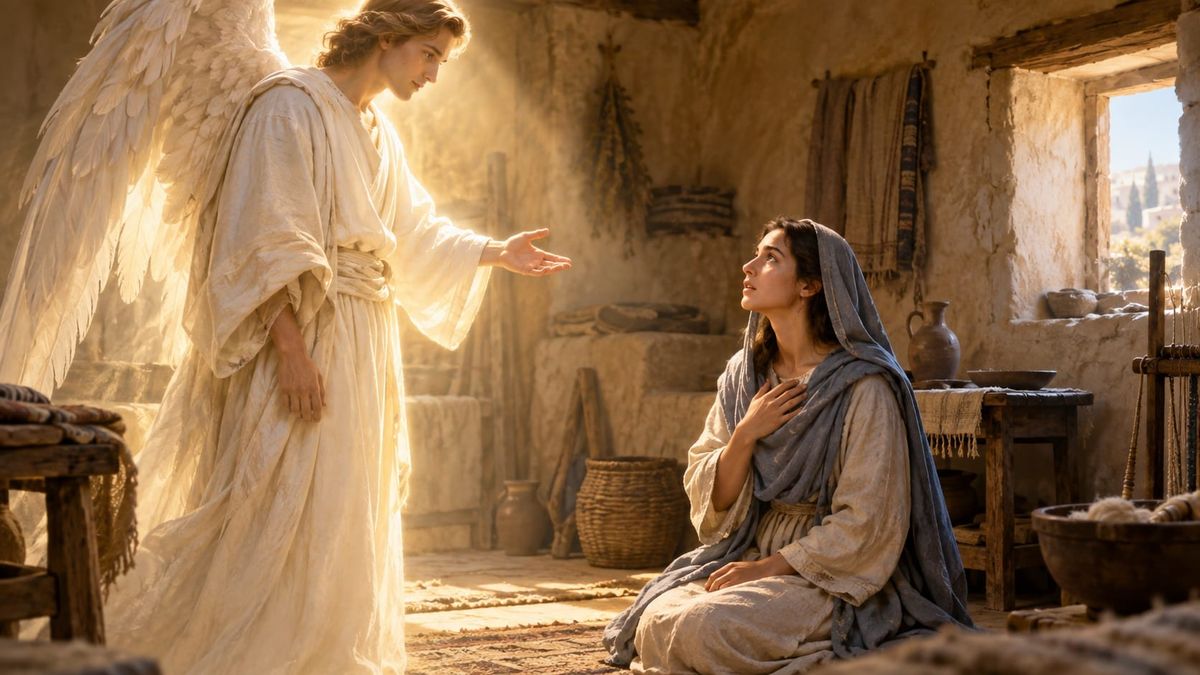
March 25, 2026, The Annunciation of our Lord Jesus Christ to the Virgin Mary, Red-Letter Holy Day, Season of Lent
Luke 1:26–38, Psalm 40:1–13, Hebrews 10:5–10, Isaiah 7:10–14
Grace, mercy, and peace from God our Father and the Lord Jesus Christ be with you on this Feast of the Annunciation of our Lord Jesus Christ to the Virgin Mary.
We find ourselves in an unusual place in the Church year today. Only three days ago we observed Passion Sunday, and Palm Sunday is now only four days away. Our attention has been narrowing toward Jerusalem, toward betrayal, the Cross, the tomb, and the Resurrection. Yet here, in the final stretch of Lent, the calendar takes us back nine months before Christmas and places us in Nazareth, where the angel Gabriel announces to the Virgin Mary that the eternal Son of God will take our human nature in her womb.
That is not a distraction from the Passion. Our Collect makes that clear. We pray, “Pour your grace into our hearts, O Lord, that we who have known the incarnation of your Son Jesus Christ, announced by an angel to the Virgin Mary, may by his Cross and passion be brought to the glory of his resurrection.” The Prayer Book moves in a single sentence from Nazareth to Calvary and then to Easter morning. The child announced by Gabriel is the Christ who will offer himself upon the Cross. The human nature he assumes from Mary is the human nature in which he will suffer, die, and rise again. The Incarnation and the Passion belong to one saving work.
Our primary Gospel is Luke 1:26–38, and Luke begins in verse 26 by telling us, “In the sixth month the angel Gabriel was sent from God to a city of Galilee named Nazareth.” (Luke 1:26, ESV) The first thing to notice is who acts. Gabriel is sent from God. The Annunciation does not begin with Mary seeking some extraordinary religious experience or somehow making herself worthy of divine attention. It begins with God sending, God speaking, and God giving.
Verse 27 tells us that Gabriel is sent “to a virgin betrothed to a man whose name was Joseph, of the house of David. And the virgin’s name was Mary.” (Luke 1:27, ESV) Luke repeats that Mary is a virgin because the point matters. She is betrothed to Joseph, but the child who will be conceived in her will not come through ordinary human generation. The Gospel is preparing us to hear that what is about to happen can only be the work of God.
Gabriel greets Mary in verse 28: “Greetings, O favored one, the Lord is with you!” (Luke 1:28, ESV) Mary is not told that she has achieved something that obligates God to use her. She is favored because God has shown her favor. Grace comes toward her before any response comes from her. Luke then tells us in verse 29 that Mary is greatly troubled and tries to discern what sort of greeting this might be, and Gabriel answers in verse 30, “Do not be afraid, Mary, for you have found favor with God.” (Luke 1:30, ESV)
Then comes the announcement itself. Gabriel says in verse 31, “And behold, you will conceive in your womb and bear a son, and you shall call his name Jesus.” (Luke 1:31, ESV) But this is immediately revealed to be far more than the announcement of one remarkable child. Gabriel continues, “He will be great and will be called the Son of the Most High. And the Lord God will give to him the throne of his father David, and he will reign over the house of Jacob forever, and of his kingdom there will be no end.” (Luke 1:32–33, ESV)
Centuries of promise are gathered into those words. The Son of David, the throne, the everlasting kingdom, the hope of Israel, all of it is being concentrated into the child who will be conceived in this young woman in Nazareth. That is where our reading from Isaiah helps us. King Ahaz is told, “Therefore the Lord himself will give you a sign. Behold, the virgin shall conceive and bear a son, and shall call his name Immanuel.” (Isaiah 7:14, ESV) Isaiah’s prophecy first comes within a particular crisis in the history of Judah, but Matthew tells us that its fullest meaning is found in the conception and birth of Jesus. Immanuel means God with us. The Annunciation therefore announces more than the arrival of another Davidic king. God has come to be with us in the person of the Son.
Mary then asks in verse 34, “How will this be, since I am a virgin?” (Luke 1:34, ESV) Her question is important because it is not a refusal to believe the promise. She is asking how the promise will be fulfilled when the ordinary human means by which a child is conceived are absent. Gabriel answers in verse 35, “The Holy Spirit will come upon you, and the power of the Most High will overshadow you; therefore the child to be born will be called holy, the Son of God.” (Luke 1:35, ESV)
This is the virginal conception. Christianity does not teach that Jesus began as an ordinary human being who was later adopted into divine status, nor does it teach that God merely appeared to be human. The eternal Son truly assumes our human nature through the miraculous work of the Holy Spirit in the womb of Mary. The Creed says it plainly: he “was incarnate by the Holy Spirit and the Virgin Mary, and was made man.”
Luke’s word overshadow also carries a biblical resonance. The Greek Old Testament uses this kind of language for the glory of God overshadowing the tabernacle. We should not force the comparison beyond what Scripture gives us, but the echo is fitting. The God who dwelt among Israel now comes to dwell among his people in a way greater than tabernacle or Temple. The Word becomes flesh, and the whole movement begins with God’s sovereign action. The Holy Spirit comes upon Mary, the power of the Most High overshadows her, and the eternal Son assumes the human nature in which he will accomplish our salvation.
Gabriel then points Mary toward Elizabeth, whose own impossible pregnancy has already begun, and says in verse 37, “For nothing will be impossible with God.” (Luke 1:37, ESV) That sentence can become sentimental if we pull it out of context. Gabriel is not promising that every desire we have will eventually come true. He is declaring that God is able to accomplish the saving promise he has spoken. Human impossibility is not an obstacle to divine faithfulness.
That brings us to Mary’s response in verse 38: “Behold, I am the servant of the Lord; let it be to me according to your word.” (Luke 1:38, ESV) The Latin tradition has often called this Mary’s fiat (FEE-aht), from the words “let it be,” and it is a beautiful confession of faith. But the order matters. Mary’s words do not cause the Incarnation, as though God had devised a saving plan that could not proceed until a human being gave him permission. God has already acted. He has sent Gabriel, spoken the promise, declared what he will do, and promised the work of the Holy Spirit.
Mary receives what God gives, and that does not make her response unimportant. Quite the opposite. Scripture holds her before us as a remarkable example of faith precisely because she receives God’s Word in trust: “Behold, I am the servant of the Lord.” There is humility there, and there is obedience without anything resembling a complete understanding of what that obedience will cost.
Mary does not yet see Bethlehem. She does not see the flight into Egypt, the years in Nazareth, the hostility that will gather around her Son, or herself standing near his Cross. She has the Word of God, and she trusts the God who has spoken it. That is where Mary becomes a genuine example for the whole Church. Her vocation is absolutely unique. None of us will be called to bear the incarnate Son of God, and the Incarnation happens once. But the shape of faith remains recognizable: God speaks, grace is given, faith receives, and obedience follows.
We often want the order reversed. We want God to show us where obedience will lead, what it will cost, whether it will succeed, and how the story will end. Then we will decide whether to trust him. Mary is given enough light for faithfulness, not a map of the next thirty-three years. Her answer is simply, “Let it be to me according to your word.”
Our Psalm and Epistle deepen the meaning of that response because Hebrews 10 takes words from Psalm 40 and places them on the lips of Christ himself. The Psalm says, “Behold, I have come; in the scroll of the book it is written of me: I delight to do your will, O my God.” (Psalm 40:7–8, ESV) Hebrews takes that language and says that when Christ comes into the world he says, “Sacrifices and offerings you have not desired, but a body have you prepared for me,” and then, “Behold, I have come to do your will, O God.” (Hebrews 10:5, 7, ESV)
That is extraordinary language to hear on the Annunciation. Luke gives us Mary’s faithful response, “Let it be to me according to your word,” while Hebrews gives us the Son’s perfect obedience, “Behold, I have come to do your will.”But the two are not equal partners in salvation. Mary receives the promise. Christ accomplishes salvation.
Hebrews tells us why the Son takes a body. He comes to do the Father’s will, and that obedience will lead to the one offering by which his people are sanctified. The body prepared for him is a body that can hunger, become tired, bleed, suffer, die, and rise. This is why celebrating the Annunciation in the week after Passion Sunday is so powerful. We are preparing to look upon the Cross, and the Church reminds us that the one hanging there truly possesses the human nature he assumed here.
The nails enter real human flesh. The blood shed is real blood. The death is a real human death. Yet the person who suffers is the eternal Son of God. The Annunciation protects Good Friday from becoming merely the tragic death of a noble teacher, because the man who will die upon the Cross is God the Son incarnate. Hebrews, in turn, protects the Annunciation from becoming merely a tender scene between an angel and a young woman, because the Son takes flesh in order to do the Father’s saving will.
Our Collect holds those truths together. We pray that those who have known the Incarnation announced by an angel may “by his Cross and passion be brought to the glory of his resurrection.” Incarnation, Cross, and Resurrection belong to one Christ and one saving work, and the Collect begins where Christian discipleship must begin: “Pour your grace into our hearts, O Lord.”
That beginning is important because there is a temptation, especially when preaching Mary’s obedience, to turn this into a sermon about being brave enough to say yes to God. There is certainly a call to obedience here, but the Prayer Book wisely starts deeper. Before faithful obedience comes grace. Mary herself is addressed as one who has found favor with God, and grace surrounds her response.
That is good news because many of us know what it is to hear the Word of God and discover resistance in ourselves. We know what he commands, but another desire pulls harder. We know what faithfulness requires, but obedience may cost something. We know we should forgive, confess, repent, speak truth, remain faithful, give generously, or entrust some frightening uncertainty to God, and yet the heart hesitates. The Christian answer is not simply, “Try harder to be like Mary.” The Christian prayer is the prayer of the Church: “Pour your grace into our hearts, O Lord.” Give us what we do not have in ourselves. Reorder what sin has disordered. Give us faith to receive what you say and strength to walk where you lead.
There are three things, then, that I think this feast gives us to carry into our own lives. First, receive the Word of God as a gift before treating it as a demand. Gabriel comes bearing promise before Mary ever speaks obedience. Christianity begins with what God has done and what God gives. That is true of the Gospel itself. Before Christ says, “Follow me,” there is Christ. Before Christian obedience, there is the Son who has become incarnate, died for sinners, and risen from the grave. We do not create grace through obedience. Obedience grows from grace received.
Second, trust God beyond what you can presently see. Mary knows remarkably little about how this promise will unfold. We know considerably more because we stand on the other side of Bethlehem, Calvary, and Easter, yet our own lives still contain unanswered questions. We often know what faithfulness requires before we know what faithfulness will produce. There may be a responsibility God has clearly placed before us, but we cannot see where it leads. There may be an act of obedience we have delayed because we want more certainty first, or circumstances for which God has not yet given us an explanation. Faith does not mean pretending uncertainty is certainty. It means knowing whom we trust when the future remains hidden. Mary’s words remain a fitting prayer: “Let it be to me according to your word.”
Third, remember that the center of the Annunciation is not Mary’s courage but Christ’s coming. Mary herself directs us there. The Magnificat, which the Prayer Book permits in place of Psalm 40 today, begins, “My soul magnifies the Lord, and my spirit rejoices in God my Savior.” (Luke 1:46–47, ESV) Mary’s faith does not terminate upon herself. It magnifies the Lord.
That should govern Christian devotion to Mary as well. We honor her because Scripture honors her. We call her blessed because Scripture tells us that generations will do so. We learn from her humility, faith, and obedience. But she is not the Savior. She rejoices in God my Savior, and the glory of the Annunciation is what God has done through her: the eternal Son has taken our humanity.
In a few days we will wave palms, and then we will hear again of betrayal, trial, the Cross, and the tomb. Today the Church tells us whose body that is. Hebrews gives us the words, “A body have you prepared for me.” The human body begins here, in the womb of the Virgin, by the power of the Holy Spirit. The Son assumes everything that belongs to true humanity except sin, and he takes our nature in order to save those who share that nature.
When he rises, he does not cast that humanity aside. The incarnate Son rises bodily. The human nature assumed at the Annunciation is carried through death into resurrection glory. That is why our Collect does not stop in Nazareth but asks that the grace of the Incarnation would bring us “by his Cross and passion…to the glory of his resurrection.”
The Annunciation is therefore a feast of astonishing hope in the middle of Lent. The Cross is coming into view, but the Church reminds us that before Christ goes willingly into death, he has willingly come among us. God has not saved humanity from a distance. The Word became flesh, entering the womb, the household, and the ordinary dependencies of human life so that he might redeem the human nature he truly assumed.
The Son of God became what we are without ceasing to be who he eternally is. He came all the way into our condition so that through his Cross and Resurrection he might bring us into life with God. So today we give thanks for Mary, the favored Virgin who received the Word of God in faith, and we ask for grace to receive God’s Word faithfully in the vocations he has given us. But above all, we worship the Son whose own perfect obedience says, “Behold, I have come to do your will, O God.”
That obedience will carry him from Nazareth to Bethlehem, through the hidden years, from Galilee to Jerusalem, and from Jerusalem to the Cross. The Cross will not be the end. The Word announced by Gabriel will become flesh, that flesh will be offered for us, the crucified body will be laid in the tomb, and on the third day the Son who came to do the Father’s will will rise in glory.
So the Church prays, “Pour your grace into our hearts, O Lord.” Give us grace to receive your Word, grace to trust your promise, grace to obey when we cannot see the whole road, and grace to follow the incarnate Son through his Cross and Passion to the glory of his Resurrection. And with Mary, let the Church answer the God who speaks with the faith of his servant: “Behold, I am the servant of the Lord; let it be to me according to your word.”
In the Name of the Father, and of the Son, and of the Holy Spirit. Amen.