Advent: An Anglican Perspective
Advent is not early Christmas. It is the season of not-yet, the season of longing, preparation, and honest acknowledgment that the world is still waiting. The Church that keeps a faithful Advent will celebrate Christmas as the arrival of the one for whom it has been genuinely waiting.
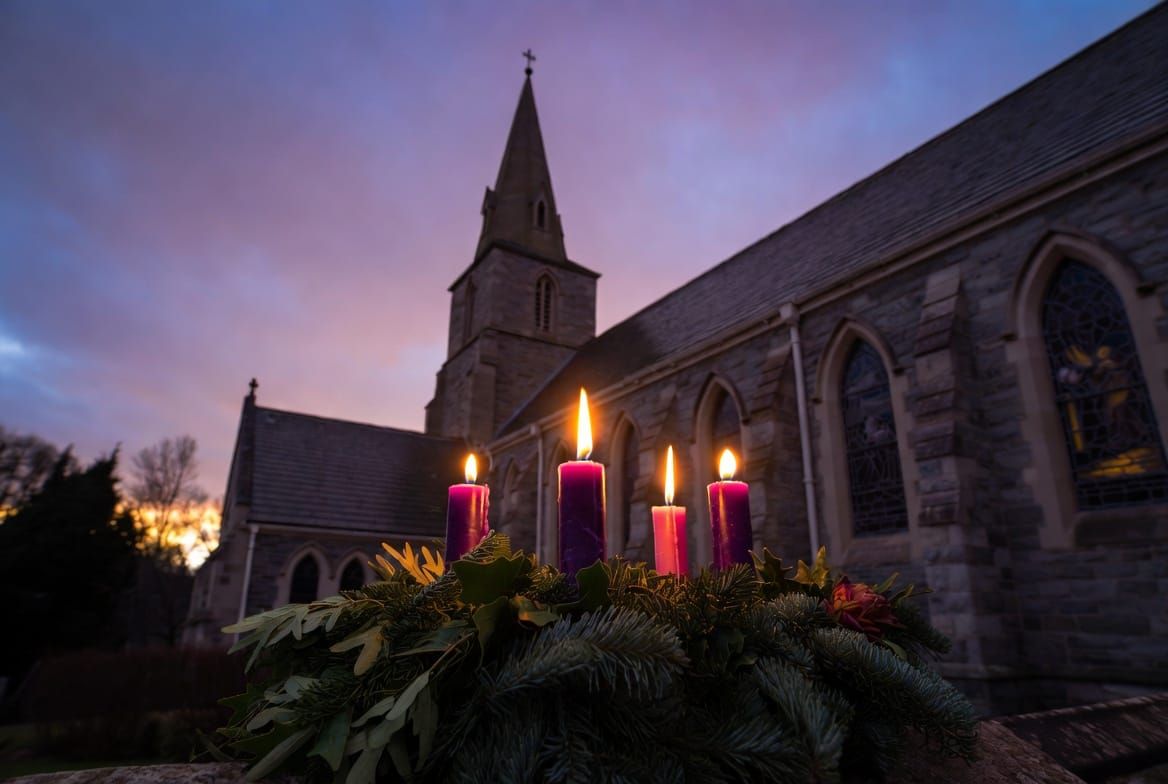
Season of Advent
The Anglican Christian year begins with Advent, four Sundays of preparation, expectation, repentance, and hope leading toward Christmas. Advent is not the Christmas season. It is the season that precedes Christmas, and the distinction matters because where the surrounding culture often fills the weeks before December 25 with celebration and festivity, the Church begins by waiting. Advent is a season of darkness that knows what is coming, an annual schooling in Christian hope.
The BCP 2019 places the season of Advent within the Incarnation Cycle, which is ordered around the Nativity of Our Lord Jesus Christ on December 25. Advent Sunday falls between November 27 and December 3, making it the Sunday nearest Saint Andrew’s Day, November 30, and the season continues through the day before Christmas. The four Sunday Collects are found on pages 598–599, the Proper Preface of Advent on page 153, and the three-year Sunday lectionary begins on page 717. Advent is brief, but its brevity is part of its character: the Church is not invited to settle comfortably into waiting, but to become attentive to the Lord who has come and who will come again.
Advent begins the Christian year because Christian time begins with promise. Before the manger comes expectation; before fulfillment comes the Word of God; before the Church sings of the Savior’s birth, she learns again to long for the Lord who comes. That longing reaches backward toward Bethlehem and forward toward the return of Christ in glory, holding both horizons together without confusing them. The Christian year begins, therefore, not with our achievement but with God’s promise and God’s coming.
The Twofold Coming of Christ
Advent holds two comings of Christ before the Church at once. The first is the coming toward which Christmas looks, the Incarnation, when the eternal Son took our nature from the Virgin Mary and was born in Bethlehem. The second is the coming toward which the Church still looks, the return of Jesus Christ in power and great glory to judge the living and the dead and bring his Kingdom to its final consummation. The Lord who came in humility is the Lord who will come in majesty.
The Collect for the First Sunday in Advent holds both horizons within a single prayer. The Church asks Almighty God to give us grace to cast away the works of darkness and put on the armor of light during this mortal life, remembering that Jesus Christ “came to visit us in great humility” and looking toward the last day when “he shall come again in his glorious majesty to judge both the living and the dead.” (BCP 2019, p. 598) The crucial words come at the beginning: “give us grace.” Advent certainly calls Christians to readiness, repentance, and watchfulness, but even the preparation for which the season calls depends upon God’s prior mercy.
The Proper Preface of Advent gives the season the same twofold horizon. It gives thanks because God sent his beloved Son to redeem us from sin and death and make us heirs in him of everlasting life, so that when Christ comes again in power and great glory to judge the world, we may without shame or fear rejoice to behold his appearing. (BCP 2019, p. 153) That is a searching Advent hope, because the Church is not merely told that Christ will return but taught to desire his appearing. Yet the Judge for whom we wait is also the Savior who first came to redeem us, so Christian watchfulness rests finally upon his mercy rather than upon our ability to make ourselves worthy of his coming.
The Four Sundays of Advent
The four Sundays of Advent have distinct emphases, though the appointed readings vary across the three-year lectionary. Together they move from the return of Christ and the call to watchfulness, through prophetic promise and the ministry of John the Baptist, toward the immediate approach of the Incarnation. The movement is not simply chronological, because every Sunday keeps the whole mystery of Christ before the Church. Advent repeatedly brings first coming and second coming, promise and fulfillment, repentance and hope into the same field of vision.
The First Sunday looks unmistakably toward the end. In Year A, Matthew 24:29–44 speaks of the coming of the Son of Man and warns that his appearing will come unexpectedly; Year B turns to Mark 13:24–37 and the command to stay awake; Year C hears Luke 21:25–33 and Christ’s teaching concerning the coming Son of Man. The Christian year therefore begins not with nostalgia for Bethlehem but with the destination of history. Before the Church remembers the child in the manger, she remembers that this child is the Lord who will come again in glory, and that ordering protects Christmas from sentimentality.
The Second Sunday gives particular prominence to the prophetic Word and to John the Baptist’s ministry of preparation. Across the three years, the Church hears Isaiah, Malachi, and the Gospel witness to the voice crying in the wilderness, “Prepare the way of the Lord.” The Collect gives Anglican Christianity one of its most beloved prayers, asking that we may “hear, read, mark, learn, and inwardly digest” the Holy Scriptures so that through patience and the comfort of God’s Word we may embrace and hold fast the hope of everlasting life. (BCP 2019, p. 598) Advent hope is therefore not vague optimism but hope created and sustained by the promises of God.
The Third Sunday continues the Baptist’s summons and carries a note of rejoicing within the season’s restraint. It is traditionally called Gaudete (gow-DEH-teh) Sunday, from the Latin command to rejoice, and some churches mark it with rose-colored vestments or a rose candle. These customs are traditional rather than BCP requirements, but they express something true about Advent: Christian waiting is not grim endurance because the one who approaches is the Savior. The Collect also connects prophetic preparation with the ministry of the Church, asking that Christ’s ministers and stewards may make ready his way and that at his second coming the Church may be found a people acceptable in his sight. (BCP 2019, p. 599)
The Fourth Sunday draws very near to the mystery of the Incarnation. Year A hears Matthew 1:18–25, with Joseph’s dream, the virginal conception, and the naming of Jesus as Emmanuel; Year B hears Luke 1:26–38 and the Annunciation; Year C hears Luke 1:39–56 and the Visitation, including Elizabeth’s Spirit-filled recognition and Mary’s Magnificat. Yet even at the threshold of Christmas, the Church does not arrive triumphantly prepared. The Collect begins, “Stir up your power, O Lord, and with great might come among us,” and confesses that we are “sorely hindered by our sins,” so that God’s bountiful grace and mercy must help and deliver us. (BCP 2019, p. 599) Advent culminates not in the Church’s successful readiness but in God’s coming to a people who still need grace.
The Advent Lectionary and the Shape of Christian Hope
The Advent lectionary gives the season an extraordinarily wide horizon. It reaches backward into Israel’s prophetic expectation, stands within the ministry of John the Baptist, approaches the mystery of the Incarnation, and looks beyond all of these toward the return of Christ. Isaiah has an especially important place in the Church’s Advent imagination, with visions of the mountain of the Lord, the peaceable Kingdom, the shoot from the stump of Jesse, the wilderness made glad, and the sign of Emmanuel. Other prophets contribute their own promises, while the apostolic readings summon the Church to wakefulness, patience, holiness, prayer, joy, and steadfast expectation.
These readings keep Advent from becoming either historical reenactment or speculative prediction. The Church is not pretending to live before the first coming of Christ, nor is she constructing a detailed timetable for his second. She hears Israel’s promises as fulfilled in Jesus Christ and waits for the same Jesus to bring to completion what his Incarnation, Cross, Resurrection, Ascension, and present reign have already secured. Advent therefore forms Christians to inhabit the already and the not yet: Christ has come, Christ reigns, and Christ will come again.
That threefold confession is important because Christian hope is grounded in accomplished redemption rather than uncertainty about whether God’s purposes will succeed. The future does not hang upon human progress, political stability, or the Church’s ability to produce the Kingdom by her own strength. The risen Christ already reigns at the Father’s right hand, and history moves toward the appearing of the King whose victory has been won. Advent trains the Church to live faithfully in the interval between victory accomplished and victory fully unveiled.
The Character of Advent
Advent has a penitential and preparatory character, but it should not simply be described as a miniature Lent. The characteristic note of Advent is expectation, even though repentance naturally belongs to preparation for the coming of the holy King. Lent is the Church’s concentrated season of fasting and penitential preparation for Easter, while Advent has a quieter austerity shaped especially by watchfulness, readiness, longing, and hope. Both seasons call Christians to repentance, but they place that repentance within different liturgical horizons.
John the Baptist gives Advent its characteristic summons: “Prepare the way of the Lord.” That command is not an invitation to earn Christ’s coming, because the King comes in faithfulness to God’s promises rather than in response to the Church making herself worthy of him. Repentance is itself a work of grace by which God exposes what is crooked, calls sinners home, forgives those who repent, and prepares his people to receive the coming Lord with joy. Advent therefore permits Christians to be serious about sin without becoming preoccupied with themselves, because preparation matters precisely because someone is coming.
This is also why Advent is not simply early Christmas. The distinction tells the truth about the Christian life: we possess promises whose fullness we have not yet seen, Christ has defeated death and yet Christians still stand beside graves, Christ reigns and yet evil still wounds the world, and those justified and adopted by grace still struggle against sin while awaiting the redemption of the body. Advent refuses both despair and premature resolution. The darkness is real, but it is darkness with a promised end.
That makes Advent a particularly merciful season for people who find December difficult. The surrounding culture can make compulsory cheerfulness feel like another burden when someone is grieving, lonely, frightened, disappointed, or exhausted, but Advent does not require Christians to pretend that everything is already as it should be. The season gives sorrow a horizon rather than denying it. Christian waiting differs from despair because our future is not an empty possibility but the promised appearing of Jesus Christ.
Advent and the Kingdom of God
Advent’s eschatology is not primarily an invitation to decode current events or arrange biblical prophecies into an elaborate chronology. Its central confession is simpler and far more demanding: Jesus Christ will come again. The Nicene Creed gives the Church the basic Advent confession whenever Christians proclaim that Christ “will come again in glory to judge the living and the dead, and his kingdom will have no end.” The season teaches us to say those words as hope rather than as an abstract item in a creed.
This fits naturally within the classical Anglican reading of the Kingdom of God. Christ’s reign has not been postponed to a future age, because through his Cross, Resurrection, Ascension, and the outpouring of the Holy Spirit the decisive victory has already been accomplished and the reign of Christ is a present reality. Yet the victory already won has not been manifested in its final fullness. Sin and death remain present realities, the Church still suffers, creation still groans, and the defeated enemy still opposes God’s people within the limits of divine sovereignty.
Christians therefore await not the beginning of Christ’s reign but its unveiled consummation. The dead will be raised, judgment will come, every enemy will finally be placed beneath Christ’s feet, death itself will be destroyed, and creation will be made new. Advent teaches the Church to live within that tension without collapsing either side. The King has come, the King reigns, and the King is coming.
The History of Advent
The history of Advent developed gradually rather than beginning everywhere at once in the form now familiar to Anglicans. By the late fourth and fifth centuries, Christians in parts of the Western Church were observing periods of preparation before the celebration of the Nativity or Epiphany, though their length, beginning, and degree of asceticism varied. Some early Western observances were longer than four weeks and bore a stronger fasting character. Over time, the Roman tradition settled into the four-Sunday Advent familiar to the Western Church, and Advent became the beginning of the ecclesiastical year.
The English Prayer Book tradition received this Western inheritance and gave Advent some of its most characteristic Anglican language. The First Sunday Collect, with its prayer to cast away the works of darkness and put on the armor of light, entered the Book of Common Prayer in 1549, and the Second Sunday Collect’s petition to “hear, read, mark, learn, and inwardly digest” the Scriptures likewise became one of the most recognizable prayers of Anglican spirituality. The BCP 2019 stands within that inheritance with four Sunday Collects, the Proper Preface of Advent, a three-year lectionary, the Great Litany, the winter Ember Days, the Daily Office, and the traditional Advent antiphons. These are not decorative additions around the season but means by which the Church learns to wait in Scripture, repentance, prayer, and hope.
Advent’s history also helps explain why it should not be forced into one simple category. The season has known both penitential and expectant forms, and Anglican practice has inherited elements of both. The result is a season sober enough to call for repentance, yet hopeful enough to rejoice in the Savior who comes. That balance is one of Advent’s great pastoral strengths.
Advent in Anglican Worship and Devotion
Purple is customarily used in Anglican worship during Advent, fitting the season’s royal expectation, sober preparation, and penitential undertone. Some Anglican churches use blue, and rose may appear on the Third Sunday according to local custom, but these variations should not be confused with universal BCP rubrics. The Gloria in Excelsis is often omitted during Advent according to local custom, allowing its return at Christmas to carry greater festal force, while the Alleluia is not characteristically suppressed as it is in Lent. These customs can serve the season well when they direct attention toward Christ rather than becoming tests of liturgical correctness.
The Great Litany has a particular place at the beginning of the season. The BCP states that it is commonly used before the Holy Eucharist on the First Sunday of Advent, giving the opening of the Christian year a fittingly comprehensive posture of repentance, intercession, and dependence upon God. The Daily Office likewise suits Advent’s sustained attentiveness, because Morning and Evening Prayer return the Church repeatedly to Scripture, Psalms, confession, intercession, and praise. In a month easily crowded by activity, the ordinary discipline of prayer can become one of Advent’s most practical gifts.
The Advent wreath is one of the most widespread devotional customs associated with the season, though it is not prescribed by the BCP. Its familiar form places four candles within a circle of evergreen, often with an additional white Christ candle in the center to be lit at Christmas, and its use spread widely in Anglican life from northern European practice in the nineteenth and twentieth centuries. Candle colors and assigned themes vary, and familiar labels such as Hope, Peace, Joy, and Love are devotional conventions rather than ancient universal assignments. The appointed Scriptures and Collects provide a richer and more authoritative account of the Sundays themselves.
The wreath’s basic visual lesson remains useful. As Advent advances, another candle is lit and the light increases, not because human beings are gradually overcoming darkness by their own effort but because the Church is approaching the celebration of the Light who comes from outside us. Used alongside Scripture and prayer, the wreath can become simple household catechesis for children and adults alike. Its value lies not in possessing the correct arrangement of candles but in teaching Christian waiting to have direction.
Advent hymnody performs similar work. O Come, O Come, Emmanuel gives the Church the repeated prayer come, Come, Thou Long-Expected Jesus joins Israel’s consolation to Christ’s rule in the human heart, and Lo! He Comes with Clouds Descending turns unmistakably toward the return of the crucified and risen Lord. These hymns do more than provide seasonal atmosphere. They teach theology by teaching Christians what to desire, forming congregations to long for Christ himself rather than merely for the emotions, traditions, and cultural comforts associated with December.
The Advent Ember Days and the O Antiphons
The winter Ember Days fall within Advent and are one of four sets of Ember Days in the Christian year. The BCP identifies them as the Wednesday, Friday, and Saturday after Saint Lucy’s Day, December 13, and the Collects also note them in the week following the Third Sunday in Advent. Ember Days are set apart particularly for prayers for those called to Holy Orders and may also be kept with fasting. Their placement is fitting because the Church awaiting her Lord also prays for those who will preach his Word, administer his Sacraments, shepherd his people, and prepare his way through faithful ministry.
The Ember Days should not be used to turn the whole of Advent into a BCP-mandated fasting season equivalent to Lent. The Prayer Book encourages every Friday of the year outside the Twelve Days of Christmas and the Fifty Days of Eastertide as a day of fasting, and Ember Days may also be kept in this way. Advent therefore includes genuine ascetical discipline without being defined by the same fasting pattern as Lent. A Church longing for her Lord should be serious both about repentance and about praying for faithful shepherds who will keep pointing his people toward Christ.
The final days of Advent intensify the Church’s longing through the traditional O Antiphons, ancient prayers addressing Christ through biblical titles. Here the BCP 2019 preserves a particularly useful pattern in its calendar: beginning on December 16 with O Sapientia, it continues with O Adonai, O Radix Jesse, O Clavis David, O Oriens, O Rex Gentium, O Emmanuel, and on December 23 O Virgo Virginum. The Prayer Book also suggests in Family Prayer that households might sing the corresponding verse of O Come, O Come, Emmanuel each night beginning December 16. The sequence reflects older Western patterns in which the familiar seven antiphons were sometimes supplemented by additional antiphons.
Each antiphon gathers a strand of biblical promise and turns it into prayer. Christ is addressed as Wisdom, Lord, Root of Jesse, Key of David, Dayspring, Desire of Nations, Emmanuel, and finally in the additional antiphon through the mystery of the Virgin who bore him. The Church does not merely meditate upon concepts such as wisdom, light, kingship, covenant, and deliverance but calls upon Jesus Christ as the fulfillment of those promises. The closer Christmas comes, the more specifically Advent names the one for whom it has been waiting.
Observing Advent
To observe Advent well, begin by allowing it to remain Advent. There is no need to become hostile toward Christmas music heard in a shop or to turn liturgical discipline into a contest with neighbors who decorate early, because the point is not to become the Advent police. The purpose is to let the Church’s calendar give Christian households and congregations a different center of gravity. Advent teaches restraint not for restraint’s sake but so that longing for Christ can become audible beneath the noise of December.
Pray the Collect appointed for each Sunday throughout the following week. The First asks for grace to cast away darkness, the Second grounds hope in Holy Scripture, the Third prays for ministries that prepare Christ’s way, and the Fourth asks the Lord himself to come with power because sin has hindered us. Together they form a remarkably complete rule of Advent prayer. They also keep preparation rooted in divine initiative, because at every stage the Church receives before she acts and asks for grace before she speaks of obedience.
Read the appointed Scriptures and pay particular attention to the prophets and to John the Baptist. Allow the First Sunday’s eschatological Gospel to unsettle complacency, but hear it as a Christian who knows who is coming. The Son of Man who comes as Judge is the same Jesus who first came to save his people from their sins. During the final days, use the BCP’s O Antiphons or the corresponding verses of O Come, O Come, Emmanuel, and keep the winter Ember Days with prayer for bishops, priests, deacons, seminarians, ordinands, and those discerning a vocation, with fasting where appropriate.
Advent is also an appropriate occasion for self-examination. Ask what works of darkness still need to be cast away, where repentance is required, what has dulled watchfulness, whether some earthly loyalty has become too important, and whether ordinary priorities reflect the conviction that Jesus Christ will come again. Those questions should not produce frantic attempts at self-repair. They should lead where the First Sunday Collect already leads, give us grace, because the Church prepares for Christ by receiving again the mercy of the Christ for whom she waits.
There will also be circumstances in which Advent’s waiting becomes painfully concrete. A prayer remains unanswered, reconciliation has not come, grief continues, the world appears deeply disordered, or a Christian simply grows tired of waiting for things to be made right. Advent does not answer those experiences by demanding greater cheerfulness but by giving them a horizon. The world is not waiting for us to save it; it is awaiting the appearing of its King, and Christians can acknowledge what remains broken without surrendering to despair because the future rests in the hands of the risen and reigning Christ.
Conclusion
Advent is the Church’s annual school of hope. It teaches Christians to wait neither with passive resignation nor with vague optimism but with confidence in the Lord who has already come and who has promised to come again. The prophets longed for him, John prepared his way, the Virgin received the Word in faith, and the Church now lives within the redemption he has accomplished while waiting for its final consummation. Every part of the season turns attention toward Jesus Christ.
The Collects give that hope its proper grammar. The Church asks for grace to cast away darkness, receives hope through Holy Scripture, prays that Christ’s ministers will prepare his way, and finally asks the Lord himself to come with power because we remain hindered by sin. Advent therefore never allows Christian preparation to become confidence in our own readiness. Grace precedes repentance, sustains watchfulness, and carries the Church toward the one she awaits.
Advent does not finally end in the Church’s successful preparation. It ends in God’s coming. The darkness is real, the waiting can be long, and much remains unfinished, but none of those things has the final word. The one who came among us in great humility is the risen and reigning Lord who will come again in glorious majesty, and the Church learns each Advent to wait for Jesus Christ with repentance, faith, and hope.