Saint Andrew the Apostle: An Anglican Perspective
Today is the Feast of Saint Andrew. The collect prays for grace to follow without delay and to bring those near to us into his gracious presence. That is Andrew’s entire ministry in one sentence. He heard, he came, he brought someone with him.
December 1, 2025, Holy Day, Saint Andrew the Apostle
Matthew 4:18–22, Psalm 19, Romans 10:8b–18, Deuteronomy 30:11–14
Drop the Nets
Grace, mercy, and peace from God our Father and the Lord Jesus Christ be with you on this Holy Day of Saint Andrew the Apostle.
Saint Andrew’s Day always stands near the beginning of Advent. Sometimes November 30 comes just before the First Sunday of Advent, and sometimes Advent has already begun. That is fitting, because Advent tells us that the Lord comes, and Andrew gives us a picture of what happens when the Lord comes near and calls a man to follow him. The pattern of Andrew’s life is remarkably simple: Christ calls him, Andrew follows, and Andrew begins bringing others to Jesus.
The Collect appointed for this day gathers that pattern into a prayer. Almighty God, the Church says, gave Andrew such grace that he readily obeyed the call of Jesus Christ and brought his brother with him. Then we ask God to give us that same grace, so that we may follow Christ without delay and bring those near to us into his gracious presence. Notice where the prayer begins. It does not begin with Andrew’s courage, his personality, or his natural gift for evangelism. It begins with God: “you gave such grace to your apostle Andrew.” Everything else follows from there. Grace comes first, Christ calls, Andrew responds, and the man who has been brought to Jesus begins bringing others.
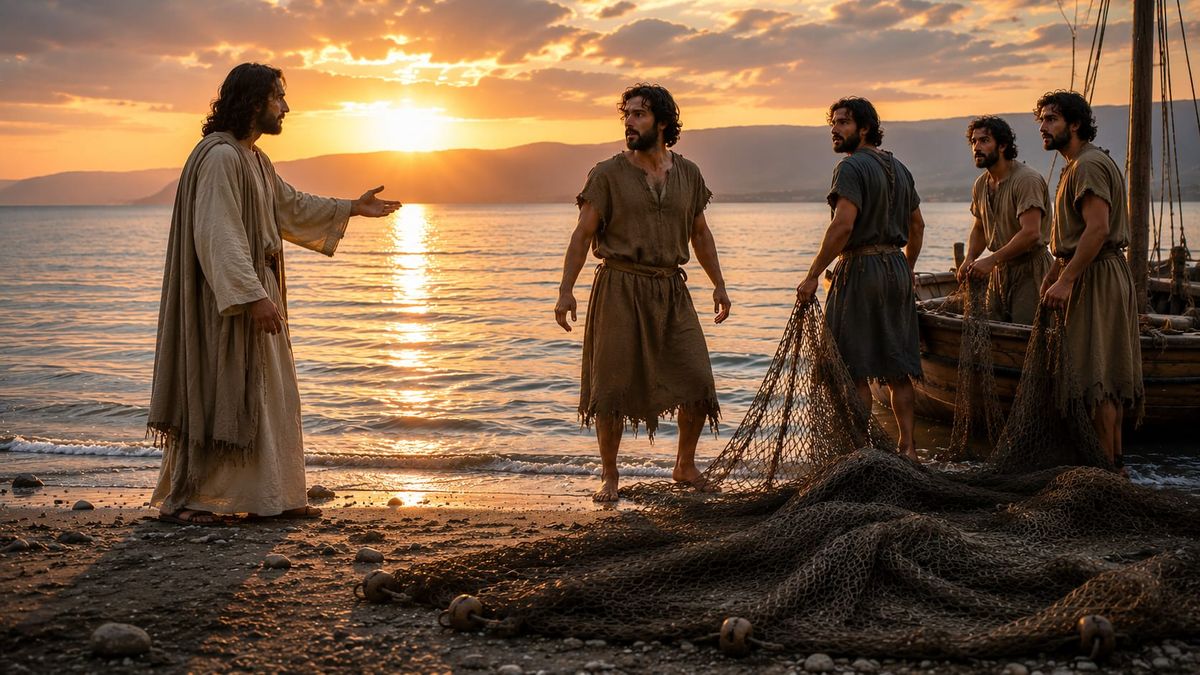
Our Gospel begins with that call. Matthew tells us in verse 18 that Jesus is walking beside the Sea of Galilee when he sees two brothers, Simon who is called Peter and Andrew his brother, casting a net into the sea, “for they were fishermen.”(Matthew 4:18, ESV) There is nothing extraordinary about what they are doing. They are at work, earning a living, doing what they have presumably done for years. Jesus comes into the middle of that ordinary life and says in verse 19, “Follow me, and I will make you fishers of men.” (Matthew 4:19, ESV)
Jesus does not begin by asking whether Andrew feels spiritually prepared. He does not offer him a program of self-improvement and tell him to return when he has completed it. He does not wait until Andrew has arranged his life so that discipleship will be convenient. Christ comes to Andrew where he is and calls him. That is where discipleship always begins. It begins not with our search for God, but with God’s gracious approach to us. Christ speaks before Andrew follows. The command is real, and Andrew’s obedience will be real, but underneath the obedience stands the grace of the Lord who has come near and called him.
Matthew tells us the response in verse 20: “Immediately they left their nets and followed him.” (Matthew 4:20, ESV) The word is eutheōs (yoo-THEH-ohs), immediately, at once, without delay. That is why the Collect for Saint Andrew is so beautifully matched to this Gospel. God gave Andrew grace to obey Christ readily, and the Church asks for grace to follow Christ without delay. Jesus continues down the shore, sees James and John with their father Zebedee mending their nets, calls them also, and Matthew again tells us that “immediately they left the boat and their father and followed him.”(Matthew 4:22, ESV) Twice in four verses Matthew makes us hear that word.
We should feel the force of it. Jesus speaks with authority, and these men act. Nets are left, a boat is left, and a familiar life is left behind. They do not yet understand everything discipleship will mean. They do not know what awaits them at Caesarea Philippi, Gethsemane, the Cross, the empty tomb, Pentecost, or the mission to the nations. They know the one who is calling them, and for now that is enough to follow.
That does not mean every Christian must leave a profession, abandon a business, or walk away from ordinary responsibilities. Most of us are called to follow Christ precisely within the places where he has put us. But it does mean that no part of our life can be placed beyond the reach of his call. When Jesus says, “Follow me,” we do not get to answer, “Yes, Lord, after I have finished everything else I wanted to do.” The question Saint Andrew puts before us is not whether we own literal fishing nets. It is what we are still holding that Christ has told us to release.
Perhaps it is a sin we have decided we will deal with later. Perhaps it is a resentment we continue to tend rather than forgive. Perhaps our identity has become so tied to career, money, reputation, comfort, politics, or control that obedience to Christ has become something we try to fit around a life already organized without him. Perhaps there is some act of faithfulness we have discussed with ourselves for months while continuing to delay it. The Collect gives us the prayer we need: Lord, give us grace to follow without delay.
But Andrew’s story does not stop with his own response to Jesus. John’s Gospel takes us to an earlier moment and gives us another part of his character. Andrew had been a disciple of John the Baptist. When John sees Jesus and says, “Behold, the Lamb of God!” Andrew and another disciple follow Jesus and spend the day with him. Then John tells us what Andrew does next: “He first found his own brother Simon and said to him, ‘We have found the Messiah’ (which means Christ). He brought him to Jesus.” (John 1:41–42, ESV)
That may be the most characteristic sentence Scripture gives us about Andrew: he brought him to Jesus. Andrew does not give Simon an elaborate theological lecture, pressure him into a decision, or promise that he can answer every question Simon might have. He tells his brother what he has discovered, “We have found the Messiah,” and brings him to Jesus. Andrew has no idea what Jesus will eventually do with Simon. He cannot see Pentecost, cannot imagine Peter standing before thousands proclaiming the Resurrection, and cannot foresee Peter’s confession, his failures, his restoration, or his place among the apostles. Andrew simply knows that he has found Christ, and someone near to him needs to meet him too.
That phrase in the Collect is worth hearing carefully: “those near to us.” The apostolic mission ultimately reaches every tribe and tongue and people and nation, but Andrew’s first missionary field is his own family. Before distant peoples and great missionary journeys, there is Simon. That is wonderfully ordinary, and perhaps uncomfortably practical, because for most of us “those near to us” are not abstractions. They have names. They may sit across the table from us, live next door, work beside us, or belong to our own family.
Sometimes those are the hardest people to speak to because their response matters so much to us. We know their objections and their history. We know the awkwardness that might follow if the conversation does not go well. It can therefore be easier to speak generally about evangelism than to pray seriously about the person whose phone number is already in our contacts. Andrew does not give us a technique for controlling that person’s response, and that is part of the freedom of his example. He cannot create faith in Simon, determine Peter’s future, or imagine what Christ will eventually make of him. He brings his brother, and the outcome belongs to the Lord.
That distinction matters because evangelism becomes either prideful or crushing when we forget it. If we imagine that another person’s conversion finally depends upon our persuasiveness, success can make us proud and failure can make us despair. But salvation belongs to the Lord. Our calling is to pray, speak truth, love genuinely, invite faithfully, bear witness to Christ, and bring people as best we can into his gracious presence. Andrew does not make Simon into Peter. He brings Simon to Jesus, and Jesus does what only Jesus can do.
Andrew appears in that same role again later in John’s Gospel. In John 6, thousands of people need food, and Andrew notices a boy with five barley loaves and two fish. He knows perfectly well that the little meal is inadequate and asks, “What are they for so many?” (John 6:9, ESV) Yet he brings what is available to Jesus. Andrew cannot solve the problem, but he can bring what he has found into Christ’s presence, and Jesus takes what is hopelessly inadequate in the disciples’ hands and makes it sufficient by his own power.
Then in John 12 some Greeks come to Philip and say, “Sir, we wish to see Jesus.” (John 12:21, ESV) Philip goes to Andrew, and together they take the request to Christ. Once again Andrew stands near the point of introduction. A brother, a boy with loaves, Greeks who want to see the Lord: Andrew keeps bringing people and needs to Jesus. The pattern is remarkably consistent. He is not always the loudest apostle or the one standing at the center of the story, but when someone needs to be brought toward Christ, Andrew is often nearby.
There is a lesson there for the whole Church because we spend enormous energy worrying about what we do not have. We do not have enough people, enough money, enough influence, enough time, or enough answers. We look at five loaves and two fish and say with Andrew, “What are they for so many?” In our hands they may indeed be very little, but the Church’s hope has never rested in the sufficiency of what we bring. Our hope is in the sufficiency of Christ. Andrew’s task is to bring what he has; multiplication belongs to Jesus.
Our Epistle from Romans 10 widens that personal pattern into the mission of the whole Church. Paul begins with the nearness of the saving Word: “The word is near you, in your mouth and in your heart,” and he identifies it as “the word of faith that we proclaim.” (Romans 10:8, ESV) He continues, “if you confess with your mouth that Jesus is Lord and believe in your heart that God raised him from the dead, you will be saved.” (Romans 10:9, ESV) The Gospel is not a ladder by which we climb toward God. Paul takes up the language of Deuteronomy 30 to tell us that we do not ascend into heaven to bring Christ down or descend into the abyss to bring him up from the dead. God has acted. Christ has come, Christ has died, Christ has risen, and the saving Word has been brought near.
That is why Paul can say, “Everyone who calls on the name of the Lord will be saved.” (Romans 10:13, ESV) Salvation is not reserved for the impressive, the morally accomplished, the religious expert, or the person who manages to become worthy before coming to Jesus. The Gospel announces what God has done in Christ, and faith receives the Savior who is proclaimed. Then, having spoken of salvation received, Paul turns immediately toward mission: “How then will they call on him in whom they have not believed? And how are they to believe in him of whom they have never heard? And how are they to hear without someone preaching?” (Romans 10:14, ESV) He asks how anyone will preach unless sent and then quotes Isaiah: “How beautiful are the feet of those who preach the good news!” (Romans 10:15, ESV)
Andrew gives us a human picture of that movement. He hears testimony concerning Jesus, he follows, he believes, and almost immediately he goes looking for Simon. The Gospel comes to Andrew, but it does not stop with Andrew. That is not because Andrew becomes the source of someone else’s salvation. Christ remains the source from beginning to end. But the Christ who saves sinners also sends witnesses, and God ordinarily places the saving Word in human mouths so that other human ears may hear.
Psalm 19 gives us another image of proclamation. “The heavens declare the glory of God, and the sky above proclaims his handiwork.” (Psalm 19:1, ESV) Day pours out speech to day and night reveals knowledge to night. Creation itself bears witness to its Creator, and then the Psalm turns from creation to God’s revealed Word: “The law of the Lord is perfect, reviving the soul.” (Psalm 19:7, ESV) Creation announces the glory of God, while his Word speaks clearly, reveals his will, exposes sin, and directs his people toward righteousness.
For Andrew, that movement is almost tangible. He spent his working life beneath those heavens and on that water, surrounded by the witness of creation. Then one day the Lord himself came walking beside the sea and said, “Follow me.” The man who had lived beneath heavens declaring God’s glory heard the living Word address him personally, and his life changed direction. The Psalm eventually turns proclamation inward with the prayer, “Let the words of my mouth and the meditation of my heart be acceptable in your sight, O Lord, my rock and my redeemer.” (Psalm 19:14, ESV) The Word that goes outward must first take hold of the heart and mouth of the one who receives it.
So Saint Andrew’s Day puts two questions before us, and they belong together. First, what obedience are we delaying? Christ may not be telling us to leave a fishing boat on the Sea of Galilee, but there are still nets we cling to when he has called us forward. The prayer of the Church is not, “Lord, make us naturally decisive people.” It is, “Give us grace to follow without delay.” We ask because even the obedience is gift before it becomes response.
The second question is: who is near to us? Who have we stopped praying for because nothing seems to change? Who needs an invitation? Who needs to hear that Christ is not merely an idea, a cultural inheritance, or a religious institution, but the risen Lord who receives sinners? Who needs a Christian friend willing to say, in words suited to the relationship, “Come and see”? We cannot manufacture repentance or raise the spiritually dead, but neither should we use God’s sovereignty as an excuse for silence. The God who saves is also the God who sends.
And perhaps someone here needs to hear the Gospel before hearing the call to become Andrew. Before we can bring anyone to Jesus, we ourselves must be brought to him. Maybe you have imagined that Christianity begins with becoming better, that before you can come to Christ you must clean up the worst parts of your life, overcome the sin that embarrasses you, become more disciplined, learn more theology, or somehow prove that your repentance is sincere enough. But Jesus comes to fishermen holding nets and says, “Follow me,” and Romans tells us that the Word has already been brought near.
Christ has already come down to us. He has taken our nature, borne our sin upon the Cross, died the death sinners deserve, and God has raised him from the dead. The promise is not that everyone who makes himself worthy will be saved. The promise is, “Everyone who calls on the name of the Lord will be saved.” Come to him with the sins you cannot fix, the guilt you cannot erase, and the life you cannot straighten out by yourself. Jesus Christ is the Lamb of God who takes away sin, the risen Lord whom Andrew found, and the Savior who receives all who call upon him in faith.
If you belong to Christ already, then Andrew’s example becomes wonderfully simple. Hear Christ’s call and do not make peace with delayed obedience. Look at those near to you and do not assume that someone else will eventually speak. Bring what you have and whom you can into Christ’s gracious presence, knowing that your adequacy was never the foundation of the mission. Andrew does not make Simon into Peter, does not multiply the loaves, and does not save the nations. He brings people and needs to Jesus, and Christ remains the one who does what only Christ can do.
As we come to the Lord’s Table, that order matters. We come first as people who need to receive. We do not approach because our obedience has been swift enough or our witness faithful enough, but because Christ gave himself for us and continues to feed his Church with the benefits of his once-for-all sacrifice. The Lord who called Andrew beside the sea nourishes his people by grace, and those who receive from him are then sent back into the world to bear witness to him. Christ gives before we give, Christ calls before we follow, and Christ saves before we bear witness.
Almighty God gave such grace to his apostle Andrew that he readily obeyed the call of Jesus Christ and brought his brother with him. May God give us that same grace: grace to hear the voice of Christ, grace to follow him without delay, grace to bring those near to us into his gracious presence, and grace to trust him with what follows. Andrew’s enduring witness is not complicated. He found the Messiah, he brought someone to Jesus, and he trusted Christ to do the rest.
In the Name of the Father, and of the Son, and of the Holy Spirit. Amen.