All Saints' Day 2025 (Revelation 7:9-17)
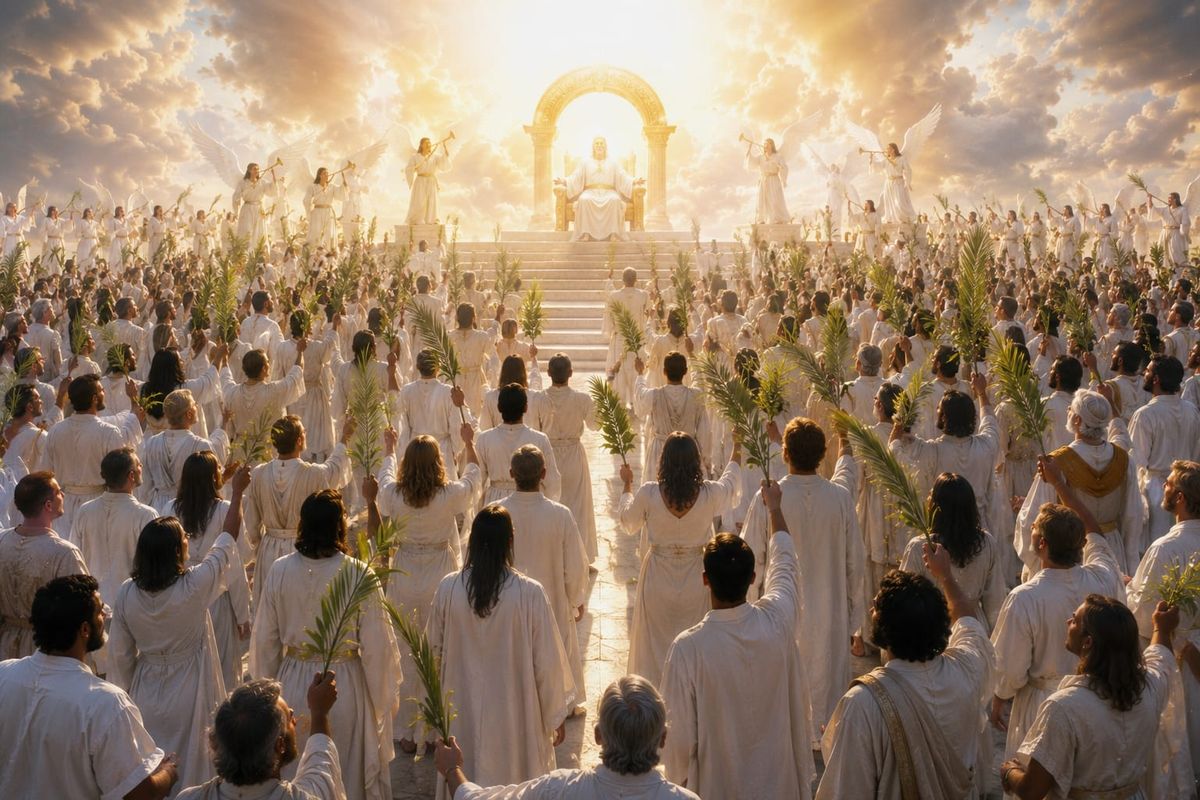
On All Saints' Day, John's vision in Revelation 7 draws back the curtain: a multitude beyond counting, from every nation, robed in white, crying "Salvation belongs to our God." Their earthly woes become heavenly blessings, and the Eucharist becomes our foretaste of that great assembly.
November 2, 2025, Year C, All Saints' Day, Season after Pentecost
Revelation 7:9–17, Psalm 149, Luke 6:20–26
Grace to you and peace from our Lord Jesus Christ. Today, we celebrate All Saints' Day, a feast that draws our eyes heavenward to the great cloud of witnesses who have gone before us. In the Anglican tradition, this day reminds us of our connection to the communion of saints, those faithful departed who now stand in God's eternal presence. Let me offer a brief history, as it roots us in the rich soil of Church tradition.
All Saints' Day traces its origins to the early Christian Church, where the faithful martyrs who had given their lives for the Gospel were honored on the Sunday after Pentecost in the East. By 609, Pope Boniface IV rededicated the Pantheon in Rome to St. Mary and All Martyrs on May 13; in the eighth century, Pope Gregory III consecrated a chapel in St. Peter's Basilica to all saints, known and unknown, on November 1, possibly to align with existing harvest festivals or to Christianize pagan customs around the dead. This set the date for All Saints' Day for the West. The day entered the English Church long before the Reformation, and Thomas Cranmer retained it in 1549, purging only the invocation of saints while keeping the thanksgiving for their example.
The Book of Common Prayer designates All Saints' Day as a principal feast, often observed on November 1 or the Sunday following. It serves not only to remember famous saints like Augustine or Teresa but also the unknown faithful, the everyday believers whose lives reflected Christ's light. This day affirms the Anglican belief in the communion of saints, as articulated in the Apostles' Creed, where we profess a mystical unity between the Church militant here on earth and the Church triumphant in heaven. It is a day of joy, not mourning, inviting us to anticipate our own place in that heavenly assembly.
With that foundation, let us turn to John's vivid vision in Revelation 7:9–17, where he beholds a scene that captures the essence of All Saints' Day. Here, we see the saints not as distant figures but as a living multitude, worshiping before the throne. This passage is not merely apocalyptic imagery; it is a promise of hope, a foretaste of the kingdom where God's people from every corner of creation find rest and redemption.
John writes in verse 9: "After this I looked, and behold, a great multitude that no one could number, from every nation, from all tribes and peoples and languages, standing before the throne and before the Lamb, clothed in white robes, with palm branches in their hands." (Revelation 7:9, ESV) Imagine the scene: an uncountable crowd, diverse beyond measure. Not a homogenous gathering, but a diversity of humanity, every nation, tribe, people, and language represented. This is the fulfillment of God's promise to Abraham, that his descendants would be as numerous as the stars, blessing all nations through his seed (Genesis 15:5; 22:18). In this multitude, we see the saints of All Saints' Day embodied: apostles and martyrs, reformers and mystics, the famous, ordinary and forgotten, all united in praise.
What unites them? Their position before the throne and the Lamb. The throne symbolizes God's sovereign rule, and the Lamb, Christ Jesus, slain yet standing, represents the sacrificial love that redeems. They are clothed in white robes, signifying purity and victory, washed not in their own righteousness but in the blood of the Lamb, as we will see later. Palm branches evoke the triumphal entry of Jesus into Jerusalem (John 12:13), but here it is the saints' triumphant entry into God's presence.
This image challenges our often insular views of the Church. In a world divided, Revelation reminds us that God's kingdom is radically inclusive, drawing his elect from every culture. For Anglicans, who span the globe from Canterbury to Cape Town, from Brazil to Canada, from the US to Asia, this vision affirms our global communion.
The multitude cries out in verse 10: "and crying out with a loud voice, 'Salvation belongs to our God who sits on the throne, and to the Lamb!'" (Revelation 7:10, ESV) Salvation is not earned but belongs to God. It is a declaration of dependence, echoing the Anglican emphasis on grace alone, as in Article XI of the Thirty-Nine Articles: "We are accounted righteous before God, only for the merit of our Lord and Saviour Jesus Christ by Faith."
This multitude is not boasting in their deeds but ascribing all glory to the one who saves. On All Saints' Day, we honor the saints not for their inherent holiness but for how God's grace shone through them. Think of St. Francis of Assisi, whose poverty mirrored Christ's, or Julian of Norwich, whose revelations of divine love sustained her through plague and isolation. Their lives point to the Lamb, not themselves.
The scene expands in verses 11–12: "And all the angels were standing around the throne and around the elders and the four living creatures, and they fell on their faces before the throne and worshiped God, saying, 'Amen! Blessing and glory and wisdom and thanksgiving and honor and power and might be to our God forever and ever! Amen.'" (Revelation 7:11–12, ESV) Here, the heavenly host joins in, a cosmic amen to the saints' cry. The elders and living creatures, symbols of creation and the Church, prostrate themselves. This is worship in its purest form, unhindered, eternal adoration.
Now, let our psalm, Psalm 149, burst into this heavenly chorus like a trumpet call: "Praise the Lord! Sing to the Lord a new song, his praise in the assembly of the godly! Let Israel be glad in his Maker; let the children of Zion rejoice in their King! Let them praise his name with dancing, making melody to him with tambourine and lyre! For the Lord takes pleasure in his people; he adorns the humble with salvation. Let the godly exult in glory; let them sing for joy on their beds. Let the high praises of God be in their throats and two-edged swords in their hands, to execute vengeance on the nations and punishments on the peoples, to bind their kings with chains and their nobles with fetters of iron, to execute on them the judgment written! This is glory for all his godly ones. Praise the Lord!" (Psalm 149:1–9, ESV)
The palm branches are not mere symbols; they are instruments of this praise. The saints wave them in rhythm, voices soaring in a new song. The two-edged swords are the word of God (Hebrews 4:12), wielded not in violence but in triumphant worship, binding evil and executing judgment through the Lamb's victory. God takes pleasure in his people, adorning the humble, the very multitude, with salvation. This psalm animates the throne room: the saints exult in glory, their praise a weapon against darkness, their dance a celebration of the King who reigns.
This heavenly worship connects profoundly to our Anglican Eucharistic theology. In the Book of Common Prayer, the Eucharistic prayer includes the Sanctus, where we join our voices with "angels and archangels, and with all the company of heaven." From an Anglican viewpoint, Communion affirms a real presence: Christ is truly present by the power of the Holy Spirit, spiritually conveyed by faith to believers when receiving it rightly.
In the Anglican rite, the prayer of consecration invokes the Holy Spirit upon the gifts, making them effective signs of Christ's presence. When we receive, we are united to Christ and to one another, including the saints. This Eucharistic fellowship bridges earth and heaven, as in Revelation's worship. Just as the multitude serves before the throne with palm-waving praise, our Eucharistic liturgy mirrors that heavenly banquet, infused with Psalm 149's joy.
We join angels and saints in the Sanctus: "Holy, holy, holy." On All Saints' Day, the Eucharist becomes a portal to that multitude, where we dance in spirit with tambourine and lyre, our voices adding to the new song. The bread is Christ's body, broken yet victorious; the wine, his blood, washing us white. Receiving, we exult in glory, high praises in our throats, the two-edged sword of Scripture in our hearts.
The elder questions John in verses 13–14: "Then one of the elders addressed me, saying, 'Who are these, clothed in white robes, and from where have they come?' I said to him, 'Sir, you know.' And he said to me, 'These are the ones coming out of the great tribulation. They have washed their robes and made them white in the blood of the Lamb.'" (Revelation 7:13–14, ESV) John's humility, "Sir, you know," models our approach to mystery. The elder reveals their identity: survivors of the great tribulation. Tribulation here is not just end-times peril but the ongoing trials of faith, persecution, suffering, doubt, sickness, grief, fear, and all other unpleasantries. The saints on All Saints' Day knew this: early martyrs like Polycarp burned at the stake, or Anglican Reformation forebears, like Thomas Cranmer, executed for his reforms. Yet they emerge victorious, robes washed white in the Lamb's blood.
This washing is paradoxical, blood stains, yet here it purifies. It is the atoning blood of Christ, as in Hebrews 9:14, cleansing conscience. In the Eucharist, we partake of this blood, our robes continually washed. Imagine the chalice lifted, crimson wine gleaming; as it touches your lips, feel the cleansing flow, linking you to the saints who endured tribulation with Psalm 149's praise on their tongues, even in chains like the Apostle Paul.
Luke 6:20–26 illuminates this: "Blessed are you who are poor, for yours is the kingdom of God. Blessed are you who are hungry now, for you shall be satisfied. Blessed are you who weep now, for you shall laugh. Blessed are you when people hate you… Rejoice in that day, and leap for joy, for behold, your reward is great in heaven." (Luke 6:20–23, ESV) Then the woes: "But woe to you who are rich, for you have received your consolation. Woe to you who are full now, for you shall be hungry. Woe to you who laugh now, for you shall mourn and weep. Woe to you, when all people speak well of you." (Luke 6:24–26, ESV)
This reversal echoes Revelation's promise and Psalm 149's adornment of the humble. The saints, often poor, hungry, weeping, persecuted, find satisfaction before the throne, exulting in glory. Their earthly woes become heavenly blessings, their praise a two-edged sword against complacency. In the Eucharist, we taste this reversal: the poor enriched, the hungry filled, the weeping comforted, all while singing a new song with the godly assembly.
Continuing in Revelation, verse 15: "Therefore they are before the throne of God, and serve him day and night in his temple; and he who sits on the throne will shelter them with his presence." (Revelation 7:15, ESV) "Therefore," because of the Lamb's blood, they serve eternally. Service here is worship, not drudgery, in God's temple, which is heaven itself (Revelation 21:22). God shelters them, like a tent in the wilderness, evoking the tabernacle. This presence is intimate; God dwells with them, fulfilling Immanuel, which means "God with us."
In Anglican Eucharistic theology, this sheltering presence is tasted in Communion. The sacrament is participation, koinonia (pronounced koy-no-NEE-ah), in Christ's body (1 Corinthians 10:16). As Article XXVIII states, "The Supper of the Lord is… a Sacrament of our Redemption by Christ's death." Receiving, we are sheltered by his presence, united to the saints who serve day and night with Psalm 149's melody. All Saints' Day Eucharist thus becomes a foretaste, where we join the heavenly liturgy, our praise dancing with theirs.
The promises deepen in verse 16: "They shall hunger no more, neither thirst anymore; the sun shall not strike them, nor any scorching heat." (Revelation 7:16, ESV) Echoing Isaiah 49:10, this reverses earthly suffering. No more famine, drought, oppression. For saints like the Desert Fathers, who fasted in harsh conditions, or modern Anglicans in war-torn regions, this is profound comfort. Luke's hungry are satisfied, the weeping laugh, adorned with salvation as in the psalm.
Finally, verse 17: "For the Lamb in the midst of the throne will be their shepherd, and he will guide them to springs of living water, and God will wipe away every tear from their eyes." (Revelation 7:17, ESV) The Lamb as shepherd blends images, slain yet guiding. He leads to living water, eternal life (John 4:14). God wipes tears, intimate consolation.
At the altar, the Lamb shepherds us to these springs in the cup, tears eased by grace. Picture God's hand brushing sorrow as you receive, a rehearsal of heaven's joy, high praises rising.
Applications flow naturally. First, recognize the diversity of God's kingdom: like the multitude, praising with one voice. Second, endure tribulation: saints' stories, fueled by Psalm 149's exultation, inspire resilience. Third, embrace the beatitudes: comfort the afflicted, challenge the comfortable, knowing reversal awaits. Fourth, partake of the Eucharist faithfully: it is union with Christ and the saints, a dance of victory. Fifth, let praise be active: wave metaphorical palms in daily life, sing new songs, wield Scripture's sword against evil.
Consider practical steps. Arrive at church imagining the threshold as heaven's gate; during the Sanctus, envision saints leaning in; at consecration, see the Spirit hover; in reception, open hands to living water; in dismissal, carry the dance outward.
In conclusion, Revelation 7, infused with Psalm 149's joy and Luke's reversals, invites us to All Saints' climax. The Eucharist is our entry: washing, sheltering, guiding. May we, by grace, join that multitude, white-robed, palm-waving, dancing, crying, "Salvation belongs to our God who sits on the throne, and to the Lamb!"
In the Name of the Father, and of the Son, and of the Holy Spirit. Amen.