Stones Fall, Faith Stands (Luke 21:5-19)
As Advent approaches, the lectionary turns our eyes toward judgment and hope. Jesus warns of trials, Malachi promises a book of remembrance for the faithful, and Psalm 98 calls creation to sing. By endurance we gain our lives, and the sun of righteousness rises with healing.
November 16, 2025, Year C, Proper 28, Season after Pentecost
Luke 21:5–19, Malachi 3:13–4:6, Psalm 98
Good morning. Today, I would like to invite you to consider the liturgical calendar. Our lectionary serves as a spiritual compass, guiding us through the seasons of the Church year with wisdom and foresight. Even though the official start of Advent is still a few weeks away, on November 30, 2025, the readings assigned for these late Season after Pentecost Sundays already resonate with Advent's core themes: anticipation, preparation, judgment, and the promise of Christ's coming. It is as if the lectionary extends Advent backward, creating what some have called a "pre-Advent" or an "extended Advent" period that begins in mid-November and builds momentum toward the Nativity.
This turn toward Advent is evident in the progression of the readings. For instance, in Year C of the lectionary cycle, which we are currently observing, the Sundays of Proper 28 (today) and Christ the King (next week) shift our focus from the everyday teachings of Jesus during his ministry to apocalyptic visions of the end times, the day of the Lord, and the establishment of God's kingdom. Today, we delve into Luke 21:5–19, foretelling destruction, persecution, and endurance, complemented by Malachi's warnings of judgment and healing, and Psalm 98's exuberant call to praise. Next week, on Christ the King Sunday, the texts will exalt Christ's sovereign rule over all creation, bridging directly into Advent 1's emphasis on his return.
This lectionary structure echoes ancient Church practices. This extended Advent serves a vital purpose: it counters the secular rush to Christmas commercialism that bombards us from early November onward. Instead of jumping straight to twinkling lights and decorations, we are invited to linger in the tension of the "already but not yet," Christ has come, yet he will come again. By meditating on themes of tribulation and triumph now, we prepare our hearts to receive the Incarnation not as a cozy holiday story, but as the pivotal event in God's redemptive history, pointing forward to the consummation of all things.
It is a call to vigilance, urging us to live with eternity in view, repenting of complacency, and cultivating hope in God's ultimate justice. In a world marked by uncertainty, political tensions, natural disasters, moral decay, this extended Advent reminds us that history is headed toward a glorious resolution in Christ.
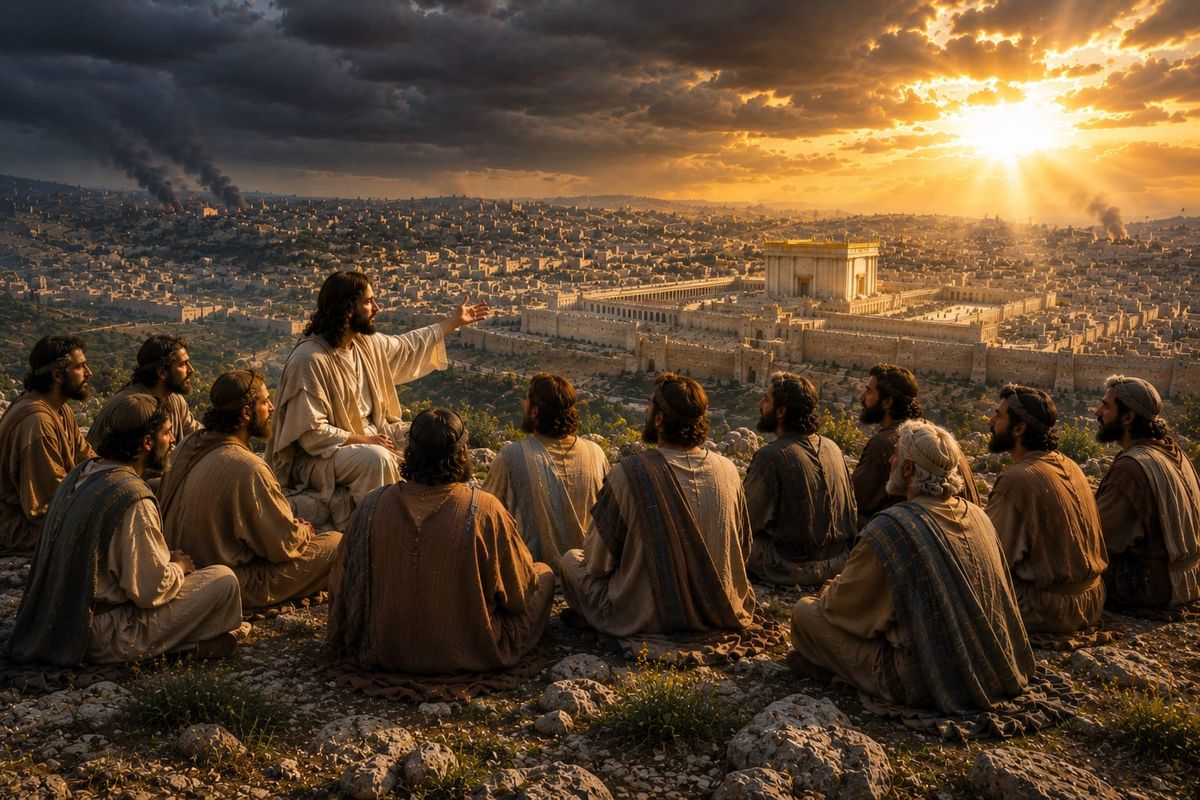
Let us now turn our attention to the heart of our sermon, the Gospel reading from Luke 21:5–19. This passage is part of Jesus' Olivet Discourse, delivered during his final week in Jerusalem, just before the Passion. The scene is vivid: Jesus and his disciples are in the temple precincts, where the massive temple structure stands as a symbol of God's presence and Israel's identity. The temple was a marvel of the ancient world. Pilgrims from afar would gaze in awe, much like tourists today at grand cathedrals. Some disciples remark on its splendor in verse 5: "And while some were speaking of the temple, how it was adorned with noble stones and offerings." (Luke 21:5, ESV)
Jesus' response is jarring, prophetic, and unflinching in verse 6: "he said, 'As for these things that you see, the days will come when there will not be left here one stone upon another that will not be thrown down.'" (Luke 21:6, ESV) This is not hyperbole; it is a foretelling of historical fact. In AD 70, Roman legions razed the temple and left it in ruins, fulfilling Jesus' words to the letter. But Jesus speaks on multiple levels. The temple's destruction symbolizes the death of the old order centered on the temple, making way for the New Covenant, for both Jew and Gentile, through his death and resurrection. It also prefigures the ongoing trials in a fallen world, and ultimately the greater tribulations of the end time, the birth pangs of the age to come.
The disciples inquire further in verse 7: "And they asked him, 'Teacher, when will these things be, and what will be the sign when these things are about to take place?'" (Luke 21:7, ESV) We can imagine their urgency, wanting dates, timelines, clear indicators. In our era of doomsday predictions and apocalyptic fiction, we too crave specifics. But Jesus redirects, offering guidance rather than a calendar. He begins with a warning against deception in verse 8: "And he said, 'See that you are not led astray. For many will come in my name, saying, "I am he!" and, "The time is at hand!" Do not go after them.'" (Luke 21:8, ESV) History is littered with such impostors. Even subtler are ideological messiahs: political saviors promising utopia, or spiritual gurus blending truth with error, or teachers hyper-focused on speculative end-times timelines. Jesus urges discernment, rooted in his word.
He continues with signs of turmoil in verse 9: "And when you hear of wars and tumults, do not be terrified, for these things must first take place, but the end will not be at once." (Luke 21:9, ESV) Then, more detail, he continues in verses 10–11: "Then he said to them, 'Nation will rise against nation, and kingdom against kingdom. There will be great earthquakes, and in various places famines and pestilences. And there will be terrors and great signs from heaven.'"(Luke 21:10–11, ESV) These are not the immediate end but the characteristic marks of this age, the end times and tribulation we have been in since Jesus ascended. Wars, in our lifetimes, think of the World Wars, Vietnam, Afghanistan, Iraq, ongoing conflicts in the Middle East and Eastern Europe. Earthquakes, devastating ones in Haiti, Japan, Turkey. Hurricanes and famine in other places. Pestilences, for crops and people alike, as we saw with COVID-19. Terrors and heavenly signs evoke cosmic disruptions, the kind of unusual celestial events that periodically draw public attention and speculation. Jesus' point: these are inevitable in a fallen creation, but they do not signal instant apocalypse. "Do not be terrified," a command to trust God's control.
The passage pivots to personal cost in verse 12: "But before all this they will lay their hands on you and persecute you, delivering you up to the synagogues and prisons, and you will be brought before kings and governors for my name's sake." (Luke 21:12, ESV) Persecution is the lot of disciples. In the early Church, this meant arrests by Jewish authorities and Roman trials, as in Acts. Today, it is global: Christians facing imprisonment in North Korea, blasphemy laws in Pakistan, violence against believers in Nigeria, and in the West, cultural marginalization for holding biblical convictions on issues like marriage, sexuality, or abortion. Yet Jesus reframes it positively in verse 13: "This will be your opportunity to bear witness." (Luke 21:13, ESV) Note, he did not say, "I will snatch you away before you suffer persecution," but rather, "This will be your opportunity to bear witness." While Paul writes in 1 Thessalonians, "the Lord himself will descend from heaven with a cry of command, with the voice of an archangel, and with the sound of the trumpet of God. And the dead in Christ will rise first. Then we who are alive, who are left, will be caught up together with them in the clouds to meet the Lord in the air…" (1 Thessalonians 4:16–17, ESV), that happens at his return, not before. Rather, Jesus tells us that our suffering becomes testimony.
Jesus then offers practical counsel in verses 14–15: "Settle it therefore in your minds not to meditate beforehand how to answer, for I will give you a mouth and wisdom, which none of your adversaries will be able to withstand or contradict."(Luke 21:14–15, ESV) No need for anxious rehearsal; the Holy Spirit provides eloquence. Think of Martin Luther's "Here I stand."
The trials intensify in verses 16–17: "You will be delivered up even by parents and brothers and relatives and friends, and some of you they will put to death. You will be hated by all for my name's sake." (Luke 21:16–17, ESV) Family betrayal cuts deepest, as in divided households during the Reformation or current conversions in Muslim-majority countries. Death is real, millions martyred across centuries. Yet the promise is in verses 18–19: "But not a hair of your head will perish. By your endurance you will gain your lives." (Luke 21:18–19, ESV) This paradox, death yet no ultimate harm, points to resurrection life. Endurance is key, not as self-reliant strength but faithful reliance on God, gaining the soul even if the body perishes.
Luke's vision of endurance amid chaos finds resonance in Malachi 3:13–4:6, the prophetic reading that the lectionary pairs with it. Malachi, writing around 430 BC to a post-exile Judah disillusioned by unfulfilled promises, confronts a people grumbling against God. They say: "It is vain to serve God. What is the profit of our keeping his charge or of walking as in mourning before the Lord of hosts? And now we call the arrogant blessed. Evildoers not only prosper but they put God to the test and they escape." (Malachi 3:14–15, ESV) This cynicism mirrors our age: why follow God when the corrupt thrive? Those with power evade justice, the unjust hold positions of influence, while the faithful struggle.
God's response in Malachi is tender yet firm. He notices the remnant: "Then those who feared the Lord spoke with one another. The Lord paid attention and heard them, and a book of remembrance was written before him of those who feared the Lord and esteemed his name." (Malachi 3:16, ESV) This "book" symbolizes divine record-keeping, like Daniel's or Revelation's, ensuring faithfulness is remembered. God declares: "They shall be mine, says the Lord of hosts, in the day when I make up my treasured possession, and I will spare them as a man spares his son who serves him. Then once more you shall see the distinction between the righteous and the wicked, between one who serves God and one who does not serve him." (Malachi 3:17–18, ESV) The "treasured possession" echoes Exodus 19:5, affirming covenant loyalty. The distinction, obscured now, will be clear.
Then, the dramatic prophecy of the day: "For behold, the day is coming, burning like an oven, when all the arrogant and all evildoers will be stubble. The day that is coming shall set them ablaze, says the Lord of hosts, so that it will leave them neither root nor branch." (Malachi 4:1, ESV) This fiery judgment recalls Sodom or the prophets' warnings, consuming evil utterly. But contrast the faithful: "But for you who fear my name, the sun of righteousness shall rise with healing in its wings. You shall go out leaping like calves from the stall. And you shall tread down the wicked, for they will be ashes under the soles of your feet, on the day when I act, says the Lord of hosts." (Malachi 4:2–3, ESV) The "sun of righteousness" is a glorious image, likely messianic, evoking Christ's light bringing healing, physical, spiritual, communal. Leaping calves capture joy after confinement, like liberation from Egypt or resurrection life.
Malachi concludes with calls to obedience and preparation: "Remember the law of my servant Moses, the statutes and rules that I commanded him at Horeb for all Israel. Behold, I will send you Elijah the prophet before the great and awesome day of the Lord comes. And he will turn the hearts of fathers to their children and the hearts of children to their fathers, lest I come and strike the land with a decree of utter destruction." (Malachi 4:4–6, ESV) Remembering the law means covenant renewal; Elijah, fulfilled in John the Baptist, brings repentance and familial reconciliation.
These themes dovetail beautifully with Luke. The temple's stones thrown down parallel Malachi's burning day, both signifying judgment on unfaithfulness. Persecution in Luke echoes the distinction in Malachi, the righteous spared, the wicked consumed. Endurance gains life; fearing God's name brings healing. Jesus embodies the sun of righteousness, rising from the tomb with healing for the nations. The lectionary's pairing invites us to see Jesus' words as fulfillment of Malachi's prophecy, urging preparation for the day through repentance and faithfulness.
Amid these sober notes of judgment and trial, Psalm 98 bursts forth like a symphony of hope, tying the texts together with joy. This psalm, one of the "enthronement psalms," celebrates God's kingship through salvation and judgment. It begins: "Oh sing to the Lord a new song, for he has done marvelous things! His right hand and his holy arm have worked salvation for him. The Lord has made his salvation known and revealed his righteousness to the nations. He has remembered his love and his faithfulness to the house of Israel; all the ends of the earth have seen the salvation of our God." (Psalm 98:1–3, ESV) The "new song" is for fresh acts of deliverance, like the exodus or, ultimately, Christ's cross and resurrection. Salvation is revealed globally, fulfilling Abraham's blessing, the father of many nations whose descendants are more numerous than the stars or grains of sand on the beach.
The call widens: "Make a joyful noise to the Lord, all the earth; break forth into joyous song and sing praises! Sing praises to the Lord with the lyre, with the lyre and the sound of melody! With trumpets and the sound of the horn make a joyful noise before the King, the Lord!" (Psalm 98:4–6, ESV) Instruments evoke temple worship, but now all earth is invited. Then, creation itself participates: "Let the sea roar, and all that fills it; the world and those who dwell in it! Let the rivers clap their hands; let the hills sing for joy together before the Lord, for he comes to judge the earth. He will judge the world with righteousness, and the peoples with equity." (Psalm 98:7–9, ESV) Personified nature, roaring seas, clapping rivers, anticipates Romans 8's creation groaning for redemption.
In context, this psalm bridges Luke and Malachi. The "marvelous things" include the temple's role, but transcend it to Christ's salvation. The judgment in Malachi's oven and Luke's tumults leads to this equitable rule, where righteousness prevails. Praise is not despite judgment but because of it, God sets right the wrongs, vindicating the persecuted, healing the broken. Psalm 98 calls us to sing now, foretasting the joy of Christ's coming.
What, then, are the applications for our lives? First, cultivate vigilance in a deceptive world. As Jesus warns, false christs abound, in cults, in ideologies, even in churches with watered-down gospels. Test everything by Scripture, as the Bereans did (Acts 17). In community, like Malachi's faithful, encourage one another to esteem God's name.
Second, refuse terror in turbulent times. Our own era brings its share of unrest, geopolitical tension, natural disasters, social upheaval. Jesus says, "do not be terrified." Instead, see them as signs of his return, and respond with compassion, feeding the hungry, visiting the sick, serving faithfully to the end as Matthew 25 enjoins.
Third, view persecution as witness. For us, it might mean workplace discrimination or social ostracism for faith. Globally, it is life-threatening. But remember your trial could be someone's salvation.
Fourth, hope in divine distinction and healing. Malachi's cynics question faithfulness's profit; our culture does too. Yet God remembers. Live as a treasured possession, serving, giving, forgiving. Await the sun of righteousness, who heals addictions, broken relationships, societal ills.
Fifth, practice repentance and reconciliation. Malachi's Elijah call echoes Advent's John the Baptist: "Repent!" Turn hearts, fathers to children, bridging generational divides in families and Church. Now is the time to reconcile.
Sixth, embrace joyful praise. Psalm 98 is not optional; it is command. In worship, sing the new song, whether through great choral works, modern hymns, or simply a posture of praise and thanksgiving. Let praise shape your daily life, turning anxiety to anticipation.
Seventh, live eschatologically in this extended Advent. Order priorities: eternal over temporal. Develop resurrection eyes. Invest in kingdom work, evangelism, justice, discipleship. As the lectionary turns us toward Christ's coming, let it transform us into watchful, hopeful, scripturally grounded disciples.
In conclusion, as we navigate this season, let Luke's endurance, Malachi's day, and Psalm 98's song propel us. The temple falls, tumults rage, but by endurance we gain life. The arrogant burn, but the sun rises with healing. Creation groans, but soon sings. This extended Advent prepares us for both manger and throne. May we, fearing his name, leap like calves into his light.
In the Name of the Father, and of the Son, and of the Holy Spirit. Amen.