Christ Above All: Christ the King Sunday 2025 (Luke 23:35-43)
Today, on the final Sunday of that Extended Advent, Christ the King Sunday gives us the purest possible picture of the coming King: not riding on the clouds with armies of angels (we will see that later), but reigning now, already, from the throne of the cross.
November 23, 2025, Year C, Christ the King Sunday, Season after Pentecost
Luke 23:35-43, Psalm 46, Colossians 1:11-20
Grace and peace to you from Jesus Christ, the faithful witness, the firstborn from the dead, and the ruler of the kings of the earth on this Christ the King Sunday.
This morning we have come to the end of another church year. Next Sunday the blue candles will appear, and we will step once more into the dark with Isaiah and John the Baptist, crying out for the heavens to be torn open and the Lord to come. But before we are allowed to begin that four-week Advent longing, the church plants itself firmly on the last Sunday of the year and refuses to let us move forward until we have looked, really looked, at the goal toward which all history is racing.
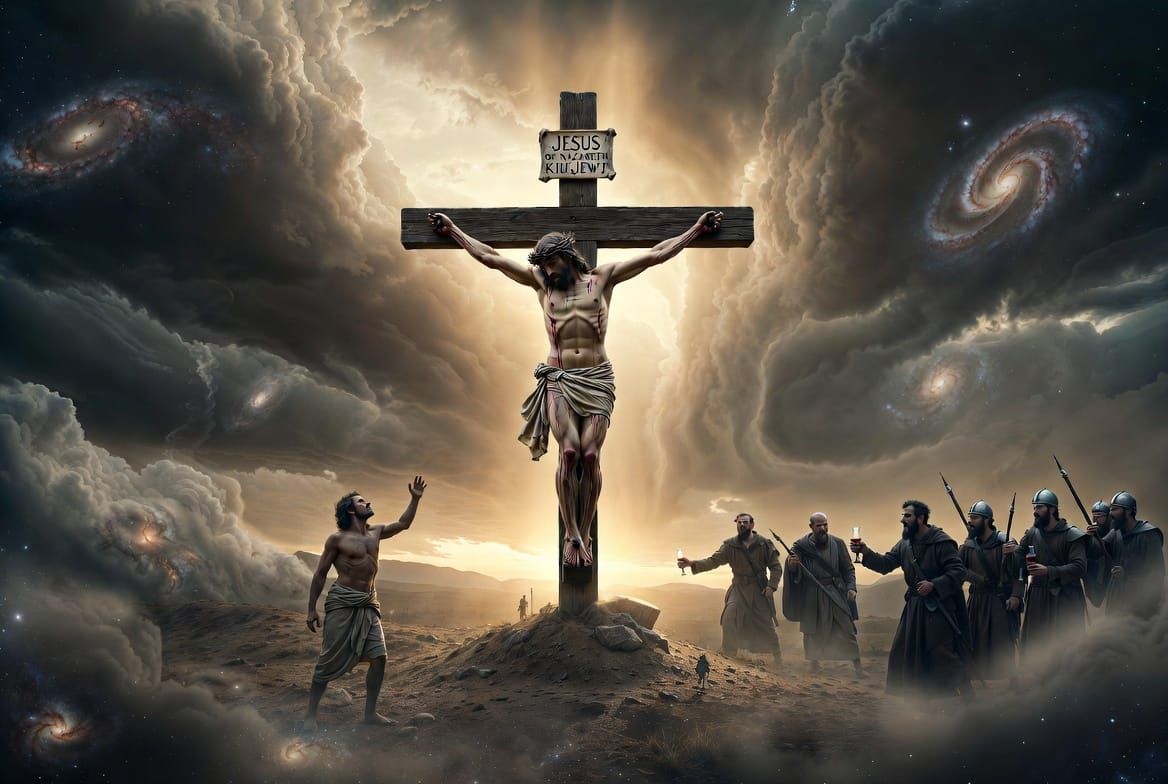
We will primarily be looking at our Gospel passage this morning, Luke 23:35-43. Luke takes us outside the city gate to a barren hill called The Skull, lifts our eyes to a naked, bleeding man dying in agony between two criminals, a mocking placard nailed above his head in Hebrew, Latin, and Greek declaring THIS IS THE KING OF THE JEWS, and with breath-taking, almost scandalous courage the church says: “Behold your King!” (John 19:14, ESV) Though Pilate was being sarcastic, his words were true.
That is much of the meaning of this day we call Christ the King Sunday. The feast is exactly one hundred years old this very month. In 1925 the world was already on its knees before new caesars. Mussolini had marched on Rome three years earlier and was forging the first fully totalitarian state of the modern age. Adolf Hitler had published the first volume of Mein Kampf that same year and was gathering the brown-shirted legions that would soon set the continent ablaze. Joseph Stalin was quietly eliminating rivals and preparing the terror that would murder tens of millions. Everywhere the fragile social order was collapsing, and frightened people were trading ancient God-given freedoms for the promise of a strong leader who would make the nation a utopia, by any means necessary.
Pope Pius XI looked at the rising cult of the omnipotent state and the omnipotent leader and responded with one of the boldest liturgical acts in centuries. He established the Solemnity of Our Lord Jesus Christ, King of the Universe, and placed it at the close of the liturgical year so that the church would end every liturgical year by proclaiming that history has one true Lord, and his name is not Caesar, not Duce, not Führer, not General Secretary; his name is Jesus.
By the time the 1979 Prayer Book and the Revised Common Lectionary were shaped, Anglicans had gladly taken the feast in, and it has been kept on this same hinge Sunday between the passing year and the coming of Advent. Christ the King Sunday is the church’s great refusal to let any earthly power have the last word. It is the final trumpet blast before we begin again with the prophets’ cry: “Oh that you would rend the heavens and come down!” (Isaiah 64:1, ESV).
And this year that trumpet blast lands in a season of extended Advent. It is a deliberate recovery of the ancient pattern of the Christian year. In the early church, and in many Anglican provinces still, the final weeks of Pentecost were never the sleepy green “ordinary time” of late summer. They were weeks of mounting eschatological intensity. The church lived the last Sundays of the year as an extended preparation for the coming of the King, first in humility at Bethlehem, and finally in glory at the end of the age. That is what our lectionary has restored. Today, on the final Sunday of that Extended Advent, the lectionary gives us the purest possible picture of the coming King: not riding on the clouds with armies of angels (we will see that soon enough), but reigning now, already, from the throne of the cross.
So let us go to the cross. It is nine o’clock in the morning, maybe a little later. The road from the praetorium has been loud with grief and mockery. Jesus has been flogged so severely that he cannot carry the crossbeam; Simon of Cyrene is yanked from the crowd to do it for him. Women follow, beating their breasts and wailing the traditional laments, and Jesus, even bone-tired and bleeding, turns to them and warns them of worse days coming for Jerusalem.
They reach the place of the Skull. The soldiers work with practiced brutality. The victim is thrown to the ground, arms stretched along the cross, spikes driven through wrists (the flesh of the palms would tear), then the feet. The cross is lifted and dropped into its socket with a jolt that dislocates shoulders and tears a cry from raw throats. Above Jesus’ head Pilate has ordered the inscription nailed: JESUS OF NAZARETH, KING OF THE JEWS, written in the three great languages of the world so that no one misses the joke. The chief priests protest the wording, “He claimed to be king” (John 19:21), but Pilate, in one of his few moments of spine, refuses to change it. The joke is on them all, of course. The inscription is true.
Four groups gather around the cross that morning, and Luke records their words like hammer blows.
First the rulers, the religious elite who have spent three years trying to trap this man and have finally succeeded. They sneer in verse 35, “He saved others; let him save himself, if he is the Christ of God, his Chosen One!” (Luke 23:35, ESV). The irony is thick enough to choke on. He did save others, the bleeding woman, the ten lepers, the widow’s son at Nain, Lazarus days dead, a tax collector up a tree, a woman caught in adultery, a Roman centurion’s servant without even crossing the threshold. He saved others. But he will not save himself, because the only way to save others is to refuse to save himself.
Second, the soldiers in verse 37. They offer sour wine, the cheap vinegar of the ranks, and laugh, “If you are the King of the Jews, save yourself!” (Luke 23:37, ESV). To them a king has legions and palaces and the power to kill or let live. They cannot imagine a kingship that conquers by dying.
Third, one of the criminals hanged beside him. Pain makes us cruel, and he lashes out with the same demand in verse 39: “Are you not the Christ? Save yourself and us!” (Luke 23:39, ESV).
But the fourth voice is different. The other criminal, tradition names him Dismas, meaning “good thief,” but Luke leaves him nameless so that any of us can step into his place, has heard something the others have not. Perhaps it is the prayer Jesus has just prayed in verse 34: “Father, forgive them, for they know not what they do.” (Luke 23:34, ESV). Whatever it is, grace cracks him open. He turns to the mocker on the other cross and says in verses 40-41, “Do you not fear God, since you are under the same sentence of condemnation? And we indeed justly, for we are receiving the due reward of our deeds; but this man has done nothing wrong.” (Luke 23:40–41, ESV). Then, with his last strength, he turns his bleeding face toward Jesus and prays the most audacious prayer ever prayed on this earth in verse 42: “Jesus, remember me when you come into your kingdom.” (Luke 23:42, ESV).
He does not ask to be taken down from the cross. He does not bargain. He simply trusts that this broken man beside him somehow has a kingdom, and that death is not strong enough to keep him out of it. And Jesus, who has been silent under every taunt, answers him with the full authority of the King he is in verse 43: “Truly, I say to you, today you will be with me in paradise.” (Luke 23:43, ESV).
Today. Not after some purgatory, not after a thousand-year earthly reign, not after the final resurrection. Today. The kingdom is so real that even while the King is still drawing ragged breaths, paradise is already opening. The thief dies a condemned man under Roman law, but he dies a citizen of the age to come, because the King has declared it so from the throne of the cross.
That is the coronation we celebrate on this last Sunday of Extended Advent.
Paul helps us see how cosmic this coronation is. Writing to a tiny house church in Colossae, he bursts into a hymn that must have stunned his first hearers:
“He is the image of the invisible God, the firstborn of all creation. For by him all things were created, in heaven and on earth, visible and invisible, whether thrones or dominions or rulers or authorities, all things were created through him and for him. And he is before all things, and in him all things hold together… For in him all the fullness of God was pleased to dwell, and through him to reconcile to himself all things, whether on earth or in heaven, making peace by the blood of his cross.” (Colossians 1:15–20, ESV).
Pause on that last phrase. The one who holds the galaxies together is now being torn apart. The one through whom the quarks and quasars were spoken into being is nailed motionless. The one who is before all things is pinned in time and space between two thieves. And Paul says this is how peace is made, not by overwhelming force from a distance, but by absorbing the worst the powers can do and exhausting their fury on his own body.
Psalm 46 sings the same song in the language of earthquake and war: “God is our refuge and strength, a very present help in trouble. Therefore we will not fear though the earth gives way, though the mountains be moved into the heart of the sea… The nations rage, the kingdoms totter; he utters his voice, the earth melts… ‘Be still, and know that I am God. I will be exalted among the nations, I will be exalted in the earth!’” (Psalm 46:1–10, ESV).
On Good Friday the earth did give way, darkness at noon, the temple veil torn, the dead stirring in their graves. The nations raged in perfect bipartisan harmony, Rome and Jerusalem together nailing the Lord of glory to a cross. And right in the center of the chaos, God was in the midst of the city, bleeding. The refuge was a dying man. The fortress had pierced hands and feet. The river that makes glad the city of God began to flow from his pierced side.
Because the King reigns from that tree, the entire Extended Advent we have been living these last weeks is not a season of terror but of fierce, defiant hope. The wars and rumors of wars, the temples thrown down, the signs in sun and moon and stars, all of it is under the authority of the crucified King who has already disarmed the powers and made peace by the blood of his cross.
So what does it look like, right now, in the final hours of Extended Advent, to live as subjects of this crucified King?
It looks, first, like refusing to save ourselves at the expense of others. When the culture screams “look out for number one,” we remember the King who refused to come down from the cross so that others might live. That might mean opening our homes to those with whom we disagree when the news tells us to be afraid. It might mean speaking up for the unborn and the elderly when both political parties find them inconvenient. It might mean absorbing the cost of someone else’s failure at work or in the family rather than making sure we come out on top. The King saved others by refusing to save himself; his people do the same.
It looks, second, like praying the thief’s prayer in the ordinary places. “Jesus, remember me…” (Luke 23:42, ESV) when the diagnosis is bad, when the child walks away from faith, when the marriage is hanging by a thread, when the election did not go our way, when the bank account is empty, when depression settles in like winter. We do not ask to be taken out of the trouble; we ask only to be remembered by the One who has a kingdom. And because he has already promised “today,” we discover that paradise is not only future; it begins the moment we are with him in the trouble.
It looks, third, like practicing forgiveness. The King’s first word from the throne was “Father, forgive them” (Luke 23:34, ESV). In a culture that keeps meticulous score of every offense, we choose to cancel the debt. We forgive the family member who wounded us decades ago. We forgive the colleague who threw us under the bus. We forgive the stranger on the internet who called us heretics or traitors. Forgiveness is not weakness; it is the power of the age to come breaking into this age. It is how the kingdom advances, one cancelled debt at a time.
It looks, fourth, like Sabbath-keeping as rebellion. The world says productivity is salvation. The crucified King says rest is built into the fabric of creation and sealed by resurrection. So we turn off the screens, close the laptops, set down the phones, and practice the ancient discipline of delighting in God and in the people he has given us. In a 24/7 economy of outrage and hustle, Sabbath is a declaration that the crucified King, not the market, not the algorithm, not the culture, gets to set the rhythm of our days.
It looks, fifth, like bearing faithful witness without fear. The early Christians conquered the Roman Empire not by taking it over but by out-living and out-dying it. When plagues struck, they stayed and nursed the sick while everyone else fled. When persecution came, they sang on their way to the arena. They lived as if the King on the cross had actually defeated death, because he had. We are called to the same fearless witness.
And when the long preparation feels heavy, when the signs of the end seem too close and the coming of the King seems too slow, we hear again the voice from the middle cross speaking to every thief, every failure, every weary pilgrim who dares to ask: “Truly, I say to you, today you will be with me in paradise.” (Luke 23:43, ESV).
Today, yes, even this broken today, the kingdom is as near as the crucified King who still breathes forgiveness from the throne of the cross.
So, lift up your heads. The year is ending, but the King reigns. Extended Advent is almost over, and ordinary Advent is about to begin. The crucified King is coming, first as a child in Bethlehem, finally as the Judge and Bridegroom of the world. Therefore we do not lose heart. Though the earth give way and the nations rage, we will not fear. The crucified King reigns. Come quickly, Lord Jesus.
In the Name of the Father, and of the Son, and of the Holy Spirit. Amen.