Christ Revealed To All Nations: Epiphany Sunday 2026 (Matthew 2:1-12)
First Sunday in Epiphany: Today we explore the Magi's journey to worship the newborn king (Matthew 2), Paul's unveiling of Gentile inclusion (Ephesians 3:1-13), and Psalm 72's vision of universal blessing; all pointing to a God whose light is for all nations, Jew and Gentile alike.
January 11, 2026, Year A, The First Sunday of Epiphany, Season of Epiphany
Matthew 2:1–12, Psalm 72, Ephesians 3:1–13
Grace, mercy, and peace to you from our Lord Jesus Christ on this First Sunday of Epiphany, as we enter into a season of revelation and light.
Epiphany, from the Greek word epiphaneia (eh-pee-FAH-nee-ah), meaning “manifestation” or “appearing,” marks the showing forth of Christ to the world. I sometimes think of it as a kind of anticipatory “mini-Pentecost,” not because Epiphany and Pentecost are the same event, but because Epiphany already reveals the universal horizon that Pentecost will later display so dramatically. At Epiphany, Gentiles come to worship Israel’s Messiah. At Pentecost, the Holy Spirit empowers the apostolic Church to proclaim that Messiah among the nations.
Today, we turn our hearts to the story of the Magi in Matthew 2:1–12, where wise men from the East, outsiders to Israel’s covenant life, come to worship the newborn King. We will also draw from Ephesians 3:1–13, where Paul unveils the mystery of Gentile inclusion, and Psalm 72, a royal Psalm that echoes the themes of kingship and universal blessing. Through these texts, we will see how God’s plan has always been to gather the nations into the blessing promised through Israel and fulfilled in Jesus Christ.
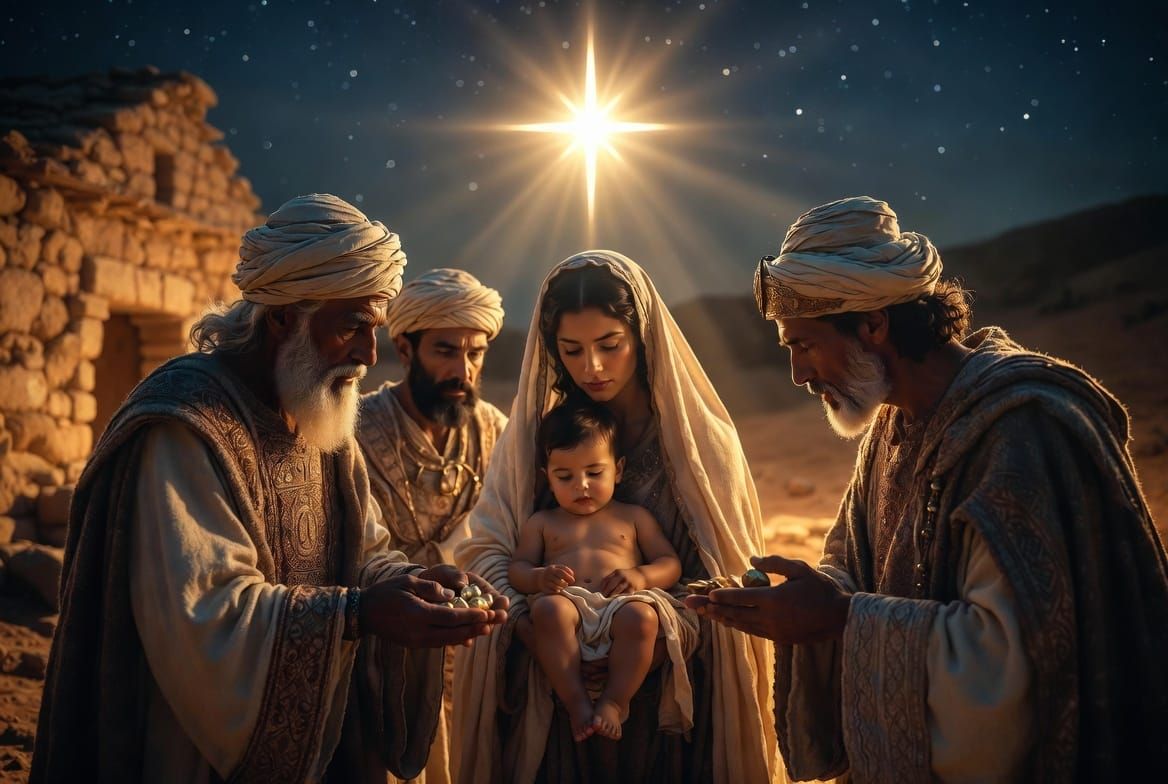
Our primary passage is Matthew 2:1–12. This passage is not merely a charming tale of star-gazing travelers; it is a profound declaration of God’s purpose for the nations. Matthew writes in verses 1–2: “Now after Jesus was born in Bethlehem of Judea in the days of Herod the king, behold, wise men from the east came to Jerusalem, saying, ‘Where is he who has been born king of the Jews? For we saw his star when it rose and have come to worship him.’” (Matthew 2:1–2, ESV)
Who are these wise men, these Magi? In the ancient world, Magi could be learned men associated with astrology, courtly wisdom, dream interpretation, or priestly learning in the East. Persia or Babylonia are plausible suggestions, but Matthew simply tells us that they came “from the east.” What matters most here is that they are Gentiles. They stand outside Israel’s covenant people, yet they are being drawn toward Israel’s King. They do not possess covenant membership by birth, but the promises made to Abraham always included the blessing of the nations. Now that promise is beginning to take visible form as Gentiles journey toward Abraham’s promised offspring.
It is a reminder that God can use the created order itself to direct people toward the truth, as the Psalmist declares in Psalm 19:1: “The heavens declare the glory of God, and the sky above proclaims his handiwork.” (Psalm 19:1, ESV) The star does not become an endorsement of astrology, and God does not leave the Magi with the heavens. He leads them toward Israel’s Scriptures and ultimately toward Israel’s Messiah. Their journey already foreshadows the Gospel’s reach as representatives of the nations come to worship the King.
But notice the contrast. While the Magi seek to worship, Herod is troubled in verses 3–4: “When Herod the king heard this, he was troubled, and all Jerusalem with him; and assembling all the chief priests and scribes of the people, he inquired of them where the Christ was to be born.” (Matthew 2:3–4, ESV) Herod was of Idumean ancestry rather than of the Davidic royal line, and he ruled Judea as Rome’s client king. He therefore represents earthly power confronted by a kingship it cannot control. His trouble spreads through Jerusalem because the arrival of the true King threatens the established order.
Why? Because the arrival of the true King upends the status quo. The chief priests and scribes know the Scriptures; they quote Micah: “They told him, ‘In Bethlehem of Judea, for so it is written by the prophet: “And you, O Bethlehem, in the land of Judah, are by no means least among the rulers of Judah; for from you shall come a ruler who will shepherd my people Israel.”’” (Matthew 2:5–6, ESV) They know where the Messiah is to be born, yet Matthew does not tell us that they travel to Bethlehem. The irony is striking. Those who possess the Scriptures can identify the place, while Gentile outsiders undertake the journey and fall down before the King. The point is not that Israel has been rejected. The Gentiles find Christ precisely through Israel’s Scriptures and come to Israel’s Messiah. But knowledge of the text without faith and worship is not enough.
Herod’s response is cunning deception in verses 7–8: “Then Herod summoned the wise men secretly and ascertained from them what time the star had appeared. And he sent them to Bethlehem, saying, ‘Go and search diligently for the child, and when you have found him, bring me word, that I too may come and worship him.’” (Matthew 2:7–8, ESV) His feigned piety masks murderous intent, as the slaughter of the Holy Innocents will soon make clear. But Herod cannot overturn the purposes of God.
The Magi continue, guided by the star in verses 9–10: “After listening to the king, they went on their way. And behold, the star that they had seen when it rose went before them until it came to rest over the place where the child was. When they saw the star, they rejoiced exceedingly with great joy.” (Matthew 2:9–10, ESV) Matthew piles joy upon joy. Their journey is reaching its goal. For Christians reading the whole Gospel, that joy also resonates with the greater joy of finding Christ and with the final hope toward which the Epiphany Collect points, when those who know him now by faith will see his glory face to face.
Finally, they arrive in verse 11: “And going into the house, they saw the child with Mary his mother, and they fell down and worshiped him. Then, opening their treasures, they offered him gifts, gold and frankincense and myrrh.” (Matthew 2:11, ESV) Worship and gifts. Christian tradition has long seen gold as fitting for a King, frankincense as fitting for worship and priestly ministry, and myrrh as foreshadowing the death Christ will undergo. Matthew himself does not explain the gifts that way, so we should recognize those meanings as received Christian interpretation. What Matthew unmistakably tells us is that these Gentiles kneel before the Jewish Messiah and offer him costly tribute.
And divine intervention completes the story in verse 12: “And being warned in a dream not to return to Herod, they departed to their own country by another way.” (Matthew 2:12, ESV) God bypasses Herod’s schemes. The Magi leave having found and worshiped the King. This Epiphany moment reveals Christ as the light for the nations, not because Israel’s story has become irrelevant, but because Israel’s Messiah is the one through whom God intends to bless the world. This is where the “mini-Pentecost” comparison helps. What begins here with Gentiles coming to Christ will later move outward as Christ sends his Church to the nations. In Acts 2, Parthians, Medes, and people from across the known world hear the mighty works of God. Epiphany already reveals the universal horizon that Pentecost will proclaim with power.
Now let us turn to Ephesians 3:1–13, where Paul expounds this mystery. Paul writes from prison in verses 1–3: “For this reason I, Paul, a prisoner of Christ Jesus on behalf of you Gentiles, assuming that you have heard of the stewardship of God’s grace that was given to me for you, how the mystery was made known to me by revelation, as I have written briefly.” (Ephesians 3:1–3, ESV) Paul, once a zealous Pharisee persecuting the Church, now stewards grace for the Gentiles.
The “mystery” is not a puzzle but a divine purpose once hidden and now revealed. Paul says in verses 4–6: “When you read this, you can perceive my insight into the mystery of Christ, which was not made known to the sons of men in other generations as it has now been revealed to his holy apostles and prophets by the Spirit. This mystery is that the Gentiles are fellow heirs, members of the same body, and partakers of the promise in Christ Jesus through the gospel.” (Ephesians 3:4–6, ESV) Gentiles are fellow heirs. In Christ, Jews who believe in Jesus and believing Gentiles alike are brought into the one New Covenant and gathered into one body. There are not two covenant peoples and there are not two saving covenants. Israel’s covenant vocation reaches its fulfillment in her Messiah, and all who belong to the New Covenant belong through Christ. The Church is therefore the true and renewed Israel in him: Jews who believe in Christ and Gentiles grafted into the promises, together sharing the inheritance through the Gospel.
Paul’s role is clear in verses 7–9: “Of this gospel I was made a minister according to the gift of God’s grace, which was given me by the working of his power. To me, though I am the very least of all the saints, this grace was given, to preach to the Gentiles the unsearchable riches of Christ, and to bring to light for everyone what is the plan of the mystery hidden for ages in God, who created all things.” (Ephesians 3:7–9, ESV) The unsearchable riches of Christ are boundless. This mystery, hidden in God and now revealed, brings the nations into the inheritance through the Messiah.
And its purpose is found in verses 10–13: “So that through the church the manifold wisdom of God might now be made known to the rulers and authorities in the heavenly places. This was according to the eternal purpose that he has realized in Christ Jesus our Lord, in whom we have boldness and access with confidence through our faith in him. So I ask you not to lose heart over what I am suffering for you, which is your glory.” (Ephesians 3:10–13, ESV) The Church displays God’s wisdom even to the cosmic powers. Epiphany celebrates the beginning of what the Church now visibly embodies: people from the nations gathered around Israel’s Messiah as one people in Christ.
Psalm 72 ties this together. It is a royal Psalm associated with Solomon, praying for the ideal king and his kingdom: “Give the king your justice, O God, and your righteousness to the royal son! May he judge your people with righteousness, and your poor with justice!” (Psalm 72:1–2, ESV) It envisions a reign of righteousness, peace, and compassion: “Let the mountains bear prosperity for the people, and the hills, in righteousness! May he defend the cause of the poor of the people, give deliverance to the children of the needy, and crush the oppressor!” (Psalm 72:3–4, ESV)
But notice the universal scope: “May he have dominion from sea to sea, and from the River to the ends of the earth! May desert tribes bow down before him, and his enemies lick the dust! May the kings of Tarshish and of the coastlands render him tribute; may the kings of Sheba and Seba bring gifts! May all kings fall down before him, all nations serve him!”(Psalm 72:8–11, ESV) Kings from afar bringing gifts naturally resonate with the Magi. The king’s compassion also extends to the weak and needy: “For he delivers the needy when he calls, the poor and him who has no helper. He has pity on the weak and the needy, and saves the lives of the needy. From oppression and violence he redeems their life, and precious is their blood in his sight.” (Psalm 72:12–14, ESV)
The Psalm continues: “Long may he live; may gold of Sheba be given to him! May prayer be made for him continually, and blessings invoked for him all the day! May there be abundance of grain in the land; on the tops of the mountains may it wave; may its fruit be like Lebanon; and may people blossom in the cities like the grass of the field! May his name endure forever, his fame continue as long as the sun! May people be blessed in him, all nations call him blessed!” (Psalm 72:15–17, ESV)
All nations blessed. That reaches back to Abraham’s promise. The Psalm concludes: “Blessed be the LORD, the God of Israel, who alone does wondrous things. Blessed be his glorious name forever; may the whole earth be filled with his glory! Amen and Amen!” (Psalm 72:18–19, ESV) Whatever partial fulfillment this royal vision knew under Solomon, its horizon exceeds any ordinary Davidic king. In Christ, the Son of David and eternal King, its deepest hope reaches fulfillment: a righteous King whose dominion extends to the nations and whose glory fills the earth.
This theme of the Gospel for all peoples threads through the Old Testament. From the beginning, God’s covenant with Abraham included blessing for the nations. In Genesis 12:1–3 the Lord promises Abraham, “I will make of you a great nation, and I will bless you and make your name great, so that you will be a blessing,” concluding, “in you all the families of the earth shall be blessed.” (Genesis 12:2–3, ESV) The promise appears again in Genesis 22:18: “and in your offspring shall all the nations of the earth be blessed.” (Genesis 22:18, ESV) Paul will identify that promised offspring ultimately with Christ. (Galatians 3:16) The blessing of the nations was therefore never an afterthought.
Isaiah prophesies this ingathering. In Isaiah 49:6, God says to his servant: “It is too light a thing that you should be my servant to raise up the tribes of Jacob and to bring back the preserved of Israel; I will make you as a light for the nations, that my salvation may reach to the end of the earth.” (Isaiah 49:6, ESV) Christ is the light to the nations, the core image of Epiphany. Isaiah 60 makes the same vision vivid: “Arise, shine, for your light has come, and the glory of the LORD has risen upon you,” and then, “nations shall come to your light, and kings to the brightness of your rising.” It even speaks of those who “shall bring gold and frankincense, and shall bring good news, the praises of the LORD.” (Isaiah 60:1, 3, 6, ESV) The correspondence with the Magi is difficult to miss. The nations stream toward the light God has caused to arise in Israel.
Other prophets join the same chorus. Micah 4:1–2 sees the nations streaming to the mountain of the Lord to learn his ways. Zechariah 8:23 envisions people from the nations taking hold of a Jew’s robe and saying, “Let us go with you, for we have heard that God is with you.” Psalm 67 prays, “May God be gracious to us and bless us and make his face to shine upon us, that your way may be known on earth, your saving power among all nations.” (Psalm 67:1–2, ESV) The Old Testament pulses with this vision. Israel’s covenant calling was always ordered toward the blessing of the nations, and in Christ that calling reaches its fulfillment as Jews who believe in him and believing Gentiles are gathered into the one New Covenant people of God.
Jesus himself teaches this. In the Great Commission he says: “All authority in heaven and on earth has been given to me. Go therefore and make disciples of all nations.” (Matthew 28:18–19, ESV) All nations, panta ta ethnē (PAHN-tah tah EHTH-nay). The risen King sends the Church outward toward every people. Mark 16 likewise gives the command, “Go into all the world and proclaim the gospel to the whole creation.” (Mark 16:15, ESV) The Gospel is not the possession of one culture or ethnicity.
Jesus says in Matthew 24:14, “And this gospel of the kingdom will be proclaimed throughout the whole world as a testimony to all nations, and then the end will come.” (Matthew 24:14, ESV) Global proclamation belongs within Christ’s promised movement of history toward its consummation. And in John 10:16 Jesus says, “And I have other sheep that are not of this fold. I must bring them also, and they will listen to my voice. So there will be one flock, one shepherd.” (John 10:16, ESV) The Gentiles are certainly included in that gathering. One flock. One Shepherd. One people under Christ.
What does this mean for us? First, in our Anglican Communion, with its global reach, Epiphany calls us to mission. Currently we have two missionary families that we support directly, the Shishkoffs in Israel and the Alenski family in the Netherlands. We would like to add missionaries on every continent going forward. World Mission Sunday is coming up in about a month, which fits naturally within this season. We will welcome Dan Omar in both services, a SAMS missionary who ministers among Muslims in the Atlanta area. Perhaps he can become our North American missionary.
In any event, just as the Magi were unexpected visitors drawn into the presence of Christ, we need to be a community that actively welcomes modern-day “Magi”: those exploring the Christian faith from other religions, from no religious background, or from cultures different from our own. They are not projects. They are people for whom Christ died and to whom the Gospel is to be proclaimed.
Second, we should pause and contrast Herod’s fear and manipulation with the Magi’s worship. In a world where political and cultural power often feels threatened by the claims of Christ, we need to examine where we might be aligning ourselves with Herod, clinging to control, comfort, party, nation, or identity rather than bowing before Jesus as King of all nations. Earthly loyalties have their proper place, but none may compete with the lordship of Christ.
Like the Magi, seek Christ diligently. Like Paul, proclaim the mystery boldly; it is not only the work of missionaries. In a divided world, embody the unity Christ has created: Jews who believe in Jesus and believing Gentiles, Muslims who come to faith in Christ, rich and poor, people from every nation and background, all gathered into the one people of God through the one New Covenant in Jesus Christ. As we conclude, let the light of Epiphany shine in our hearts. The Gospel is for all nations, and the Church is sent to make Christ known. Alleluia! Alleluia!
In the Name of the Father, and of the Son, and of the Holy Spirit. Amen.