Do You Love Me? Peter and Paul, Apostles (John 21:15-19)
June 29: Peter and Paul. On the shore of Tiberias, Jesus asks Peter three times: do you love me? The same number he denied. Each question overrides a denial. Feed my lambs. Tend my sheep. Feed my sheep. And then: follow me. This is what restoration looks like.
June 29, 2026, The Feast of Saint Peter and Saint Paul, Apostles, The Season after Pentecost
John 21:15–19, Psalm 87, 2 Timothy 4:1–8, Ezekiel 34:11–16
Grace, mercy, and peace from God our Father and the Lord Jesus Christ be with you on this feast of Saint Peter and Saint Paul, Apostles.
Yesterday was Proper 8, the last Sunday of Movement I in our summer through Matthew. We heard Jesus commission the Twelve, heard the cost named honestly: the sword, not peace; take up your cross; whoever finds his life will lose it. We heard him promise that anyone who gives a cup of cold water to a little one because he belongs to Christ will not lose his reward. And we named Peter and Paul as the faces of that passage: two men who lost the psyche and found it. Today they have their feast.
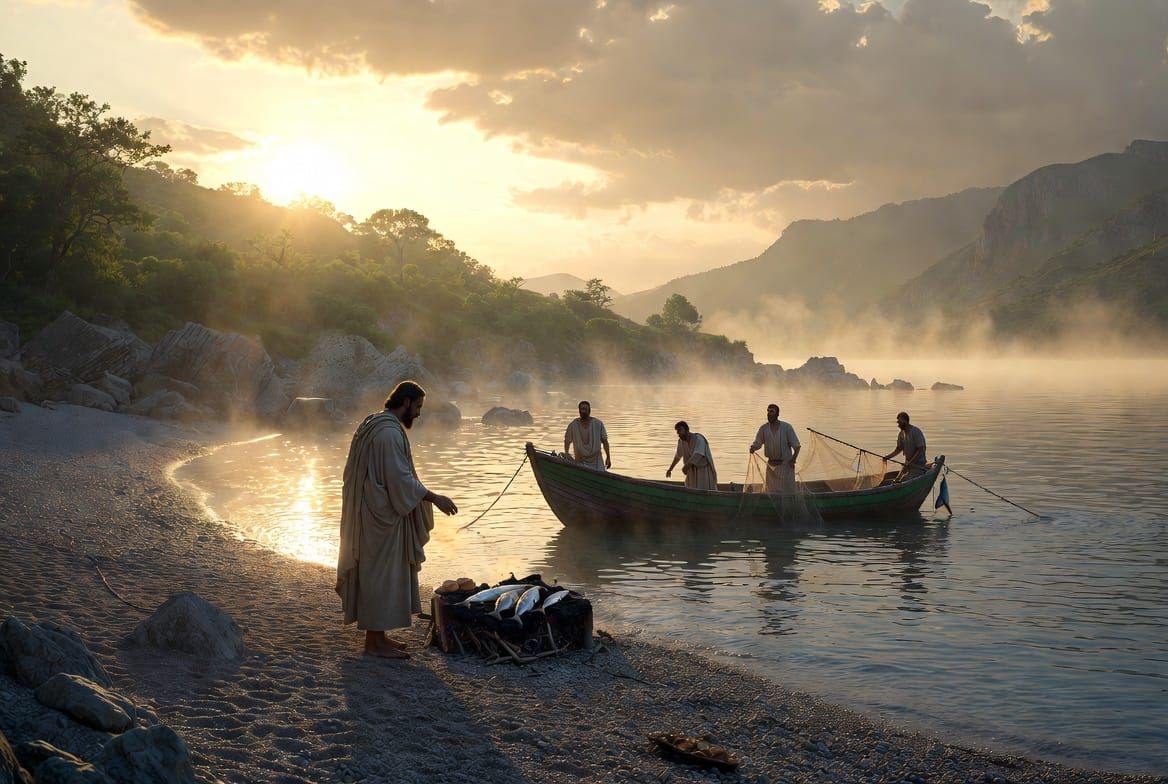
Let's start in our Gospel reading, John 21:15–19. The scene is the shore of the Sea of Tiberias. It is early morning. The disciples have been fishing all night and caught nothing; then a stranger on the shore tells them to cast the net on the right side of the boat, and the catch overwhelms the net. John is the first to recognize the stranger: “It is the Lord.” And Peter, characteristically, throws himself into the water and swims to shore. When they get there, Jesus already has a charcoal fire going with fish on it. The detail matters: the last charcoal fire in John’s Gospel was the one in the high priest’s courtyard, where Peter warmed himself and said three times that he did not know the man. Now there is another charcoal fire. And after breakfast, Jesus asks Peter a question.
Verse 15: “Simon, son of John, do you love me more than these?” (John 21:15, ESV) Notice the name. He does not call him Peter, the rock. He calls him Simon, son of John, the old name, the name before the calling and the renaming and the denials. It is deliberate, and it is tender. He is not addressing the Rock right now. He is addressing the man beneath the title. And he asks: do you love me more than these? Whatever “these” represents in Peter’s heart at that moment, the question is the same.
The Greek of the passage has drawn considerable comment. In verses 15 and 16, Jesus asks using agapas (ah-GAH-pahs), often associated with self-giving love, while Peter answers with philo (FEE-lo), a word for friendship and affection. Scholars debate whether John intends a sharp distinction; many today see the two verbs functioning more synonymously in his Gospel, and John himself uses them interchangeably elsewhere. What is not debated is that the third time, in verse 17, Jesus shifts to Peter’s own word, phileis (FEE-lays). And Peter is grieved, because he said to him the third time: do you love me? The text ties that grief directly to the threefold repetition, which echoes the threefold denial by the charcoal fire in the high priest’s courtyard. Peter does not try to argue or to promise. He appeals to the only authority that could adjudicate his sincerity: “Lord, you know everything; you know that I love you.” (John 21:17, ESV) He has no resume to offer. His record is disqualifying. He throws himself not on his own consistency but on the omniscience of the one who is asking.
Three questions. Three answers. Three commands: feed my lambs, tend my sheep, feed my sheep. The structure is unmistakable. The three questions answer the three denials, not by erasing them but by meeting them directly and overriding them with love and commission. Peter is not restored by pretending the denials did not happen. He is restored in full sight of them, by the one who knew they were coming and called him the Rock before they occurred. This is what restoration looks like in John’s Gospel: not the denial reversed but the commission renewed, the call re-issued, the vocation handed back to the one who failed and is therefore perfectly suited to carry it.
It is worth noting that Peter loses no standing through the denials. Jesus does not demote him, reassign his role, or name a replacement. The commission in John 21 is given to Peter specifically and first, which is consistent with his role throughout the Gospels as primus inter pares (PREE-mus in-ter PAH-rays), first among equals: the spokesman and representative of the Twelve, the first to confess, the first named in every apostolic list. His primacy is a primacy of honor and initiative, not of monarchy; the other apostles share fully in the apostolic commission. But the commission to tend the sheep is given here to Peter by name, and the denials do not diminish it. The resurrection has already handled the grave; three questions on a shoreline handle the courtyard.
There is something worth dwelling on in Peter’s appeal in verse 17. He does not say: Lord, you know my record is now clean, or you know I have made amends. He says: Lord, you know everything; you know that I love you. The appeal to Christ’s omniscience is the appeal of a man who has nothing else to offer. His track record in the courtyard is disqualifying. His courage in the weeks since has been modest. He is standing on the shore with fish on the fire and three denials behind him, and the only ground he has is the knowledge of the one who knows him. That is the ground on which everyone who has failed stands before the risen Christ. Not our performance but his knowledge. Not our consistency but his perception. He knows what we love even when we have demonstrated that we cannot be trusted with it.
Our Old Testament reading from Ezekiel 34 gives us the theological ground on which this commission stands. God speaks through Ezekiel against the shepherds of Israel who have failed their flock: they have not strengthened the weak, bound up the injured, sought the lost. And then God declares: “I myself will search for my sheep and will seek them out. As a shepherd seeks out his flock when he is among his sheep that have been scattered, so will I seek out my sheep.” (Ezekiel 34:11–12, ESV) The human shepherds have failed. So God takes the work himself. He will seek the lost, bring back the strayed, bind up the injured, strengthen the weak. And then, six centuries later, on a Galilean shore after breakfast, he turns to a fisherman who denied him three times and says: feed my sheep.
The connection is direct and staggering. The shepherd work that Ezekiel’s God claimed for himself is the work Jesus hands to Peter. The divine vocation, the seeking of the lost and the binding of the injured, is entrusted to the man who most recently demonstrated what a failed shepherd looks like. The grace of John 21 is not that God finds a worthy candidate for the shepherd’s work. It is that he finds the least worthy candidate and makes him the most necessary one. The one who most needs the seeking shepherd is the one now sent to seek.
He gives him three images: lambs, sheep, sheep. The language is pastoral in the most literal sense. The shepherd’s work is not administrative but relational: seeking the scattered, tending the hurt, feeding the hungry. Ezekiel’s language for the shepherd work is entirely about individual animals: the lost one sought, the strayed one brought back, the injured one bound up, the weak one strengthened. Peter is not commissioned to build an institution. He is commissioned to be a shepherd. The institution, as Jesus says in verse 18, will follow the cross, and the shepherd work will cost the shepherd exactly what it cost the Good Shepherd.
Verse 18: “Truly, truly, I say to you, when you were young, you used to dress yourself and walk wherever you wanted, but when you are old, you will stretch out your hands, and another will dress you and carry you where you do not want to go.” (John 21:18, ESV)John adds the comment: this he said to show by what kind of death he was to glorify God. The arms stretched out and the carrying to a place one does not want to go: crucifixion. Jesus is telling Peter from the first moment of his restoration that the shepherd’s road ends at a cross. And then: “Follow me.” (John 21:19, ESV) The same words spoken on the shore of Galilee at the first calling. The same two words. Follow me. Not: serve me efficiently, or lead my organization, or build my institution. Follow me. The shape of the following is the shape of the cross. Peter would understand that more fully later, and he would follow.
The feast of Peter and Paul together on June 29 is among the oldest observances in the Christian calendar. The Depositio Martyrum(deh-POH-see-tee-oh mar-TEER-oom), Latin for the burial record of the martyrs, a Roman church calendar document from 354 AD listing the dates on which martyrs were commemorated, already records June 29 as the day for both apostles. They are honored on the same day not because they died on the same day but because their witness belongs together. They disagreed sharply: Paul describes opposing Peter to his face at Antioch in Galatians 2, where the question of table fellowship with Gentiles exposed a genuine division between the apostle to the circumcised and the apostle to the uncircumcised. The New Testament does not paper over the disagreement. The joint feast does not erase it either. It holds both men under the same collect and asks the Church to receive their teaching and example together, knit by the same Spirit into a unity that neither of them fully achieved in life.
Now Paul. He was not on that shore. He had never met Jesus in Galilee. His calling came on the road to Damascus, not beside the sea: a blinding light, a voice, “Saul, Saul, why are you persecuting me?” (Acts 9:4, ESV) His version of the question was not do you love me but why are you persecuting me. His version of the restoration was not three commissions on a shore but a blinded man led by the hand into the city, waiting, not eating or drinking, until Ananias was sent to him. The structure is different; the grace is identical. The one who was chief among the persecutors of the Church became, by the sovereign call of the risen Christ, the apostle to the nations. Both Peter and Paul arrived at the same place by different roads. Neither of them chose the road.
Our reading from 2 Timothy 4 is Paul’s final letter, written from prison in Rome, near the end that he can already see coming. He charges Timothy to preach the word, in season and out of season, to reprove, rebuke, and exhort, because the time is coming when people will not endure sound teaching. And then the personal testament: “As for me, I have fought the good fight, I have finished the race, I have kept the faith. Henceforth there is laid up for me the crown of righteousness, which the Lord, the righteous judge, will award to me on that day, and not only to me but also to all who have loved his appearing.” (2 Timothy 4:7–8, ESV) These are not the words of a man who is afraid. They are the words of a man who has spent himself entirely in one direction and knows it. He fought the fight, not without suffering: five floggings, three shipwrecks, a night and a day in the open sea, danger from rivers and bandits and his own countrymen. He finished the race, not without stumbling: the conflict at Antioch, the sharp disagreement with Barnabas, the churches that turned away from him. He kept the faith, not without being tested to keep it.
What Paul bequeaths to Timothy, and through Timothy to the Church, is not just his theology or his missionary zeal. It is the example of a life that went all the way. He did not protect himself. He did not manage his platform. He did not calculate what was safe to say. He preached the word in season and out of season until there was no more season left, and then he wrote this letter, and then he died. The crown, he says, is not his alone: it belongs to all who have loved Christ’s appearing. Both the apostle and the congregation are inheritors of the same promise.
Psalm 87 gives us the vision toward which Peter and Paul both spent themselves. It is the psalm of Zion, the holy city, open to all nations: “Among those who know me I mention Rahab and Babylon; behold, Philistia and Tyre, with Cush: ‘This one was born there,’ they say.” (Psalm 87:4, ESV) Every nation registered as a citizen of Zion. Egypt, Babylon, Philistia, Tyre, Ethiopia, the nations that surrounded and opposed Israel, all to be counted as born in the holy city. The Lord loves the gates of Zion more than all the dwelling places of Jacob; the gates are open to all. This is the Old Testament’s vision of the Gospel reaching every nation, God’s salvation opening to peoples far beyond Israel, and it is appointed for the feast of the two apostles who more than any others carried that Gospel through those gates to fulfil it. Peter went to Cornelius. Paul went to Athens and Corinth and Ephesus and Rome. Psalm 87 is the vision their missionary work was enacting: the nations being registered in Zion, one city at a time, one household at a time, one cup of cold water at a time.
The collect for this feast holds both men under a single sentence: “Almighty God, whose blessed apostles Peter and Paul glorified you by their martyrdom: Grant that your Church, instructed by their teaching and example, and knit together in unity by your Spirit, may ever stand firm upon the one foundation, which is Jesus Christ our Lord.” (BCP 2019, p. 630) They glorified God by their martyrdom: Peter crucified, upside down, tradition says, because he did not consider himself worthy to die as his Lord died. Paul beheaded. Both in Rome. Both under Nero. The one who was restored by a threefold question and the one who was stopped by a blinding light, both dying in the same city for the same Lord they could not stop confessing. The collect asks the Church to stand firm on the one foundation, which is Jesus Christ our Lord, not Peter, not Paul. Paul makes this exact point in 1 Corinthians 3:11: “For no one can lay a foundation other than that which is laid, which is Jesus Christ.” (1 Corinthians 3:11, ESV) The foundation is not the apostles. It is the one the apostles confessed.
And that is where the feast lands on us here at Christ the King. The commission to feed and tend and follow is not reserved for first-century apostles. It is the calling of this congregation: visiting the homebound, welcoming the newcomer, bearing witness in these mountains, showing up week after week in the Season after Pentecost when the calendar is green and the work is quiet and faithful. Do you love me? Feed my sheep.
Jesus does not ask Peter’s congregation on June 29 whether they have fought the good fight or tended the sheep adequately. He asks the same question he asked on the shore. Do you love me? It is not a theological question. It is not a performance review. It is the question that precedes every commission and underlies every calling. Peter answered it from the depth of his failure, with an appeal to the only one who could know the truth of it: Lord, you know everything; you know that I love you. That is still the answer. It does not require a clean record. It requires an honest appeal to the one whose knowledge is sufficient to know what our record cannot prove.
The question is also pastoral. For those of us who have carried the faith for fifty or sixty years and wonder whether it has amounted to much, 2 Timothy 4 speaks directly: I have fought the good fight, I have finished the race, I have kept the faith. Paul does not say: I built the largest churches or persuaded the most people or left behind an organization that still bears my name. He says he fought, finished, and kept. That is the testimony available to every believer who has endured in faithfulness, and it is sufficient. The crown, Paul says, is not reserved for apostles. It is laid up for all who have loved Christ’s appearing. That includes this congregation, on this Monday in June, in the Season after Pentecost.
The feast of Peter and Paul arrives in the middle of the Season after Pentecost to ask ordinary people the question that grounds every extraordinary calling. The fisherman who denied was restored, commissioned, and martyred. The persecutor who was stopped was called, sent, and martyred. Both of them, in the end, followed all the way. The Church they helped build is still here, still gathering, still asking the same question at every Baptism and every Communion and every Sunday morning in the Season after Pentecost: do you love me? Do you love me? Do you love me? Feed my sheep. Follow me.
In the Name of the Father, and of the Son, and of the Holy Spirit. Amen.