The Feast of Peter and Paul, Apostles: An Anglican Perspective
June 29: Peter and Paul. One who denied and was restored. One who persecuted and was arrested by grace. They argued in Antioch. They were martyred in Rome. The Church has never thought it necessary to choose between them. That is what the joint feast says.
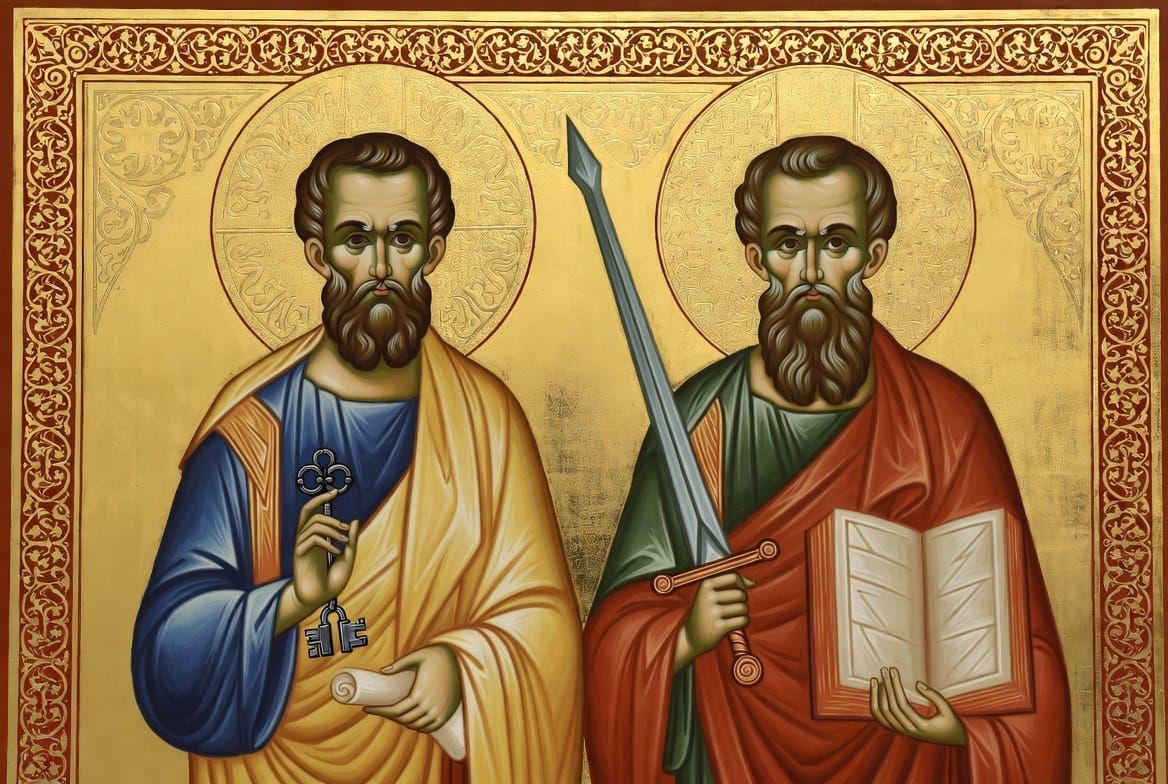
Feast Day: June 29
The Anglican calendar is ordered by a hierarchy of holy days, each carrying a different weight of observance. At the top sit the seven Principal Feasts, the highest days of the liturgical year. Below them are the Red-Letter Holy Days, appointed in the BCP 2019 with their own collects, propers, and lectionary readings, listed on page 688. They are called Red-Letter Days because, in the tradition of printing church calendars, these days appear in red ink, distinguished from the Optional Commemorations which appear in ordinary type. The joint feast of Saint Peter and Saint Paul, Apostles, observed on June 29, is one of these Red-Letter Holy Days. The BCP 2019 appoints a collect on page 630 and lectionary readings on page 731 for this feast.
June 29 falls in the Season after Pentecost, in the week of Proper 8. It arrives the day after the Sunday on which the lectionary appoints Matthew 10:34–42, the end of the commissioning discourse, the cost of following Jesus, the cup of cold water given in his name. Peter and Paul are the New Testament's two supreme exemplars of that commissioning: one who was sent to the circumcised, one to the uncircumcised, one who denied and was restored, one who persecuted and was arrested by grace. Together they do not merely illustrate the apostolic calling. They define it in its full range.
The feast of Peter and Paul together on June 29 is among the oldest in the Christian calendar. The Depositio Martyrum, a Roman liturgical document from the mid-fourth century, already lists June 29 for both apostles, and the observance is clearly earlier still. Some scholars tie the joint date to the translation or dedication of their relics at Rome. The feast honors both apostles on the same day not because they died on the same day but because their witness belongs together. Both were martyred in Rome under Nero, tradition says in the mid-sixties AD. Both gave their lives for the Gospel they proclaimed. The Church has never thought it necessary to choose between them.
The Biblical Portrait: Peter
Simon Peter is the most prominent of the twelve apostles in all four Gospels. He is the one who confesses at Caesarea Philippi: "You are the Christ, the Son of the living God." (Matthew 16:16, ESV) He is the one to whom Jesus responds: "You are Peter, and on this rock I will build my church." (Matthew 16:18, ESV) He is the one who warms himself by the fire in the high priest's courtyard and three times denies that he knows the man. He is the one who weeps bitterly. And he is the one to whom the risen Christ appears first: "he appeared to Cephas" (1 Corinthians 15:5, ESV); and to whom he gives, on the shore of the Sea of Tiberias, the threefold commission that answers the threefold denial.
The appointed Gospel for this feast is John 21:15–19, that restoration scene. Jesus asks Peter three times: "Simon, son of John, do you love me?" And Peter answers three times: you know that I love you. And three times Jesus says: feed my lambs. Tend my sheep. Feed my sheep. The restoration is not merely personal; it is vocational. Jesus does not simply forgive Peter and let him resume as a disciple. He restores him to shepherding. The one who failed to follow the shepherd is given the shepherd's work. And then the word that answers the denial most completely: "Follow me." (John 21:19, ESV) The same two words with which the whole thing began, on a different shore, years earlier. Follow me. The call was not revoked by the failure. It was renewed through the restoration.
John 21:18–19 adds what Peter perhaps did not want to hear: "Truly, truly, I say to you, when you were young, you used to dress yourself and walk wherever you wanted, but when you are old, you will stretch out your hands, and another will dress you and carry you where you do not want to go." (John 21:18, ESV) The Evangelist adds: "This he said to show by what kind of death he was to glorify God." (John 21:19, ESV) The commission to feed the sheep and the prediction of the cross are given in the same conversation. Peter's restoration is not to comfort but to costly faithfulness. The feast of June 29 honors the one who was restored and then followed all the way.
The Biblical Portrait: Paul
Paul's apostolate is the great surprise of the New Testament. He was Saul of Tarsus, a Pharisee of Pharisees, a persecutor of the Church who held the coats of those who stoned Stephen and consented to his death. His encounter with the risen Christ on the road to Damascus was not sought, not expected, and not refused. "And falling to the ground, he heard a voice saying to him, 'Saul, Saul, why are you persecuting me?'" (Acts 9:4, ESV) The persecutor is arrested by the one he is persecuting. The one who breathed threats and murder against the disciples becomes the apostle to the Gentiles, the one through whom the Gospel goes to the ends of the earth.
The appointed Epistle for this feast is 2 Timothy 4:1–8, Paul's farewell. He is writing from prison in Rome, near the end of his life. The words are among the most stripped and certain in all of his letters: "I have fought the good fight, I have finished the race, I have kept the faith. Henceforth there is laid up for me the crown of righteousness, which the Lord, the righteous judge, will award to me on that day, and not only to me but also to all who have loved his appearing." (2 Timothy 4:7–8, ESV) These are not the words of a man who is afraid. They are the words of a man who has spent himself entirely in one direction and knows it. He fought the fight. He finished the race. He kept the faith. The crown is not a reward for achievement but a gift from the righteous judge to those who have loved his appearing, which brings the passage into the same orbit as the Advent preface and the eschatological hope that runs through the apostolic proclamation.
Paul's apostleship was always contested. He was not one of the Twelve. He had not walked with Jesus in Galilee. His authority came not from the community's appointment but from the encounter on the road to Damascus, and he defended it against every challenge. The tension between Peter and Paul described in Galatians 2, where Paul opposes Peter to his face at Antioch over the question of table fellowship with Gentiles, is one of the most honest passages in the New Testament. Two apostles, one Gospel, a genuine disagreement, stated plainly. The Church has had to live with this ever since, and the joint feast of June 29 is part of how it does: not by pretending the tension was not real but by honoring both within the same day, under the same collect, knit together by the same Spirit.
The Appointed Readings
The lectionary for the Feast of Peter and Paul is found on page 731 of the BCP 2019. Ezekiel 34:11–16 is the great shepherd passage from the Old Testament: "I myself will search for my sheep and will seek them out… I will seek the lost, and I will bring back the strayed, and I will bind up the injured, and I will strengthen the weak." (Ezekiel 34:11, 16, ESV)This passage is the theological ground of Jesus' commission to Peter in John 21: the God who promises to be the shepherd of Israel is now giving Peter the shepherd's work. The shepherd who tends the sheep in Ezekiel 34 is the shepherd who says to Peter: feed my lambs. The Old Testament promise and the New Testament commission are the same pastoral office, handed through the risen Christ to a fisherman who once denied knowing him.
Psalm 87 is the psalm of Zion as the city of all nations: "Among those who know me I mention Rahab and Babylon; behold, Philistia and Tyre, with Cush, 'This one was born there,' they say." (Psalm 87:4, ESV) Every nation registered as born in Zion. The psalm is the Old Testament's vision of the universality of God's salvation, and it is appointed for the feast of the two apostles who, more than any others, carried the Gospel to the nations. Peter took the Gospel to Cornelius. Paul took it to the ends of the Roman world. Psalm 87 is the vision their missionary work was fulfilling.
The BCP 2019 Collect and Preface
The BCP 2019 appoints the following collect for June 29 on page 630: "Almighty God, whose blessed apostles Peter and Paul glorified you by their martyrdom: Grant that your Church, instructed by their teaching and example, and knit together in unity by your Spirit, may ever stand firm upon the one foundation, which is Jesus Christ our Lord; who lives and reigns with you, in the unity of the Holy Spirit, one God, now and for ever. Amen." The collect holds the two apostles together in a single petition without flattening their differences. They glorified God by their martyrdom, Peter crucified, Paul beheaded, tradition says, both in Rome. The Church is to be instructed by their teaching and example, both of them, which means receiving the full range of apostolic witness, including its tensions. It is to be knit together in unity by the Spirit, the only one who can hold together two apostles who argued in Antioch and two traditions of theology that have never fully resolved their differences. And it is to stand firm upon the one foundation, which is Jesus Christ our Lord, the foundation Peter confessed at Caesarea Philippi and Paul declared in 1 Corinthians 3:11: "For no one can lay a foundation other than that which is laid, which is Jesus Christ." (1 Corinthians 3:11, ESV)
The Preface of the Apostles, found on page 155 of the BCP 2019, is appointed for this feast: "Through the great shepherd of your flock, Jesus Christ our Lord; who after his resurrection sent forth his apostles to preach the Gospel and to teach all nations; and promised to be with them always, even to the end of the ages." (BCP 2019, p. 155) The preface names the risen Christ as the great shepherd, the same title Ezekiel's God claimed for himself, who sent the apostles out to preach and to teach. Peter and Paul were not self-appointed. They were sent. The preacher who denies knowing Christ on a Thursday and the persecutor who breathes threats on Wednesday are both, by the sovereign grace of the risen Lord, among those through whom all nations are to be taught.
Saint Peter and Saint Paul in Anglican Worship
Red vestments are worn on the Feast of Peter and Paul, honoring both as martyrs. The joint feast has been observed in the Church of England since the medieval period and was retained in every edition of the Book of Common Prayer. The BCP 2019 continues this tradition, giving June 29 its full Red-Letter status with collect, preface, and appointed lectionary.
The feast of Peter and Paul has frequently been an occasion for Christian unity efforts. Catholic, Orthodox, and Anglican dialogues have repeatedly found common ground in the joint witness of these two apostles, Peter as the figure of apostolic authority and primacy, Paul as the figure of apostolic mission and theological articulation. The two are not interchangeable, but they cannot be separated. Every serious ecumenical conversation about the nature of the Church eventually comes back to the question these two apostles pose together: what does it mean to be built upon the one foundation, knit together by one Spirit, sent to all nations? June 29 is the day the whole Church asks that question together.
The feast falls the day after Proper 8 Sunday in most years of the Season after Pentecost. In Year A of the lectionary, the Sunday before the feast appoints Matthew 10:34–42, the end of the commissioning discourse. The proximity is fitting: Peter and Paul are the living embodiment of that discourse's demands. They did not come to bring peace but a sword. They divided households. They were betrayed and brought before governors. They lost their lives for Christ's sake and found it. The feast of June 29 in Year A functions almost as a lived commentary on the commissioning text, the difficult words of Matthew 10 made flesh in two apostolic lives.
Peter and Paul together show the full range of what being sent looks like: one who denied and was restored, one who persecuted and was arrested. The preacher who uses this feast has the whole apostolic story available, failure and restoration, opposition and conversion, the shepherd's commission and the fighter's farewell. No two apostles more completely display both the cost and the grace of the apostolic calling.
Observing the Feast
The Feast of Saint Peter and Saint Paul falls on June 29 and always lands in the Season after Pentecost. The collect is on page 630 of the BCP 2019 and the lectionary readings are on page 731. Red vestments are worn.
To observe the feast: pray the collect and receive its three petitions, instructed by their teaching and example, knit together in unity, standing firm on the one foundation. Read John 21:15–19 and hear the threefold commission that answered the threefold denial: feed my lambs, tend my sheep, feed my sheep, follow me. Read 2 Timothy 4:1–8 and receive Paul's farewell: I have fought the good fight, I have finished the race, I have kept the faith. Read Ezekiel 34:11–16 and hear the God who promises to seek the lost sheep handing that same work to a restored fisherman on a Galilean shore.
Let the two apostles stand together as they do in the collect: different temperaments, different callings, different routes to Rome, a shared foundation and a shared martyrdom. The Church that honors both is the Church that has room for the one who failed and was restored and the one who opposed and was converted, which is to say, the Church that has room for everyone.
Conclusion
The Feast of Peter and Paul is the Church's annual acknowledgment that the apostolic foundation is wider than any single personality or tradition. Peter the Rock, the denier who became the shepherd. Paul the persecutor, the convert who became the apostle to the nations. Together they fought, together they suffered, together they were martyred, and together they are honored on June 29 as the two apostles through whose witness the Church was built upon the one foundation that no one else has laid. The collect asks that the Church they planted would be knit together in unity by the Spirit, a prayer that remains as necessary now as it was when two apostles argued in Antioch and the whole future of the Gospel was at stake.
"Almighty God, whose blessed apostles Peter and Paul glorified you by their martyrdom: Grant that your Church, instructed by their teaching and example, and knit together in unity by your Spirit, may ever stand firm upon the one foundation, which is Jesus Christ our Lord." (BCP 2019, p. 630)