Follow Me: Saint Matthew, Apostle and Evangelist (Matthew 9:9-13)
That is what grace does. It does not merely forgive the old life and leave us sitting where we were. It calls us into a new one. Christ calls before Matthew follows. Christ gives before Matthew proclaims. And the same Lord still calls sinners today.
September 21, 2026, Saint Matthew, Apostle and Evangelist, Red-Letter Holy Day, Season after Pentecost
Matthew 9:9-13, Psalm 119:33-40, 2 Timothy 3:1-17, Proverbs 3:1-12
Grace, mercy, and peace from God our Father and the Lord Jesus Christ be with you on this Feast of Saint Matthew, Apostle and Evangelist.
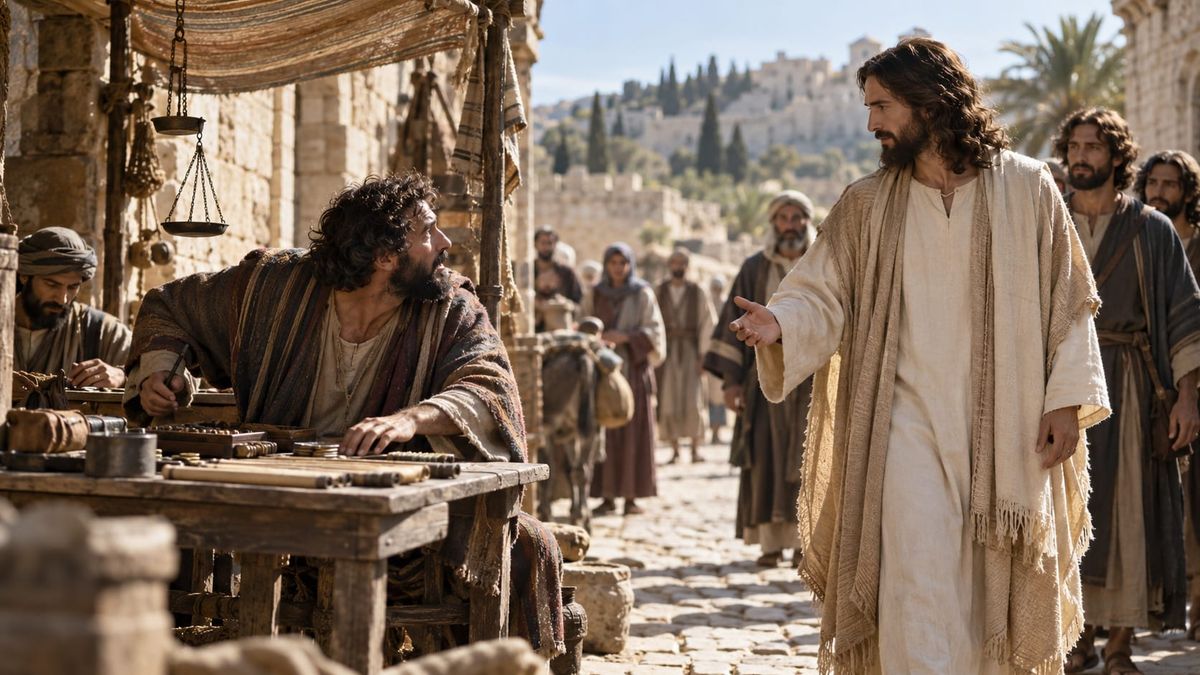
Yesterday Jesus told us about a landowner who kept going into the marketplace to call workers into his vineyard. Some came early, some came late, and the people who had borne the heat of the day struggled with the generosity shown to those who came at the eleventh hour. Today that parable almost seems to take on a face. Jesus walks past a tax booth, sees a man many respectable people would have considered an unlikely candidate for the Kingdom, and says, “Follow me.” Matthew gets up and follows. The Master is still going into the marketplace, still calling people we might not have chosen, and still showing that the Kingdom begins with his generosity rather than our qualifications.
Verse 9 tells the story with remarkable simplicity: “As Jesus passed on from there, he saw a man called Matthew sitting at the tax booth, and he said to him, ‘Follow me.’ And he rose and followed him.” (Matthew 9:9, ESV) Matthew does not tell us what he was thinking. He does not describe a long spiritual crisis or explain how dissatisfied he had become with his life. He gives us the decisive facts. Jesus saw him, Jesus called him, and Matthew rose and followed. Before Matthew follows Christ, Christ comes to Matthew. Before Matthew does anything worthy of remembering, Jesus sees him sitting exactly where he is. The first movement belongs to Christ, and that is why Saint Matthew’s story is a story of grace before it is a story of obedience.
Tax collectors were not obvious candidates for religious leadership. They worked within the machinery of Roman taxation, and the system could encourage extortion and abuse. They were often treated as collaborators with occupying power, and the Gospels regularly group tax collectors with “sinners.” We should not assume that every tax collector committed every possible abuse, but the social reputation of the occupation is clear. Matthew is not sitting in a place of honor when Jesus calls him. He is sitting at a booth associated with money, power, suspicion, and moral compromise.
That makes the first phrase of verse 9 even more important: Jesus “saw a man called Matthew.” The people around Matthew could see a tax collector. They could see an occupation, a reputation, perhaps a history. Jesus sees a man whom he is about to call. We are very good at reducing people to the most obvious thing we know about them. We see the divorce, the addiction, the political opinion, the prison record, the family scandal, the years away from church, the difficult personality, or the sin we happen to find particularly offensive. We can decide that this is simply who a person is. Jesus is not naive about sin, but neither is he trapped by our categories. He sees Matthew at the booth and calls him to become something Matthew could never have made himself.
That should also keep us from despair about ourselves. Some of us know exactly where our own tax booth has been. We know the years we wasted, the things we loved too much, the compromises we made, or the parts of our history we would rather leave unmentioned. The Gospel does not begin with pretending those things never happened. It begins with Christ meeting sinners there and calling them to himself. But grace does not mean remaining at the booth. Verse 9 says, “And he rose and followed him.” Matthew’s response is immediate and real. Jesus does not repent for Matthew, and Jesus does not follow for Matthew. Grace comes first, but grace calls forth obedience.
Our Collect holds those two truths together beautifully. We pray, “Lord Jesus, you called Matthew from collecting taxes to become your apostle and evangelist: Grant us the grace to forsake all covetous desires and inordinate love of riches, that we may follow you as he did and proclaim to the world around us the good news of your salvation.” Christ called Matthew, and Christ must grant us grace. Then the prayer asks that we forsake, follow, and proclaim. God’s action does not eliminate our response. It creates and sustains it.
The Collect also helps us understand why the tax booth matters. Matthew is called from collecting taxes, and the Church asks for grace to forsake “covetous desires and inordinate love of riches.” The Prayer Book is not teaching us that money itself is evil or that everyone with possessions is covetous. Scripture gives us faithful people who possess wealth and use it rightly. The issue is disordered love. Money becomes spiritually dangerous when it becomes a rival source of security, identity, power, or hope.
Psalm 119 gives us almost the same prayer: “Incline my heart to your testimonies, and not to selfish gain!” (Psalm 119:36, ESV) The psalmist knows that the problem reaches deeper than our bank balance. We need God to incline the heart. Our tax booths will not all look like Matthew’s. For one person it may be money. For another it may be reputation. For another it may be control, comfort, resentment, sexual sin, career, approval, or the need to win every argument. We can turn almost any created good into a place where we sit down and quietly say, “This is where my security comes from. This is what I cannot surrender.”
Then Christ says, “Follow me,” and Matthew gets up. The question is not whether every Christian must abandon a career or give away every possession. The question is whether anything in our life has acquired the right to tell Jesus no. If Christ may command everything except our money, then money has become lord. If he may command everything except our politics, our relationship, our plans for our children, our comfort, or our cherished resentment, then we have found the place where discipleship stops. Matthew rises because grace is not opposed to obedience. Grace has made obedience possible.
Verse 10 then moves us from the booth to the table: “And as Jesus reclined at table in the house, behold, many tax collectors and sinners came and were reclining with Jesus and his disciples.” (Matthew 9:10, ESV) The story does not end with one sinner called. Soon Jesus is surrounded by the sort of people religious society knew how to categorize.
The Pharisees notice. Verse 11 says, “And when the Pharisees saw this, they said to his disciples, ‘Why does your teacher eat with tax collectors and sinners?’” (Matthew 9:11, ESV) Their question reveals a real concern badly directed. They know holiness matters. They know sin is serious. What they cannot understand is why a holy teacher would place himself at a table with people whose lives were visibly compromised.
Jesus answers in verse 12: “Those who are well have no need of a physician, but those who are sick.” (Matthew 9:12, ESV) A physician goes where sickness is because healing is the purpose. Jesus does not deny the diagnosis. He calls them sick. What he rejects is the idea that holiness means staying safely away from the people who need mercy.
Then verse 13 gives us the center of the passage: “Go and learn what this means: ‘I desire mercy, and not sacrifice.’ For I came not to call the righteous, but sinners.” (Matthew 9:13, ESV) Jesus quotes Hosea 6:6. He is not abolishing worship or saying obedience is unimportant. He is exposing religion that can perform outward acts while remaining untouched by the mercy of God. Matthew himself is the living illustration. The Pharisees see a tax collector at the wrong table. Jesus sees a sinner he has come to call.
The Church can still fall into the Pharisees’ mistake. We can become so concerned about distinguishing ourselves from the sins of the world that we lose compassion for the people caught in them. We can speak correctly about holiness while quietly communicating that certain people should stay away until they have made themselves less embarrassing.
But there is an equal and opposite mistake. We can redefine mercy until mercy means never asking anyone to leave anything behind. Jesus does not say to Matthew, “I accept you, therefore remain at the booth.” He says, “Follow me.” Christian mercy is not indifference to sin, and Christian holiness is not indifference to sinners. Jesus holds together what we often separate. He receives sinners, and he calls sinners to follow him. Grace welcomes us, and grace changes us. The physician comes because we are sick, and the physician intends to heal.
That is worth examining in our own lives. Some of us are more comfortable with truth than mercy. We can identify what is wrong quickly and accurately, but we are slower to love the person caught in it. Others of us are more comfortable with mercy than truth. We want people to feel welcome, but we become uneasy when Jesus’ call requires repentance, change, or costly obedience. Matthew 9 will not let us choose between them. The same Lord who eats with sinners says, “Follow me.”
Proverbs 3 gives another dimension to Matthew’s response: “Trust in the LORD with all your heart, and do not lean on your own understanding.” (Proverbs 3:5, ESV) Matthew is sitting in a world he understands. The booth is tangible. The money is tangible. Whatever its moral problems, the arrangement offers a kind of predictability. Jesus’ call gives him no detailed map of the next thirty years. Matthew knows less about the road than he knows about the one calling him.
That is often how discipleship works. We would prefer Christ to give us the entire plan before asking us to obey. We want guarantees about our career, family, health, finances, or future before we take the next faithful step. We want to know that obedience will work out the way we hope. But faith is not confidence that our plan will succeed. Faith is confidence in the Lord who calls us. Verse 9 does not say Matthew understood everything. It says he followed.
And what Christ does with that man is extraordinary. The tax collector becomes an apostle. The man called from a world of revenue and gain becomes associated with the Gospel that records Jesus saying, “Do not lay up for yourselves treasures on earth” (Matthew 6:19, ESV) and “You cannot serve God and money.” (Matthew 6:24, ESV) The Gospel does not merely change Matthew’s job. It begins to reorder what he loves.
Then the disciple becomes a witness, and that is where 2 Timothy 3 fits this feast so well. Paul tells Timothy, “All Scripture is breathed out by God and profitable for teaching, for reproof, for correction, and for training in righteousness.” (2 Timothy 3:16, ESV) Paul is speaking first of the sacred writings Timothy had known from childhood, the Scriptures of Israel. The Church would also receive the apostolic writings of the New Testament as Holy Scripture, including the Gospel according to Matthew. Saint Matthew therefore reminds us that the Church receives a Word she did not invent. Matthew does not create a Jesus suited to his preferences. He bears apostolic witness to the Lord who called him.
That matters because every age is tempted to reverse the order. Instead of allowing Scripture to judge us, we judge Scripture. Instead of receiving the faith and learning to live beneath it, we ask which parts fit comfortably with what we already believe. We become willing to be taught only where the Word agrees with us.
But Scripture is profitable not only for encouragement. Paul says it teaches, reproves, corrects, and trains. The Word of God sometimes tells us that we are wrong, and that correction is itself a mercy. When Scripture exposes our greed, pride, bitterness, lust, self-righteousness, fear, or unbelief, God is not being cruel to us. The physician is diagnosing what needs healing.
The same is true when the Word confronts the Church. We do not own the apostolic faith. We receive it. That means our task is not to adjust Christianity until every generation finds it easy to accept. Our task is to hear the Word faithfully, believe it, live under it, and proclaim it with love and clarity.
Matthew’s story moves in exactly that direction. Jesus calls him. Matthew follows. And the man who follows becomes a man through whom the Gospel is proclaimed. The Collect makes that our prayer too: “that we may follow you as he did and proclaim to the world around us the good news of your salvation.” We are not all apostles in Matthew’s unique sense. We are not all evangelists by office. But the whole Church lives beneath the apostolic mission.
And notice what the Collect says we proclaim: “the good news of your salvation.” Not our goodness. Not our insight. Not our moral superiority. Christ’s salvation.
That keeps us from turning Saint Matthew into a sermon about self-improvement. Matthew’s story is not finally, “A bad man decided to do better.” The center of the story is Jesus Christ. The Son of God came for sinners. He went to the Cross bearing sins that were not his own. He rose from the dead, defeated death, and calls sinners to repent and believe. We are not reconciled to God because we managed to rise from our tax booth impressively enough. We are reconciled because Christ has done for us what we could never do for ourselves.
Grace comes first, and then grace gets us up. Grace begins reordering the loves that kept us seated, teaches us to follow, and puts the Gospel in our mouths.
That is why yesterday’s vineyard Gospel and today’s feast belong together so naturally. Yesterday the master kept going out to call workers others might have overlooked. Today Jesus finds Matthew at a tax booth. He is exactly the sort of worker many religious people would not have recruited. Yet Christ calls him, and we are reminded again that the Lord sees what we do not.
That should make us hopeful about other people. The person we think is too compromised, too difficult, too late, too hardened, or too unlikely is not beyond the call of Christ. We do not know whom Jesus may still be calling from a booth we have already written off.
And it should make us humble about ourselves. None of us hired ourselves into the vineyard. None of us earned the right to sit at Christ’s table. None of us can turn years of discipleship into a claim of superiority. If we have followed Christ for a long time, that is another reason to thank him for grace, not another reason to boast.
So Saint Matthew leaves us with practical questions worth carrying into this week. Where has Christ’s call become inconvenient for us? What love competes with him? What Scripture have we been explaining away because obedience would cost something? Whom have we quietly decided is the wrong sort of person for Jesus to call? Where have we used the language of truth without mercy, or the language of mercy without repentance? And where has fear kept us silent about the good news of Christ’s salvation?
The answer to those questions is not to manufacture spiritual courage from within ourselves. The Collect gives us the better prayer: “Grant us the grace.” Grant us grace to forsake what competes with Christ, grace to trust the Lord who calls us, grace to sit at the table with sinners without pretending sin is harmless, grace to receive the apostolic Word even when it corrects us, grace to follow, and grace to proclaim.
Matthew’s story begins with Christ seeing a sinner at a tax booth, and it ends far beyond that booth. The man who once collected revenue becomes an apostolic witness to the King whose authority extends over heaven and earth. The life that might have remained defined by money and reputation becomes defined by Jesus Christ. That is what grace does. It does not merely forgive the old life and leave us sitting where we were. It calls us into a new one.
Christ calls before Matthew follows. Christ gives before Matthew proclaims. And the same Lord still calls sinners today. May he incline our hearts away from selfish gain, teach us to trust him with all our heart, root us in the Word we did not create, and grant us grace to follow where he leads and proclaim to the world around us the good news of his salvation.
In the Name of the Father, and of the Son, and of the Holy Spirit. Amen.