Good Friday: An Anglican Perspective
Good Friday stops everything. No flowers, no music, just a bare altar and silence. In this countercultural observance, the worst day in history is called “good”; the day divine love triumphed on the cross.
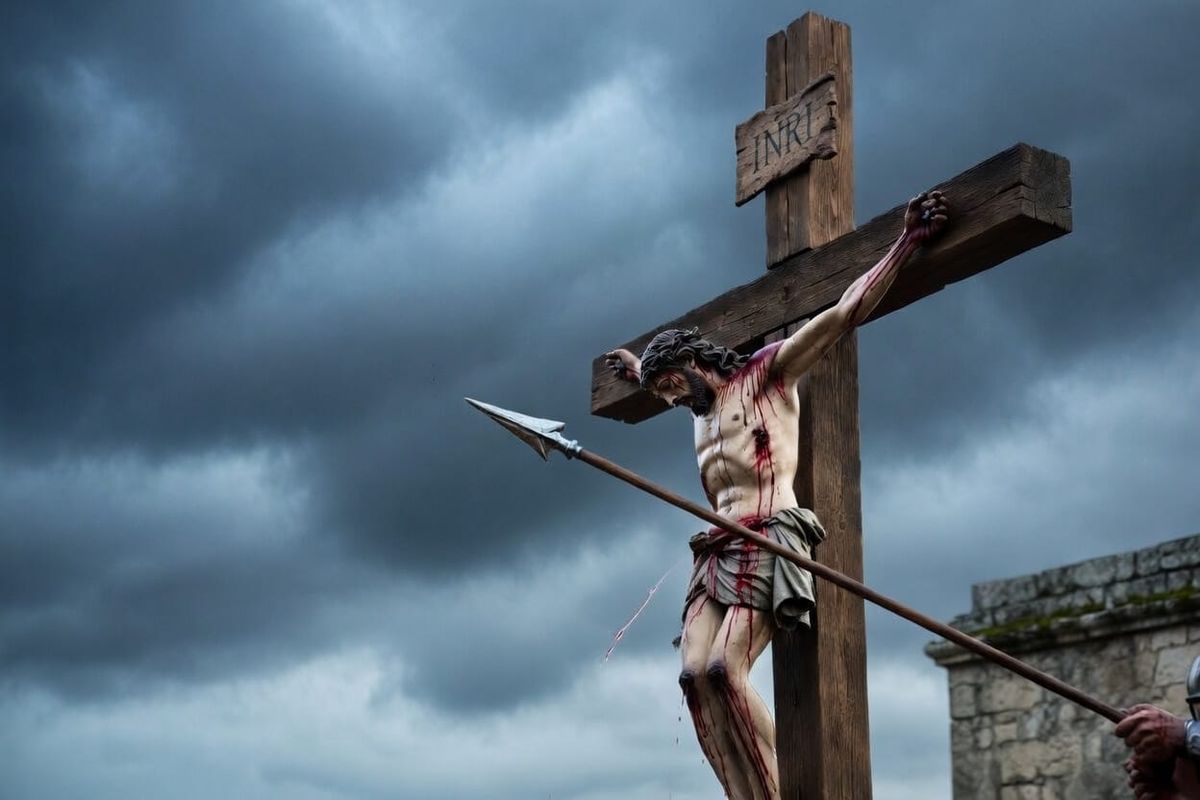
Friday in Holy Week, Principal Fast, Day of Discipline, Denial, and Special Prayer
The Anglican calendar is ordered by a hierarchy of holy days, each carrying a different weight of observance. At the top sit the seven Principal Feasts. Below them are the Red-Letter Holy Days. Woven throughout the calendar are also the Days of Discipline, Denial, and Special Prayer. Among these, Ash Wednesday and Good Friday are the two principal fasts of the Christian year. The BCP 2019 describes them as “traditionally days of special devotion and total abstinence.” It names Good Friday specifically as “the day of our Lord’s Crucifixion” and gives it a special liturgy beginning on page 565. (BCP 2019, p. 689)
Good Friday falls on the Friday of Holy Week and is the second part of the Paschal Triduum (TRID-yoo-um), the sacred three days that begin on Maundy Thursday and carry the Church through the Cross, the tomb, and the Great Vigil into Easter. The Prayer Book describes Good Friday as “the most somber of all days,” appropriately marked by fasting, abstinence, and penitence, with the Church’s attention concentrated upon Jesus and the meaning of his Cross. (BCP 2019, p. 564)
Every year on this Friday, the Church does something quietly countercultural: it stops. The sanctuary is bare and stark. Ordinary festal signs disappear. In a world that quickly turns away from suffering and moves toward the next distraction, Good Friday asks Christians to remain before the Cross and hear again what happened there.
The English name Good Friday may initially sound strange for the day of the Crucifixion. The word good here reflects an older English sense of holy or sacred, a usage found in the name by the later Middle Ages. Theologically, the name is also fitting. Human sin does its worst, and divine love gives its fullest answer. The Son of God willingly gives himself for sinners, and through the Cross God accomplishes our redemption.
The Heart of Holy Week
Good Friday does not stand alone. Maundy Thursday has moved the Church from the table toward Gethsemane. Good Friday carries that movement to Golgotha. The Prayer Book explicitly calls the Good Friday liturgy “the second part of the Triduum.” (BCP 2019, p. 564)
The altar has been stripped, the blessing and dismissal omitted on Maundy Thursday, and the congregation has departed in silence. Good Friday begins again in silence. The continuity is deliberate, even though the Prayer Book does not treat the entire Triduum as one literally uninterrupted service. Maundy Thursday, Good Friday, Holy Saturday, and the Great Vigil together “form a single liturgy,” while each retains its own rite. The Upper Room leads to the garden, the garden to the judgment hall, and the judgment hall to the Cross.
The Church does not gather to reenact the Crucifixion as though Christ were dying again, nor does she pretend not to know the Resurrection. She gathers because the once-for-all death of Jesus Christ must be heard, prayed, and received in all its saving weight.
The Cross is the center of the day because the Cross stands at the center of the Gospel. Here human rebellion reaches its terrible climax, and here the obedient Son gives himself according to the Father’s saving purpose. Christ is not merely caught in the machinery of injustice. He willingly offers himself for us.
Why John’s Gospel
The Passion Gospel on Good Friday is always taken from John, regardless of the year of the lectionary cycle. The BCP lectionary appoints John 19:1–37, with John 18:1–40 included as the fuller beginning of the reading. The special Good Friday liturgy likewise provides John 18:1–19:37 or John 19:1–37. (BCP 2019, pp. 566, 722)
John bears eyewitness testimony to the Passion and repeatedly draws attention to the meaning of what occurs. Jesus is never portrayed as the helpless victim of circumstances. He is the obedient Son who knowingly walks the road the Father has given him.
In the garden Jesus steps forward to meet those who have come to arrest him. When he identifies himself, they draw back and fall to the ground. Before Pilate he speaks with the authority of a King whose kingdom Pilate does not understand. From the Cross he entrusts his mother to the beloved disciple. At the end John records, “He bowed his head and gave up his spirit.” (John 19:30, ESV)
That does not make the human violence against Jesus unreal. He is betrayed, arrested, falsely accused, scourged, mocked, and crucified. Yet John presents his death as willing self-offering rather than the defeat of a man whose mission has escaped his control.
John also insists upon the truth of his testimony: “He who saw it has borne witness, his testimony is true, and he knows that he is telling the truth, that you also may believe.” (John 19:35, ESV) Good Friday rests upon events that happened in history and upon the apostolic witness that tells us who the crucified Jesus is.
Passover imagery surrounds the death of Christ. Sour wine is lifted to Jesus on hyssop, recalling the plant used in Exodus when the blood of the Passover lamb was applied to the doorway. The soldiers discover that Jesus is already dead and therefore do not break his legs. John explicitly identifies this as fulfillment of Scripture: “Not one of his bones will be broken.” (John 19:36, ESV) The crucified Jesus is the true Paschal Lamb whose death brings deliverance.
The Appointed Readings
The propers for Good Friday are found on page 722 of the BCP 2019 and remain the same throughout the three-year lectionary cycle. The Old Testament reading is Genesis 22:1–18 or Isaiah 52:13–53:12. The psalm may be Psalm 22:1–11(12–21), Psalm 40:1–16, or Psalm 69:1–22. The Epistle is Hebrews 10:1–25, and the Gospel is John 19:1–37, with John 18:1–40 optionally included.
Genesis 22 has long been read by Christians typologically in relation to Christ’s Passion. Abraham is commanded to offer his beloved son. Isaac carries the wood of the sacrifice. Father and son ascend the mountain together, and God himself provides the sacrifice. Yet the correspondence also contains a decisive difference. Isaac is spared. Jesus is not. The Father gives his Son for the salvation of sinners.
Isaiah 52:13–53:12 gives the Church the great prophecy of the Suffering Servant: despised and rejected, wounded for our transgressions, crushed for our iniquities, bearing the sin of many. Good Friday hears Isaiah not simply as a detached parallel but as Scripture fulfilled in Jesus Christ.
Psalm 22 gives the words Jesus takes upon his lips from the Cross: “My God, my God, why have you forsaken me?”(Psalm 22:1, ESV) The cry must be allowed its full weight. Jesus truly enters the horror, shame, suffering, and dereliction expressed by the psalm. The Father does not cease to be the Father, nor is the eternal communion of Father, Son, and Holy Spirit torn apart. Yet the incarnate Son truly bears the judgment and suffering into which our sin has brought humanity.
By quoting the opening words of Psalm 22, Jesus also speaks from within a psalm whose movement his hearers could recognize. The psalm begins in desolation, but it does not end there. The afflicted one is vindicated, the congregation praises God, the nations turn to the Lord, and “kingship belongs to the LORD.” (Psalm 22:28, ESV) The words from the Cross therefore carry both the full reality of Christ’s suffering and the scriptural horizon of the victory that lies beyond it.
Hebrews 10 gathers the theology of sacrifice into its climax. The repeated sacrifices of the old covenant could never finally perfect the worshiper, but Christ offers himself once for all. “For by a single offering he has perfected for all time those who are being sanctified.” (Hebrews 10:14, ESV) Nothing remains to be added to the sacrifice of Christ.
When Jesus declares tetelestai (teh-TEL-es-tie), “It is finished,” he announces that the saving work given to him has reached its appointed completion. The Cross is not the failure of Christ’s mission. It is its accomplishment.
The Once-for-All Sacrifice
Good Friday gives particular clarity to the Anglican doctrine of the Cross. Article XXXI of the Thirty-Nine Articles describes Christ’s offering as “that one oblation of Christ finished upon the Cross,” the perfect redemption, propitiation, and satisfaction for the sins of the whole world.
The language matters. The sacrifice is one. It is finished. Christ does not need to suffer repeatedly, and the Church cannot add another sacrifice to his. Hebrews makes the same point relentlessly: “We have been sanctified through the offering of the body of Jesus Christ once for all.” (Hebrews 10:10, ESV)
This does not reduce the Cross to a theological formula. The doctrine protects the Gospel proclaimed by the event. Our salvation rests not upon the adequacy of our sorrow, the severity of our fasting, or the intensity of our devotion, but upon the finished work of Jesus Christ.
The Church fasts because Christ has died for sinners. She does not fast in order to make his sacrifice effective.
The Structure of the Good Friday Liturgy
The Good Friday liturgy is built around Scripture, intercession, devotion before the Cross, and, where desired, Holy Communion from the Sacrament consecrated on Maundy Thursday. Its simplicity is deliberate. The Church is not entertained or hurried. She is brought face to face with the saving death of her Lord.
The ministers enter in silence, and the congregation kneels for silent prayer. The first word of the rite therefore rises out of silence. The Officiant may say, “All we like sheep have gone astray; we have turned every one to his own way,” and the people answer, “And the Lord has laid on him the iniquity of us all.” (BCP 2019, p. 565)
The Passion Gospel may be read or chanted by clergy and lay persons, with particular roles assigned and the congregation or choir taking the words of the crowd. The purpose is not drama for its own sake. The Church hears the Passion not as detached spectators but as sinners for whom Christ died. The BCP’s own introduction presses this point upon the faithful by reminding us of the role our own sin played in Christ’s suffering as he took sin upon himself in obedience to the Father’s will.
The Prayer Book gives bodily directions as the reading moves toward Golgotha. The congregation may sit during the earlier portion of the Passion. All stand when the reading reaches the place of crucifixion and may kneel in silence after the verse announcing Jesus’ death. The body is drawn into the Church’s reverence before the Cross.
The Solemn Collects
After the Passion come the Solemn Collects, the great intercessions of Good Friday. The Church prays outward from beneath the Cross for the whole world.
The prayers include the Church and her ministers, those preparing for Baptism, Christians who suffer persecution, the nations and their rulers, those in every kind of need, those who do not yet believe in Christ, those who do not believe in God, and the whole human family.
These prayers prevent Good Friday from becoming private religious sorrow. The Church stands beneath the Cross and intercedes for the world because the Gospel proclaimed there is for the world. Christ has not died merely to produce a powerful moment of devotion among those already gathered. The Crucified One is the Savior whom the Church is sent to proclaim to every nation.
The posture of the Solemn Collects is therefore missionary as well as penitential. The Cross turns the Church outward.
The Devotion Before the Cross
The BCP also provides the Devotion Before the Cross. Where it is observed, a Cross is brought before the people and the congregation responds in prayer, Scripture, and reverence.
This devotion must be understood carefully. Christians do not worship wood. The Cross is honored because of the Lord who was crucified upon it and because it has become the great Christian sign of his saving death. Reverence before the Cross is therefore directed toward Christ crucified.
The Prayer Book’s own introduction to Good Friday gives the theological framework: “By the Cross we are redeemed, set free from bondage to sin and death. The Cross is a sign of God’s never-ending love for us. It is a sign of life, in the midst of death.” (BCP 2019, p. 564)
That paradox is central to the day. The instrument of execution becomes the sign of life because the Son of God has made it the place of his saving self-offering.
The BCP 2019 Collect
The BCP 2019 appoints this Collect for Good Friday on page 608:
“Almighty God, we beseech you graciously to behold this your family, for whom our Lord Jesus Christ was willing to be betrayed and given into the hands of sinners, and to suffer death upon the Cross; who now lives and reigns with you and the Holy Spirit, one God, for ever and ever. Amen.” (BCP 2019, p. 608)
The Collect is spare and exact. It asks God to behold “this your family,” the people for whom Christ was betrayed, handed over, and crucified. The death of Jesus is not an abstraction. It is for us.
The word willing is also important. Christ’s Passion is not merely something done to him. He willingly gives himself into the hands of sinners in obedience to the Father and for the salvation of his people.
Then the prayer quietly moves beyond the grave: “who now lives and reigns.” The Church does not pretend that she does not know Easter. Christian worship is not historical reenactment. We know the Crucified One lives and reigns. Yet because he truly died for us, we do not use the Resurrection to hurry past the Cross.
Holy Communion on Good Friday
The BCP provides for Holy Communion on Good Friday but no new Eucharistic consecration takes place. If Communion is administered, the Sacrament is brought from the place where it was reserved after being consecrated on Maundy Thursday. The Prayer Book specifically directs that the elements intended for Good Friday be consecrated at the Maundy Thursday service and kept apart from the main sanctuary.
The connection between the two days is therefore unmistakable. On Maundy Thursday Christ gives the sacramental meal by which the Church proclaims his death. On Good Friday the Church stands before the death that meal proclaims.
If Communion is administered, no new sacrifice is being offered. Calvary is complete, sufficient, and unrepeatable. In the Sacrament, the faithful receive the crucified and risen Christ and the benefits of the once-for-all sacrifice he accomplished upon the Cross.
There is therefore no competition between Christ’s sacramental presence and Christ crucified. The Christ received in Holy Communion is the same crucified and risen Lord whose finished sacrifice the Church contemplates and proclaims on Good Friday.
Fasting and Bodily Observance
Good Friday is, together with Ash Wednesday, one of the two principal fasts of the Anglican year. The BCP describes the two days as “traditionally days of special devotion and total abstinence.” It also explains that fasting, in addition to reduced consumption, normally includes prayer, self-examination, and acts of mercy. (BCP 2019, p. 689)
Fasting properly concerns food, although other forms of self-denial may accompany it. The Prayer Book does not prescribe one universal modern formula for every Christian. The purpose is genuine bodily self-denial ordered toward prayer, repentance, and attention to Christ.
The precise form of the fast requires wisdom. Age, pregnancy, health, medication, physical labor, and other legitimate circumstances can make severe restriction of food unwise or impossible. Christian fasting is not an invitation to injure the body God has given, nor is it a competition in severity.
Where a strict fast is inappropriate, a simpler and reduced diet or another prudent form of bodily abstinence can preserve the discipline’s purpose. What should not be lost is the bodily character of the observance. Hunger reminds us that we are creatures who depend upon God, and on Good Friday it helps turn attention toward the One who gave his Body for us.
The bare church, the silence, the fast, and the Cross all form the whole person. Good Friday understands that Christians worship with bodies as well as minds. The liturgy places the body itself in a posture of humility, attention, and waiting.
The Liturgical Color and Visual Language of Good Friday
In our church, black is used on Good Friday. Black expresses mourning, death, and the profound solemnity of the day. It directs the Church’s attention toward the death and burial of the Lord.
The BCP itself does not prescribe a universal Good Friday color, but it does describe the church as having a “bare, stark appearance.” (BCP 2019, p. 564) The sanctuary has ordinarily been stripped following the Maundy Thursday liturgy, and the visual austerity continues as the Church gathers before the Cross.
The black and the starkness are not signs of hopelessness. They are acts of reverence before the saving death of Christ. The Church does not decorate the Cross in order to make it easier to bear. She looks upon the place where the Lord of glory was crucified and confesses that here, in apparent defeat, redemption was accomplished.
A Passage, Not an Ending
For all its solemnity, Good Friday is not the final word. The Church does not pretend that the Resurrection is unknown, yet neither does she rush to Easter before she has stood beneath the Cross.
The grief is real because the death is real. Jesus truly suffered, truly died, and truly was buried. Yet Christian grief is never hopeless grief. The Collect already confesses that the Crucified One “now lives and reigns.”
Good Friday therefore refuses the temptation to hurry from suffering to resolution. The Church remains at the Cross because this darkness is not meaningless darkness. Here Christ bears sin, breaks the dominion of sin and death, and accomplishes the redemption whose victory will be proclaimed at Easter.
The silence of Good Friday is therefore a silence of waiting, not despair. The sacrifice is complete. The body will be laid in the tomb. The Church waits for the night when the Resurrection will be proclaimed.
Observing This Day
Good Friday falls on the Friday of Holy Week and is one of the Church’s two principal fasts. It is the second part of the Triduum and retains its proper observance without displacement by another Holy Day.
To observe Good Friday, keep the fast according to wisdom and circumstance. Read Isaiah 52:13–53:12 slowly and hear the prophecy of the Servant fulfilled in Christ. Read Hebrews 10:1–25 and rest in the sufficiency of the single offering of Jesus.
Read John 18 and 19 in full. Do not hurry through the arrest, trial, mockery, scourging, Crucifixion, and death of Christ. Attend to both the wickedness of human sin and the willing obedience of the Son.
Where possible, participate in the Good Friday liturgy. Pray the Solemn Collects. If the Devotion Before the Cross is offered, approach it as an act of reverence toward Christ crucified. If Holy Communion is administered, receive the Sacrament with thanksgiving for Christ and for the benefits of the once-for-all sacrifice he gives to his people.
The BCP also commends other devotions appropriate to the day, including the Way of the Cross, Tenebrae, and the Seven Last Words. These can deepen the day’s meditation when they remain subordinate to the Gospel they proclaim rather than becoming religious performances in themselves.
Leave room for silence. Good Friday does not need to be filled with constant activity. The Church’s task is not to manufacture sufficient emotion but to attend faithfully to the Cross.
Conclusion
Good Friday is not a feast. It is one of the Church’s two principal fasts, traditionally a day of special devotion and total abstinence. Yet its solemnity is not hopeless mourning. The Church gathers because the death before which she kneels is the saving death of the Lord who now lives and reigns.
The Cross is the place where human sin does its worst and divine love gives its fullest answer. Christ is betrayed, condemned, mocked, scourged, and crucified, yet no human evil overturns the saving purpose of God. The Son willingly gives himself for sinners. The sacrifice is complete. Redemption has been accomplished.
The Church therefore leaves Good Friday neither explaining away the horror of the Cross nor despairing before it. She stands beneath the Cross and receives again the Gospel that saves. The Collect gives the day its proper final prayer: “Almighty God, we beseech you graciously to behold this your family, for whom our Lord Jesus Christ was willing to be betrayed and given into the hands of sinners, and to suffer death upon the Cross; who now lives and reigns with you and the Holy Spirit, one God, for ever and ever. Amen.” (BCP 2019, p. 608)