It Is Finished: Good Friday 2026 (John 18:1-19:37)
A Good Friday sermon on John 18–19. From the garden to Golgotha, one word reorders everything: "tetelestai" (paid in full).
April 3, 2026, Good Friday, Holy Week, Season of Lent
John 18:1–19:37, Hebrews 10:1–25, Psalm 69:1–22
Grace, mercy, and peace from God our Father and the Lord Jesus Christ be with you on this Good Friday, as we stand together at the foot of the Cross.
Last night, we were in an upper room. The table was set. The bread was broken, the cup was poured, and Christ gave his disciples the sacramental gift of his Body and Blood before going to accomplish upon the Cross the once-for-all offering that gift proclaims and gives to his people. He looked around that circle of twelve and said, with an intensity of longing that Luke tells us had been building across the whole journey from Galilee: “I have earnestly desired to eat this Passover with you before I suffer.” (Luke 22:15, ESV) He knew exactly what was coming. He went to the table anyway.
Today, we follow him out the door.
John tells us in chapter 18 that Jesus went out with his disciples across the brook Kidron to a garden. The detail matters. The Kidron was the ravine between Jerusalem and the Mount of Olives, and sacrificial blood from the Temple drained toward that valley. At Passover, when thousands of lambs were being sacrificed, the image is difficult to miss. Jesus crosses the Kidron on his way to the arrest. John, writing with the precision of a theologian and the memory of an eyewitness, wants us to feel the weight of it.
Judas knows the place. He has been there before with Jesus. He arrives now with a band of soldiers and officers, carrying lanterns and torches and weapons, all that military apparatus, to arrest one unarmed man in a garden.
Verse 4 tells us that Jesus steps forward, not backward, not sideways, and asks them, “Whom do you seek?” (John 18:4, ESV) They answer, “Jesus of Nazareth.” And he says, “I am he.” (John 18:5, ESV)
The Greek is simply ego eimi, I am. The same words John has placed on Jesus’ lips throughout his Gospel: I am the bread of life. I am the light of the world. I am the door. I am the good shepherd. I am the resurrection and the life. I am the way, the truth, and the life. And now, in the darkness of the garden, to soldiers with torches: I am.
Then verse 6 tells us, “They drew back and fell to the ground.” (John 18:6, ESV) John does not portray this arrest as armed men finally overpowering a helpless victim. The words echo the divine name revealed to Moses, “I AM WHO I AM” (Exodus 3:14, ESV), and the armed men fall backward. Jesus is not dragged unwillingly into the Passion. He steps forward. As he has already said in John 10, “No one takes it from me, but I lay it down of my own accord.” (John 10:18, ESV) The Lamb of God, as John the Baptist declared at the very beginning of this Gospel, does not have the sacrifice imposed upon him. He steps forward and gives himself.
What follows in John 18 is a sequence of interrogations, before Annas, before Caiaphas, and before Pilate, and John weaves through them with careful artistry. But it is the exchange with Pilate that demands our full attention.
In verse 33 Pilate asks, “Are you the King of the Jews?” And Jesus answers in a way no political prisoner ever has: “My kingdom is not of this world. If my kingdom were of this world, my servants would have been fighting, that I might not be delivered over to the Jews. But my kingdom is not from the world.” (John 18:36, ESV)
Last Sunday we watched him ride into Jerusalem on a donkey, the crowd shouting Hosanna, waving palms, hoping he would seize the throne in the way kings seize it, by force. Last night at the table, the disciples argued about who would be greatest in his Kingdom. Even now Pilate assumes the categories of earthly power: throne, army, territory, conquest.
Jesus will have none of it. His Kingdom does not arise from the world’s source or advance by the world’s weapons. The Cross is not a defeat on the way to victory. It is the decisive victory through which sin, death, and the devil are overcome, a victory that will be openly consummated when the King comes again.
Pilate stands before a truth he does not understand. He asks, “What is truth?” (John 18:38, ESV), and walks away before the answer can reach him. That is perhaps the saddest sentence in the Passion narrative. The Truth is standing three feet away, and Pilate turns his back.
Three times in John’s Passion Pilate declares that he finds no guilt in Jesus, and repeatedly he tries to release him. The opposition only hardens. And in one of John’s most devastating ironies, when the chief priests say to Pilate, “We have no king but Caesar,” (John 19:15, ESV), they appeal to the Roman emperor in order to reject Israel’s true King. John lets the irony stand in all its severity.
All of this had been seen before. Not in every detail, but in its pattern. Psalm 69 is one of the most frequently echoed psalms in the New Testament, and for good reason. David writes from the depths of an abyss that John’s account makes suddenly, horribly recognizable.
“Save me, O God! For the waters have come up to my neck. I sink in deep mire, where there is no foothold; I have come into deep waters, and the flood sweeps over me.” (Psalm 69:1–2, ESV)
The sufferer in this psalm is hated without cause: “More in number than the hairs of my head are those who hate me without cause.” (Psalm 69:4, ESV) He bears reproach for God’s sake: “The reproaches of those who reproach you have fallen on me.” (Psalm 69:9, ESV) His companions have abandoned him: “I looked for pity, but there was none, and for comforters, but I found none.” (Psalm 69:20, ESV)
And then, in verse 21, a detail so specific it reads like a transcript of what is about to happen on Golgotha: “They gave me poison for food, and for my thirst they gave me sour wine to drink.” (Psalm 69:21, ESV)
John records it happening. When Jesus says, “I thirst,” (John 19:28, ESV) a jar of sour wine is there, and they lift it to his lips on a hyssop branch. Hyssop, the same plant used to apply the blood of the Passover lamb to the doorframes in Egypt (Exodus 12:22). John is not reaching for symbolism out of thin air. He is reporting what he saw, and the symbolism was built into the history God had been writing long before John was born.
David’s suffering was real, but the Spirit carried the psalm beyond David. The cry “Save me, O God” reaches its fullest depth here, in the righteous sufferer who sinks into the deep mire of human sin, abandonment, judgment, and death, not because he himself has fallen into sin, but because he has come to carry sinners out.
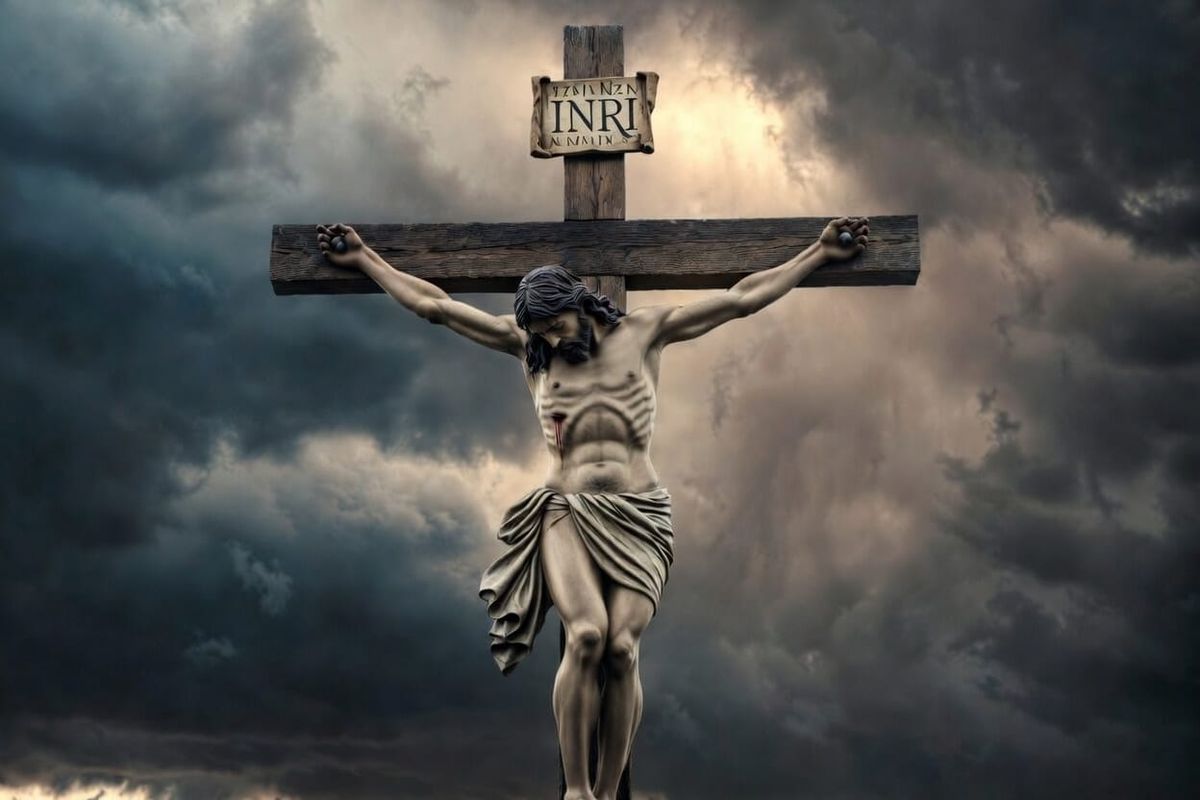
When we reach chapter 19, Jesus is taken to Golgotha. They crucify him between two others, with a sign above his head written in Aramaic, Latin, and Greek so that no one could miss it: “Jesus of Nazareth, the King of the Jews.” (John 19:19, ESV)
The chief priests protest. They want the sign to say that this man claimed to be King of the Jews. Pilate, in one of the Passion’s great moments of accidental theological clarity, answers, “What I have written I have written.” (John 19:22, ESV) The inscription stands. The King of the Jews is being crucified by Rome, and the truth of his kingship is nailed above his head in three languages.
From the Cross, Jesus makes provision for his mother. He sees her standing with the beloved disciple and says to her, “Woman, behold, your son!” and to the disciple, “Behold, your mother!” (John 19:26–27, ESV) Even here, hanging between heaven and earth, bearing the weight of the world’s sin, he is attentive. He is caring for the vulnerable. He is still, as he said at the table only hours earlier, the One who is among his people as the One who serves.
The writer to the Hebrews sees the whole of the Passion through the lens of the great High Priest entering the Most Holy Place. Under the old covenant, sacrifices were offered again and again. Year after year. The same cycle of sin and sacrifice, sin and sacrifice. Hebrews 10 opens by reminding us that those repeated sacrifices could never finally perfect the worshiper. Their repetition testified to their incompleteness.
But Christ is different. Hebrews says, “We have been sanctified through the offering of the body of Jesus Christ once for all.” (Hebrews 10:10, ESV) And then in verse 14: “For by a single offering he has perfected for all time those who are being sanctified.” (Hebrews 10:14, ESV) Once for all. That phrase lands differently when you have just watched him cross the Kidron and enter the garden.
The same letter puts it this way: “He has appeared once for all at the end of the ages to put away sin by the sacrifice of himself.” (Hebrews 9:26, ESV) And again, “Christ, having been offered once to bear the sins of many, will appear a second time, not to deal with sin but to save those who are eagerly waiting for him.” (Hebrews 9:28, ESV) The offering is complete. It does not need to be repeated. It will not be improved upon. What he does today, he does once, and it is enough.
And then, finally, in John 19:30, the three words that reorder everything: “It is finished.”
In Greek, a single word: tetelestai (teh-TEL-es-tie). The word carries the sense of something brought to its goal, completed, accomplished, fulfilled. It could be used in the world of obligations and transactions when what was required had been completed. That is why Christians have long heard in it the resonance of a debt fully paid. But John’s meaning is larger still. Everything the Father gave the Son to accomplish, the Scriptures to fulfill, the cup to drink, the sacrifice to offer, has now reached its appointed completion.
Jesus does not say, “I am finished.” He says, “It is finished.” There is a world of difference. I am finished is the gasp of a man who has run out. It is finished is the declaration of a priest who has completed the offering, a King who has won the battle, a Son who has accomplished everything the Father sent him to do.
Then he bows his head and gives up his spirit. Gives it up. Not because death is unreal or because the agony has been anything less than terrible, but because even here John emphasizes the willing obedience of the Son. Jesus dies as he has lived, laying down his life according to the Father’s saving will. “No one takes it from me, but I lay it down of my own accord.” (John 10:18, ESV) This is the gift spoken of last night at the table: “My body, which is given for you.” Now the self-offering has been accomplished.
After his death, the soldiers come to break the legs of those crucified, hastening death before the Sabbath. When they come to Jesus, he is already dead. So instead of breaking his legs, one of the soldiers pierces his side with a spear, and immediately blood and water flow out (John 19:34).
John, who is standing there watching, inserts himself into the narrative at this point with unusual personal urgency: “He who saw it has borne witness, his testimony is true, and he knows that he is telling the truth, that you also may believe.”(John 19:35, ESV) He is not decorating the account. It is almost as though he is swearing an oath: he was there, he saw it, and he is bearing solemn witness that it happened.
And it fulfills Scripture in two directions at once: “Not one of his bones will be broken” (John 19:36, ESV), recalling the requirement for the Passover lamb (Exodus 12:46), and “They will look on him whom they have pierced” (John 19:37, ESV), drawing from Zechariah 12:10 and its promise of mourning and the spirit of grace and pleas for mercy.
The Lamb of God: bones unbroken, side pierced, Blood poured out. The greater Passover toward which the first Passover pointed. The bread and cup we received last night, the Body given and the Blood of the new covenant, bring us directly to this self-offering now accomplished upon the Cross. This soldier, this spear, this hillside outside Jerusalem on a Friday afternoon stand within the story of redemption God has been writing since the garden where the first man and woman hid from him in shame.
We come now to the question Good Friday always forces us to face. Not merely an intellectual question. A personal one.
Why did he do this? The answer is not an abstract theory detached from the man on the Cross. Scripture gives us the doctrine of the atonement precisely because it tells us what his love accomplished. The answer can be seen in the garden at the beginning of the night, where he stepped forward rather than back, said “I am,” and let them bind his hands. It can be seen in the upper room the night before, where he looked around at people who were about to betray him, deny him, and flee from him, and broke bread for them anyway, washed their feet anyway, loved them anyway. It can be seen on the Cross where, even in his final hours, he makes sure his mother is cared for.
The answer is love. Not sentimental love. Not love that avoids cost. The love described in John 3:16, “For God so loved the world, that he gave his only Son” (John 3:16, ESV), and unpacked across the whole narrative of salvation: love that enters the miry bog of Psalm 69 not to observe it from a safe distance but to sink into it, to stand where we stand, to bear what we could not bear, to drink the cup we had earned.
Hebrews tells us that Jesus is not a High Priest unable to sympathize with our weaknesses, but One who “in every respect has been tempted as we are.” (Hebrews 4:15, ESV) The wilderness we explored at the beginning of Lent, the forty days, the hunger, the temptation to shortcut the cost of obedience, all of it prepared us to recognize this High Priest, the One who entered not with the blood of bulls and goats but by means of his own Blood, “thus securing an eternal redemption.”(Hebrews 9:12, ESV) It is an eternal redemption, not seasonal, not conditional upon our performance, and not subject to renewal. It is secured, accomplished, finished.
Good Friday is not a day for ten practical steps. The liturgy of this day is deliberately sparse for a reason. After the service there will be no blessing, no dismissal. The altar is bare. The candles are out. We left it that way last night, and we leave it that way today. Some things need to be felt before they can be applied, and some truths need to be received in silence before we reach for conclusions. The Prayer Book calls Good Friday the second part of the Triduum and describes the church as bare and stark, drawing our attention toward Jesus and the meaning of his Cross.
But let me offer this. Last night the Maundy Thursday sermon closed with an invitation: come to the Table, receive what is given, and go and do likewise. Today we see where that gift leads. Last night Christ gave us the bread and cup, his Body given and his Blood of the new covenant. Today he accomplishes upon the Cross the once-for-all sacrifice that the Eucharist proclaims and gives to his people.
If you have been carrying a debt you cannot pay, a moral account you know will never balance, hear the word tetelestai. It is finished. Paid in full. The account against you is answered by the finished work of Christ. That is not cheap grace. It cost him everything. But it is free grace, freely given and received with the empty hand of faith. You do not complete what Christ has left unfinished. There is nothing left unfinished.
If you have been sinking in the deep mire of Psalm 69, overwhelmed, abandoned, crying out and hearing only silence, know that the One in whom this psalm reaches its fullest depth has gone further into the darkness than you ever will. He knows the waters. He knows the mud. And the deep did not hold him.
And if the dispute about greatness from last night still lives anywhere in you, the quiet ranking of who matters, the pride that thinks it deserves a better seat, look at the sign nailed above his head: “The King of the Jews.” Written in three languages so no one could miss it. This is what the King looks like. This is what love looks like when it gives everything.
We will gather again when Easter comes. The story is not finished. We know that. But we are not there yet.
Today we stay here on Golgotha, at the foot of the Cross, with John and the women who did not run. We look on him whom they pierced. We hear the word that is both an ending and the declaration that redemption has been accomplished.
“It is finished.” (John 19:30, ESV)
In the Name of the Father, and of the Son, and of the Holy Spirit. Amen.