Greater Love Has No One Than This: Memorial Day 2026 (John 15:12-17)
This Memorial Day, we explore the heart of the Gospel through John 15: “Greater love has no one than this, that someone lay down his life for his friends.” We honor those who served and gave their lives while fixing our eyes on Christ, the true Keeper and the Lamb who shepherds the multitude.
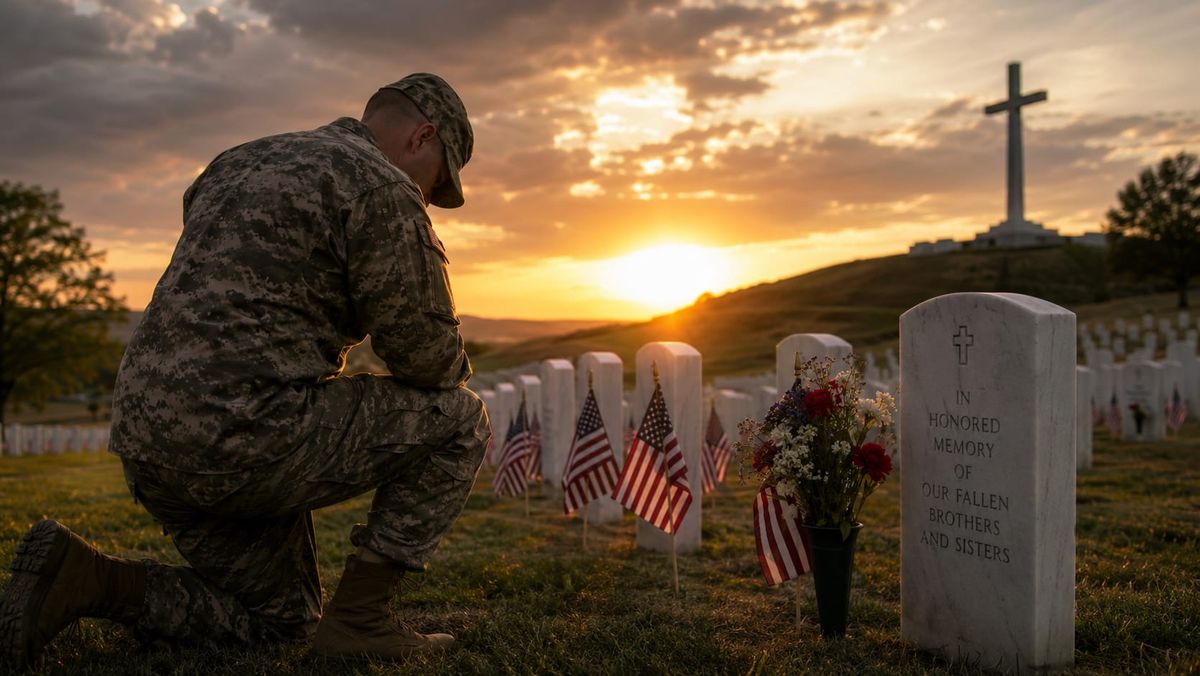
Grace, mercy, and peace from God our Father and the Lord Jesus Christ be with you on this Memorial Day.
Many of us are veterans, members of military families, sons and daughters of those who served, or neighbors who have known the cost of freedom in flesh and blood. Today we remember graves marked by flags, names read aloud at ceremonies, folded flags presented with honor, and empty chairs at family tables. We remember those who did not come home. But first and always, we remember the Gospel, because the Gospel anchors Christian remembrance and teaches us how to understand every sacrifice we honor.
Our primary text is John 15:12–17, and it places us back in the Upper Room on Maundy Thursday night. Jesus has washed his disciples’ feet. Judas has gone out into the darkness. Jesus has spoken of himself as the true Vine and his disciples as the branches. He is preparing these men for what is coming, although they do not yet understand how quickly it will come. Before the night is over, Jesus will be arrested. By the following afternoon, he will be dead. Into that darkness, verse 12 gives us the command that governs the passage: “This is my commandment, that you love one another as I have loved you.” (John 15:12, ESV)
That last phrase controls everything that follows: “as I have loved you.” Jesus does not begin by telling his disciples to manufacture heroic love from somewhere inside themselves. He begins with what he has already given them. His love comes first. The command rests upon the gift. They are to love because they have already been loved by him. Christianity is not a religion in which we somehow make ourselves worthy of God by becoming courageous enough, sacrificial enough, moral enough, or loving enough. God does not stand at a distance waiting to see whether we can climb high enough to reach him. Christ comes to us. Christ loves us. Christ calls us. Christ gives himself for us. Then he says, “Love one another as I have loved you.”
Verse 13 brings us to the words from which this sermon takes its title: “Greater love has no one than this, that someone lay down his life for his friends.” (John 15:13, ESV) Those words belong naturally on Memorial Day. We remember men and women who put on the uniform, left homes and families, stood watch through long nights, entered dangerous places, and accepted the possibility that they might not return. Some did not return. They were husbands and wives, fathers and mothers, sons and daughters, brothers and sisters, friends and neighbors. They came from communities very much like ours. They placed themselves in danger for their comrades, their country, and people they would never meet. There is genuine nobility in such sacrifice, and Christians should not be embarrassed to say so.
But we also need to hear verse 13 first in the setting in which Jesus spoke it. Within hours, Jesus himself will walk the path of this greater love. He will leave the Upper Room for Gethsemane. He will be betrayed, arrested, falsely accused, mocked, beaten, condemned, and crucified. He knows what is coming. He knows the cost. And he gives himself anyway.
Even then, we have to make an important distinction. Jesus does not merely provide the supreme example of sacrificial courage. He does something at the Cross that no soldier, martyr, parent, friend, or hero can ever do. Christ atones for sin. The death of a soldier, however courageous, is not the atoning death of Jesus Christ. No military death bears the sins of the world. No battlefield sacrifice reconciles sinners to the Father. No mere human being can die in another’s place and thereby bring that person into the Kingdom of God. Jesus can because he is not merely another man laying down his life. He is the eternal Son of God who became truly human for us and for our salvation, and in his once-for-all sacrifice he gives himself for sinners. The Cross therefore stands above every lesser sacrifice.
Yet that does not make human sacrifice meaningless. The willingness of one person to risk or surrender life so that another may live can genuinely reflect, however faintly and imperfectly, the self-giving love revealed supremely in Jesus Christ. We can honor that reflection without confusing it with the source. We can honor the sacrifice without turning it into salvation. That distinction matters on Memorial Day because we honor the fallen, but we worship only Christ.
We also refuse to sentimentalize war. War is brutal, tragic, and destructive. It tears apart bodies, minds, families, communities, and nations. The Church does not celebrate war as though war itself were noble. We pray for those who serve, and we also pray that wars may cease. Yet courage, duty, loyalty, service, and self-sacrifice remain genuine goods in a fallen world. We can honor those virtues while still longing for the day when nation shall not lift up sword against nation.
Our Prayer Book helps us hold these truths together. The Collect for Memorial Day begins, “O King and Judge of the nations: We remember before you with grateful hearts the men and women of our armed forces, who in the day of decision ventured much for the liberties we now enjoy.” Notice where the prayer begins. It does not begin with America. It does not begin with the flag. It does not begin with the armed forces. It begins with God: “O King and Judge of the nations.”We remember the nation under God’s rule. We remember military sacrifice under God’s judgment. We receive liberty as a gift for which we should be grateful, but we do not turn liberty into an idol. Nations are accountable to God. Armies are accountable to God. Presidents and generals are accountable to God. So are citizens. God alone is King and Judge of the nations.
The Collect then turns from the dead to the living and asks that we “may not rest until all the people of this land share the benefits of true freedom and gladly accept its disciplines.” That final word matters. Freedom has disciplines. Memorial Day cannot simply be about what somebody else sacrificed years ago. The prayer asks what we are doing with what was placed into our hands. If others ventured much for liberties we now enjoy, those liberties are not merely permission to please ourselves. Freedom carries responsibilities. It calls for service, integrity, self-government, justice, love of neighbor, and a willingness to place the good of others ahead of our own convenience.
Then, in verses 14 and 15, Jesus moves from sacrificial love to friendship with him: “You are my friends if you do what I command you. No longer do I call you servants, for the servant does not know what his master is doing; but I have called you friends.” (John 15:14–15, ESV) We need to hear those words in the grace-filled order Jesus gives them. He is not saying, “Obey well enough and perhaps I will decide to become your friend.” His love has already come first, and the next verse makes the order unmistakable.
Verse 16 says, “You did not choose me, but I chose you and appointed you that you should go and bear fruit and that your fruit should abide.” (John 15:16, ESV) In its immediate setting, Jesus is speaking to the apostles whom he has chosen and appointed for their particular mission, but the order of grace revealed here belongs to the whole Christian life: God acts first, and our obedience follows from what he has given.
Christ’s initiative comes first. He has brought these disciples near. He has revealed to them what he heard from the Father. He has loved them. He will die for them. Their obedience does not purchase his love. Their obedience is the fruit of his love.
That is good news because these men are about to fail spectacularly. Peter will boast of his loyalty and then deny three times that he even knows Jesus. The others will scatter. Their courage will not save them. Their faithfulness will not hold Jesus to the Cross. Jesus will hold them. On a day when human courage is rightly honored, the Gospel refuses to become another story about heroic human effort. We do not save ourselves by being brave enough. We do not save ourselves by being patriotic enough. We do not save ourselves by sacrificing enough. Salvation begins with God’s action toward sinners. Christ calls. Christ gives himself. Christ saves.
Still in verse 16, Jesus tells his disciples why he chose and appointed them: they are to “go and bear fruit and that your fruit should abide.” That takes us back to the image of the Vine from the opening verses of John 15. A branch does not manufacture life. It receives life. The branch bears fruit because it abides in the vine, and the Christian bears the fruit of love because the life of Christ is at work in him.
That also tells us what faithful remembrance should produce. Remembering the dead is not meant to end at the cemetery. Gratitude should bear fruit in the living. We honor the fallen not only with words, ceremonies, flags, and monuments, but by using faithfully the life and liberty entrusted to us. We bear fruit through faithful marriages, patient parenting, service to neighbors, integrity under pressure, care for veterans and military families, prayer for those currently serving, concern for those bearing wounds seen and unseen, and willingness to give ourselves in the smaller but still costly ways that ordinary Christian love requires.
Verse 17 brings Jesus back to the command with which he began: “These things I command you, so that you will love one another.” (John 15:17, ESV) The entire passage is held together by love. Verse 12 commands love. Verse 13 shows us love willing to lay down its life. Verses 14 and 15 speak of friendship with Christ. Verse 16 tells us that Christ chose and appointed his apostles to bear lasting fruit. Then verse 17 returns once more to love. But this is not sentimental love. It is cruciform love, love shaped by the Cross, and it comes from Christ before it comes from us.
Psalm 121 gives us another word for this day when it declares, “I lift up my eyes to the hills. From where does my help come? My help comes from the LORD, who made heaven and earth.” (Psalm 121:1–2, ESV) The Psalm speaks of the God who neither slumbers nor sleeps, the Lord who keeps his people and watches over their going out and their coming in. Those words carry particular weight for anyone who has stood watch, waited for news, watched a deployment bus pull away, heard a telephone ring in the middle of the night, or sent someone they loved into danger.
But the Psalm does not promise that every soldier will return home. Scripture gives us no such promise. Christians die. Soldiers die. People for whom desperate prayers have been offered sometimes die. The promise is deeper than immunity from death. The Keeper does not cease to be God when danger comes. He does not fall asleep when human strength fails. Those who belong to him are never beyond his keeping, not in life, not in suffering, and not even when the earthly pilgrimage reaches its end.
Our appointed reading from Wisdom gives us similar language: “The souls of the righteous are in the hand of God, and no torment will ever touch them.” (Wisdom 3:1) Wisdom is one of the books the Anglican tradition receives for “example of life and instruction of manners,” though not for establishing doctrine, and its language here gives voice to a profound biblical hope: death does not place God’s people outside his keeping. We must not turn that into an automatic promise about anyone who dies nobly. Dying in service to one’s country does not itself make a person righteous before God. A uniform does not save. Heroism does not justify. The hope belongs to those who belong to God.
That is why Revelation 7 matters so much today. John sees “a great multitude that no one could number, from every nation, from all tribes and peoples and languages, standing before the throne and before the Lamb.” (Revelation 7:9, ESV) Every nation is represented, but no nation owns the throne. Then the multitude cries out, “Salvation belongs to our God who sits on the throne, and to the Lamb!” (Revelation 7:10, ESV) That may be one of the most important sentences Christians can say on a National Day. Salvation belongs to God, not to America, not to an army, not to a political party, not to a president, not to a flag, not to our courage, and not even to our sacrifice.
Verse 14 then tells us why that multitude can stand there. They “have washed their robes and made them white in the blood of the Lamb.” (Revelation 7:14, ESV) No one stands before God’s throne because of military courage, patriotic sacrifice, public service, or the manner in which he died. Among the redeemed are people whose earthly lives ended in countless ways. Some may have died in war. Some may have died quietly in bed. Some may have been martyrs. Some may have died almost unnoticed by the world. But everyone before that throne stands there for the same reason: the Lamb has redeemed them.
That means the deepest question on Memorial Day is finally the same question we face every other day: Do you belong to Jesus Christ? The Gospel is not merely that Jesus showed us how to love sacrificially. The Gospel is that the eternal Son of God became truly human for us and for our salvation, gave himself for sinners, bore our sins upon the Cross, rose bodily from the grave, and now gives forgiveness and eternal life to all who turn to him in repentance and faith. If your hope rests in your virtue, your service, your courage, your goodness, your patriotism, or your record, then your hope rests in something that cannot carry you through death. Christ can. Come to him. Trust him. Abide in him. The Lamb who was slain is alive, and salvation belongs to him.
Revelation then gives us the promise toward which every Christian cemetery finally points: “They shall hunger no more, neither thirst anymore; the sun shall not strike them, nor any scorching heat. For the Lamb in the midst of the throne will be their shepherd, and he will guide them to springs of living water, and God will wipe away every tear from their eyes.”(Revelation 7:16–17, ESV) That is where Christian remembrance leads. We begin today with cemeteries, flags, monuments, photographs, folded flags, and names carved into stone. Those things matter because people matter and memory matters. But Christian hope does not stop there. It lifts our eyes beyond every cemetery to the throne.
A grateful nation may remember the dead for generations, but nations themselves do not last forever. Monuments weather. Names fade from public memory. Republics rise and fall. Jesus Christ is risen, and because he is risen, death does not have the last word over those who belong to him. The redeemed are held by God. The Lamb will shepherd his people. God himself will wipe away every tear.
The Gospel therefore does not diminish Memorial Day. It gives Memorial Day its proper place. The sacrifices we remember can point us toward the one Sacrifice that actually redeems. The courage we honor can remind us of the greater love revealed at the Cross. The grief we carry can be brought beneath the promise of Resurrection, where it is neither denied nor permitted to have the final word.
Jesus did not die for an idea, a flag, or a nation. He died for sinners. He died for the veteran still carrying memories that will not easily fade, for the Gold Star family whose grief remains when the ceremony is over, for the service member preparing to deploy, for the person who has never worn a uniform, and for every one of us who has no hope apart from his mercy. The same Christ who says, “Greater love has no one than this,” is the eternal Son made flesh who actually lays down his life and takes it up again.
That is why our application cannot stop with remembering. Jesus says that he chose and appointed his apostles to bear fruit that abides, and that same Gospel calls every Christian to a life of abiding fruitfulness. We honor the fallen not only by remembering what they gave but by asking what faithful love requires from us now. For most of us, that will not mean laying down our lives on a battlefield. It may mean something quieter and less dramatic, but still costly: keeping a promise when breaking it would be easier, caring for a spouse whose health is failing, raising children patiently, forgiving someone who has wounded us, serving a neighbor who cannot repay us, caring for a veteran who feels forgotten, praying for those in harm’s way, or giving time and strength when no one is likely to notice.
None of that earns the love of Christ. It grows from the love of Christ. The branch does not produce fruit by straining harder to become alive. It bears fruit because it abides in the Vine. Christ loved us first. Christ called us by his Gospel. Christ gave himself for us. His grace produces the love he commands and sustains the fruit he calls us to bear.
So on this Memorial Day, we remember with gratitude, but not with sentimentality. We grieve, but not without hope. We honor the fallen, but we worship only Christ. We cherish liberty, but we remember that true freedom has disciplines. We look upon the graves of those who died in service to others, and then we lift our eyes beyond every grave to the Lamb who died and rose again.
Until the day when God wipes away every tear and the redeemed from every nation stand together before his throne, let us live as those who have been called by Christ and brought into his grace. Let us bear fruit that abides, use our freedom faithfully, care for those who still carry the cost of war, and love one another as he has loved us, remembering the words of our Lord: “Greater love has no one than this, that someone lay down his life for his friends.” (John 15:13, ESV)
In the Name of the Father, and of the Son, and of the Holy Spirit. Amen.