Hesed: Steadfast Love (Matthew 9:9-13)
The Pharisees had the sacrifices exactly right. They’d lost the "hesed". Jesus quotes Hosea to the Bible scholars: ‘I desire mercy, and not sacrifice.’ Without the inner reality, the outward form is a morning cloud — gone before noon.
June 7, 2026, Year A, Proper 5, The Second Sunday after Pentecost
Matthew 9:9–13, Psalm 50, Hosea 5:15–66
Grace, mercy, and peace be with you on this second Sunday after Pentecost.
Last Sunday, on Trinity Sunday, we stood on the mountain in Galilee and heard the Great Commission. Jesus spoke the words that open this entire season: "All authority in heaven and on earth has been given to me. Go therefore and make disciples of all nations, baptizing them in the name of the Father and of the Son and of the Holy Spirit, teaching them to observe all that I have commanded you. And behold, I am with you always, to the end of the age." (Matthew 28:18–20, ESV) And now, this second Sunday after Pentecost, we find out what that commission looks like in practice. It begins not with another mountain moment, but with a tax booth.
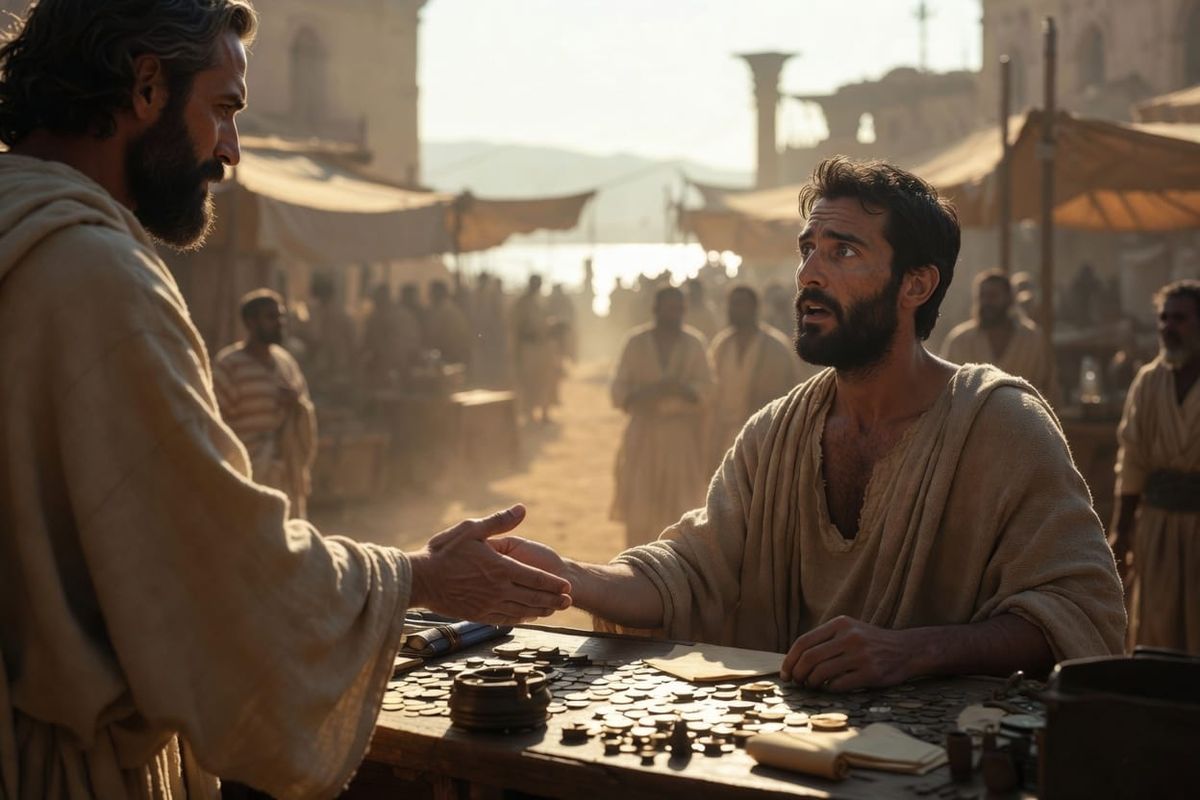
In verse 9, Matthew tells us: "As Jesus passed on from there, he saw a man called Matthew sitting at the tax booth, and he said to him, 'Follow me.' And he rose and followed him." (Matthew 9:9, ESV) There is a great deal in that short verse. Let us begin with who Matthew was, because the word "tax collector" lands much more softly on our ears than it would have on a first-century Jewish audience.
Tax collectors in first-century Judea were agents of Rome, members of the conquered people conscripted to collect from their own neighbors, because a local man would know everyone, know what they owned, and know where to find them. They were seen as traitors to their people and to God, enriching themselves by collecting more than was required. A Jewish tax collector like Matthew would have been excommunicated from the synagogue, disowned by his family, and despised by every decent member of the community. His only friends would have been other tax collectors.
To help us feel the weight of it: think of the word "tax collector" as shorthand for someone who is corrupt, treasonous, self-serving, and entirely comfortable profiting from the suffering of others, the kind of person we would be tempted to regard as simply beyond the reach of God's grace. That is how Matthew's neighbors felt about him. Jesus' hearers would have heard that word with something close to revulsion.
And right there, in the middle of that booth, in the middle of that life, Jesus walks by and says two words: "Follow me."No application, no background check, no probationary period. Two words. And in verse 9, Matthew records his own response with extraordinary restraint: "And he rose and followed him." That is the entire conversion narrative of the man who would one day write the first Gospel in the New Testament. Two sentences. No drama. No explanation of what it cost him. He simply reports what happened: Jesus called, and he followed.
Praise God. Did he not do the very same for us? Our lives may have been more socially acceptable than Matthew's, but our hearts were not so different. God reached into our sinful mess and said the same two words. The question for us on this first Sunday after Pentecost, as we step into the long season of ordinary time, is whether we can extend to others what was extended to us, even to the tax collectors of our own day.
In verse 10, Matthew tells us what happened next: "And as Jesus reclined at table in the house, behold, many tax collectors and sinners came and were reclining with Jesus and his disciples." (Matthew 9:10, ESV) Matthew threw a dinner party. And is it not just like a new believer to want to tell the world? He did not wait until he had been sufficiently formed as a disciple. He simply opened his house and filled it with the only friends he had, other outcasts, other sinners, so they could meet the one who had just called him out of his old life.
Nothing is wasted in God's economy. Matthew's love of precision, his literacy in multiple languages, his familiarity with Roman and Jewish legal categories, all of it, developed at a tax booth, would eventually be placed in service of the most carefully structured of the four Gospels. The man who once catalogued debts would one day catalogue the teachings of the Son of God. The gifts that were corrupted by sin were not discarded when grace arrived. They were redeemed.
In verse 11 the Pharisees appear: "When the Pharisees saw this, they said to his disciples, 'Why does your teacher eat with tax collectors and sinners?'" (Matthew 9:11, ESV) Notice that they do not ask Jesus directly. They go to the disciples. It sounds less like a question seeking an answer and more like an accusation seeking an audience. They were blinded by their disgust, for the tax collectors, for the sinners, and for Jesus, the renegade rabbi who was breaking every convention by sitting at their table.
The Pharisees had no hope for these people, only accusation and condemnation. One wonders whether they even wanted them saved. There is a form of religious pride that does not merely judge sinners as unworthy; it actively prefers them to remain so, because their exclusion confirms the righteousness of those inside. That is a dangerous place to be, and it is precisely what Jesus is about to address.
In verse 12, Jesus hears the Pharisees' muttering and responds: "Those who are well have no need of a physician, but those who are sick." (Matthew 9:12, ESV) The image is simple and devastating. A physician goes to where the sick people are. Jesus is not defiled by his contact with sinners any more than a physician is made ill by his contact with the sick. He is there to do his work.
But there is something even more pointed in verse 12. The Pharisees have categorized themselves among the well. And that, Jesus implies, is the most dangerous condition of all. A man who does not know he is sick does not seek a physician. The tax collectors at Matthew's table knew exactly what they were. That self-knowledge, painful and humiliating as it was, was their door into the Kingdom. The Pharisees, certain of their own righteousness, had closed that door from the inside. Jesus will say it plainly later in Matthew 21:31–32: "Truly, I say to you, the tax collectors and the prostitutes go into the kingdom of God before you." (Matthew 21:31–32, ESV) Not because their sins were smaller, but because they knew they were sick.
In verse 13, Jesus drives the point home with a Scripture the Pharisees would have known by heart: "Go and learn what this means: 'I desire mercy, and not sacrifice.' For I came not to call the righteous, but sinners." (Matthew 9:13, ESV) He is reaching directly into our Old Testament reading this morning, Hosea 6:6. And to understand why that quotation has such force, we need to hear it in context.
Our reading from Hosea opens in chapter 5 with God announcing his withdrawal: "I will return again to my place, until they acknowledge their guilt and seek my face, and in their distress earnestly seek me." (Hosea 5:15, ESV) Then in chapter 6, Israel responds; but listen carefully to how they respond: "Come, let us return to the Lord; for he has torn us, that he may heal us; he has struck us down, and he will bind us up. After two days he will revive us; on the third day he will raise us up, that we may live before him." (Hosea 6:1–2, ESV) On the surface that sounds like repentance. But God hears something else in it, a certain confidence, a certain ease, a certain assumption that returning to God is a simple matter of turning up and saying the right words. And in verse 4 his heartbroken response: "What shall I do with you, O Ephraim? What shall I do with you, O Judah? Your love is like a morning cloud, like the dew that goes early away."(Hosea 6:4, ESV) Thin love. Evaporating love. The kind that glistens in the morning and is gone by midday. And then verse 6: "For I desire steadfast love and not sacrifice, the knowledge of God rather than burnt offerings." (Hosea 6:6, ESV)
The Hebrew word behind "steadfast love" is hesed (pronounced HEH-sed), one of the great covenant words of the Old Testament. It means loving-kindness, covenantal faithfulness, mercy that will not let go. It is emphatically not the morning-cloud love of Hosea 6:4. It is not thin. It does not evaporate. It is the love described in Psalm 136, where every single verse ends with the same refrain: "his steadfast love endures forever." That is the word. Hesed. Forever. The opposite of morning cloud.
What scholars call a Semitic antithesis, a Hebraic literary construction, does not mean A instead of B, but that B is foundational to A. God is not abolishing the sacrificial system. He is insisting that hesed must precede and animate the sacrifice, or the sacrifice is hollow. Think of Cain's offering in Genesis 4, the sacrifice for which God had no regard. The sacrifice was present. The heart was not. Israel in Hosea's day had replicated Cain's error at the level of the entire religious system. The Pharisees standing outside Matthew's dinner party have done it again.
Now, Psalm 50, our appointed psalm, stands in exactly this same prophetic tradition. God speaks from Zion as judge, summoning his people: "Hear, O my people, and I will speak; O Israel, I will testify against you. I am God, your God."(Psalm 50:7, ESV) And then the indictment: "Not for your sacrifices do I rebuke you; your burnt offerings are continually before me. I will not accept a bull from your house or goats from your folds." (Psalm 50:8–9, ESV) The problem is not the absence of sacrifice. The problem is the assumption behind it, that God needs what they are bringing, that the ritual alone is sufficient, that the external performance is the thing. The psalm drives to its conclusion: "The one who offers thanksgiving as his sacrifice glorifies me; to one who orders his way rightly I will show the salvation of God!" (Psalm 50:23, ESV) Thanksgiving. A rightly ordered life. Hesed. Three witnesses, Psalm 50, Hosea 6, Matthew 9, and one verdict across three centuries: the sacrifice without the covenant love is not what God asked for.
And here the theology must be stated precisely, because it matters. Hesed was not a new requirement introduced by Jesus, nor something merely anticipated for the future. It was always required in the Old Testament sacrificial system, from Leviticus onward. When an Israelite came to the altar in genuine contrition and faith, with hesed, the sacrifice was effectual. God was not playing a shell game with his people. Leviticus 17:11 is plain: "it is the blood that makes atonement by the life." (Leviticus 17:11, ESV) That atonement was real. The sin was genuinely covered, genuinely forgiven. But it was forgiven on the basis of what God knew was coming, the one sacrifice to which all the others pointed. Paul makes this explicit in Romans 3:25, where he writes that God had passed over former sins in his forbearance, and the cross is the revelation of his righteousness in having done so. The Old Testament saints were saved by the same grace, through the same Christ, on the basis of the same cross; they simply approached it from the other side of history. Hesed plus sacrifice genuinely forgave. But that forgiveness was always grounded in the blood of the Son.
Jesus is therefore not offering a new principle when he quotes Hosea. He is the fulfillment of what Hosea was always pointing toward. He is both the one true sacrifice that the system foreshadowed, "Behold, the Lamb of God, who takes away the sin of the world!" (John 1:29, ESV); and the very embodiment of the hesed that was always required to receive it rightly. In him, the sacrifice and the covenant love are one person. He does not provide the atonement from a distance and leave us to find our own way to it. He sits down at a table with sinners. He is present with the sick. He is the physician and the medicine both.
Every Sunday morning, before we come to this Table, we confess our sins together. We kneel and acknowledge that we have not loved God with our whole heart, that we have not loved our neighbors as ourselves, that we have left undone the things we ought to have done. The confession is not an optional warm-up. It is the required threshold. It is the difference between the Pharisee who stands outside the dinner party and the tax collector who sits down at the table.
The BCP places the Exhortation before Communion on the First Sunday of Advent and the First Sunday in Lent for exactly this reason. It reminds us of the gravity of what we are doing, citing Saint Paul: "For as the benefit is great, if we receive that holy Sacrament with a truly penitent heart and lively faith, spiritually eating the Flesh of Christ and drinking his Blood, so that we might be made one with Christ and he with us; so also is the danger great, if we receive these gifts unworthily. For then we become guilty of profaning the Body and Blood of Christ our Savior, and we eat and drink to our own condemnation. Therefore, judge yourselves lest you be judged by the Lord." To come to this Table without hesed, without genuine penitence, without mercy received and mercy extended, is to do precisely what the Pharisees did at Matthew's dinner. The sacrifice is present. The heart is absent. The form is maintained while the hesed drains out, like the morning cloud of Hosea 6.
What the confession does is not clean us up by our own effort. We cannot do that. What it does is bring us to the Table the way Matthew came to the dinner, knowing what we are, not pretending otherwise, coming through the door of acknowledged need rather than assumed merit. We arrive at the altar the way Israel was meant to arrive: not with a performance, but with a broken and contrite heart that God will not despise. The cleansing is Christ's work. The penitence is ours. Both are required. Neither can substitute for the other. That is hesed at this Table, covenant faithfulness flowing both directions, the mercy of God meeting the honest need of his people.
Let me close with the question this text puts to all of us. Who are our tax collectors? Who is the person, or the kind of person, that we have quietly decided is probably beyond the reach of God's grace? Who is the one whose presence in this congregation would cause us to raise an eyebrow, or quietly wonder whether God really meant it?
Matthew appeared beyond salvation. He was as publicly corrupt as anyone in Capernaum, excommunicated from church and family, despised by his own people. And Jesus called him with two words, and he became the Evangelist. If Matthew can be saved, who cannot? God can do anything, can he not? He saved us too, in some cases against all odds. These things should always give us hope, and should keep us praying.
Not praying as a moral obligation to check off a list. Praying with hesed, with genuine broken desire that the lost would be found, that the sick would be healed, that those we would love to write off would instead be written into the Book of Life. When we pray that way, our hearts are changed from repulsion and anger to humility and compassion. We remember: but for the grace of God, go we. And from that place, not from self-righteous distance, we find the courage and the pure motives to reach toward the tax collectors of our own day, as Jesus reached toward Matthew.
It is not simply enough for us to go through the motions, to pray for the lost as if checking a moral box, to come to the Table as if the ritual alone will do. Our hearts must be in it. They must be reminded of the mercy we have received, broken for the lost as God's heart is broken, so that we desire for them what God desires: that they would turn from their wicked ways and toward him. The morning-cloud love of Hosea 6 evaporates before noon. The hesed God desires endures forever. That is what he is asking of us. That is what he himself extends.
Hesed. The steadfast love that will not let go, present in the Old Testament sacrifices when Israel brought it, fulfilled in the one true sacrifice of the Son, enacted in our confession every Sunday morning, and extended from us outward toward those we would love to shun. This is where the Season after Pentecost begins.
In the Name of the Father, and of the Son, and of the Holy Spirit. Amen.