The Season after Pentecost: An Anglican Perspective
The Season after Pentecost is the Church’s longest season — twenty-four to twenty-eight Sundays of green. Not preparation, not celebration, but formation: the slow, sustained work of becoming what the Gospel has declared the Church to be. Trinity Sunday to Christ the King.
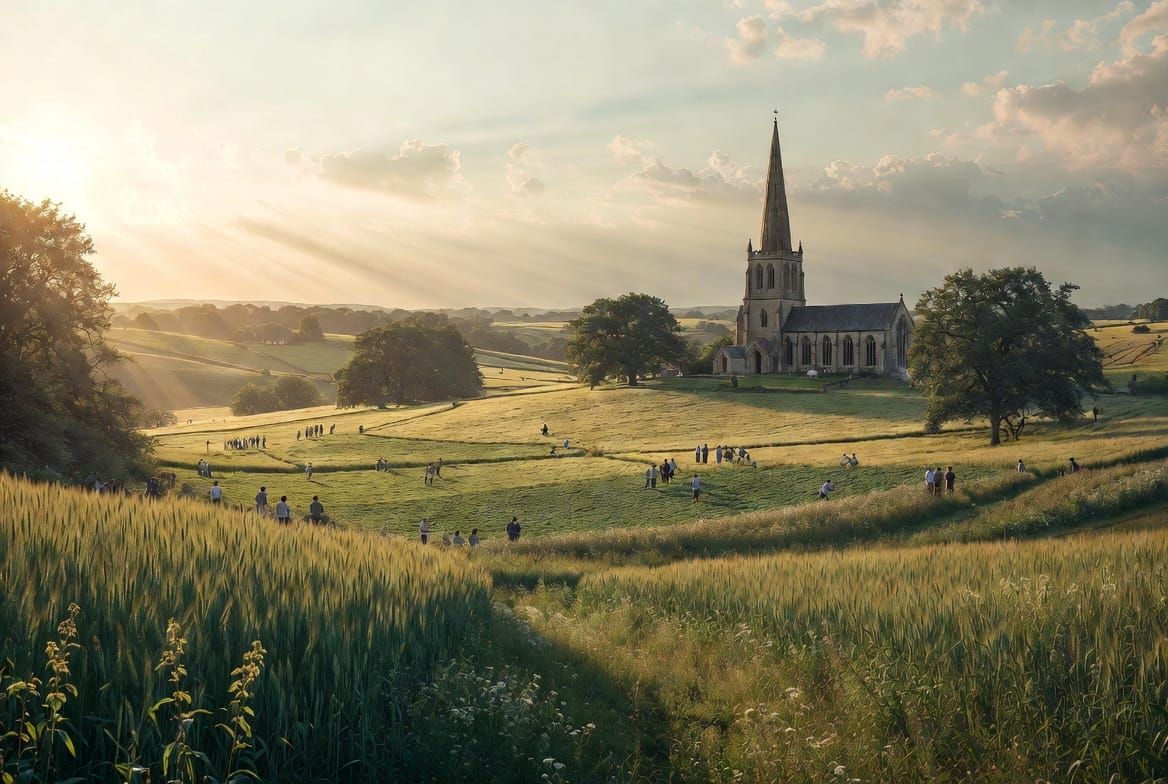
The Long Season of Christian Growth, From Trinity Sunday to the Eve of Advent
The Season after Pentecost is the longest season in the Anglican liturgical year, the great green stretch of the Christian year whose first Sunday is Trinity Sunday and which continues through the Last Sunday after Pentecost, Proper 29, Christ the King, ending when Advent begins. It covers the full arc of summer and autumn and, depending upon the date of Easter, may extend across more than half the Christian year.
The BCP 2019 places Trinity Sunday and the numbered Propers beneath the heading The Season after Pentecost. It explains that the Easter Season includes and ends with the Day of Pentecost, that the First Sunday after Pentecost is Trinity Sunday, and that all subsequent Sundays have numbered Propers and may be designated either after Pentecost or after Trinity. The Sunday lectionary for the season appears on pages 725–729, while the Collects begin with Trinity Sunday on page 615 and continue through Proper 29 on page 623.
The season is sometimes called Ordinary Time, a term more characteristic of Roman Catholic usage but occasionally heard among Anglicans as well. The BCP 2019 consistently calls it The Season after Pentecost. Its permission to number Sundays after Trinity preserves the traditional Anglican usage. The two descriptions emphasize complementary truths. Pentecost gives the season its missionary and Spirit-filled context, while the older numbering after Trinity keeps the Church’s life consciously oriented toward the Triune God whom Trinity Sunday confesses.
This is the season in which the Church lives most visibly in the ordinary conditions of Christian discipleship. The great mysteries of the Gospel have already been proclaimed across the year: the coming of the Son in Advent and Christmas, his manifestation in Epiphany, the call to repentance in Lent, his Passion and Resurrection, his Ascension, and the outpouring of the Holy Spirit at Pentecost. The Season after Pentecost asks what life looks like when those truths are inhabited week after week.
The Character of the Season
The Season after Pentecost is above all a season of formation. Its character is not determined by one saving event in the same concentrated way as Christmas, Easter, or Pentecost. Instead, it gives the Church a long period in which the Gospel already proclaimed is worked into the ordinary habits of Christian life.
The liturgical color is green for the ordinary Sundays of the season, fittingly suggesting life, growth, fruitfulness, and patient maturation. A field does not become fruitful in a day, and neither does a Christian. The Spirit poured out at Pentecost continues his work in the Church through Word and Sacrament, prayer and repentance, obedience and fellowship, discipline and mercy.
The kingdom parables heard especially in Year A provide a memorable image for this season. Jesus compares the Kingdom to a mustard seed, leaven hidden in flour, treasure concealed in a field, and a net cast into the sea. These images describe a Kingdom already present and active whose work is often gradual, hidden, and awaiting final completion.
That is much of the Christian life. Baptism does not remove the need for growth, and conversion does not eliminate the need for sanctification. The Christian has been made alive in Christ and is therefore called to “grow up in every way into him who is the head, into Christ.” (Ephesians 4:15, ESV) The long green season gives liturgical space for that growth.
The season is therefore ordinary only in the sense that ordinary Christian life is ordinary. There is nothing insignificant about learning to forgive, resisting temptation, caring for a neighbor, praying when prayer feels dry, receiving Scripture repeatedly, returning to the Eucharist, repenting again, serving without recognition, persevering in suffering, and learning over decades to trust the promises of God. Much of holiness looks exactly like that.
Pentecost and Trinity Sunday
Pentecost brings the Great Fifty Days of Easter to their culmination. The risen and ascended Christ pours out the promised Holy Spirit upon his Church and sends her into the world to bear witness to him. The Season after Pentecost grows directly out of that gift.
The BCP begins the section titled The Season after Pentecost with Trinity Sunday, the First Sunday after Pentecost. Trinity Sunday is one of the seven Principal Feasts and therefore stands as the theological threshold of the season before the numbered Propers begin.
After celebrating the mighty acts of God across the first half of the Christian year, the Church pauses to confess the God who has acted: Father, Son, and Holy Spirit, one God in Trinity of Persons and Unity of Substance.
The long season that follows can therefore be understood as life in the grace of the Triune God. The Father has created and called his people. The Son has redeemed them through his Incarnation, Cross, and Resurrection. The Holy Spirit has been given to dwell within the Church, conform believers to Christ, and empower her witness.
The traditional Anglican habit of counting Sundays after Trinity has a theological logic. The Church spends these months learning to live within the life God has revealed and given. We are formed by the Word of the Son, animated by the Spirit, reconciled to the Father, and directed toward the glory of the Triune God.
The Proper System
The BCP 2019 organizes the long season through numbered Propers. Proper 1 through Proper 29 provide Collects and lectionary readings tied to particular calendar windows. Because Easter moves from year to year, the numbered sequence does not begin at the same place every year. Early Propers may be omitted when Easter falls late, while an earlier Easter allows more of the sequence to be used.
The BCP assigns each Proper to the week of the Sunday falling within a specific date range. Proper 1, for example, belongs to the week of the Sunday from May 8 through May 14, while Proper 29 belongs to the week of the Sunday from November 20 through November 26.
This differs from seasons such as Advent and Lent, where Sundays carry fixed seasonal names. The Proper system allows the lectionary to continue through the long months while keeping the later weeks anchored to the approach of Advent.
Proper 29 always brings the numbered sequence to its conclusion. The BCP designates it Christ the King. It is the Last Sunday after Pentecost and uses the Proper assigned to the Sunday falling from November 20 through November 26.
The Collects of the season form a kind of extended school of prayer. They range widely across the Christian life, asking for grace to love God above all things, for faith and steadfastness, for protection, for right desires, for the fruitfulness of God’s Word, for holy living, for good works, for peace, and finally for the restoration of all things under Christ.
The breadth is appropriate because the Season after Pentecost is not teaching one isolated doctrine. It is forming a whole Christian life.
The Three-Year Lectionary
The Sunday lectionary for the Season after Pentecost appears on pages 725–729 of the BCP 2019 and follows the three-year cycle. Matthew predominates in Year A, Mark in Year B, and Luke in Year C, although the sequence is not mechanically continuous and John appears at important points, especially during Year B.
The shape of the Gospel readings depends partly upon where the movable date of Easter causes the numbered Proper sequence to begin.
In Year A, the sequence moves through major portions of Matthew. Earlier Propers contain material from the Sermon on the Mount, though some of these may be omitted depending upon the date of Pentecost. As the sequence continues, the Church hears the call and mission of the disciples in Matthew 9 and 10, the kingdom parables of Matthew 13, the mighty works and growing recognition of Jesus in Matthew 14–16, the community teaching of Matthew 18, the journey toward Jerusalem, the controversies surrounding Jesus’ final ministry, and finally the eschatological teaching of Matthew 24 and 25.
Year A therefore has a particularly strong kingdom movement. Jesus calls, sends, teaches, heals, confronts, forms his Church, warns of judgment, and finally appears as the Son of Man seated upon his glorious throne. The year ends with the King whom the Gospel has steadily unveiled.
Year B follows Mark’s urgent portrait of Jesus through his ministry, opposition, teaching, miracles, and journey toward Jerusalem. In the middle of the sequence, Mark gives way for several Sundays to John 6 and the Bread of Life discourse. The result is an extended meditation upon Christ as the true Bread from heaven before the Markan sequence resumes.
Year C follows Luke through much of his distinctive journey material toward Jerusalem. The Church hears stories and teachings especially characteristic of Luke: the Good Samaritan, Mary and Martha, warnings concerning possessions, teachings on humility and discipleship, the Rich Man and Lazarus, the persistent widow, the Pharisee and the tax collector, and Zacchaeus. Luke repeatedly reveals the mercy of God toward sinners while exposing pride, self-righteousness, greed, and false security.
The Epistle readings likewise carry sustained apostolic instruction through the season, though they move through several letters rather than following a single epistle from beginning to end. The exact pattern varies by year, but the effect remains consistent: the Church hears the Gospel narratives alongside extended apostolic teaching concerning grace, faith, holiness, suffering, perseverance, ministry, unity, and hope.
The Old Testament readings are generally selected in relation to the Gospel and the other readings of the day, allowing the Church to hear Christ and the life of the Kingdom against the broad background of the Law, Prophets, Wisdom literature, and Israel’s history.
The result is not simply a sequence of unrelated Sunday lessons. Over months, the lectionary forms a congregation by repeated exposure to the whole counsel of Scripture.
Formation by the Collects
The Collects are one of the great treasures of the Season after Pentecost because they refuse to let Christian formation become a project of self-improvement. Again and again the Church asks God to do what she cannot accomplish by her own strength. We ask him to increase faith, order our desires, protect us from what harms us, stir up our wills, give us grace to think and do what is right, and bring forth in us the fruit of good works.
That grammar matters. Christian formation is active, but it is not self-generated. We obey because grace has first been given. We seek holiness because God is already at work within his people. The Collects repeatedly place the initiative with God and then teach Christians to respond faithfully to what he gives.
This makes the Season after Pentecost particularly valuable in a culture shaped by techniques, programs, and promises of self-optimization. Christian sanctification is not simply the improvement of the old self through better habits. It is the gracious work of God conforming those united to Christ into the likeness of his Son.
The habits matter. Prayer matters. Scripture matters. Discipline matters. Good works matter. But beneath and before them stands grace.
The Lord’s Day Through the Long Season
The Season after Pentecost has no single seasonal Eucharistic Preface governing all of its Sundays. The BCP says explicitly that there is no seasonal Preface for the numbered Propers and that Prefaces of the Lord’s Day are used on Sundays. Trinity Sunday retains its own Proper Preface, and Proper 29 has the Proper Preface of Christ the King.
The Lord’s Day Prefaces keep the long green season rooted in the central mysteries of the faith. They direct thanksgiving toward Christ’s Resurrection, his identity as the living Word, and God’s work of creation and new creation.
The long season therefore never becomes spiritually detached from Easter. Every Sunday remains the Lord’s Day, the weekly Christian celebration of the Resurrection. The Church does not leave Easter behind when the Paschal Candle is no longer lit throughout the season and the customary color becomes green. She lives from Easter.
The Eucharist embodies this reality each week. The Church hears the Word, confesses the faith, brings her prayers before God, receives the sacramental memorial of Christ’s once-for-all sacrifice, and is fed by the risen Lord according to his promise. Formation occurs through repetition, but this repetition is not empty. God repeatedly gives what his people repeatedly need.
Holy Days Within the Season
Numerous Red-Letter Holy Days fall within the season, and All Saints’ Day, one of the seven Principal Feasts, also occurs near its end. The exact relationship of a particular Holy Day to the surrounding Sundays changes from year to year, but the long green season is regularly interrupted by observances of apostles, evangelists, martyrs, and other biblical saints, as well as days centered directly upon the person and work of Christ.
Depending upon the date of Easter, the first Holy Days encountered within the season vary. Across the months normally occupied by the Season after Pentecost are Saint Barnabas, the Nativity of Saint John the Baptist, Saint Peter and Saint Paul, Saint Mary Magdalene, Saint James the Apostle, the Transfiguration of Our Lord Jesus Christ on August 6, the Virgin Mary, Saint Bartholomew, Holy Cross Day, Saint Matthew, Holy Michael and All Angels, Saint Luke, Saint James of Jerusalem, and Saint Simon and Saint Jude.
These observances keep the long season from becoming an undifferentiated expanse of green. They remind the Church that Christian formation produces actual lives. The saints are not abstractions. They are men and women in whom the grace of God bore recognizable fruit through faith, witness, suffering, repentance, service, courage, and perseverance.
When a Holy Day is observed, the festal color appropriate to that observance replaces the seasonal green. The visual interruption reinforces the calendar’s theological rhythm: the ordinary course of discipleship is periodically interrupted so that the Church may attend to a particular mystery of Christ or to the witness of one of his saints.
Ember Days and Continuing Discipline
The Autumn Ember Days fall on the Wednesday, Friday, and Saturday following Holy Cross Day, September 14. The BCP sets Ember Days aside particularly for “prayers for those called to Holy Orders,” and they may also be kept with fasting.
Their appearance in the latter portion of the long season turns the Church’s attention toward the ministers God calls and gives for the service of his people.
Their presence also corrects one possible misunderstanding of the Season after Pentecost. Lent is over, but Christian discipline is not. The concentrated Lenten fast belongs to an earlier portion of the year, yet the Prayer Book continues to commend Friday fasting outside the seasons in which that ordinary Friday discipline is suspended. Ember Days may likewise be kept with fasting, normally joined to prayer, self-examination, and acts of mercy.
The Season after Pentecost is therefore not spiritually casual. Its disciplines are less concentrated than Lent’s, but the call to repentance, prayer, self-denial, and holiness never disappears from Christian life.
The Autumn Ember Days are particularly fitting within this season because formation requires faithful ministers. The Church prays for those discerning Holy Orders, for seminarians and ordinands, for bishops, priests, and deacons already serving, and for God to raise up laborers for his harvest.
The same Spirit who sanctifies every Christian also calls and equips particular servants for the ordered ministry of the Church.
The Daily Office and Ordinary Faithfulness
Morning and Evening Prayer belong naturally to the character of this season. Much of Christian formation occurs not in dramatic spiritual experiences but through sustained exposure to Scripture, confession, praise, intercession, and thanksgiving.
The Daily Office embodies precisely that kind of faithfulness. Christians return to the Psalms. They hear Scripture when it consoles and when it confronts. They confess sin before they feel particularly spiritual. They praise God whether the day has been extraordinary or uneventful.
The long green season trains the same instinct. What it asks for is not constant religious intensity but fidelity: showing up, Sunday after Sunday and day after day, to receive what God gives and to be shaped by it.
A mature Christian life cannot depend upon continually recreating the emotional intensity of Easter morning, Christmas Eve, or Good Friday. Those great days proclaim truths by which Christians must then live on ordinary Tuesdays in August and ordinary Thursdays in October. The Season after Pentecost is full of those days.
Christ the King and the End of the Season
The season reaches its conclusion with Proper 29, Christ the King, the Last Sunday after Pentecost. Christ the King is not a Principal Feast or Red-Letter Holy Day in the BCP hierarchy. It is the final Proper of the season, with its own designation, Collect, readings, and Proper Preface.
The Collect on page 623 prays:
“Almighty and everlasting God, whose will it is to restore all things in your well-beloved Son, the King of kings and Lord of lords: Mercifully grant that the peoples of the earth, divided and enslaved by sin, may be freed and brought together under his most gracious rule; who lives and reigns with you and the Holy Spirit, one God, now and for ever. Amen.”
The Collect gives the entire season a destination. The months of formation are not an endless process of personal improvement. God wills to “restore all things” in his Son. The people being formed through the long green season are themselves among the peoples “divided and enslaved by sin.” They do not deliver themselves. God mercifully frees and gathers them beneath Christ’s “most gracious rule.”
The season ends where the Christian life must always end: not in confidence about our spiritual progress but in the gracious reign of Jesus Christ.
The three-year lectionary brings this royal conclusion into focus from different directions. Year A ends with the Son of Man judging the nations in Matthew 25. Year B places Jesus before Pilate declaring that his Kingdom is not from this world. Year C shows the crucified King promising paradise to the criminal who asks to be remembered.
The long season that began beneath the confession of the Triune God therefore closes beneath the kingship of the Son.
From Christ the King to Advent
The transition from Christ the King to Advent is one of the most fruitful turns in the Christian calendar. On the final Sunday after Pentecost, the Church confesses that Christ already reigns. With Advent, the Church begins again to look toward his coming in glory.
There is no contradiction. Christian hope lives between what Christ has already accomplished and what has not yet been manifested in its fullness. The King has come. He has died. He has risen. He has ascended. He reigns at the Father’s right hand. His Spirit has been poured out. His Kingdom is present among his people. Yet Christians still pray, “Thy kingdom come.”
The Season after Pentecost lives within this tension. The Church grows because the Kingdom is already present, and she perseveres because its fullness is still coming. She works without imagining that she can establish the Kingdom by her own strength. She waits without becoming passive because her King has given her work to do.
When Advent arrives, the calendar does not abandon what the long green season has taught. It gathers it into expectation.
Observing the Season after Pentecost
To observe the Season after Pentecost well, begin by accepting its length. Do not treat the green weeks as empty space between Pentecost and Advent. Their repetition is part of their purpose.
Follow the lectionary over time rather than treating each Sunday as an isolated unit. Read Matthew, Mark, or Luke alongside the Sunday Gospel sequence and notice how the portrait of Christ develops across the months. Pay attention to the Epistles as apostolic teaching repeatedly returns the Church to grace, faith, holiness, perseverance, hope, and life together.
Pray the Collect each week and notice what it assumes. Again and again the Church asks God for something she does not possess naturally. The Collects teach dependence before they teach achievement.
Keep the ordinary disciplines of Christian life. Pray the Daily Office where possible. Receive the Eucharist faithfully. Keep the Church’s ordinary pattern of repentance and self-denial, including Friday fasting where the Prayer Book commends it, and keep the Ember Days especially as occasions of prayer for those called to Holy Orders, with fasting where appropriate.
Observe the Holy Days that interrupt the season and receive the witness of the saints as testimony to the grace of God. Above all, allow the season to be what it is: the long school of Christian faithfulness.
Conclusion
The Season after Pentecost is the Church’s longest and, in some ways, most honest season. It does not offer the concentrated drama of Christmas, Holy Week, or Easter. It offers instead the long work of formation: Scripture heard repeatedly, Collect after Collect of honest petition, Eucharist after Eucharist, repentance renewed, prayers offered, sins forgiven, neighbors served, suffering endured, and grace received.
The Sunday course of the season begins with the Triune God confessed on Trinity Sunday and ends with Christ proclaimed as King on the Last Sunday after Pentecost. Everything between those two declarations is the Church learning, slowly and imperfectly, to live in the light of both.
The Spirit poured out at Pentecost has not departed. The risen Christ has not ceased to reign. The Father has not abandoned the work he began. The long green season is therefore not a season of spiritual self-improvement but of grace-bearing fruit: God patiently forming a people who belong to his Son.
Week after week the seed grows, often quietly. The Word is preached. The Sacraments are received. Sinners repent. Saints persevere. Children are baptized. The dying are commended to God. The poor are served. The faith once delivered is taught again. Most of it happens without spectacle.
And then, at the end of the long season, the Church looks toward the throne and confesses where all this ordinary faithfulness is going. God wills to restore all things in his well-beloved Son, the King of kings and Lord of lords. The Christian year turns toward Advent, and the Church begins again to wait for the King who already reigns.