Holy Saturday: An Anglican Perspective
Holy Saturday keeps the Church at the tomb of Jesus. Christ truly died, was buried, and descended to the dead. Yet this day is not hopeless silence. It is the final day of the Lenten fast, a day of waiting for the third day and the dawn of the new creation.
Saturday in Holy Week, Day of Discipline, Denial, and Special Prayer
The Anglican calendar is ordered by a hierarchy of holy days, each carrying a different weight of observance. Holy Saturday is the final day of Holy Week and the last day of the Season of Lent before the Church enters the celebration of Easter at the Great Vigil. As a weekday of Lent, it belongs within the Prayer Book’s broader pattern of Days of Discipline, Denial, and Special Prayer, although the BCP does not single Holy Saturday out with the more particular fasting designation it gives Ash Wednesday and Good Friday. Holy Saturday stands between the death of Christ on Good Friday and the first liturgical proclamation of his Resurrection. The BCP 2019 gives it its own brief and unusually restrained liturgy beginning on page 578, and no Holy Day or other observance may replace the fixed propers of Holy Week.
Holy Saturday is not simply an empty space between two more important observances. Good Friday proclaims that Christ truly died, and Easter proclaims that he truly rose. Holy Saturday insists that between those two truths stands another: he was truly buried. His body lay in the tomb, and, as the Apostles’ Creed confesses, he descended to the dead. The day therefore carries its own theological weight. The Son of God has entered death completely. The sacrifice of the Cross is finished, but the Resurrection has not yet been proclaimed in the Church’s liturgical movement. The Church waits at the tomb, not because she does not know what has happened, but because she refuses to hurry past what Christ has done.
The Silence of the Tomb
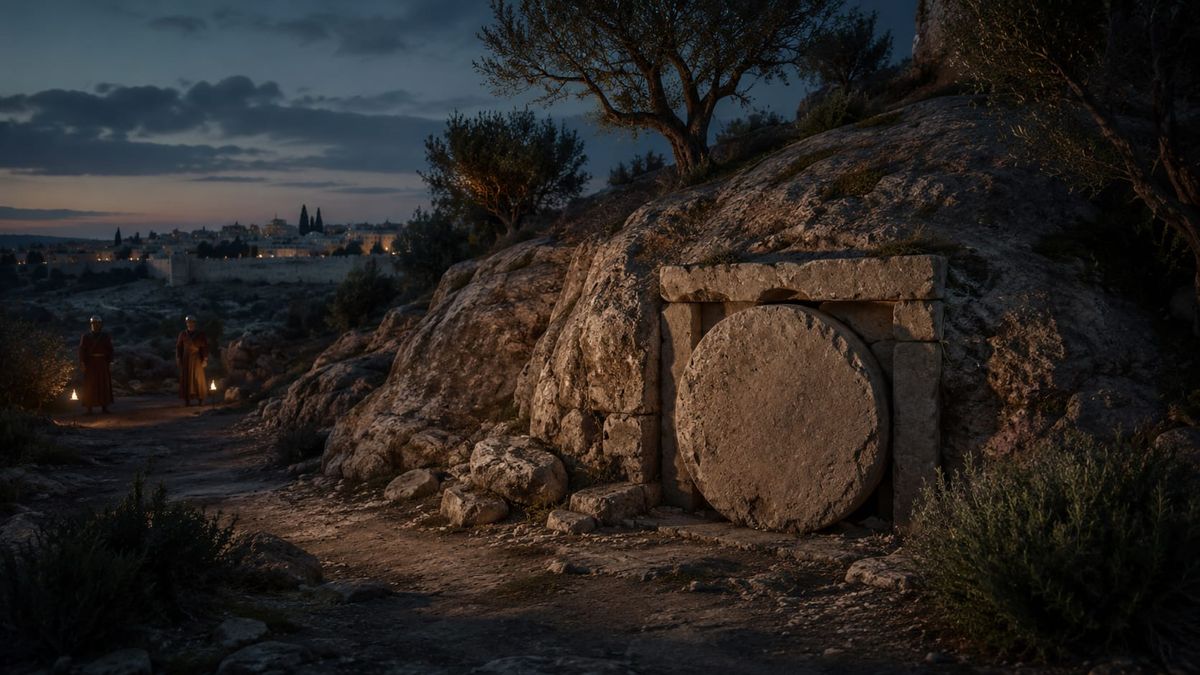
The Gospels are remarkably restrained about the hours between Jesus’ burial and the discovery of the empty tomb. Matthew tells us that Joseph of Arimathea took the body of Jesus, wrapped it in a clean linen shroud, laid it in his own new tomb, and rolled a great stone across the entrance. Mary Magdalene and the other Mary remained opposite the tomb. The chief priests and Pharisees, meanwhile, went to Pilate and asked that the tomb be secured, fearing that the disciples might steal the body and claim that Jesus had risen. The stone was sealed and a guard posted. (Matthew 27:57–66) John likewise records that Joseph of Arimathea and Nicodemus took the body of Jesus, bound it in linen cloths with spices according to Jewish burial custom, and laid it in a nearby new tomb because the Jewish day of Preparation was ending. (John 19:38–42)
The burial matters because the Christian confession is not that Jesus appeared to die, passed into a trance, or somehow escaped the Cross. He died. His body was taken down, prepared for burial, placed in a tomb, and left there. Paul includes the burial within the apostolic summary of the Gospel when he writes that Christ “died for our sins in accordance with the Scriptures,” “was buried,” and “was raised on the third day in accordance with the Scriptures.” (1 Corinthians 15:3–4, ESV) Burial stands between death and Resurrection because all three belong to what actually happened. Holy Saturday gives the Church time to receive that middle clause: he was buried.
The Holy Sabbath
The first BCP Collect gives the day its distinctive character:
“O God, Creator of heaven and earth: Grant that, as the crucified body of your dear Son was laid in the tomb and rested on this holy Sabbath, so we may await with him the coming of the third day, and rise with him to newness of life; through Jesus Christ our Lord. Amen.” (BCP 2019, pp. 578, 608–609)
The language of Sabbath rest is deeply fitting. Jesus completes the saving work given him to accomplish and declares from the Cross, “It is finished.” (John 19:30, ESV) His crucified body then rests in the tomb on the Sabbath.
Christians have long recognized a fitting correspondence with the biblical pattern of creation. God completed the work of creation and rested on the seventh day. Christ completes his saving obedience through the Cross and rests in the tomb on the Sabbath before the Resurrection breaks forth on the first day of the week. This should not be turned into a hidden chronology that Scripture itself does not explain, but the theological correspondence is powerful. Holy Saturday is not inactivity in the sense of failure. Christ’s sacrifice has been offered. Redemption does not require some further sacrifice to complete Calvary. The crucified body rests, and the Church awaits the third day.
He Descended to the Dead
Holy Saturday also brings us to one of the most easily misunderstood lines of the Apostles’ Creed: “He descended to the dead.” The BCP’s alternative Collect makes the connection explicit:
“O God of the living, on this day your Son our Savior descended to the place of the dead: Look with kindness on all of us who wait in hope for liberation from the corruption of sin and death, and give us a share in the glory of the children of God; through Jesus Christ your Son our Lord. Amen.” (BCP 2019, pp. 578, 609)
Article III of the Thirty-Nine Articles states the confession even more directly: “As Christ died for us, and was buried, so also is it to be believed, that he went down into Hell.” In this creedal and Article language, Hell refers to Christ’s descent to the realm of the dead. It does not mean that Jesus continued suffering after the Cross as though “It is finished” were incomplete, nor that some additional atoning payment remained to be made after his death. Christ’s once-for-all sacrifice upon the Cross is complete. The confession tells us that the incarnate Son truly entered death and the state of the dead.
The New Testament gives glimpses of this mystery without supplying a detailed geography of the intermediate state. Peter speaks of Christ being “put to death in the flesh but made alive in the spirit” and of his proclamation to “the spirits in prison.” (1 Peter 3:18–19, ESV) Ephesians speaks of Christ descending to the lower regions before ascending in triumph. (Ephesians 4:9–10) Christian tradition has long used the expression Harrowing of Hell for Christ’s victorious descent and triumph over the powers of death.
We should affirm the biblical and creedal center without pretending Scripture tells us every detail. Christ truly died. He descended to the dead. His saving work was not defeated there. Death did not master him. The One who entered the realm of the dead rose victorious.
The Appointed Readings
The BCP gives Holy Saturday readings in two closely related places, and there is a small difference between them. The special Holy Saturday liturgy itself appoints Job 14:1–14, Psalm 130 or Psalm 88 or Psalm 31:1–6, 1 Peter 4:1–8, and either Matthew 27:57–66 or John 19:38–42. The Sunday, Holy Day, and Commemoration Lectionary gives Job 14:1–17, Psalm 130 or Psalm 31:1–6, 1 Peter 4:1–8, and the same Gospel options. The special liturgy therefore shortens Job slightly and includes Psalm 88 as an additional option. The lectionary table confirms the longer Job form and the Psalm 130/31 options.
Job 14 gives voice to the mortality that hangs over the day: “Man who is born of a woman is few of days and full of trouble.” (Job 14:1, ESV) Job then asks the question that Holy Saturday seems to place before the sealed tomb: “If a man dies, shall he live again?” (Job 14:14, ESV) The longer lectionary form continues beyond that question, allowing Job’s longing for God to call and for the creature to answer to remain before the Church. Holy Saturday knows the Gospel’s answer, but it allows the ancient human question to be heard before Easter is proclaimed.
Psalm 130 begins De profundis, “Out of the depths,” with the cry, “Out of the depths I cry to you, O LORD!” (Psalm 130:1, ESV) Yet it is also a Psalm of expectant hope: “I wait for the LORD, my soul waits, and in his word I hope.”(Psalm 130:5, ESV) Few texts better capture the posture of Holy Saturday. The Church waits, but she waits in hope.
Psalm 88, included among the options in the special Holy Saturday liturgy, gives the day an even darker voice. Unlike many lament psalms, it does not resolve into an explicit declaration of deliverance. Its final movement remains among darkness, abandonment, and the grave. On Holy Saturday, that severity is not hopelessness imposed upon the Gospel. It allows the Church to remain for a time with the full reality of death without rushing ahead to the Easter proclamation.
Psalm 31:1–6 offers another appointed Psalm. It joins distress to trust and culminates in words Jesus himself takes upon his lips from the Cross: “Into your hand I commit my spirit.” (Psalm 31:5, ESV; Luke 23:46) Heard on Holy Saturday, the Psalm allows the Church to remain with the crucified Lord whose life was entrusted entirely to the Father and whose body now rests in the grave.
First Peter speaks to Christians who live in the light of Christ’s suffering and coming victory. Peter calls believers away from their former manner of life and toward sober prayer, earnest love, hospitality, and faithful stewardship because “the end of all things is at hand.” (1 Peter 4:7, ESV) Holy Saturday is therefore not merely contemplation of Christ’s burial. The saving events of Christ call forth a transformed life in those who belong to him.
The Gospel then returns the Church to the tomb itself. Matthew emphasizes Joseph’s burial of Jesus, the sealed stone, and the guard. John emphasizes Joseph and Nicodemus preparing Christ’s body according to Jewish burial custom and laying it in a nearby new tomb. Either way, the liturgical image remains deliberately restrained: Jesus has died and has been buried.
The Holy Saturday Liturgy
The BCP’s Holy Saturday rite is remarkably brief. It does not attempt to compete with Good Friday or anticipate the Great Vigil, and its restraint is part of its strength. The Prayer Book begins with one of the two Collects, then appoints Job 14:1–14, Psalm 130 or 88 or 31:1–6, 1 Peter 4:1–8, and Matthew 27:57–66 or John 19:38–42. A homily may follow the Gospel.
The Church then says or sings the solemn anthem beginning, “Man born of woman has but a short time to live, and is full of misery.” It confronts mortality directly with the words, “In the midst of life we are in death,” yet even in the face of death the prayer turns toward the mercy of God and asks the Savior for deliverance.
The Lord’s Prayer follows, with its concluding doxology customarily omitted, and the Officiant concludes with the apostolic grace: “The grace of our Lord Jesus Christ, and the love of God, and the fellowship of the Holy Spirit, be with us all evermore.” (BCP 2019, p. 580)
That ending deserves careful distinction from the other rites of the Triduum. The BCP describes Maundy Thursday, Good Friday, Holy Saturday, and the Great Vigil as forming a single liturgical movement, but Holy Saturday nevertheless has its own brief office and concludes with the apostolic grace. It does not have a Eucharistic dismissal, nor does it attempt to provide the final Paschal conclusion of the Triduum. That comes with the Great Vigil.
The BCP is equally explicit about another important point: “There is no celebration of the Eucharist on this day.” (BCP 2019, p. 578) The Church remains at the tomb until the Great Vigil begins the first liturgy of Easter Day.
Waiting Without Pretending
There is a temptation in Holy Week to treat each observance as though Christians must psychologically reenact the ignorance of the first disciples. Holy Saturday resists that temptation. We do not pretend that we do not know Jesus is risen. We do not create artificial suspense or imagine ourselves as people for whom Easter has never occurred. The Resurrection is an accomplished historical event, just as surely as the Crucifixion and burial are accomplished events.
The Church’s waiting is therefore liturgical rather than ignorant. We know the tomb is empty. We know Christ has risen. Yet knowing the end does not make his burial unimportant. Holy Saturday teaches us to resist collapsing the Gospel into only Cross and Resurrection while passing too quickly over death and burial. Christ has gone all the way into the condition from which fallen humanity cannot rescue itself, and the Church remains for a time at the tomb because the tomb belongs to the Gospel.
Death Has Been Entered
Holy Saturday has particular pastoral force because death is not an abstraction. Every Christian who has stood beside a grave knows something of the stillness this day represents. Bodies are buried, voices fall silent, places at the table become empty, and the living return home while the dead remain behind. Christianity does not answer that grief by saying death is unreal. Jesus himself entered it.
The body in Joseph’s tomb is the body of the incarnate Son of God. The Word through whom all things were made has entered the grave. The Christian hope is therefore not that faithful people somehow avoid the reality of death, but that Christ has entered death before us and broken its final claim upon those who belong to him.
This is why Christian burial can speak both honestly and hopefully. The grave is real, but it is no longer ultimate. Christ has made even the grave a place through which he has passed. The tomb received him, but it could not keep him.
The Final Day of Lent
Holy Saturday remains on the Lenten side of the boundary until the Great Vigil begins. The BCP encourages the weekdays of Lent as days of fasting, and Holy Saturday belongs within that wider Lenten discipline. Ash Wednesday and Good Friday receive the more particular description as days traditionally marked by special devotion and total abstinence. Holy Saturday therefore continues the restrained character of the Lenten and Holy Week journey, but it should not be described as though it carried the same explicit fasting designation as Good Friday.
The day should not be allowed to become Easter prematurely. There is wisdom in preserving its simplicity with less noise, less unnecessary activity, and less eagerness to begin the feast before the liturgical boundary is crossed. At the same time, Holy Saturday is not governed by despair. Everything about the day points forward. The Collect awaits “the coming of the third day.” Psalm 130 waits for the Lord. Burial awaits Resurrection, and the darkness awaits the new fire.
The fast is nearly over, but the Church allows the Lenten journey to reach its proper end.
The Liturgical Character of Holy Saturday
Holy Saturday retains the bare and restrained character inherited from Good Friday. The BCP itself does not prescribe a universal liturgical color or state in its Holy Saturday rite that there must be no hangings. That language therefore should not be presented as though it were a rubric of the BCP 2019. Where a parish keeps the church stripped or uses no hangings during the daytime, the practice fittingly expresses the character of Christ’s burial and the restraint of the day.
The important distinction is between Holy Saturday during the day and the Great Vigil after sunset. The daytime belongs to the burial and waiting. The Great Vigil belongs to Easter.
When the Vigil begins, the Church crosses the liturgical boundary. White fittingly returns with Resurrection joy. The new fire is kindled, the Paschal Candle is lit, the saving acts of God are proclaimed, Baptism is celebrated or baptismal vows renewed, the Alleluia returns, and the Eucharist becomes the culmination of the Easter liturgy. The visual transformation serves the Gospel: the restraint of the tomb gives way to the light of the Resurrection.
The Great Vigil and the End of Holy Saturday
The BCP is explicit that “The Great Vigil, when observed, is the first liturgy of Easter Day.” It is celebrated at a convenient time between sunset on Holy Saturday and sunrise on Easter morning. (BCP 2019, p. 581)
That means the Great Vigil should not be treated merely as the final devotion of Holy Saturday. It is the Church’s liturgical crossing into Easter. Holy Saturday has contemplated Christ’s burial; the Vigil begins the proclamation of his victory.
The distinction gives Holy Saturday its distinctive place in the Christian year. It is the holy Sabbath of Christ’s burial, the final day of Lenten restraint, and the threshold across which the Church passes when the Easter Vigil begins.
Observing This Day
Holy Saturday is best observed quietly. Read Matthew 27:57–66 or John 19:38–42 and attend deliberately to the burial itself, allowing the stone to remain closed for a time rather than moving immediately to the empty tomb. Pray one or both of the BCP Collects on pages 578 and 608–609. The first emphasizes Christ’s bodily rest in the tomb and our waiting for the third day, while the second confesses his descent to the dead and asks for liberation from the corruption of sin and death.
If following the readings printed directly in the Holy Saturday rite, read Job 14:1–14 and allow its great question about death and life to remain before you. Pray Psalm 130 and wait upon the Lord, pray Psalm 88 and remain with its unrelieved lament, or pray Psalm 31:1–6 and hear again the prayer Christ himself takes upon his lips at death: “Into your hand I commit my spirit.” Read 1 Peter 4:1–8 and remember that life in the light of Christ’s victory calls the Church to sobriety, prayer, earnest love, hospitality, and service.
Where the Holy Saturday liturgy is offered, attend it without expecting elaborate ceremony. Its brevity is intentional. The Church does not need to fill the tomb with words. Allow the day to remain restrained until the Great Vigil.
Then, when the Vigil begins, cross the threshold fully. Holy Saturday has ended. The first liturgy of Easter Day has begun.
Conclusion
Holy Saturday gives the Church something modern life rarely permits: a day to remain with what has been accomplished without immediately rushing to what comes next. Jesus is dead. His body rests in the tomb. The sacrifice of the Cross is complete. He has descended to the dead, and nothing remains for sinners to add to the work by which redemption has been accomplished.
Yet death does not have the final word. The Church waits at the tomb because the Resurrection is certain, not because it is unknown. She waits because Christ truly entered death, truly was buried, and truly went into the state of the dead. The Gospel is greater because the Lord did not merely approach death and turn aside. He entered it and overcame it.
The first Collect therefore gives Holy Saturday its proper final posture: “Grant that, as the crucified body of your dear Son was laid in the tomb and rested on this holy Sabbath, so we may await with him the coming of the third day, and rise with him to newness of life.” (BCP 2019, pp. 578, 608–609) The Church waits beside the tomb in hope, knowing that when the Vigil begins the long restraint of Lent will give way to the proclamation that Jesus Christ is risen.