He Was Buried: Holy Saturday 2026 (Matthew 27:57-66)
Holy Saturday asks us not to hurry past the words “he was buried.” Christ truly entered death, yet the grave could not make the final claim. Because his saving work is finished, the Church can wait in hope, trusting the God who raises the dead.
April 4, 2026, Holy Saturday, Holy Week, Season of Lent
Matthew 27:57–66, Psalm 130, Job 14:1–14, 1 Peter 4:1–8
Grace, mercy, and peace from God our Father and the Lord Jesus Christ be with you on this Holy Saturday, as we remain for a little while at the tomb.
On Thursday night, Jesus gathered his disciples around the table. He gave them the bread and the cup, his Body given and his Blood of the new covenant, and he gave them the commandment by which that night takes its name: “Just as I have loved you, you also are to love one another.” Yesterday we followed him from that table, across the Kidron, through the garden and the judgment hall, all the way to Golgotha, where we heard the word that gathered his saving work into one declaration: tetelestai. “It is finished.” (John 19:30, ESV) The sacrifice is complete. The debt has been answered. The Son has accomplished what the Father sent him to do.
Today, the Church gives us the next sentence. Paul summarizes the Gospel in 1 Corinthians 15 with remarkable simplicity: Christ “died for our sins in accordance with the Scriptures,” “he was buried,” and “he was raised on the third day in accordance with the Scriptures.” (1 Corinthians 15:3–4, ESV) We naturally hurry from the first statement to the third. He died. He rose. Cross and Resurrection. Good Friday and Easter Day. But between them the apostle places three words that Holy Saturday asks us not to skip: he was buried.
Matthew brings us there in verse 57. “When it was evening, there came a rich man from Arimathea, named Joseph, who also was a disciple of Jesus.” (Matthew 27:57, ESV) The crowds are gone now. The cries of Hosanna are gone. The shouts of Crucify him have fallen silent. Pilate has given the order, the soldiers have finished their work, and Jesus hangs dead upon the Cross. Into that silence comes Joseph of Arimathea.
Verse 58 tells us that Joseph goes to Pilate and asks for the body of Jesus, and Pilate orders that it be given to him. There is no ambiguity left about what has happened. Joseph does not ask for a wounded man. He asks for a body. The One who healed the sick, opened blind eyes, calmed the storm, and called Lazarus out of the tomb is himself dead. Joseph cannot undo what has happened. He cannot call Jesus down from the Cross alive. He cannot bargain with Pilate for another outcome. The only faithful thing left for him to do is receive the body and care for it.
Then verses 59 and 60 tell us that Joseph takes the body, wraps it in a clean linen shroud, lays it in his own new tomb cut from the rock, rolls a great stone across the entrance, and goes away. There is something painfully ordinary about that final movement. The body is prepared. The grave is closed. The living person who loved him leaves.
Anyone who has buried someone they love understands something of that moment. There comes a point when the prayers have been prayed, the words have been spoken, the body has been committed to the earth, and the living go home while the dead remain behind. You return to the car. You return to the house. Eventually you sit again at the table, but someone who occupied a place in your life is no longer there. Their voice does not answer. Their chair remains empty. Their clothes, books, photographs, tools, or favorite cup may still be where they were left, and yet the person is gone. Death has a terrible way of making the ordinary world feel suddenly unfamiliar.
Christianity does not answer that experience by pretending death is less real than it is. Holy Saturday will not permit us to say that Jesus merely appeared to die, or that burial was an incidental pause before the important part of the story. Jesus died. His body was taken down. His body was wrapped. His body was placed in a tomb. A stone was rolled across the entrance. That is why Paul includes the burial in the Gospel itself. The nails were real. The spear was real. The blood and water John solemnly testified that he saw were real. And the death they confirmed was real enough that Joseph had to ask Pilate for the body and find a place to lay it.
Our reading from Job gives voice to the human condition behind every grave. Job says, “Man who is born of a woman is few of days and full of trouble. He comes out like a flower and withers; he flees like a shadow and continues not.” (Job 14:1–2, ESV) Then in verse 14 he asks the question that every cemetery eventually places before us: “If a man dies, shall he live again?”
Holy Saturday lets that question remain in the air for a while. We know Easter has happened. We are not pretending otherwise. The Resurrection is an accomplished event in history, and the Church cannot make herself ignorant of it for twenty-four hours. But knowing the answer does not make Job’s question meaningless. We live on this side of Easter while still burying people we love. We confess the resurrection of the body while still standing beside graves. We know Christ has conquered death while still feeling what death does when it enters a family.
And that means Christian hope is not denial. It is not optimism pasted over grief. It is not the demand that mourners smile because “we know where this is going.” Jesus himself wept at Lazarus’s tomb even though he knew exactly what he was about to do. Holy Saturday gives grief room to tell the truth, because the Gospel is strong enough to bear the truth. We can say that death is an enemy and still say that Christ has defeated it. We can mourn and still hope. We can sit beside the stone and still believe the promise.
That is why Psalm 130 belongs so naturally to this day. The psalm begins, “Out of the depths I cry to you, O LORD!”(Psalm 130:1, ESV) It does not deny the depths. It begins there. But then the psalmist says, “I wait for the LORD, my soul waits, and in his word I hope.” (Psalm 130:5, ESV) Christian waiting is not ignorance of the promise. It is living by the promise while the stone is still in front of us.
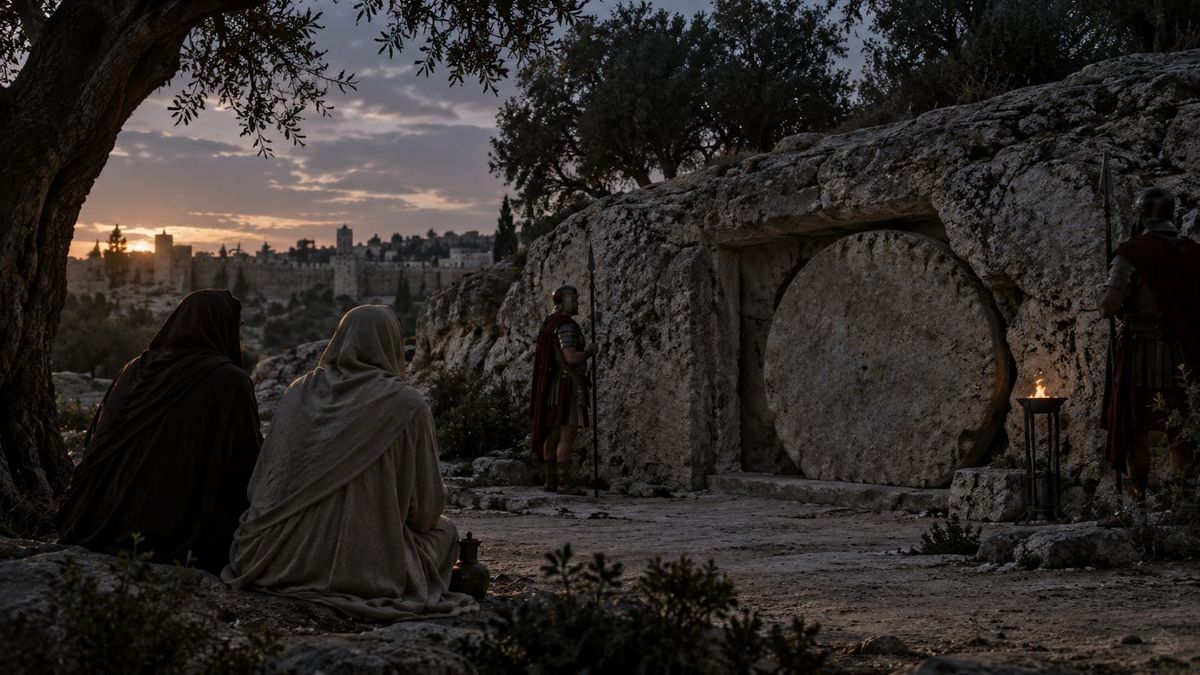
Matthew tells us in verse 61 that Mary Magdalene and the other Mary are there, “sitting opposite the tomb.” Joseph has gone away, but the women remain. Matthew gives us no speech from them, no explanation, no theological reflection. They simply sit opposite the tomb. Sometimes that is what faithfulness looks like. It remains. It watches. It grieves. It does not yet see what God will do, but it does not abandon the place where love has brought it.
There is pastoral wisdom in that picture. Sometimes we want to solve grief because we do not know how to sit with it. We rush to explanations, offer easy answers, or try to move people toward acceptance on our timetable. But the women sit. Holy Saturday reminds the Church that presence can itself be a form of love. There are moments when the faithful thing is not to explain the stone but to remain beside someone who cannot move it.
Then Matthew gives us one final scene. Beginning in verse 62, the chief priests and Pharisees go to Pilate because they remember something Jesus had said: “After three days I will rise.” (Matthew 27:63, ESV) They are afraid the disciples will steal the body, so Pilate allows them to secure the tomb. Verse 66 ends the chapter this way: “So they went and made the tomb secure by sealing the stone and setting a guard.” (Matthew 27:66, ESV) Everything in that verse says closed. The body is inside. The stone is in place. The seal is fixed. The guard is standing watch. Human power has done everything it knows how to do to make death final. Rome has killed him. The authorities have rejected him. A stone blocks the entrance, an official seal says the matter is settled, and armed men stand outside to make sure nothing changes.
But place that beside yesterday’s word: tetelestai. It is finished. The authorities look at the sealed tomb and imagine that Jesus is finished. But Good Friday told us something altogether different. Christ’s saving work is finished. Christ himself is not. The sacrifice is complete. The tomb is not his final destination. The seal says nothing more can happen here. The Cross says nothing more needs to be added to what Christ has done.
That distinction takes us into the mystery confessed every time we say the Apostles’ Creed: “He descended to the dead.”The body of Jesus rests in Joseph’s tomb, and the incarnate Son has truly entered death and the state of the dead. He has not merely approached death from the outside. He has gone all the way into the condition from which fallen humanity cannot rescue itself.
But Holy Saturday does not mean that Jesus continued paying for sin after the Cross, as though Calvary had left something unfinished. Good Friday’s word still stands: tetelestai. The once-for-all sacrifice is complete. The descent to the dead is not another payment added to the Cross. It is the full reality of death entered by the One whose saving work has already been accomplished.
Christian tradition has long spoken of Christ’s victorious descent, and Article III of the Thirty-Nine Articles confesses that he “went down into Hell.” We do not need to pretend Scripture gives us a detailed map of everything that occurred in the realm of the dead. The center is clear enough: Christ truly died. He descended to the dead. His saving work was not defeated there. Death did not master him. The One who entered the place of the dead entered as the Lord whose sacrifice was already complete.
And that is where the doctrine becomes deeply pastoral. There is nowhere death can take those who belong to Christ that Christ himself has not already gone. When Christians stand beside a grave, we do not pretend the grave is harmless. We confess something greater: the grave is no longer unexplored territory. Jesus Christ has entered it before us. The Shepherd who leads us through the valley of the shadow of death is not shouting directions from the other side. He has walked the valley himself.
The body in Joseph’s tomb is the body of the incarnate Son of God. The Word through whom all things were made lies in the grave. The hands that touched lepers are still. The voice that commanded storms is silent. The feet that walked the roads of Galilee do not move. The One who called Lazarus from his tomb now lies inside one himself. The tomb receives Christ, but it has received someone it cannot keep.
The first Collect appointed for Holy Saturday gives us another way of seeing the same mystery. It remembers that “the crucified body of your dear Son was laid in the tomb and rested on this holy Sabbath.” There is a deep biblical fittingness here. God completed the work of creation and rested on the seventh day. On Good Friday the incarnate Son declares the work given him to accomplish complete: tetelestai. Then on the Sabbath his body rests in the tomb.
We do not need to turn that correspondence into some secret chronology. The picture is strong enough. The work is finished, and the body rests. Nothing remains to be added to Calvary. Christ does not need another sacrifice. He does not need our suffering to complete his suffering, our fasting to make his offering effective, or our devotion to finish what he left incomplete. The saving work is done.
That matters spiritually because we are always tempted to add something. We know grace is a gift, and then we quietly begin trying to pay God back. We confess that Christ’s sacrifice is sufficient, and then we live as though our guilt must be carried a little longer to prove we are sorry enough. Holy Saturday confronts that instinct with the stillness of Christ’s body in the tomb. The work is finished. He rests because nothing remains to be added to the offering. Repentance matters. Obedience matters. Love and service matter. But none of them complete the Cross. They flow from a salvation already accomplished.
Psalm 130 therefore gives us the posture of this day: “My soul waits for the Lord more than watchmen for the morning, more than watchmen for the morning.” (Psalm 130:6, ESV) Watchmen do not wonder whether morning exists. They know it will come. They simply cannot make it arrive sooner. Holy Saturday teaches us that faith does not always mean doing something dramatic. Sometimes faith means receiving what Christ has done and waiting upon the Lord because only the Lord can do what must happen next.
Joseph can place Jesus in the tomb, but Joseph cannot raise him. The women can sit opposite the stone, but they cannot conquer death. The guards can seal the tomb, but they cannot make death permanent. The chief priests can remember Jesus’ promise, but they cannot prevent God from keeping it. Everyone in Matthew’s final scene has reached the limit of what human beings can do.
That makes Holy Saturday particularly pastoral for those moments when we reach the same limit. There are griefs we cannot solve, losses we cannot reverse, prayers whose answers we cannot force, diagnoses we cannot wish away, relationships we cannot repair by ourselves, and circumstances whose stones we cannot roll away by determination. Holy Saturday does not promise that every earthly problem is secretly three days away from disappearing. The tomb of Jesus is not a promise that every illness will heal now, every relationship will be restored, or every disappointment will be reversed on our timetable.
It gives us something greater. Even death itself is not beyond the saving victory of Christ. If the grave cannot finally hold him, then no darkness gets to make an ultimate claim upon those who belong to him. We may have to wait. We may have to grieve. We may have to sit opposite the stone longer than we would choose. But our hope does not rest in how well we wait, how firmly we hold ourselves together, or whether we can understand what God is doing. Our hope rests in Christ’s accomplished work and in the promise of the God who raises the dead.
First Peter tells us something about how Christians live while they wait. Verse 7 says, “The end of all things is at hand; therefore be self-controlled and sober-minded for the sake of your prayers.” (1 Peter 4:7, ESV) Peter then calls the Church to earnest love, hospitality, and faithful service. Waiting for God is not passivity. Because Christ has suffered and because his victory is certain, his people can pray, love, serve, and remain faithful even when they cannot yet see the fullness of what God has promised.
That brings these three days together. Thursday night, Christ gave himself to us and commanded us to love as he loved. Friday, we saw the cost of that love and heard tetelestai: the sacrifice is finished. Today, he was buried, and the Church learns to wait. Not because nothing has happened, but because everything necessary for our salvation has been accomplished and what happens next belongs entirely to God.
There are few places in modern life where we are encouraged simply to wait. We fill silence with noise, grief with activity, uncertainty with plans, and sometimes even worship with the feeling that something must always be happening. Holy Saturday gives us a bare church, a brief liturgy, no celebration of the Eucharist, and a tomb. It tells us that silence is not necessarily absence, waiting is not unbelief, and the inability to fix something does not mean God has abandoned it.
So today we do not rush ahead. We remain for a little while with Matthew’s final image: the stone sealed, the guard posted, the women waiting, and the body of Jesus resting within. We remember Job’s question: “If a man dies, shall he live again?” We know the answer, but we allow the question to carry its proper weight because death itself carried real weight for Christ. He did not save us by avoiding death. He entered it fully, and death will not have the final word.
And we remember yesterday’s word: tetelestai. It is finished. The sacrifice is complete. Nothing remains for sinners to add. Because the work is finished, the Church can wait without panic. Our hope does not depend upon our ability to roll away the stone.
The Collect asks that, as the crucified body of God’s dear Son rested on this holy Sabbath, “so we may await with him the coming of the third day, and rise with him to newness of life.” That is the posture of Holy Saturday: not ignorance, not despair, but hopeful waiting. The tomb is closed, the body rests, and the Church waits. But death has received someone it cannot keep. As the Psalm says, “I wait for the LORD, my soul waits, and in his word I hope.” (Psalm 130:5, ESV)
In the Name of the Father, and of the Son, and of the Holy Spirit. Amen.