Holy Week: An Anglican Perspective
Holy Week is the culmination of Lent, carrying the Church from Palm Sunday through the Cross, the tomb, and into the first proclamation of Easter. The BCP 2019 gives these days unusual weight because they draw us again to the saving work of the crucified and risen Christ.
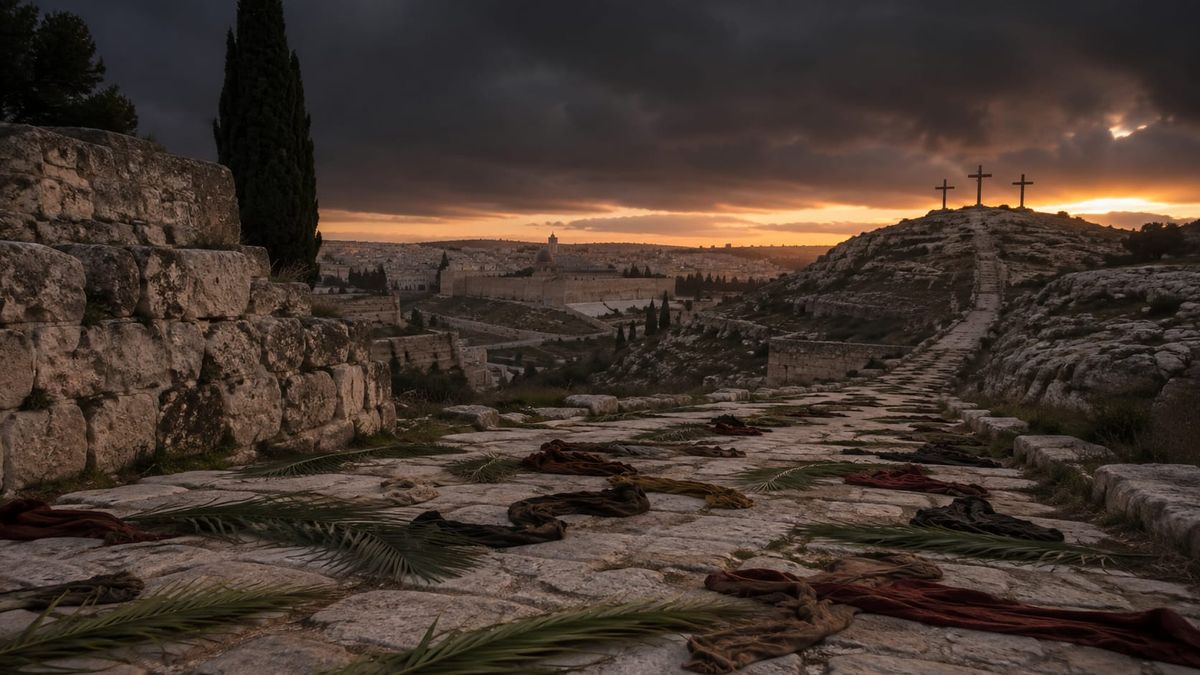
The Final Week of Lent
The Anglican calendar is ordered by a hierarchy of holy days, each carrying a different weight of observance. At the top sit the seven Principal Feasts, followed by the Red-Letter Holy Days. Holy Week is neither a separate feast nor a separate liturgical season. It is the final and most solemn week of Lent, beginning with Palm Sunday and carrying the Church through the Passion, death, and burial of Jesus Christ to the threshold of the Resurrection. The BCP 2019 gives these days unusual precedence: “No holy day or observance can replace the fixed propers for Ash Wednesday, Holy Week, or Easter Week.” (BCP 2019, p. 689) It also provides special liturgies for Palm Sunday, Maundy Thursday, Good Friday, Holy Saturday, and the Great Vigil of Easter. (BCP 2019, pp. 554, 560, 565, 578, 582)
Holy Week is where the long discipline of Lent reaches its destination. Ash Wednesday called the Church to repentance, prayer, fasting, self-examination, alms-giving, and meditation upon God’s Word. These disciplines were never ends in themselves. Lent prepares Christians to receive with greater attention the mighty acts by which God has accomplished our redemption in Jesus Christ.
The week therefore narrows the Church’s attention. Palm Sunday begins with the coming of the King and turns immediately toward the Passion. Monday, Tuesday, and Wednesday keep Christ’s suffering and the way of the Cross steadily before the Church. Maundy Thursday brings us to the Last Supper, the new commandment, and betrayal. Good Friday brings us beneath the Cross. Holy Saturday keeps us at the tomb. The Great Vigil then becomes the first liturgy of Easter Day and proclaims that the crucified and buried Lord has risen.
Holy Week is not simply a collection of related commemorations. The BCP says that Maundy Thursday, together with Good Friday, Holy Saturday, and the Great Vigil, “form a single liturgy.” The individual rites remain distinct services, but the Prayer Book deliberately joins them into one sustained movement through the saving work of Christ from the Upper Room to the Cross, the tomb, and the Resurrection.
Holy Week Is the Culmination of Lent
Holy Week does not replace Lent; it is Lent reaching its climax. Palm Sunday begins Holy Week while remaining within the Lenten journey. The weekdays that follow continue the Church’s Lenten discipline, and the BCP encourages the weekdays of Lent as days of fasting. Good Friday receives particular weight together with Ash Wednesday, which the Prayer Book describes as “traditionally days of special devotion and total abstinence.” (BCP 2019, p. 689) Holy Saturday retains its stark restraint until the Great Vigil begins the celebration of Easter.
The Prayer Book’s rules of precedence reinforce the importance of the week. Even a Holy Day that would ordinarily have its own Collect and readings cannot displace the fixed propers of Holy Week. The reason is more than calendrical convenience. The Church is being asked to give concentrated attention to the Passion of the Lord and to the saving events that stand at the center of the Gospel.
This is why Holy Week belongs naturally at the end of Lent. The season’s penitence has always been ordered toward Christ.
Palm Sunday: The King Goes to the Cross
Holy Week begins with Palm Sunday, when the BCP moves deliberately from the triumphal entry into Jerusalem to the proclamation of the Passion. The congregation first hears of Jesus entering the city amid branches and cries of Hosanna, fulfilling the prophetic image of the humble King who comes to save. Yet the liturgy refuses to let the royal acclamation stand by itself. The Passion Gospel follows, revealing what kind of kingship Jesus has come to exercise.
The Collect interprets that movement by recalling that the Father sent his Son to take our nature and suffer death upon the Cross, and then asks that we may walk in the way of his suffering and share in his Resurrection. The BCP also appoints the Preface of Holy Week beginning on Palm Sunday and continuing through Wednesday, proclaiming that Christ was lifted high upon the Cross for our sins and became the author of eternal salvation for all who put their trust in him. (BCP 2019, pp. 153, 607)
Palm Sunday therefore gives the whole week its direction. The King enters Jerusalem, but his throne will be the Cross. Glory will come, but not by avoiding suffering.
Monday, Tuesday, and Wednesday
The first three weekdays of Holy Week are quieter than the days surrounding them, but the BCP gives each its own Collect and appoints the Preface of Holy Week. Together they teach the Church how to approach the Passion.
Monday’s Collect recalls that Christ “went not up to joy but first he suffered pain, and entered not into glory before he was crucified,” and asks that walking in the way of the Cross may become for us the way of life and peace. Tuesday’s Collect recalls Christ giving his back to be whipped and his face to shame and spitting, asking for grace to accept suffering in confidence of the glory to be revealed. Wednesday’s Collect asks that we may “enter with joy upon the meditation of those mighty acts” by which God has promised life and immortality. (BCP 2019, pp. 607–608)
That last phrase gives a particularly good description of Holy Week itself. The Church enters into meditation upon God’s mighty acts, not merely into a sequence of religious emotions. The purpose is not to manufacture sorrow or to recreate the psychology of the first disciples. It is to attend more fully to what God has done for the salvation of sinners.
Maundy Thursday: The Triduum Begins
On Maundy Thursday, Holy Week enters its most concentrated movement. The evening begins the Paschal Triduum (TRID-yoo-um), the sacred three days through which the Church follows Christ from the Upper Room to the Cross, the tomb, and the first proclamation of the Resurrection.
The BCP makes an unusually strong statement about this sequence: Maundy Thursday, together with Good Friday, Holy Saturday, and the Great Vigil, “form a single liturgy.” This does not mean that they constitute one literally uninterrupted worship service. Rather, the Prayer Book deliberately joins them into one sustained liturgical movement. Maundy Thursday omits the final blessing and dismissal and ends in silence. Good Friday likewise concludes without the ordinary blessing or dismissal. Holy Saturday has its own brief and restrained office. The Great Vigil then becomes the first liturgy of Easter Day and brings the movement into the joy of the Resurrection.
The name Maundy comes from the Latin mandatum (man-DAH-toom), meaning “commandment,” recalling Jesus’ words, “A new commandment I give to you, that you love one another: just as I have loved you.” (John 13:34, ESV) The BCP allows that commandment to become visible in the optional washing of feet, while the institution of the Holy Eucharist stands at the heart of the evening.
The Eucharist is given on the night of betrayal and therefore cannot be separated from the Cross toward which Christ is moving. In the sacrament, the Church proclaims the Lord’s death until he comes, truly receives the Body and Blood of Christ, and receives the benefits of his once-for-all sacrifice. The BCP appoints the Preface of Maundy Thursday, distinguishing the evening from the preceding days of Holy Week and centering it upon the sacramental gift Christ gives before he suffers.
White is customary for Maundy Thursday, fitting the Eucharistic character of the evening even as the service moves toward the darkness of betrayal and the Passion. The altar may be stripped as a public ceremony at the conclusion of the liturgy. The final blessing and dismissal are omitted, and the congregation departs in silence.
Good Friday: The Cross
Good Friday stands with Ash Wednesday as one of the Church’s two principal fasts. The BCP describes both as “traditionally days of special devotion and total abstinence.” (BCP 2019, p. 689) The Good Friday rite itself further describes the day as appropriately marked by fasting, abstinence, and penitence.
The liturgy is correspondingly stark. The Passion according to John is proclaimed, the Church offers the Solemn Collects, and the Cross stands at the center of the day. Where the Devotion Before the Cross is observed, reverence is directed not toward wood as though the material object possessed holiness in itself, but toward Jesus Christ and the saving death accomplished upon the Cross.
The Cross is not merely an example of suffering or a tragedy that God later reverses. Article XXXI of the Thirty-Nine Articles confesses Christ’s offering upon the Cross as the “perfect redemption, propitiation, and satisfaction” for the sins of the whole world. His sacrifice is complete, sufficient, once offered, and unrepeatable.
The BCP’s Collect makes the personal character of that saving work unmistakable, praying for the family “for whom our Lord Jesus Christ was willing to be betrayed and given into the hands of sinners, and to suffer death upon the Cross.”(BCP 2019, p. 608) The Church stands beneath the Cross because Christ died for sinners and because this death is the once-for-all sacrifice through which redemption has been accomplished.
The Good Friday rite also presses the Passion personally upon the faithful. The Prayer Book reminds us of the role our own sin played in Christ’s suffering as he took sin upon himself in obedience to the Father’s will. We therefore do not stand beneath the Cross merely identifying the failures of Judas, Pilate, the religious leaders, soldiers, or crowd. We stand there as sinners for whom Christ willingly died.
Good Friday concludes with a final prayer placing Christ’s Passion, Cross, and death between divine judgment and our souls. The BCP directs that no blessing or dismissal is added, and the ministers and people depart in silence.
Holy Saturday: The Tomb
Holy Saturday gives the burial of Jesus its own day. The BCP specifically directs that the Eucharist is not celebrated before the Great Vigil begins the Easter celebration.
The Prayer Book appoints a strikingly restrained liturgy with two alternative Collects, Scripture readings centered upon death and burial, a solemn anthem, the Lord’s Prayer, and the grace. One Collect remembers the crucified body of Christ resting in the tomb on the holy Sabbath and asks that we may await with him the coming of the third day and rise with him to newness of life. The other recalls that Christ descended to the place of the dead and asks that those waiting in hope may be delivered from the corruption of sin and death. (BCP 2019, pp. 578–580, 608–609)
The day insists upon the full reality of the Incarnation and death of Christ. He truly suffered, truly died, was truly buried, and descended to the dead. Yet Holy Saturday is not a reenactment of uncertainty. The Church knows that Christ has conquered death, even while she refuses liturgically to hurry past the tomb.
Holy Saturday therefore remains restrained until Easter begins. The Church waits at the tomb because the Resurrection is certain, not because its outcome remains unknown.
The Great Vigil: The First Liturgy of Easter Day
The Great Vigil marks the transition from Lent into Easter. The BCP explicitly identifies it as “the first liturgy of Easter Day” and directs that it be celebrated at a convenient time between sunset on Holy Saturday and sunrise on Easter morning. (BCP 2019, p. 581)
The Vigil normally consists of four parts: the Service of Light, the Service of Lessons, Holy Baptism or the Renewal of Baptismal Vows, and the Holy Eucharist. It appropriately begins in darkness. A new fire is kindled and the Paschal Candle is lit, proclaiming Christ as the light who has overcome darkness. The ancient Exsultet (eg-ZUHL-tet) sings the victory of the Paschal Lamb, and the Church then hears again the record of God’s saving deeds in history.
At least three of the appointed Old Testament lessons are read, and the BCP directs that one must always be the lesson of Israel’s deliverance at the Red Sea, Exodus 14:10–15:1. The Exodus therefore holds a privileged place in the Vigil’s proclamation. Bondage gives way to deliverance, the people pass through water, and God brings them into freedom. The Church hears that history in the light of Christ and Baptism, where the greater passage from sin and death into new life is proclaimed.
Baptism therefore belongs naturally to this night. Christians are united with Christ in his death and Resurrection, and the renewal of baptismal vows reminds the whole Church that Easter is not only an event Christians observe from a distance. The risen life of Christ is the life into which they have been incorporated.
The restraint of Lent then gives way to the Easter proclamation, and the Holy Eucharist becomes the proper culmination of the first liturgy of Easter Day. The movement begun on Maundy Thursday has reached its destination: the Lord who was betrayed, crucified, dead, and buried is risen.
One Paschal Mystery
The sequence of Holy Week teaches the Church to hold together what Scripture holds together. Palm Sunday cannot be reduced to triumph because the King enters Jerusalem in order to give himself. Maundy Thursday cannot be separated from the Cross because the sacramental meal is instituted on the night of betrayal. Good Friday cannot be treated as the final word because the crucified Lord rises. Holy Saturday gives death and burial their proper reality without surrendering hope. Easter does not erase the Cross, because the risen Lord is the same Jesus who was crucified.
The traditional expression Paschal mystery describes this unity. It does not mean that Christ’s saving work is vague, inaccessible, or unknowable. It means that his Passion, death, burial, descent to the dead, and Resurrection belong together within the one redemptive work of God accomplished in history.
Paul gives that proclamation in compressed form when he writes that Christ “died for our sins in accordance with the Scriptures,” “was buried,” and “was raised on the third day.” (1 Corinthians 15:3–4, ESV) Holy Week stretches that apostolic confession across sacred time so that the Church may dwell upon each part without separating it from the whole.
Remembering What Christ Has Accomplished
Holy Week makes extensive use of embodied worship: branches, processions, foot-washing, stripping, silence, fasting, the Cross, darkness, fire, water, and light. These actions matter because Christian worship involves the whole person, not merely the intellect. Yet the liturgies do not repeat the saving events. Christ does not enter Jerusalem again because palms are carried, nor does Calvary occur again on Good Friday. Jesus does not return to the tomb on Holy Saturday, and the Resurrection is not produced when the Paschal Candle is lit. These saving events happened once in history and have been accomplished.
The Church instead receives and remembers them through the means Christ has given. Scripture is proclaimed, prayer is offered, and the Sacraments are administered. The congregation is formed through disciplined remembrance of God’s mighty acts. This is especially important in relation to the Eucharist. The sacrifice of Christ is not repeated. Holy Communion is the sacramental memorial of his once-for-all offering, in which the faithful truly partake of his Body and Blood and receive the benefits of his finished work.
Holy Week therefore draws the Church more deeply into the reality of Christ’s accomplished salvation without pretending that the saving events must happen again.
Holy Week and Repentance
The Passion narratives also expose the human heart. Judas betrays. Peter denies. The disciples flee. Religious leaders protect their own power. Pilate compromises before pressure. Soldiers mock and brutalize. Crowds demand death. Even those who love Jesus repeatedly misunderstand what he has come to do. The Church hears these accounts not merely to identify the guilty people in the story but to recognize the sin for which Christ goes to the Cross. Greed, cowardice, pride, fear, violence, unbelief, and self-preservation are not confined to first-century Jerusalem.
This is one reason Lent prepares the Church for Holy Week. Weeks of penitence teach Christians to approach the Passion without self-righteousness. We come beneath the Cross as sinners in need of the mercy accomplished there. The BCP itself makes this connection on Good Friday, directing the faithful to recognize the role of their own sin in the suffering Christ bore for them.
Yet repentance in Holy Week is never separated from grace. The center of the week is not the depth of our failure but the greater depth of Christ’s obedience, sacrifice, and mercy.
From Fast to Feast
The bodily discipline of Lent remains visible throughout Holy Week. The BCP encourages the weekdays of Lent as days of fasting and gives Good Friday particular weight, together with Ash Wednesday, as traditionally a day of “special devotion and total abstinence.” The Prayer Book also explains that fasting, in addition to reduced consumption, normally includes prayer, self-examination, and acts of mercy. (BCP 2019, p. 689)
The fast, however, is ordered toward a feast, and that movement is fundamental to the Christian year. Lent does not end in permanent penitence, and Good Friday is not Christianity’s final destination. Holy Saturday waits because Easter is coming. The Great Vigil marks the transition from the restraint of Lent into the Paschal feast, from darkness to light, and from burial to Resurrection.
Christian fasting is therefore hopeful. The Church disciplines herself not because death has the last word, but because she is preparing to celebrate the victory of the risen Christ.
The Liturgical Character of Holy Week
Holy Week’s visual character changes as the week unfolds rather than being governed by one color or ceremonial pattern. Red is customary on Palm Sunday, fitting the Passion and royal entry. Purple customarily continues through the first weekdays of Holy Week. White is customary on Maundy Thursday because of the Eucharistic character of the evening, before the sanctuary is stripped and the liturgy moves toward Good Friday.
In our church, black is used on Good Friday, expressing mourning, death, and the profound solemnity of the Lord’s Crucifixion. More important than any particular color custom, however, is the BCP’s own insistence upon the day’s bare and stark character. Holy Saturday retains that restraint until Easter begins.
At the Great Vigil, white returns with the festal joy of the Resurrection. Light, the restored Alleluia, Baptism, and Eucharist all proclaim that the Church has crossed from the Lenten fast into the Paschal feast.
These visual changes are not decoration for their own sake. They serve the theological movement of the week, helping the Church attend bodily as well as intellectually to Passion, death, waiting, and Resurrection.
Observing Holy Week
The best way to observe Holy Week is to allow it to become genuinely different from ordinary time. Begin with Palm Sunday and resist treating it merely as the Sunday before Easter. Hear both the entry into Jerusalem and the Passion, allowing the liturgy itself to establish the direction of the week.
Use the BCP Collects and appointed Scriptures on Monday, Tuesday, and Wednesday. These quieter days create space for sustained attention to the Passion before the Triduum begins.
Where possible, participate in the principal liturgies from Maundy Thursday through the Great Vigil. Receive the Eucharist on Maundy Thursday, hear again Christ’s commandment of love, and remain with the silence into which the service passes. Keep Good Friday with the seriousness appropriate to one of the Church’s principal fasts and attend to the Passion without hurrying toward resolution. Allow Holy Saturday to remain quiet and restrained.
Then enter Easter through the Great Vigil where it is offered. Hear again the saving acts of God, remember the grace of Baptism, and receive the Eucharist as the Church begins the celebration of the Resurrection.
Where participation in every service is impossible, the week can still be observed through the Daily Office, the appointed Collects and readings, fasting according to wisdom and circumstance, works of mercy, and deliberate reduction of unnecessary distraction.
Holy Week is also a fitting time, where pastorally appropriate, to make use of the Rite of Reconciliation of a Penitent with a priest. The BCP places this ministry under the heading Reconciliation of Penitents beginning on page 223. Christians troubled in conscience by particular sins, who need help making an honest confession, or who desire pastoral counsel and the assurance of absolution may seek out a priest for this ministry. The purpose is not to add another religious accomplishment to the week but to bring sin into the light and hear personally the Gospel promise of forgiveness in Christ.
The aim is not liturgical achievement. No Christian earns a more blessed Easter by accumulating services. Holy Week is a discipline of attention, drawing the Church again toward Christ and the salvation he has already accomplished.
Conclusion
Holy Week is the culmination of Lent because it brings the Church into sustained contemplation of the events at the heart of the Gospel. The King who enters Jerusalem goes willingly toward the Cross. At the Last Supper he gives his Church the Sacrament of his Body and Blood on the night before he suffers. On Good Friday he gives himself once for all for sinners. On Holy Saturday his body rests in the tomb and he descends to the dead. At the Great Vigil, the Church crosses into Easter and proclaims that the crucified Lord has been raised and that death has been defeated.
The Prayer Book gives these days extraordinary weight not because Christ’s saving work must be repeated, but because Christians need continually to be returned to it. Holy Week teaches the Church to resist both the desire for glory without the Cross and the temptation to contemplate the Cross without Resurrection hope. The two belong together in the one saving work of the crucified and risen Lord.
The week therefore leads the Church from penitence toward joy without abandoning either truth. Sin is real, the Cross was necessary, death was truly entered, and the tomb was truly occupied. Yet the Son has given himself for sinners, his sacrifice is complete, and the grave cannot hold him. Holy Week ends at the threshold of the Paschal feast, where Lent has been leading from the beginning, ready for the Church to proclaim that Jesus Christ, who was crucified, is risen indeed.