In My Father's House (Luke 2:41-52)
Jesus does not become the Son of God by adoption. He is the eternal Son by nature. But the eternal Son took our humanity, entered our history, bore our sin, and rose again so that, united to him by grace, we might become sons and daughters of God by adoption.
January 4, 2026, Year A, The Second Sunday of Christmas, Season of Christmas
Luke 2:41–52, Psalm 84, Ephesians 1:3–14
Grace, mercy, and peace from God our Father and the Lord Jesus Christ be with you on this Second Sunday of Christmas.
Today, we find ourselves still wrapped in the quiet afterglow of the Nativity. The frantic preparations are behind us, the candlelight and Christmas Day services have faded, the carols that filled our homes and streets have begun to recede, yet the Church in her ancient wisdom refuses to let us rush onward. She bids us linger here a little longer, in the season of the Incarnation, so that the profound mystery of God-with-us might settle deeply into our hearts and minds. The Christmas light has not been packed away with the decorations; it continues to burn, steady and true, illuminating the path ahead.
The Gospel appointed for this day is Luke 2:41–52. This passage transports us twelve years forward from the stable in Bethlehem. The infant whom the angels proclaimed, whom the shepherds sought, whom Simeon and Anna recognized in the temple, has grown into a boy on the threshold of manhood. Jesus, now twelve years old, journeys with Mary and Joseph to Jerusalem for the feast of the Passover.
This was no mere family tradition. The law commanded Israelite males to appear before the Lord three times each year, and for devout families like this one, the annual pilgrimage to Jerusalem for Passover would have been a significant part of life. The roads would have been crowded with travelers, families and villages journeying together for safety and companionship. We can imagine the sounds of conversation and laughter, the bleating of lambs destined for sacrifice, and psalms sung as the pilgrims ascended the hills toward the holy city.
When the seven days of the feast concluded, the caravan set out for home. Mary and Joseph, assuming Jesus was somewhere among their relatives or acquaintances, traveled a full day's journey before realizing he was missing. What parent has not felt that sudden chill of fear when a child is momentarily out of sight? For Mary and Joseph, that fear stretched across three long days of retracing their steps and searching for their son. Three days, days that echo forward to another loss, another search, and another finding in resurrection joy.
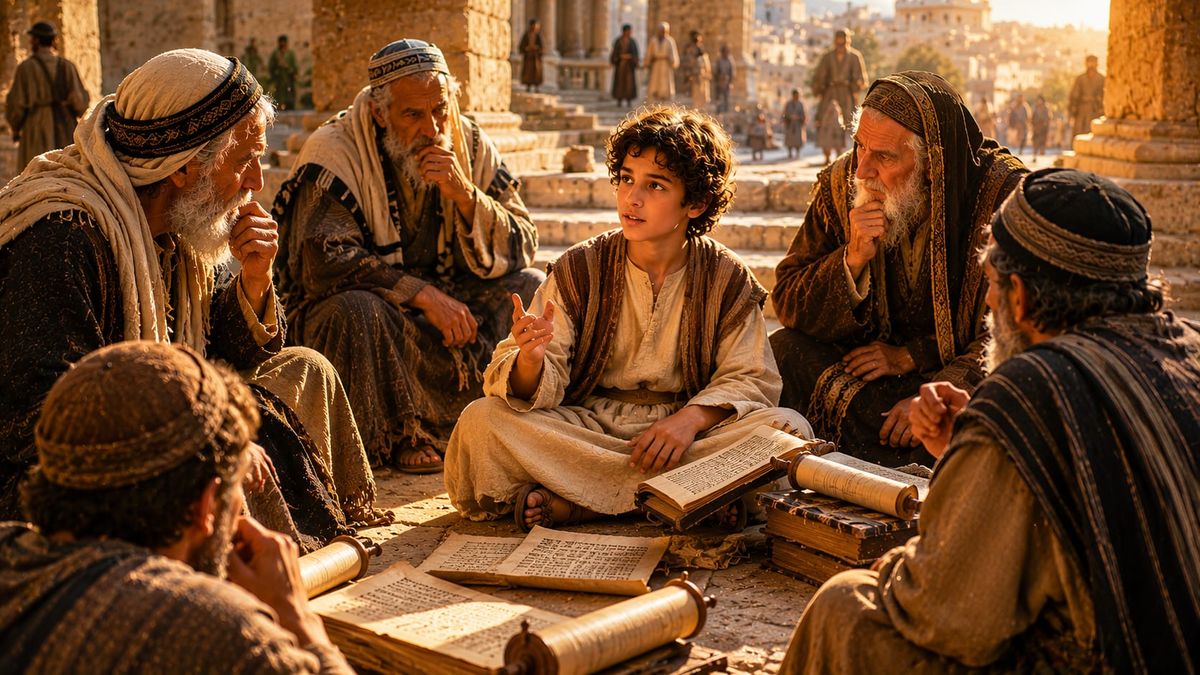
At last they find him, not in the marketplace or playing in the streets, but in the temple, sitting among the teachers, listening to them and asking them questions. Everyone who heard him was amazed at his understanding and his answers. Even at twelve, something extraordinary is being revealed about this child.
When his parents finally locate him, Mary speaks first, her voice carrying both relief and reproach. In verse 48 we hear, “Son, why have you treated us so? Behold, your father and I have been searching for you in great distress.” (Luke 2:48, ESV). Jesus answers in verse 49, “Why were you looking for me? Did you not know that I must be in my Father's house?” (Luke 2:49, ESV). Luke tells us plainly that they did not understand what he meant. Yet Jesus returns with them to Nazareth and is submissive to them. Mary treasures all these things in her heart, and Luke tells us that Jesus “increased in wisdom and in stature and in favor with God and man” (Luke 2:52, ESV).
This is the only story Scripture gives us from Jesus' childhood between his infancy and the beginning of his public ministry. Why does Luke include it? Because it reveals something essential about who Jesus is. It shows us his genuine humanity. The eternal Son has truly taken our human nature. He grows in wisdom and stature. He submits to Mary and Joseph. He lives the ordinary hidden life of Nazareth. None of this threatens his divinity. It shows us how completely the Son of God has entered our humanity while remaining the sinless eternal Son.
At the same time, the passage discloses his unique identity. Jesus already speaks of God as “my Father.” The temple is not merely a place of religious obligation for him. It is his Father's house. And notice the word he uses: “I must.” This is more than preference. Luke will use this language of necessity again as Jesus moves toward the work the Father has given him to accomplish. He must proclaim the Kingdom. He must go to Jerusalem. He must suffer, die, and rise. Already at twelve, his life is ordered toward his Father's will.
That longing for the Father's presence brings us naturally to Psalm 84, a pilgrimage psalm, a song of ascent toward Zion. The psalmist cries out, “How lovely is your dwelling place, O LORD of hosts! My soul longs, yes, faints for the courts of the LORD; my heart and flesh sing for joy to the living God.” (Psalm 84:1–2, ESV). The temple, for the psalmist, is not merely a building of stone. It is the place where God has promised to dwell among his people. Even the sparrow finds a home and the swallow a nest beside the altars. If God makes room for the birds, how much more for those who seek him?
Then the psalm turns to the pilgrims themselves: “Blessed are those whose strength is in you, in whose heart are the highways to Zion.” (Psalm 84:5, ESV). They are going somewhere. Their hearts are set toward the presence of God, and that orientation shapes the journey.
Then we come to one of the most beautiful and mysterious images in the Psalm: “As they go through the Valley of Baca, they make it a place of springs; the early rain also covers it with pools.” (Psalm 84:6, ESV).
Baca has traditionally been associated with weeping, and the Psalm gives us the picture of pilgrims passing through a dry and difficult place on their way toward Jerusalem. The road toward Zion passes through places of sorrow, dryness, trial, and grief. The pilgrims do not reach God's house by traveling only through pleasant country.
What the pilgrims do in this valley is remarkable. The old picture is of travelers digging wells or cisterns along the route, creating places where water could gather and refresh those who came after them. Their labor matters, but their labor cannot produce the rain. The pilgrims may dig, but they cannot command the heavens. God sends the rain. God gives the strength for the journey. God turns the place of weeping into a place of refreshment.
That is a beautiful picture of grace. We pray. We obey. We dig the wells we have been given to dig. But our labor does not generate grace, and grace does not wait at the end for us to accomplish the difficult part ourselves. God gives the water. God gives the strength. God makes our faithful labor fruitful. The pilgrims go, the psalm says, “from strength to strength” until each one appears before God in Zion (Psalm 84:7, ESV).
This image speaks directly to Christian discipleship. The way to Zion is not a detour around suffering. Our road passes through valleys of weeping. Yet those valleys do not have the final word. In the providence of God, places of sorrow can become places from which others are refreshed. Tears can deepen compassion. Trials can teach us to pray. The comfort we receive from God can become comfort we offer to someone walking the same road behind us.
We have seen this among God's people. A parent who has known terrible grief may become able to sit beside another grieving parent in a way few others can. Someone who has endured years of illness may learn depths of prayer and dependence that become a gift to the Church. A congregation that has passed through hardship may discover a patience and tenderness it did not possess before. None of this means suffering is good in itself, or that we must pretend grief does not hurt. It means that the Valley of Baca is never the end of the story. And nowhere do we see that more clearly than in Jesus himself.
The boy Jesus lives this pattern perfectly. The temple is his Father's house, yet he returns to Nazareth and embraces the long hidden years of obedience. Later the road will pass through misunderstanding, rejection, betrayal, and finally the Cross. He will go to Jerusalem not merely as another pilgrim seeking the temple, but as the Son sent by the Father to accomplish our salvation.
At the Cross he enters the deepest valley of weeping. There he digs the deepest well. From his wounded side flows the life we could never provide for ourselves. Yet even there death does not have the final word. The Son who dies rises on the third day. Christ is not merely another pilgrim showing us how to endure the road. He is the Savior who opens the road home.
Paul unveils the eternal purpose behind this pilgrimage in the magnificent opening of his letter to the Ephesians. He bursts into praise: “Blessed be the God and Father of our Lord Jesus Christ, who has blessed us in Christ with every spiritual blessing in the heavenly places.” (Ephesians 1:3, ESV). Paul tells us that God chose us in Christ before the foundation of the world and, in love, predestined us for adoption through Jesus Christ, according to the purpose of his will, to the praise of his glorious grace.
Through Christ's blood we have redemption, the forgiveness of our trespasses, according to the riches of God's grace. God has made known the mystery of his will, his purpose to unite all things in Christ. And those who belong to Christ are sealed with the promised Holy Spirit, the guarantee of our inheritance.
Adoption is the beating heart of what Paul is proclaiming. The twelve-year-old Jesus can say “my Father's house” because he is the Son in a way that we are not. Jesus does not become the Son of God by adoption. He is the eternal Son by nature. But the eternal Son took our humanity, entered our history, bore our sin, and rose again so that, united to him by grace, we might become sons and daughters of God by adoption.
We are not strangers trying to earn our way into the household. God has chosen us in Christ, redeemed us through his blood, forgiven our sins according to the riches of his grace, and sealed us with his Spirit. The longing of Psalm 84 is fulfilled beyond imagination. We do not merely stand outside longing for the courts of the Lord. In Christ, we have been brought into the Father's household as beloved children.
The temple that drew Jesus at twelve he himself fulfills and transcends. He is the living temple, the true meeting place of God and humanity. The boy who said “my Father's house” has opened the Father's house to us. His Father becomes our Father by grace. His household becomes our home. His inheritance becomes our inheritance because we belong to him.
As we stand at the turning of the year, what does this mean for us?
First, it calls us to cultivate the longing of the pilgrim. Do we truly desire the presence of God, or have we become comfortable living as though the road to Zion were optional? We do not earn our place in the Father's house by worship, prayer, Scripture, the sacraments, service, forgiveness, or generosity. Christ has opened the house to us by grace. But those who have been given a home learn to love the things of home. We gather with God's people. We pray. We hear his Word. We receive his gifts. We learn again to set our hearts toward Zion.
Second, it gives us courage for the valleys ahead. None of us knows what this year will bring. There may be joy and sorrow, health and illness, gain and loss. But we know who walks with us. We can bring our tears to him. We can dig wells of kindness and prayer for those who will walk behind us. And we can trust God for the rain. The grace that has carried us this far will not disappear when the road becomes difficult.
Third, it reminds us that we already belong to the Father's household. The Incarnation means that the Son of God entered the ordinary human life we know: family, work, meals, worship, obedience, waiting. Our ordinary lives therefore need not be spiritually empty. They can be received as places of faithful discipleship because we live them as God's adopted children. As Don+ always said, “God loves us more than we can imagine.”
That changes the way we live together. In our families, when tensions rise and patience wears thin, we can practice forgiveness and dig springs of reconciliation. In our workplaces, when stress and competition threaten to harden us, we can practice integrity and kindness. In our church, when differences arise, we can remember that we have not assembled ourselves. We have been adopted into one household through the same grace.
Parents, godparents, and grandparents have a particular responsibility here. Mary and Joseph did not make Jesus the Son of God or teach the eternal Son to know his Father. But they faithfully brought him within the worshiping life of Israel. They took him to Jerusalem. They lived within the covenant practices God had given his people. That gives us a pattern. We cannot create faith in our children or grandchildren, but we can bring them to worship, teach them the Scriptures, pray with them, catechize them, and order our homes so that the road toward Zion is familiar beneath their feet.
For those who are older, the call is perseverance. The hidden years of Nazareth remind us that quiet years are not useless years. Retirement, reduced activity, or a life that has become smaller in the eyes of the world does not make us marginal to the purposes of God. There are wells of prayer, wisdom, encouragement, and faithful witness that only years of walking with Christ can dig for those who follow.
And for all of us, a new year offers a natural moment to ask where our hearts are pointed. We will make plans and perhaps resolutions. But beneath them all is the deeper question of Psalm 84: are the highways to Zion in our hearts? Do we know where home is?
The Christmas light continues to shine because the Word became flesh and dwelt among us. The boy in the temple is the eternal Son who knew exactly where he belonged: “Did you not know that I must be in my Father's house?” (Luke 2:49, ESV). And this Son has gone through the deepest valley for us. He has died. He has risen. He has opened the way home.
Mary treasured these things in her heart. May we do the same as this Christmas season draws toward its close and the Church approaches the Epiphany of Our Lord Jesus Christ. May we carry the wonder of the Incarnation into the year ahead, knowing that the Son by nature has made us children by grace. When the road is easy, our strength is in him. When the road passes through Baca, our strength is in him. When we dig wells for those who come after us, God sends the rain. And when our pilgrimage is finished, the Father will bring us home, from strength to strength, through Jesus Christ his Son.
“How lovely is your dwelling place, O LORD of hosts!” (Psalm 84:1, ESV). This is the house for which we were made, and in Christ, this is the household into which we have been adopted.
In the Name of the Father, and of the Son, and of the Holy Spirit. Amen.