The Epiphany of Our Lord Jesus Christ: An Anglican Perspective
January 6 is the Epiphany, one of the seven Principal Feasts of the Anglican year. Where Christmas celebrates the Word becoming flesh, the Epiphany celebrates his manifestation to the nations. The Magi were not the destination of the Gospel. They were its first sign.
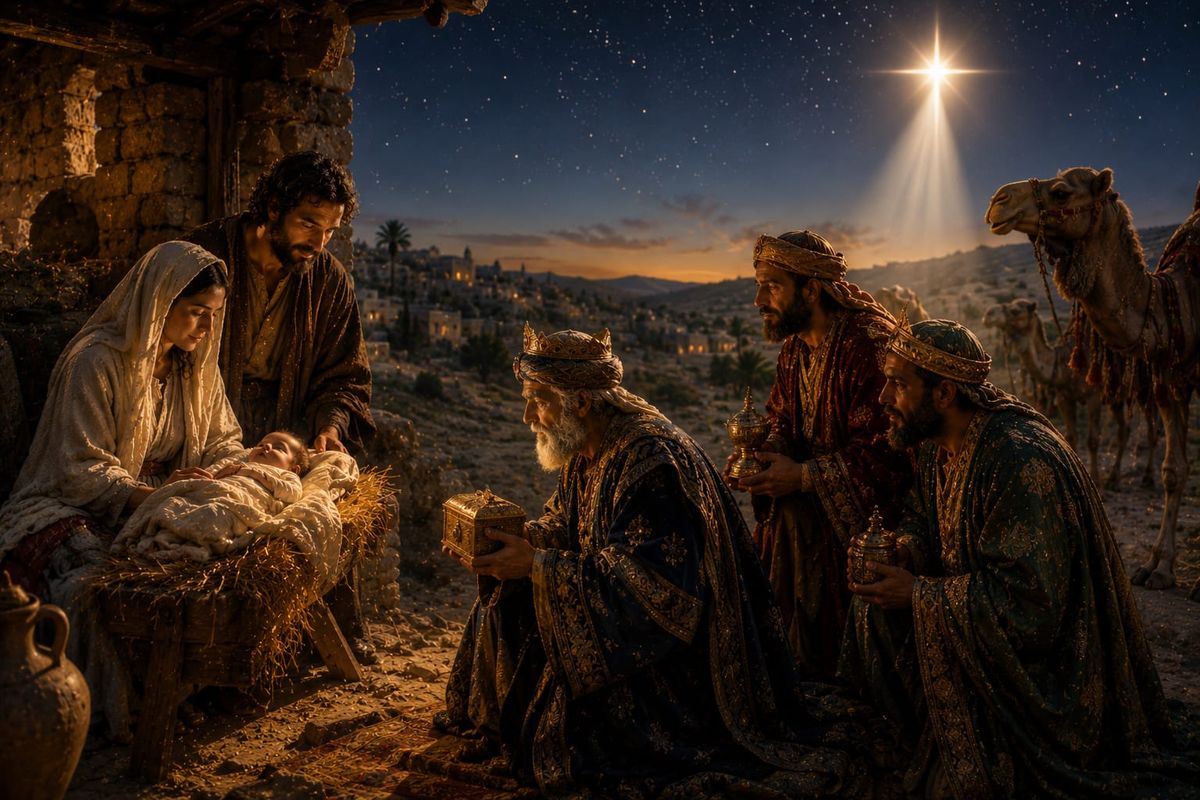
Principal Feast: January 6
The Anglican calendar is ordered by a hierarchy of holy days, each carrying a different weight of observance. At the top stand the seven Principal Feasts, the highest-ranking days of the liturgical year: Easter Day, Christmas Day, Ascension Day, the Day of Pentecost, All Saints’ Day, Trinity Sunday, and the Epiphany. These are listed on page 688 of the BCP 2019 and take precedence over other observances. The Epiphany of Our Lord Jesus Christ, observed on January 6, therefore belongs to the highest rank of the Anglican calendar.
Christmas celebrates the birth of the incarnate Son. Epiphany celebrates his manifestation to the nations. The Child born in Bethlehem is Israel’s Messiah, and precisely because God is faithful to his promises to Israel, he is also the one through whom the ancient promise of blessing to the nations is fulfilled. When Magi come from the East and fall down before him, the nations have begun to come to Israel’s light.
The word epiphaneia (eh-pee-FAH-nee-ah) means appearing, manifestation, or showing forth. The traditional description of the feast as the Manifestation of Christ to the Gentiles captures its theological heart. The one whom Mary bore and the shepherds worshiped is now sought by Gentiles from afar. The light that arose in Bethlehem is already drawing the nations toward Israel’s King. In that sense, Epiphany carries the Christmas mystery toward its full cosmic horizon: the Word made flesh is manifested as the Savior whose glory is for the world.
The Biblical Event
The appointed Gospel is Matthew 2:1–12. Matthew begins, “Now after Jesus was born in Bethlehem of Judea in the days of Herod the king, behold, wise men from the east came to Jerusalem.” (Matthew 2:1, ESV) They immediately ask the question around which the narrative turns: “Where is he who has been born king of the Jews? For we saw his star when it rose and have come to worship him.” (Matthew 2:2, ESV)
Matthew calls these men magoi (MAH-goy), the plural of magos. The term could refer to learned men associated with astrology, dream interpretation, priestly learning, or courtly wisdom in the ancient East. Persia and Babylonia are plausible suggestions for their background, but Matthew gives neither their exact homeland nor their precise occupation. Scripture simply tells us that they came “from the east.”
What matters most for the theology of the feast is that they are Gentiles. Foreigners arrive in Jerusalem looking for Israel’s King, while Herod and all Jerusalem are troubled by the news. The chief priests and scribes know from the prophet Micah that the Messiah is to be born in Bethlehem, yet Matthew does not tell us that they accompany the Magi there. Those who possess the Scriptures can identify the place, while Gentile strangers undertake the journey and worship the Child.
This contrast should not become a crude opposition between Israel and the Gentiles. Jesus is the King of the Jews, born in Bethlehem according to Israel’s Scriptures, and the Gentiles find him precisely because God is fulfilling promises made within Israel’s covenant history. The irony lies not in Israel being rejected, but in some who possess the Scriptures failing to act upon what they know while outsiders are drawn to Israel’s Messiah.
The Magi, Tradition, and the Gifts
Matthew calls them Magi rather than kings and does not tell us their number or names. The familiar number three arises naturally from the three gifts, while the later names Caspar, Melchior, and Balthasar belong to Christian tradition. The portrayal of the Magi as kings was influenced in part by passages such as Psalm 72 and Isaiah 60, where kings and nations come bearing tribute.
That does not make the tradition meaningless. The tradition reads Matthew canonically, connecting the visitors from the East with the larger scriptural expectation that the nations and their rulers will come before the Lord’s anointed King.
The familiar interpretation of the gifts is likewise traditional rather than explicitly supplied by Matthew. Gold has long been associated with Christ’s kingship, frankincense with worship and priesthood, and myrrh with the death he will eventually undergo. These associations are theologically rich and deeply rooted in Christian reflection, provided they are presented as received interpretation rather than as meanings Matthew himself explains.
Matthew’s emphasis remains beautifully simple: “And going into the house, they saw the child with Mary his mother, and they fell down and worshiped him. Then, opening their treasures, they offered him gifts, gold and frankincense and myrrh.” (Matthew 2:11, ESV) Their journey ends not merely in discovery but in worship.
The Star
Various astronomical explanations have been proposed for the star, but Matthew’s theological emphasis is clearer than its precise astronomical identity: God providentially leads these Gentile visitors to the Messiah. Matthew tells us that the Magi saw the star at its rising and later that it “went before them until it came to rest over the place where the child was.”(Matthew 2:9, ESV)
This should not be taken as biblical approval of astrology or divination. Scripture repeatedly warns against looking to the created heavens as sources of occult knowledge or spiritual control. The wonder is instead that God sovereignly uses what these eastern travelers can perceive to lead them beyond the heavens to the Child through whom the heavens themselves were made. He does not leave them at the star. The sign brings them eventually to Israel’s Scriptures and then to Israel’s King.
The star therefore serves Christ rather than competing with him. It is a sign whose purpose is fulfilled when the Magi arrive, see the Child, fall down, and worship.
The Nations Come to the Light
Isaiah 60:1–9 is the appointed Old Testament reading, and it gives the feast its great prophetic horizon: “Arise, shine, for your light has come, and the glory of the LORD has risen upon you.” The prophet continues, “And nations shall come to your light, and kings to the brightness of your rising.” (Isaiah 60:1, 3, ESV)
Matthew does not explicitly quote Isaiah 60, but the canonical correspondence is difficult to miss. Nations come toward the light. Wealth is brought from afar. Isaiah even speaks of those who “shall bring gold and frankincense, and shall bring good news, the praises of the LORD.” (Isaiah 60:6, ESV) The Church therefore hears Isaiah alongside Matthew and recognizes in the Magi a firstfruits of the nations streaming toward the glory God has caused to arise in Israel.
This must not be turned into a story in which Israel is simply discarded so that the Gentiles can take her place. The Magi come to worship the King of the Jews, and they find him because Israel’s Scriptures have named the place of his birth. Yet neither does the New Testament leave us with two parallel covenant peoples, one Jewish and one Gentile. Israel’s covenant vocation reaches its fulfillment in Jesus Christ, Israel’s Messiah. Jews who believe in Jesus Christ and believing Gentiles alike are brought into the New Covenant through him and gathered into the one people of God, the true and renewed Israel in Christ. There is not one covenant for Jews apart from Christ and another for Gentiles in Christ. The promises made to Israel reach their fulfillment in Jesus, and all who belong to the New Covenant belong through faith in him. Gentile believers are grafted into the promises given to Israel, while Jews who believe in Christ receive those same promises in their fulfillment through the Messiah.
This also means that ethnic descent by itself does not constitute membership in the New Covenant or in the true Israel of God. Paul can say that “not all who are descended from Israel belong to Israel” (Romans 9:6, ESV) because covenant identity reaches its fulfillment in the Messiah. Unbelief does not become a second path into the promises of God. There is one Lord, one Gospel, one New Covenant, and one people gathered in Christ.
The movement outward to the Gentiles is therefore not a divine change of plans. God had promised Abraham, “in you all the families of the earth shall be blessed.” (Genesis 12:3, ESV) Epiphany celebrates that ancient purpose beginning to take visible form as representatives of the nations kneel before Abraham’s promised offspring.
Fellow Heirs in Christ
Ephesians 3:1–13 gives the feast its apostolic interpretation. Paul speaks of the mystery made known to him by revelation: “This mystery is that the Gentiles are fellow heirs, members of the same body, and partakers of the promise in Christ Jesus through the gospel.” (Ephesians 3:6, ESV)
The biblical word mystery does not mean something permanently obscure or irrational. It describes a purpose of God once hidden and now revealed. What has been revealed is not merely that Gentiles may stand near Israel’s hope as tolerated outsiders. In Christ they are fellow heirs, members of the same body, and partakers of the same promise through the Gospel.
The Magi anticipate that reality dramatically. They are not Israelites returning from exile. They are Gentiles coming from beyond the covenant people, yet the light of Israel’s Messiah draws them to worship.
The long history of God’s particular covenant dealings with Israel was always moving, according to God’s promise, toward blessing for the nations. Epiphany does not erase Israel’s covenant history. It reveals its fulfillment in Christ and the enlargement of the covenant people through him. Jews who believe in Christ and believing Gentiles are gathered into one body around Israel’s Messiah. The nations are not given a separate salvation alongside Israel, and ethnic Israel does not retain a separate covenant apart from Christ. In the Messiah, the promises made to Abraham reach their fulfillment, and all who are united to Christ share in that one covenant inheritance.
The feast therefore has an unavoidable missionary character. The Christ manifested to the Gentiles must be proclaimed among the Gentiles. As Paul says, the “unsearchable riches of Christ” are to be preached to the nations. (Ephesians 3:8, ESV) The Church cannot treat the Gospel as private religious property.
The King and the Nations
Psalm 72 is the appointed Psalm for the feast. It is a royal prayer for the king and his kingdom, asking that his dominion extend “from sea to sea, and from the River to the ends of the earth.” It continues, “May the kings of Tarshish and of the coastlands render him tribute; may the kings of Sheba and Seba bring gifts!” (Psalm 72:8, 10, ESV)
The Psalm reaches beyond the reign of any ordinary son of David. It prays for a king before whom “all kings” will fall down and whom “all nations” will serve. (Psalm 72:11, ESV) Epiphany gives the Church a glimpse of that universal kingdom in miniature. Gentiles from the East kneel before the Son of David in Bethlehem.
The Magi are not the full realization of Psalm 72, but they are a kind of first installment of its tribute. Gold, frankincense, and myrrh are laid before the King as the nations begin to arrive.
Matthew’s Gospel will complete that missionary movement after the Resurrection. What begins with Gentiles coming to Christ ends with Christ sending his disciples to the nations: “Go therefore and make disciples of all nations.” (Matthew 28:19, ESV) Epiphany is therefore not the Great Commission before the Great Commission in a strict historical sense, but it already reveals the universal horizon that the risen Lord will later make explicit.
The Twelve Days of Christmas and Epiphany
Epiphany falls on January 6, immediately after the twelve days of Christmas, which run from Christmas Day through January 5. Christmas therefore does not begin in Advent, nor does it end on December 26. The Church celebrates the Nativity through Christmastide and then arrives at the distinct Principal Feast of the Epiphany.
Epiphany is closely bound to Christmas without simply being another day of Christmas. Christmas announces that the Word became flesh. Epiphany shows the nations coming to the incarnate Word. The movement is from birth to manifestation, from Bethlehem outward, from Israel’s promised Messiah to the Messiah through whom Israel’s God gathers the peoples of the earth.
The feast also opens the Season of Epiphany, which continues through the Last Sunday of Epiphany, Transfiguration Sunday. The First Sunday of Epiphany is the Baptism of Our Lord, where manifestation moves from the worship of the Magi to the Father’s declaration at the Jordan. The intervening Sundays reveal Christ through his calling, teaching, healing, signs, and authority, and the season culminates with his glory upon the mountain.
Epiphany is therefore both a Principal Feast in its own right and the doorway into a season of manifestation. The feast asks, Who is this Child, and what does his coming mean for the nations? The season continues answering that question.
The BCP 2019 Collect, Preface, and Propers
The BCP 2019 appoints the Collect for Epiphany on page 601: “O God, by the leading of a star you manifested your only Son to the peoples of the earth: Lead us, who know you now by faith, to your presence, where we may see your glory face to face; through Jesus Christ our Lord, who lives and reigns with you and the Holy Spirit, one God, now and for ever. Amen.”
The Collect moves beautifully from manifestation to pilgrimage. The Magi are led by the star to Christ. Christians know him now by faith, yet faith itself moves toward sight. The feast looks backward to Bethlehem and forward to the promised presence of God in which his people will see his glory face to face.
That movement keeps Epiphany from becoming merely a charming remembrance of distant travelers with unusual gifts. Their pilgrimage becomes an image of the Church’s pilgrimage. They were led until they saw Christ. We know Christ through faith and ask God to lead us until faith gives way to sight.
The grace of that prayer should not be missed. The Magi are led, and the Church asks to be led. The journey begins and ends with divine initiative. God manifests the Son, God draws the nations, God gives faith, and God leads his people toward the glory they will one day behold without veil or distance.
The Preface of the Epiphany, on page 153, gives the feast its Incarnational theology: “Through Jesus Christ our Lord, who took on our mortal flesh to reveal his glory; that he might bring us out of darkness and into his own glorious light.”(BCP 2019, p. 153) The manifestation depends upon the Incarnation. The eternal Son took mortal flesh so that the glory of God might be revealed within human history and sinners might be brought from darkness into light.
The appointed readings are Isaiah 60:1–9, Psalm 72 or 72:1–11, Ephesians 3:1–13, and Matthew 2:1–12. These propers remain fixed from year to year. Every January 6 the Church therefore hears the same scriptural movement: the nations come to the light, royal tribute is brought, the Gentiles are declared fellow heirs, and the Magi fall down before the Child.
Epiphany in Anglican Worship
Epiphany is one of the Church’s most ancient feasts and was being observed on January 6 before December 25 became established as the Nativity feast throughout much of the Church. Early observance was not completely uniform. In parts of the Christian East, January 6 gathered several manifestations of Christ, especially his Nativity and Baptism. As the calendars of East and West developed, Christmas and Epiphany became more clearly distinguished, with the Western January 6 observance particularly associated with Christ’s manifestation to the Gentiles through the Magi.
The feast remained important within the English Christian calendar and passed into the Anglican Prayer Book tradition. Its enduring importance is reflected in its rank among the seven Principal Feasts of the BCP 2019.
Various European customs also accumulated around the feast, including gift-giving and royal offerings. Those customs reflect the biblical imagery of nations and rulers bringing tribute, though they are not themselves the theological center of the day. The heart of Epiphany remains Christ manifested and worshiped.
The liturgical color is white, fitting the feast’s themes of joy, light, glory, and manifestation. Isaiah announces, “Arise, shine, for your light has come,” while the Eucharistic Preface praises Christ for bringing his people from darkness into his glorious light. White allows the Church’s worship to embody visually the brightness at the center of the feast.
White also connects Epiphany with the Christmas mystery from which it flows. The one manifested to the Gentiles is the same incarnate Son whose Nativity the Church has just celebrated. Yet the light now moves outward toward the nations.
Manifestation and Mission
Epiphany has always had a missionary logic because the feast celebrates Christ manifested beyond the immediate boundaries of Israel. The Magi do not come because Bethlehem has become culturally attractive or because Israel has devised an effective strategy for reaching eastern intellectuals. They come because God has manifested his Son and drawn them to him.
Christian mission proceeds from the same grace. The Church does not create the light and does not convert the nations by her own power. She bears witness to Christ, proclaims his Gospel, baptizes, teaches, prays, sends, and serves because the risen Lord commands her to make disciples of all nations.
The Gospel was never destined to remain the possession of one ethnicity or culture. Yet neither is mission the abandonment of Israel’s story. The Church carries to the nations the good news concerning Israel’s Messiah, the Son of David and Son of Abraham in whom God’s promises reach their appointed fulfillment. Jews who believe in Christ and believing Gentiles are gathered in him into one body, one household, and one New Covenant people, the true and renewed Israel in Christ.
Epiphany therefore gives missionary work its proper center: the Church is not sent to make the world admire the Church, but to make Christ known.
Observing This Feast
Epiphany is observed on January 6. Pray the Collect on page 601 and read Matthew 2:1–12 slowly, paying attention both to what Matthew says and to what later tradition has supplied. The number and names of the Magi are unknown. Their journey, their gifts, and their worship are not. They come from the nations seeking Israel’s King, and when they find him they fall down before him.
Read Isaiah 60:1–9 and allow the prophet’s vision of the nations coming to the light to interpret Bethlehem. Read Psalm 72 and hear the prayer for the King whose dominion reaches the ends of the earth. Read Ephesians 3:1–13 and remember what Gentile inclusion means: those once outside Israel’s covenant people are made fellow heirs and members of the same body through the Gospel.
The feast is also an appropriate time to pray for the mission of the Church. Pray for missionaries, pastors, evangelists, church planters, Bible translators, persecuted Christians, and peoples among whom Christ is scarcely known. The light that drew the Magi has not ceased to shine, and Christ remains worthy of worship among every people and language.
Finally, allow the Magi’s posture to become a personal question. They traveled far in response to the light they had been given, but the purpose of their journey was not information. It was worship. Christians have been given the clearer witness of Scripture and Gospel. Epiphany therefore asks not merely whether we know who the King is, but whether we fall before him in faith, obedience, and worship.
Conclusion
The Epiphany of Our Lord Jesus Christ is the feast of the light moving outward. The Child born in Bethlehem is Israel’s promised King, and precisely because God is faithful to his promises to Israel, this King is also the hope of the nations. Magi come from the East, Isaiah’s nations begin to stream toward the light, Psalm 72’s tribute begins to arrive, and Paul’s mystery begins to take visible form: Gentiles are becoming fellow heirs, members of the same body, and partakers of the promise in Christ through the Gospel.
The nations are not gathered into a second covenant people alongside Israel, nor does ethnic descent secure participation in the New Covenant apart from Christ. Israel’s covenant vocation reaches its fulfillment in Jesus Christ, and Jews who believe in him and believing Gentiles are gathered into the one people of God, the true and renewed Israel in Christ. There is one Messiah, one Gospel, one New Covenant, and one covenant people in him. The Church therefore stands not outside Israel’s story but within its fulfillment in Christ, bearing the Gospel of Israel’s King to all nations.
Yet the feast does not permit Christians merely to watch the Magi from a distance. Their journey ends in worship, and the Collect turns their pilgrimage into ours. We know Christ now by faith, through the Scriptures, the Gospel proclaimed, and the grace given in the life of his Church, but faith is moving toward sight. The star has given way to the clearer light of God’s revealed Word, yet the destination remains the same: the presence of the King.
The Collect therefore gives Epiphany its fitting final prayer: “Lead us, who know you now by faith, to your presence, where we may see your glory face to face.” (BCP 2019, p. 601) God manifested his Son to the nations, drew the Magi to Bethlehem, and continues to gather a people from every tribe and tongue around Jesus Christ. The Church goes into the world bearing witness to that light while she herself continues the pilgrimage from faith toward sight, awaiting the day when the King first worshiped in Bethlehem will be beheld in unveiled glory.