In the Name of the Father, and of the Son, and of the Holy Spirit: Trinity Sunday 2026 (Matthew 28:16-20)
The Trinity is not primarily a doctrine to master, it is a God to worship. On Trinity Sunday we look past the acts of salvation to the one who performed them. We have been receiving his gifts all season. Today we behold the giver.
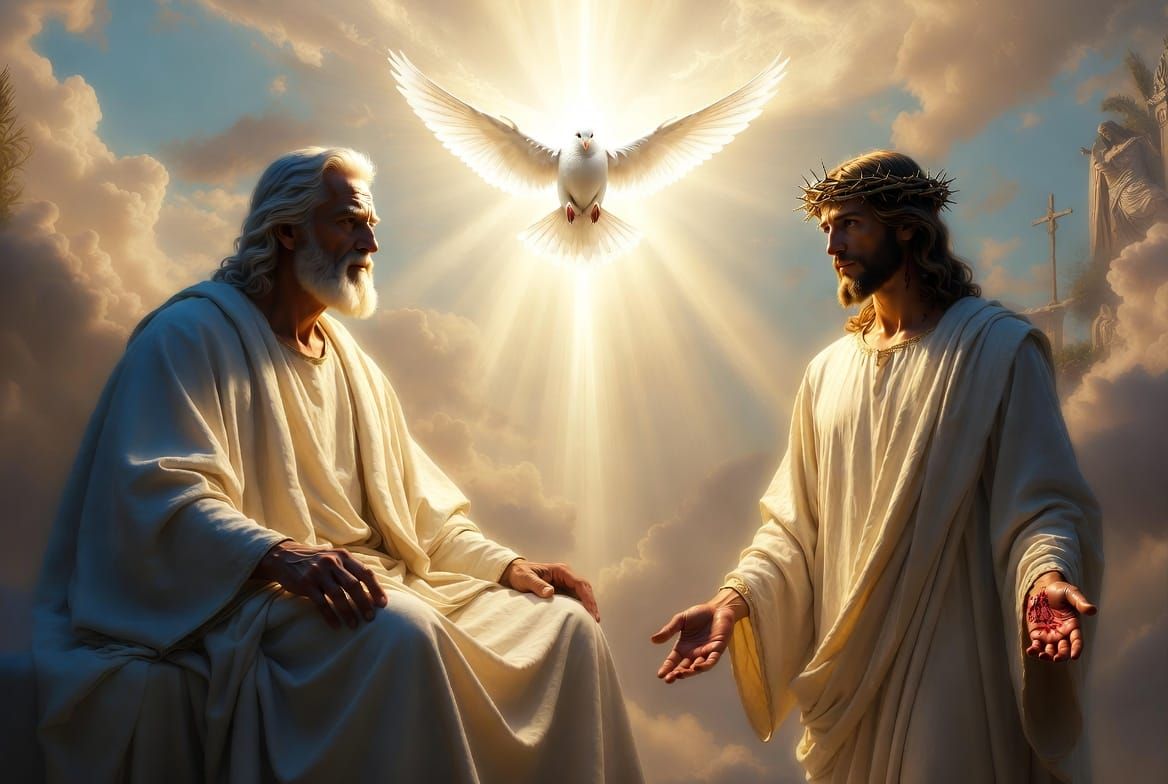
May 31, 2026, Trinity Sunday, Year A, Season after Pentecost
Matthew 28:16–20, Psalm 150, 2 Corinthians 13:5–14, Genesis 1:1–2:3
Grace, mercy, and peace from God our Father and the Lord Jesus Christ be with you on this Trinity Sunday.
Today is Trinity Sunday, the First Sunday after Pentecost and the beginning of the Season after Pentecost, also traditionally called the Season after Trinity. It is one of the seven Principal Feasts of the Anglican liturgical year, which tells us something important before we even open a Bible: the Church considers the worship of the Triune God to be among the highest acts of her corporate life. Not just a doctrine to be defended, but a feast to be celebrated. A mystery not to be solved, but to be adored.
Trinity Sunday is unique among the Principal Feasts. The other great feasts turn our attention toward particular mighty acts of God in the history of salvation: the Incarnation, the Resurrection, the Ascension, Pentecost. On those days we give profound thanks for what God has done to rescue us. But Trinity Sunday does something different. It turns our attention from what God has done in history to who God eternally is. Not only his acts, but his being. Not only what he accomplished, but who he is that he could accomplish it. Father, Son, and Holy Spirit: one God, three Persons, the same divine substance, equal in power and glory.
We have just come through the great movement of Eastertide giving thanks for what this Triune God has done. The Father sent the Son. The Son lived, died, rose, and ascended. The Holy Spirit was poured out like wind and fire on the Day of Pentecost. Trinity Sunday gathers all of that gratitude and asks us to go one step further, to look through the mighty acts to the God who performed them and worship him for who he is, not only for what he has done. We have been receiving his gifts all season. Today we behold the giver.
Our Old Testament reading begins at the beginning: “In the beginning, God created the heavens and the earth. The earth was without form and void, and darkness was over the face of the deep. And the Spirit of God was hovering over the face of the waters.” (Genesis 1:1–2, ESV)
The Spirit of God hovering over the waters. That image has been with us throughout Eastertide. The Holy Spirit whom the risen Jesus breathed upon his disciples on Easter evening, the same Spirit poured out like wind and fire at Pentecost, is here at the very beginning, before the first word of creation is spoken, hovering over the deep.
And John tells us of the eternal Word: “In the beginning was the Word, and the Word was with God, and the Word was God.” Then he says, “All things were made through him, and without him was not any thing made that was made.” (John 1:1, 3, ESV) The Word, the Son, was there. Before the light was named, before the waters were separated, before the dry land appeared, before any creature drew breath, the God who created all things already was who he eternally is: Father, Son, and Holy Spirit.
This is why Trinity Sunday belongs after Pentecost. We have watched the saving work of God unfold. We have received the Son sent by the Father, celebrated the resurrection, witnessed the Ascension, and heard again of the Spirit poured out. Now the Church stands back and says: this is the God who has done all of this. The God of the new creation is the same God who made the heavens and the earth. Father, Son, and Holy Spirit. One God.
The Church received this faith from Scripture, but in the early centuries Christians had to learn to say it with great precision because serious errors threatened the Gospel itself. In the fourth century a teacher named Arius taught that the Son was not eternally God, but the highest of created beings, made by the Father before all other things. There was, Arius taught, a time when the Son was not.
It spread widely because it sounded close enough to Christianity to be dangerous. Almost. But almost right about Jesus is wrong about the Gospel. If the Son is a creature rather than true God, then the one Scripture presents as the Savior of the world belongs on the side of creation rather than sharing eternally in the divine life. Who Jesus is and what Jesus accomplished for us cannot finally be separated.
The Council of Nicaea in AD 325 answered that controversy with the confession that the Son is “God from God, Light from Light, true God from true God, begotten, not made, of one substance with the Father.” The Council of Constantinople in AD 381 reaffirmed that Nicene faith and confessed with equal clarity the full divinity of the Holy Spirit. These were not arguments over theological trivia. The Church was guarding the identity of the God who saves.
Athanasius spent much of his life defending that confession and endured repeated exile rather than surrender it. He understood what was at stake. The Son who took our flesh, bore our sins, died, and rose again is not almost God. He is true God from true God. The Holy Spirit who gives life to the Church is not merely an impersonal force or created messenger. Father, Son, and Holy Spirit are one God.
So when we say the Nicene Creed this morning, we are not reciting a museum piece. We are receiving a confession handed to us across the centuries because Christians before us understood that knowing who Jesus is matters for knowing what Jesus has done. The God into whose Name we were baptized is Father, Son, and Holy Spirit, and the salvation he has accomplished for us is fully sufficient.
Our primary text is Matthew 28:16–20. It is the final scene of Matthew’s Gospel. Eleven disciples have gone to a mountain in Galilee because the risen Jesus told them to meet him there.
Verse 17 tells us, “And when they saw him they worshiped him, but some doubted.” (Matthew 28:17, ESV) Matthew does not hide that detail. These disciples are standing before the risen Christ, worshiping him, and some are still struggling to take in what stands before them.
There is something encouraging in that, but doubt is not the destination of the passage. Their hesitation does not cause Jesus to turn away from them. He comes to them. He speaks to them. He gives them his command and his promise. These are not perfected saints standing on the mountain. They are disciples who still have much to learn, and Jesus is about to entrust the mission of the Church to them.
That matters on Trinity Sunday. We do not have to comprehend everything about the being of God before we can worship him faithfully. God has truly revealed himself, and therefore we can truly know him. But we will never know the infinite God exhaustively. We confess what he has revealed. We bow before what exceeds our understanding. Faith seeks understanding, but it begins by receiving what God has made known.
Then in verse 18 Jesus speaks: “All authority in heaven and on earth has been given to me.” (Matthew 28:18, ESV) All authority. Not some authority over spiritual matters while the rest of life belongs to somebody else. All authority in heaven and on earth belongs to the risen Son.
Then verse 19 gives us the heart of Trinity Sunday in one sentence: “Go therefore and make disciples of all nations, baptizing them in the name of the Father and of the Son and of the Holy Spirit.” (Matthew 28:19, ESV)
Notice: one Name. Not three names. “In the name,” singular, “of the Father and of the Son and of the Holy Spirit.” Three Persons, one Name. One God. Three Persons. Not three gods. Not one God wearing three masks in succession. The Father is not the Son. The Son is not the Spirit. The Spirit is not the Father. Yet the Father is God, the Son is God, and the Holy Spirit is God, and there are not three Gods, but one God.
That is what the Church was protecting at Nicaea, and it is the Name Christ commanded his Church to speak in Baptism.
Christian Baptism therefore has a Trinitarian shape because Jesus himself gave it one. We are baptized in the Name of the Father, and of the Son, and of the Holy Spirit. In Christ we are adopted as children of the Father, joined to the Body of Christ, and given the Holy Spirit. We are not merely enrolled in a religious organization or handed a moral framework. God claims us as his own and joins us to the people Christ has redeemed.
I remember performing a baptism years ago. A young woman had come to faith out of a background of genuine brokenness, and the journey to that font had been long and costly. When I poured the water and spoke the Name, she wept. She simply stood there in the font and wept.
What I was witnessing, I think, was the realization that she had not merely agreed to a set of beliefs. The God who made her had come seeking her. The Son had given himself for her. The Holy Spirit had brought her to faith. And now the Name of the Triune God was being spoken over her in Baptism. The Trinity is not primarily a doctrinal puzzle placed at the edge of Christianity for specialists to solve. The doctrine tells us who the God of the Gospel actually is.
Psalm 150 is the last psalm in the Psalter, one hundred and fifty psalms of lament, praise, confession, petition, and wonder, and it ends here: “Let everything that has breath praise the LORD!” (Psalm 150:6, ESV) Not “let those who have completely understood the Trinity praise the LORD.” Everything that has breath. The doctrine of the Trinity does not end in argument. It ends in praise.
Isaiah heard that praise in the temple: “Holy, holy, holy is the LORD of hosts; the whole earth is full of his glory!” (Isaiah 6:3, ESV) John heard heaven singing the same song: “Holy, holy, holy, is the Lord God Almighty, who was and is and is to come!” (Revelation 4:8, ESV) And every Sunday at this Table the Church joins that heavenly worship in the Sanctus. Holy, Holy, Holy. We are joining a song that was already in progress before we arrived.
Trinity Sunday asks us to remember whose song it is and why we have been given a place within it. We add our voices not because we have earned the right, but because the God whom heaven praises made us, redeemed us, and has given us his Holy Spirit.
Paul brings the same truth directly into the life of the Church. He closes 2 Corinthians, a letter written to a troubled and divided congregation, with these words in verse 14: “The grace of the Lord Jesus Christ and the love of God and the fellowship of the Holy Spirit be with you all.” (2 Corinthians 13:14, ESV) Three Persons named within one blessing.
Notice what Paul does with the doctrine. He does not end a difficult letter by giving Corinth one more abstract theological argument. He blesses them with the grace of Christ, the love of God, and the fellowship of the Holy Spirit. The truth of the Trinity has become pastoral care.
That is where our life together begins as well. We do not create Christian fellowship by becoming agreeable enough, similar enough, or strong enough to hold ourselves together. We live because God has acted for us. We forgive because we have received grace. We love because God first loved us. We remain in fellowship because the Holy Spirit is at work among people who could never manufacture this life for themselves. Paul wrote that blessing to Corinth. It is no less necessary in Hiawassee.
Back to Matthew 28. The commission closes in verse 20 with a promise that carries everything: “And behold, I am with you always, to the end of the age.” (Matthew 28:20, ESV)
Matthew began his Gospel by telling us that Jesus is Emmanuel, God with us. Now Matthew ends with the risen Jesus saying, I am with you always. The one who spoke Mary Magdalene’s name in the garden, who came among frightened disciples with words of peace, and who opened the Scriptures to his followers is the one who sends his Church into the world and promises never to abandon her.
And Pentecost has just reminded us that the Church does not undertake this mission in her own strength. The Holy Spirit has been poured out upon the people of God. The Spirit does not replace an absent Jesus as though one divine Person simply takes another’s place. Father, Son, and Holy Spirit act together for our salvation while remaining truly distinct. The risen Christ sends his people, and the Holy Spirit gives the Church power to bear witness to him.
So the Great Commission rests on grace before it becomes a command. Jesus does not merely say, “Go.” First he says, “All authority in heaven and on earth has been given to me.” Then, after he sends them, he says, “I am with you always, to the end of the age.” The mission of the Church is held between the authority and the presence of Christ.
This is where we stand today. We have been brought through Easter, through the Ascension, through Pentecost, and now to this mountain in Galilee. On Trinity Sunday we hear the Name into which we were baptized and under which we are sent: Father, Son, and Holy Spirit.
As we step into the Season after Pentecost, three truths to stand on.
First, worship the God we cannot exhaust. The disciples on the mountain worshiped while some still struggled to understand what they were seeing. Their questions did not make the resurrection less true, and our inability to comprehend the infinite God does not make his revelation uncertain. God has told us who he is. Our calling is to receive, confess, study, and worship what he has made known.
So say the Creed this week not as religious background noise, but as confession. When we pray, “Glory be to the Father, and to the Son, and to the Holy Spirit,” hear what the Church is teaching us to say. When we come to the Sanctus and join the angels in “Holy, Holy, Holy,” remember that Christian theology is meant to end there: in worship of the living God.
Second, remember the Name spoken over us. There may be a moment this week, perhaps there already has been, when prayer feels like speaking into silence, when God feels distant, or when suffering makes us wonder whether we have somehow been forgotten. In that moment, our assurance does not rest on how strongly we can feel God’s presence.
Remember who God has revealed himself to be. The Father loved us and sent his Son. The Son loved us and gave himself for us, rose from the dead, and even now intercedes for his people. The Holy Spirit dwells in us and helps us in our weakness, even when we do not know what to pray. We are not saved by understanding the Trinity perfectly. We are saved by the Triune God.
Third, the Great Commission is not merely a church program. It is our sending, and it begins where we are. The world around us needs more than a lecture about the Trinity. It needs the Gospel of the Triune God proclaimed by people who have received his mercy and live as though his Name truly belongs to them.
That happens in ordinary places. It happens in the conversation at the hardware store when someone mentions that life is falling apart and we do not change the subject. It happens with the neighbor whose spouse has died and who needs someone to sit with them in the rubble. It happens when a grandchild asks why we go to church and receives not merely a rehearsed answer, but a testimony: come and hear what God has done for my soul.
We are sent under the authority of the risen Son, in the Name of the Father, and of the Son, and of the Holy Spirit, with the promise that we do not go alone. That is the commission. It belongs to the Church into which we were baptized. It has not been rescinded.
The Collect for Trinity Sunday gathers it all: “Almighty and everlasting God, you have given to us your servants grace, by the confession of a true faith, to acknowledge the glory of the eternal Trinity, and in the power of your divine Majesty to worship the Unity: Keep us steadfast in this faith and worship, and bring us at last to see you in your one and eternal glory, O Father; who with the Son and the Holy Spirit live and reign, one God, for ever and ever. Amen.”
Bring us at last to see you in your one and eternal glory. That is where the Christian life is heading. Not toward a day when we have finally reduced God to something small enough for us to master, but toward the day when faith becomes sight and we behold the God who made us, redeemed us, and gives us life.
We are not yet there. We are still on the mountain with imperfect disciples. We still have things to learn. But Christ has come to us. He has given us his Name. He has given us his commission. And he has given us his promise.
The Father has loved us. The Son has redeemed us. The Holy Spirit gives us life. One God, forever blessed. And the risen Jesus still says what he said on that mountain: “Behold, I am with you always, to the end of the age.” (Matthew 28:20, ESV)
In the Name of the Father, and of the Son, and of the Holy Spirit. Amen.