It Shall Not Return Empty (Matthew 13:1–9; 18–23)
Isaiah 55:11: "My word shall not return to me empty." Matthew 13 shows most seed producing nothing. But the word accomplishes God’s purpose even when it does not visibly bear fruit in every hearer. In the good soil, it exceeds every expectation.
July 12, 2026, Proper 10, Year A, Season after Pentecost
Grace, mercy, and peace from God our Father and the Lord Jesus Christ be with you on this Seventh Sunday after Pentecost.
Last week we sat with the gentle and lowly king in Matthew 11: “Come to me, all who labor and are heavy laden, and I will give you rest.” (Matthew 11:28, ESV) We received his promised rest and heard Zechariah’s prisoners of hope called out of the waterless pit.
This week we enter Matthew 13, the third of Matthew’s five great discourses. Movement I gave us the commissioning. Last Sunday opened Movement II with the Kingdom described from the inside. Today that description continues in the form of a parable.
If you will remember, Paul asks in Romans 10:14: “…how are they to hear without someone preaching?” (Romans 10:14, ESV) That is the preacher’s half of the equation. The other half is equally necessary. The word goes out, and something must receive it. This is not merely an observation about church attendance. It is the very structure of the parable. The sower in Matthew 13 is doing his part. The question is what happens when the seed reaches the ground. Pulpit and pew are partners in the act of proclamation. A sermon is not finished when the preacher says, “Amen.” It is finished when the word has been received, understood, and begun to bear its fruit in the life of the hearer. Until then, something necessary has not yet occurred.
Verse 1 gives us the scene: that same day Jesus went out of the house and sat beside the sea. The crowds were so large he borrowed a boat, sat down in it, and taught from the water while the whole crowd stood on the beach. Before we enter the parable itself, it is worth noticing what is already happening. Jesus is preaching, and preaching always requires both a speaker and a hearer. There must be a sower, and there must be soil. The word does not simply leave the preacher’s mouth and disappear into the air. Jesus is teaching this crowd. The word is going out. What happens next involves the God who sends the word and the ground that receives it.
There is, however, one detail that should surprise us before Jesus explains anything further. No careful farmer would sow this way. Seed was precious. A prudent sower would avoid the path, the rocks, and the thorns. Yet this sower scatters everywhere without distinction. Why?
Isaiah has already answered the question: “For as the rain and the snow come down from heaven and do not return there but water the earth, making it bring forth and sprout, giving seed to the sower and bread to the eater, so shall my word be that goes out from my mouth; it shall not return to me empty, but it shall accomplish that which I purpose, and shall succeed in the thing for which I sent it.” (Isaiah 55:10–11, ESV) The word goes out from God as surely and generously as rain from a cloud. And it will not return to him empty: it will accomplish what he purposes.
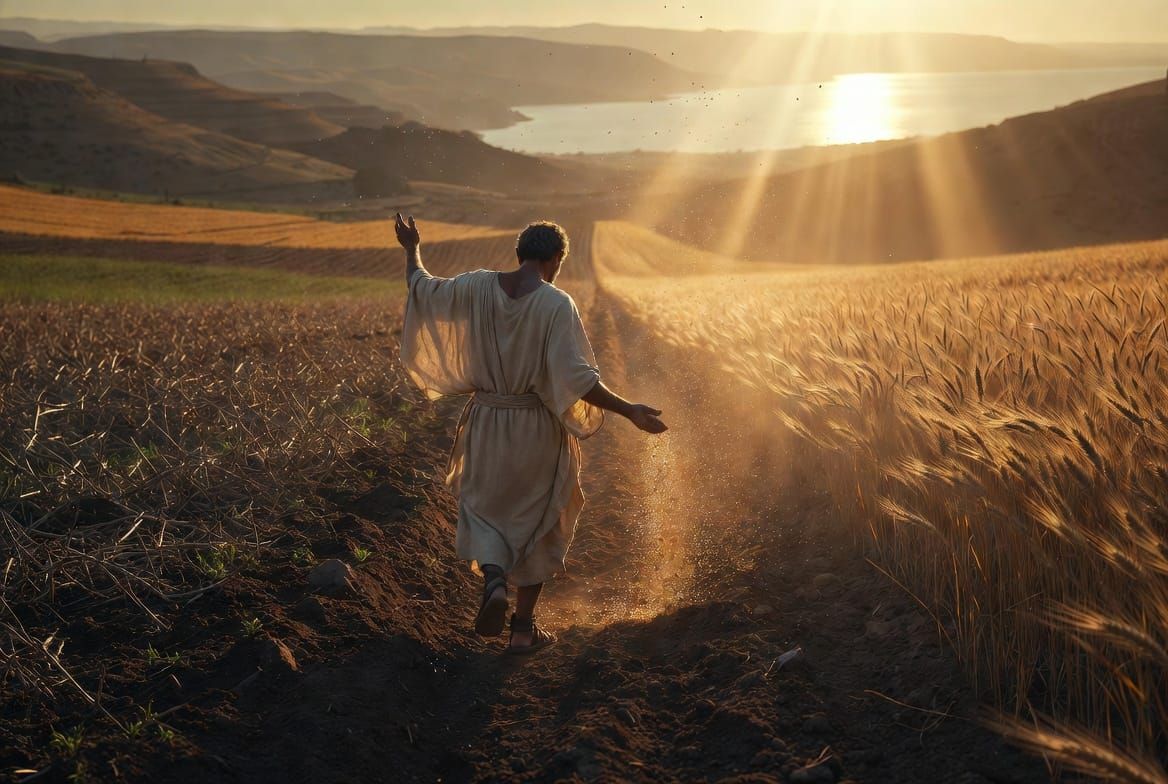
Verse 3: “A sower went out to sow.” (Matthew 13:3, ESV) That is all the introduction we are given. The parable begins with action rather than explanation. Before Jesus tells us what the seed means or what the soils represent, he simply invites us to watch the sower. Like the rain from Isaiah’s clouds, he scatters the seed everywhere. He does not test the soil first. He does not reserve the seed for the ground most likely to produce a harvest. The word goes out with the same generosity to every kind of soil.
The parable is not primarily a story about the sower or about the seed. The sower is constant. The seed is the same seed in every case. What varies is the ground.
The soils, however, are more than four different kinds of people. On one level, Jesus is describing people’s four different responses to the proclamation of the Gospel. Some hearts remain closed. Some receive the word with joy but never develop depth. Others receive it, yet allow the ordinary cares of life to choke it. Still others hear, understand, and bear abundant fruit. Yet there is another way to hear this parable. These soils are not only different kinds of people. They are conditions of the heart through which any one of us may pass as believers. The same believer may know seasons of hardness, seasons of shallowness, seasons crowded by thorns, and, by his grace, seasons of fruitful abundance. Both readings are true, and both confront us today.
The first ground is the path. Verse 19: “When anyone hears the word of the kingdom and does not understand it, the evil one comes and snatches away what has been sown in his heart.” (Matthew 13:19, ESV) The path soil is the hardened surface along the edge of the field, packed down by traffic. Seed does not penetrate it; it sits on the surface until the birds take it. The interpretation names the problem: the person does not understand. But the lack of understanding here is not intellectual; it is dispositional, a matter of the heart’s posture toward the word. The path is hard because it has been walked on repeatedly. Hearts become hardened the same way, not all at once, but little by little: by repeated exposure to the word without ever allowing it to enter, by hearing without intending to receive, by becoming familiar with holy things without ever letting them sink beneath the surface. The evil one does not have to work very hard when the seed lies on a closed surface. He snatches away what never found its way beneath the surface.
The second ground is the rocky soil. Verses 20 and 21: “This is the one who hears the word and immediately receives it with joy, yet he has no root in himself, but endures for a while, and when tribulation or persecution arises on account of the word, immediately he falls away.” (Matthew 13:20–21, ESV) The rocky ground is not a closed heart. It is a shallow one. The initial response is enthusiastic: the word is received with joy. The joy is real. Jesus does not suggest otherwise. But the rock beneath the thin layer of soil prevents any root from going deep, and when the sun comes up in earnest, there is nothing to draw on. The issue is not the sincerity of the beginning, but the depth that follows. Many people receive the word with real feeling in a moment of encounter, and the feeling is genuine. What they lack is the root system that sustains faith through difficulty. When trouble comes, and Jesus says plainly that it will come, the shallow-rooted plant has nothing to hold it.
The rocky soil carries a pastoral warning because, at first, it looks like success. A person may hear the Gospel, rejoice in it, and sincerely believe that everything has changed. Jesus does not dismiss that response. The danger comes later. The word has not yet been allowed to put down roots. Roots grow through prayer when prayer feels dry, through the steady reading of Scripture when no new insight seems to come, through remaining with the Church when she disappoints us, and through holding fast to Christ when suffering tests what we truly believe. Roots are not formed in moments of excitement. They are formed over years of quiet faithfulness.
The third ground is the thorny soil. Verse 22: “This is the one who hears the word, but the cares of the world and the deceitfulness of riches choke the word, and it proves unfruitful.” (Matthew 13:22, ESV) The thorny ground is neither closed nor shallow. The word germinates. Something grows. The problem is not that the seed dies immediately, but that something else is allowed to grow beside it. The cares of the world: not necessarily hostility, not necessarily deliberate rejection of the Gospel, but the accumulated weight of ordinary concerns pressing in from every side. The deceitfulness of riches: not necessarily great wealth, but the quiet lie that security and comfort are the primary goods to be secured in life. For a congregation that has been faithful for a long time, the thorns worth naming are not usually dramatic. They are the slow, persistent anxieties that crowd the word out: worry about health, grief that has not lifted, the exhaustion of years of burden. The thorny heart is often not rebellious. It is simply crowded. The thorns grow quietly. The seed was real. The thorns simply got more attention.
Yet where the word finds receptive ground, the story is entirely different.
Verse 23: “As for what was sown on good soil, this is the one who hears the word and understands it. He indeed bears fruit and yields, in one case a hundredfold, in another sixty, and in another thirty.” (Matthew 13:23, ESV) The distinguishing mark of the good soil is not simply that it receives the word but that it understands it. The Greek is syniemi (soon-EE-ay-mee). It means more than simply hearing sounds. It is to grasp, to comprehend, to receive the word in such a way that it can do its work. This understanding is not merely intellectual. It is the Spirit opening the heart to receive what God is saying.
The hearing that produces fruit is not the hearing of a smarter person. It is the hearing of a heart opened, ultimately by the Spirit, but attended to by the person. This is why the same sermon, heard by the same congregation on the same Sunday, lands deeply in one heart and sits on the surface of another. It is why one person responds to the Gospel and comes to faith and another does not. The difference is the disposition of the heart. And the yield is extravagant when the hear is right: a hundredfold, sixty, thirty. Ancient agriculture expected a yield of perhaps sevenfold. Jesus is describing a harvest that exceeds all reasonable expectation. The good soil does not produce a modest return. It produces an extravagant abundance.
Here is the question the parable raises for anyone listening carefully: if God’s word does not return empty, why does so much of the seed appear to bear no fruit? The answer is that Isaiah’s promise is about the word accomplishing God’s purpose, not about every hearer bearing immediate fruit. The word is active in all four soils, even when it is not visibly fruitful. Even the path soil has the word fall on it: the hardness is exposed. Even the rocky ground responds initially: the shallowness is revealed. Even the thorny ground germinates: what chokes it is named. The word diagnoses what is there. It reveals. It judges. And it invites.
Isaiah’s promise is fulfilled in the hundredfold harvest: in the depth of faith growing in prepared hearts and in the breadth of the Kingdom reaching new lives. The word of God will accomplish the purpose for which he sends it.
Psalm 65, appointed for this Sunday, lets us see the harvest from another perspective. The parable shows the seed in the ground. The psalm shows the God who gives the growth. Verse 9: “You visit the earth and water it; you greatly enrich it.” (Psalm 65:9, ESV) And verse 13: “the valleys deck themselves with grain, they shout and sing together for joy.” (Psalm 65:13, ESV) The psalmist is not praising the quality of the soil. He is praising the God who waters the earth and brings forth the harvest. The fruitfulness of the good soil is never the soil’s achievement. It is ultimately the gift of the one who sends the seed, waters the ground, and produces the growth. Paul says the same thing in 1 Corinthians 3:6: “I planted, Apollos watered, but God gave the growth.” (1 Corinthians 3:6, ESV)
The collect for this Sunday is worth hearing alongside the parable. “Let your merciful ears, O Lord, be open to the prayers of your humble servants; and, that we may receive what we ask, teach us by your Holy Spirit to ask only those things that are pleasing to you.” (BCP 2019, p. 617) There is an irony in the pairing: the parable is about our ears being open to God’s word; the collect is about God’s ears being open to our prayer. There is a holy conversation taking place. That petition, “teach us by your Holy Spirit to ask only those things that are pleasing to you,” is itself a prayer to become good soil. It is asking the Spirit to shape our desiring so that what we want aligns with what God purposes. That is the definition of the prepared heart: not the heart that has achieved a perfect receptivity, but the heart that is being taught by the Spirit to want what God wants. The Spirit who inspired the word is the Spirit who prepares the heart to receive it.
For a congregation that has been gathering faithfully for many years, the parable of the sower carries a particular word. There is a temptation to hear it as a diagnostic about other people: which of those soils describes the person who hasn’t come back since Easter? But Jesus addresses the parable to the crowd that came to hear him. It is addressed to us, the people who are present. And the honest pastoral question is: what is the condition of our hearts today, when the word comes to us today? Not which soil are we permanently, because the soils are not castes. They are conditions. A person who has been faithful for fifty years has been, at different moments, all four. The thorns grow quietly in the most faithful lives. The rocky ground can appear at any age when trouble presses in.
What does it look like in practice to be good soil? The old sermon tradition gives us a useful answer that has not lost its force: preparation and attention. Preparing to hear the word means coming with a specific intention to receive rather than merely to observe. It means, before the sermon begins, something as simple as a brief prayer, like our Collect, or, “Lord, open my heart to what you want to say to me today.” That may be one of the most dangerous prayers a Christian can pray, because God delights to answer it.
And it means paying attention during the sermon rather than allowing the mind to range over everything else that is competing for it. The mind wanders; this is simply true of all of us. The discipline is to bring it back. The thorny ground does not fail to hear because it is hostile; it fails to hear because something else gets more attention. Attention is one of the simplest forms of obedience.
Hearing and understanding are never the end of the word’s work. The good soil bears fruit. It yields. Something changes in the life of the hearer. A sermon is meant not only to be heard but to be lived. The word heard on a Sunday is delivered to the congregation so that the congregation can deliver it to the world throughout the rest of the week. The layman in the pew takes the seed home and plants it in everything the week brings: in the difficult conversation, in the act of service, in the extension of mercy where it is not expected. The harvest happens out there, not only in here.
Before this week is over, take one thing you have heard today and put it into practice: speak a word of mercy to someone who has not earned it, return to a prayer that has been neglected, reach out to someone the thorns of isolation have cut off, share the Gospel. This is how the thirtyfold, sixtyfold, and hundredfold harvest begins: one life, ours, shaped week by week by the word it has received and put into practice.
And the harvest is not only personal. The seed is the word of the Kingdom, and the Kingdom grows in the world through the community that receives it: a congregation that hears deeply becomes a congregation that forgives more readily, welcomes more generously, serves more faithfully, and bears witness more clearly to what God is doing in Hiawassee and beyond. The sower is not seeking merely better listeners. He is raising up a people through whom his Kingdom bears fruit in the world so that they may take the seed to others that may enter the Kingdom as well.
There is one more observation the parable invites before we close. The sower casts seed even upon the path. He throws seed on the rocky ground knowing there is no depth. He throws seed among the thorns knowing the competition. He throws it anyway, everywhere, with the same generosity. This is what Isaiah 55 describes. The invitation of the Gospel is genuinely open to all. The word reaches every condition of the human heart at some level. If someone is present today who has not yet trusted Christ, this parable speaks directly to you as well: the word is falling on your ground right now, generously, and without reservation. The question it asks you is the same one it asks every heart that hears the Gospel: how will you receive it? The sower has already thrown the seed. That is the word going out today. Complete the preaching dialogue and believe.
In summary, this parable is asking what kind of ground the word meets. An open heart, hearing the word not as information but as invitation. This is the soil that yields a hundredfold. And Psalm 65 reminds us that even this openness is not our achievement but God’s gift. We ask for it in the collect. We receive it through the Spirit. And the harvest he brings from it exceeds every expectation, personally at the level of our maturity, and publicly at the level of people coming into the Kingdom.
“He who has ears, let him hear.” (Matthew 13:9, ESV)
In the Name of the Father, and of the Son, and of the Holy Spirit. Amen.