Joseph, Husband of the Virgin Mary and Guardian of Jesus: An Anglican Perspective
March 19 is the feast of Joseph, Guardian of Jesus. He never speaks in any Gospel. His entire portrait is obedience: he named the child, fled to Egypt, returned, searched three days in Jerusalem. Upright and obedient — the collect asks us to imitate exactly that.
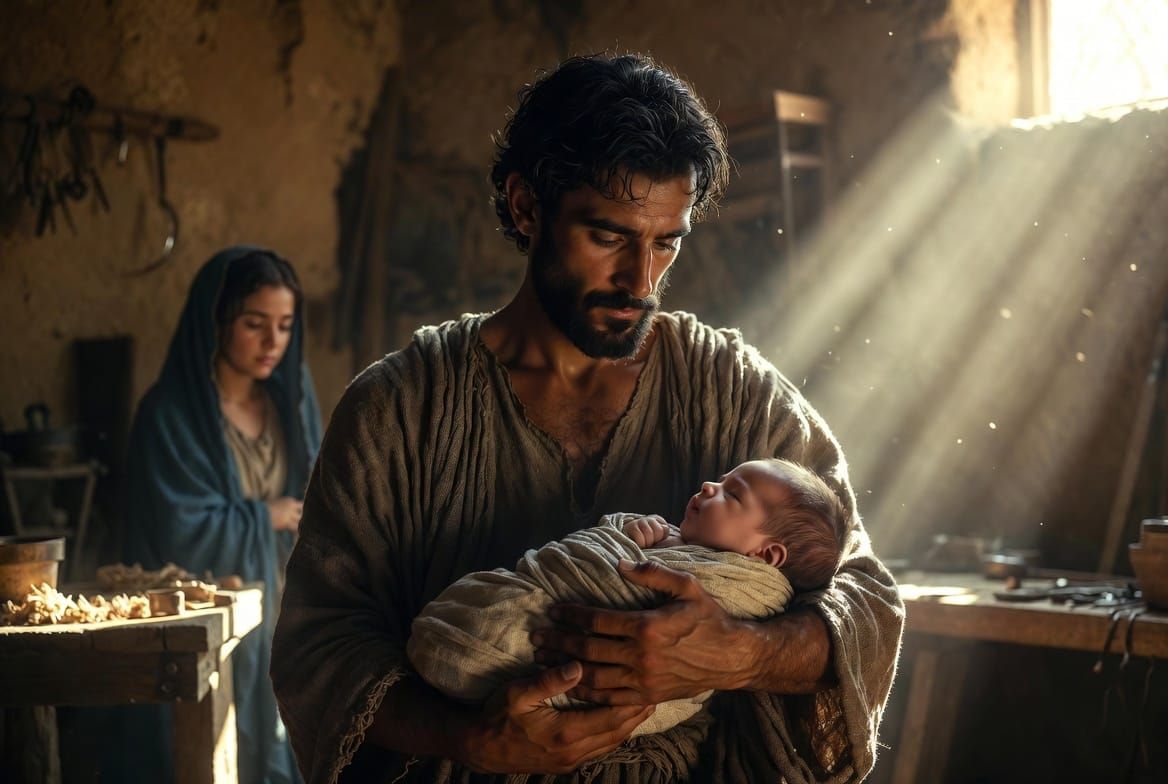
Feast Day: March 19
The Anglican calendar is ordered by a hierarchy of holy days, each carrying a different weight of observance. At the top sit the seven Principal Feasts, the highest days of the liturgical year. Below them are the Red-Letter Holy Days appointed in the BCP 2019 with their own Collects and propers. Joseph, Husband of the Virgin Mary and Guardian of Jesus, observed on March 19, is one of these Red-Letter Holy Days. The BCP 2019 appoints its Collect on page 627 and its lectionary readings on page 730.
The Prayer Book’s full calendar title is carefully chosen. Joseph is Husband of the Virgin Mary and Guardian of Jesus. The first title places him within the household through which the incarnate Son entered the ordinary human life of Israel. The second names the vocation Scripture most clearly gives him. Joseph receives Mary as his wife, names the child as the angel commands, carries him into exile when Herod seeks his life, brings him safely home, and raises him within the household at Nazareth.
Joseph never speaks in any of the four Gospels. Scripture preserves no quotation from him. What the Gospels record instead is a remarkable sequence of actions. He receives Mary when he had intended to divorce her quietly. He names the child Jesus. He rises in the night and takes the child and his mother to Egypt. He returns when commanded. He travels with his family to Jerusalem for the Passover and searches for the twelve-year-old Jesus when he remains behind in the Temple. His biblical portrait is formed largely through faithful responses to circumstances he did not choose and could not have anticipated. The Collect names the pattern succinctly: “uprightness of life” and “obedience to your commands.”
The Biblical Portrait
Matthew introduces Joseph within the genealogy that opens his Gospel. He is descended from David through the royal line of Solomon, and Matthew describes him as “Joseph the husband of Mary, of whom Jesus was born, who is called Christ.” (Matthew 1:16, ESV) The grammar is careful. Jesus is born of Mary, not begotten by Joseph. Yet Matthew deliberately brings the genealogy to Joseph because Jesus is received into the Davidic household through him.
That becomes even clearer when the angel appears to Joseph in a dream and addresses him as “Joseph, son of David.”The angel says, “Do not fear to take Mary as your wife, for that which is conceived in her is from the Holy Spirit. She will bear a son, and you shall call his name Jesus, for he will save his people from their sins.” (Matthew 1:20–21, ESV)Joseph is therefore commanded both to receive Mary and to name the child.
Matthew tells us that Joseph does exactly what the angel commands: “He took his wife, but knew her not until she had given birth to a son. And he called his name Jesus.” (Matthew 1:24–25, ESV) By receiving Mary and naming Jesus as commanded, Joseph publicly receives the child into his Davidic household. The virgin conception remains unmistakable, but so does Joseph’s real fatherly vocation. Jesus is not Joseph’s biological son, yet Joseph truly becomes the husband, guardian, provider, and earthly father whom God appoints for him.
Matthew 2 develops the same pattern of obedience. When the angel warns Joseph that Herod is seeking the child, “he rose and took the child and his mother by night and departed to Egypt.” (Matthew 2:14, ESV) After Herod dies, the angel speaks again, and Joseph again responds: “And he rose and took the child and his mother and went to the land of Israel.”(Matthew 2:21, ESV) When further danger arises in Judea, Joseph withdraws to Galilee and settles in Nazareth.
The repetition is striking: God commands; Joseph acts. Matthew never records an argument or negotiation. God uses Joseph’s obedience to protect the human life of the incarnate Son during the years when that life is vulnerable to the violence of Herod.
The appointed Gospel for the feast is Luke 2:41–52, the only canonical account from Jesus’ childhood between infancy and adulthood. Joseph and Mary travel to Jerusalem for Passover, as they do every year. On the return journey they discover that twelve-year-old Jesus is not with the traveling company. After three days they find him in the Temple among the teachers.
Mary speaks for both parents: “Son, why have you treated us so? Behold, your father and I have been searching for you in great distress.” (Luke 2:48, ESV) Jesus answers, “Why were you looking for me? Did you not know that I must be in my Father’s house?” (Luke 2:49, ESV) The words reveal the mystery that defines Joseph’s vocation. Luke can call Joseph Jesus’ father in the ordinary human sense, while Jesus identifies God uniquely as “my Father.” Joseph is the earthly father and guardian of the eternal Son whose true and eternal Father is God.
Yet Jesus’ divine Sonship does not abolish Joseph’s genuine earthly authority. Luke immediately tells us, “And he went down with them and came to Nazareth and was submissive to them.” (Luke 2:51, ESV) The incarnate Son lives in obedience within the household entrusted to Mary and Joseph. Joseph himself lives in obedience to God. The household of Nazareth is therefore marked by an extraordinary ordering of authority under divine obedience.
The Son of David
The appointed Old Testament reading is 2 Samuel 7:4, 8–16, where God makes his covenant promise to David. The Lord declares, “When your days are fulfilled and you lie down with your fathers, I will raise up your offspring after you, who shall come from your body, and I will establish his kingdom.” God then promises, “I will establish the throne of his kingdom forever.” (2 Samuel 7:12–13, ESV)
The immediate promise concerns David’s dynasty and especially Solomon, but its language reaches beyond any merely earthly reign. The royal house of David becomes the line through which Israel awaits the promised King whose throne will endure.
Joseph stands within that house. The angel does not accidentally address him as “son of David.” Matthew has just traced the royal genealogy through David and Solomon to Joseph, and Joseph’s obedient reception of Jesus places the child within that Davidic household.
The promise reaches its fulfillment not because Joseph generates the Messiah by ordinary human descent, but because God acts. The child conceived by the Holy Spirit is received into the house of David through the obedient Joseph, and the Son whom Joseph guards is the one whose kingdom will have no end.
Psalm 89:1–4, 19–29 reinforces the same theme. The Psalm recalls God’s promise: “I have made a covenant with my chosen one; I have sworn to David my servant: ‘I will establish your offspring forever, and build your throne for all generations.’” (Psalm 89:3–4, ESV) Read on Joseph’s feast, the Psalm directs our attention beyond Joseph himself toward the faithfulness of God. Generations pass. Kingdoms rise and fall. David’s throne disappears as an ordinary political reality. Yet God does not forget his promise. In the fullness of time, the Messiah enters a Davidic household in Nazareth, guarded by a man whom the angel calls “son of David.”
Faith That Receives the Promise
The appointed Epistle, Romans 4:13–18, places Joseph’s feast within the great biblical pattern of faith seen in Abraham. Paul speaks of the patriarch who trusted the promise of God when its fulfillment appeared humanly impossible: “In hope he believed against hope, that he should become the father of many nations.” (Romans 4:18, ESV)
The connection is fitting. Abraham receives a promise he cannot fulfill through ordinary human power. Joseph receives an extraordinary word from God that overturns the future he had expected. Their circumstances are very different, but the same God who calls Abraham to trust his promise calls Joseph to receive what he gives. When God tells Joseph to take Mary, he takes her. When God tells him to name the child Jesus, he names him. When God tells him to flee, he flees. When God tells him to return, he returns. Joseph does not merely admire the word of God. He entrusts himself to it. His obedience is therefore not merely strong character; it is faith taking visible form.
The Guardian of the Incarnate Son
The BCP title Guardian of Jesus deserves particular attention. Joseph cannot contribute anything to Christ’s divine Sonship, nor does the Son of God depend upon Joseph in his divine nature. Yet in the mystery of the Incarnation, the eternal Son truly assumes the vulnerability of human childhood.
The child can be carried from place to place. He can be exposed to danger. Herod can seek to kill him. The eternal Son has truly assumed our human nature and entered the ordinary vulnerability and dependence of human childhood. The Word through whom all things were made receives the ordinary protection of a household, and God appoints Joseph to provide that protection.
This is one of the quiet marvels of the Incarnation. The God who could summon angels gives Joseph a dream and tells him to get up. The one who governs nations appoints an ordinary man to guard the human life of his incarnate Son. Joseph’s guardianship therefore reveals something not merely about Joseph but about the humility of Christ. The Son does not enter humanity at a safe distance from its ordinary dependencies. He truly becomes one of us and receives the ordinary care of a mother and an earthly father.
The BCP 2019 Collect and Preface
The BCP 2019 appoints this Collect on page 627:
“O God, who from the family of your servant David raised up Joseph to be the guardian of your incarnate Son and the husband of his virgin mother: Give us grace to imitate his uprightness of life and his obedience to your commands; through Jesus Christ our Lord, who lives and reigns with you and the Holy Spirit, one God, for ever and ever. Amen.”
The Collect gives the feast its theology in miniature. Joseph comes “from the family” of David. His vocation is defined by his relationship to Christ and Mary: guardian of the incarnate Son and husband of the virgin mother. The Church then asks for grace to imitate two qualities that Scripture repeatedly displays in him, uprightness and obedience.
The order of the petition is important. The Collect does not simply command the congregation to become more like Joseph by determination. It asks God, “Give us grace to imitate.” Joseph’s example becomes Christian discipleship only within the prior grace of God. Matthew calls Joseph a “just man” when he is considering what to do after discovering Mary’s pregnancy (Matthew 1:19, ESV). His righteousness appears together with mercy: before he understands what has happened, he does not want to put Mary publicly to shame. Once God speaks, his righteousness takes the form of obedience. He receives Mary and names the child.
The Preface of the Presentation is appointed for the Eucharist on this feast. It praises God because “in the mystery of the Word made flesh, you have caused a new light to shine in our hearts, to give the knowledge of your glory in the face of your Son Jesus Christ our Lord.” (BCP 2019, p. 153) The choice of Preface keeps the feast centered where it belongs. Joseph matters because of the mystery entrusted to his guardianship: the Word has become flesh. The same Joseph who carries the child into Egypt and raises him at Nazareth is guarding the incarnate Son in whose face the glory of God is revealed.
Joseph in Anglican Worship and History
Devotion to Joseph developed gradually in the Western Church. References connecting Joseph with March 19 appear in the West by about the beginning of the ninth century, and references to Joseph as the spouse of Mary become increasingly common in the centuries that follow. His feast gained far greater prominence during the later Middle Ages, especially in the fifteenth century through the influence of figures such as Jean Gerson and Bernardino of Siena. By the late fifteenth century, March 19 had acquired a more established place in the Western calendar.
Joseph did not retain the same prominence among the holy days of the classical post-Reformation Prayer Book tradition, but modern Anglican calendars have restored a formal observance of his feast. The BCP 2019 observes March 19 as a Red-Letter Holy Day with its own Collect, psalm, readings, and Eucharistic Preface.
The Prayer Book’s treatment is biblical and Christological. The feast is not built upon later legends about Joseph’s age, the circumstances of his death, or other details Scripture does not reveal. It focuses instead upon what the canonical Gospels actually give us: Joseph belongs to David’s family, is Mary’s husband, serves as guardian of Jesus, and responds obediently to the commands of God.
The BCP 2019 Collect does not invoke Joseph or ask for his intercession. It addresses God and asks for grace to imitate Joseph’s uprightness and obedience. Whatever wider differences exist among Anglicans concerning the invocation of saints, the Prayer Book’s own emphasis on this feast is clear: Joseph is held before the Church as a faithful servant whose life directs attention toward the incarnate Son entrusted to him.
White is the customary liturgical color for Joseph’s feast, fitting its festal and Incarnational character. When March 19 falls during Lent, the white of the feast provides a visual interruption within the season’s purple and directs attention toward the mystery of the Word made flesh.
Joseph and the Hidden Life
Joseph also gives the Church a particularly important picture of hidden faithfulness. Most of his life with Jesus is completely unrecorded. Scripture tells us about the crisis surrounding Jesus’ conception, the flight to Egypt, the return, and the journey to Jerusalem when Jesus is twelve. Then Joseph disappears from the Gospel narrative. We are not told when he dies, how he dies, or exactly how long he lives.
What lies between those recorded events are years we can infer but cannot narrate in detail: ordinary household life in Nazareth, work, provision, Sabbath worship, pilgrimage, family responsibilities, and the raising of a child who is truly human and yet unlike any other child. That hiddenness is part of Joseph’s witness. Christian faithfulness is not measured by how much of it becomes historically memorable. Most obedience happens without an audience, and most Christian vocations consist largely of ordinary responsibilities faithfully discharged over time.
Joseph is remembered by the Church precisely as one whose most important work was largely hidden. He guarded what God entrusted to him, obeyed what God commanded, and did not need to become the center of the story.
Observing This Feast
Joseph, Husband of the Virgin Mary and Guardian of Jesus, is observed on March 19. To observe the feast, pray the Collect from page 627 and ask particularly for the grace to imitate Joseph’s uprightness and obedience. Read the appointed Gospel, Luke 2:41–52, and notice both Joseph’s genuine fatherly place within the household and Jesus’ unique relationship with his heavenly Father.
Read 2 Samuel 7:4, 8–16 and Psalm 89:1–4, 19–29 as the great scriptural background to Joseph’s identity as a son of David. The promises do not end with Joseph. They reach their fulfillment in the Son whose kingdom will have no end.
Read Romans 4:13–18 and meditate upon faith as trust in the God who keeps promises that human beings cannot fulfill by their own power. Then return to Matthew 1:18–25 and Matthew 2. Watch Joseph respond each time God speaks. He receives Mary. He names Jesus. He rises and flees. He rises and returns.
The feast also gives an occasion to pray for fathers, husbands, adoptive and foster parents, guardians, and all those entrusted with the protection and formation of children. Joseph’s circumstances are unique, but the shape of his vocation is recognizable: receive what God has entrusted, protect it faithfully, and remember that those placed in our care ultimately belong to God.
Conclusion
Joseph never speaks in the Gospel record. His faith is known almost entirely through what he does. He receives Mary when God tells him not to fear. He names the child when God tells him his name. He rises in the night when danger comes. He carries the child into exile and brings him home again. He searches anxiously for the twelve-year-old Jesus and then returns with him to the hidden life of Nazareth.
Yet Joseph’s silence should not be mistaken for insignificance. God places him within the fulfillment of the Davidic promise and entrusts to him the guardianship of the incarnate Son. His life demonstrates a form of holiness the Church always needs: righteousness joined to mercy, authority exercised as protection, and faith expressed through obedience when the whole plan of God cannot yet be seen. Joseph’s greatness lies finally in the one he was called to receive and guard, the incarnate Son whose coming fulfills the promises Joseph was called faithfully to serve.
The Collect therefore gives Joseph’s feast its proper final prayer, asking not that we admire him from a distance but that God would form the same kind of faithfulness in us: “Give us grace to imitate his uprightness of life and his obedience to your commands.” (BCP 2019, p. 627)