Lift Up Your Eyes: Wednesday of Summer Embertide 2026 (John 4:31-38)
We entered a harvest we did not plant. Someone prayed for us before we were born. Someone built this congregation before we arrived. The faithfulness of this church is the planted harvest someone else will one day reap. We plant, we water, God gives the growth.
May 27, 2026, Summer Ember Day I, Year A, 2026, Wednesday of Summer Embertide
John 4:31–38, Psalm 99, Numbers 11:16–17, 24–29, 1 Corinthians 3:5–11
Grace, mercy, and peace be with you on this first day of Summer Embertide.
Three days ago, on Pentecost Sunday, the Holy Spirit was poured out on the gathered disciples in Jerusalem — wind and fire and the proclamation of the mighty works of God in every language under heaven. Three thousand were baptized before the day was over. The great harvest had begun. And on Sunday, Trinity Sunday, we will stand on the mountain in Galilee and hear the commission that opens this entire season: “All authority in heaven and on earth has been given to me. Go therefore and make disciples of all nations, baptizing them in the name of the Father and of the Son and of the Holy Spirit, teaching them to observe all that I have commanded you. And behold, I am with you always, to the end of the age.” (Matthew 28:18–20, ESV) Now it is Wednesday. The wind has settled. The fire has cooled into something steadier. And the Church pauses, in this week between Pentecost and Trinity, to observe the Summer Ember Days.
Ember Days are one of the most ancient observances in the Western Church, as early as the fifth century, with roots possibly reaching the fourth, and kept continuously in Anglican practice since the Reformation. Each set lasts three days — Wednesday, Friday, and Saturday — and each is kept as a time of fasting, prayer, and particular intercession for those called to the ministry of the Church, both ordained and lay. The ACNA 2019 BCP restores them as a fully resourced observance with appointed collects, lectionary readings, and calendar dates. Their primary intention is prayer for those called to Holy Orders. But the tradition has always understood their scope to extend further — to every baptized Christian who has received gifts for the service of God’s people and is called to exercise them faithfully. As St. Peter writes: “As each has received a gift, use it to serve one another, as good stewards of God’s varied grace.” (1 Peter 4:10, ESV) That is all of us.
On these three days we fast in some form — at minimum a simpler meal than usual, a small physical interruption of ordinary comfort that sharpens our attention toward God and his work. The traditional form is one full meal and two smaller ones. For those for whom that is not medically appropriate, abstaining from meat or eating more plainly serves the same purpose. Fasting is not a performance. As the prophet Joel says: “Rend your hearts and not your garments.” (Joel 2:13, ESV) We will return at the close of this homily to how we pray today specifically. But first, the readings.
Our readings today bring us to two moments separated by more than a thousand years of history, but asking exactly the same question.
The first is from Numbers 11. Moses is exhausted. The people are complaining again — they want meat, they miss Egypt, the manna is not enough. In verse 14 Moses cries to God: “I am not able to carry all this people alone; the burden is too heavy for me.” (Numbers 11:14, ESV) This is not a failure of faith. This is a man who has been carrying the weight of an entire nation, alone, and has finally admitted what was always true: no single person can bear the whole harvest. God’s response in verses 16 and 17 is instructive: “Gather for me seventy men of the elders of Israel... and I will take some of the Spirit that is on you and put it on them, and they shall bear the burden of the people with you, so that you may not bear it yourself alone.” (Numbers 11:16–17, ESV)
God does not solve the crisis by making Moses stronger. He distributes the Spirit. He raises up seventy. He multiplies the ministry. And in verses 24 through 29, the Spirit falls even on Eldad and Medad, who had not gathered at the tent but were still in the camp. They prophesied. Joshua cried to Moses to stop them. And Moses answered with one of the most extraordinary statements in the entire Pentateuch: “Would that all the Lord’s people were prophets, that the Lord would put his Spirit on them!” (Numbers 11:29, ESV)
Moses does not hoard the Spirit. He does not guard the tent. He sees two men prophesying outside the structure, outside the official appointment, and says: I wish there were more of this. Heard in the week after Pentecost, that wish lands with particular weight — because what Moses longed for, Pentecost accomplished. The Spirit poured out on all flesh, just as Joel had foretold: “And it shall come to pass afterward, that I will pour out my Spirit on all flesh; your sons and your daughters shall prophesy, your old men shall dream dreams, and your young men shall see visions.” (Joel 2:28, ESV) That prayer was answered at Pentecost. Now the question is: will the Church steward that outpouring faithfully?
Psalm 99 frames the whole morning from above. It opens with the sovereignty of God: “The Lord reigns; let the peoples tremble! He sits enthroned upon the cherubim; let the earth quake!” (Psalm 99:1, ESV) It names Moses, Aaron, and Samuel as those through whom the sovereign King chose to make his voice heard, and closes with the word that governs everything: “Exalt the Lord our God; worship at his holy mountain; for the Lord our God is holy!” (Psalm 99:9, ESV) The King reigns. He calls whom he will. He distributes the Spirit as he pleases. No laborer enters the harvest by their own decision. They are sent.
Paul in 1 Corinthians 3 corrects the Corinthians who are quarreling about their ministers. He answers them directly: “What then is Apollos? What is Paul? Servants through whom you believed, as the Lord assigned to each. I planted, Apollos watered, but God gave the growth. So neither he who plants nor he who waters is anything, but only God who gives the growth.” (1 Corinthians 3:5–7, ESV) Every minister is a servant, no more and no less. And in verse 9: “For we are God’s fellow workers. You are God’s field, God’s building.” (1 Corinthians 3:9, ESV) Fellow workers — invited into the labor of the one who owns the field. Not entrepreneurs of the Gospel. Not personalities to follow. Servants of the harvest.
And our Gospel reading from John 4. The disciples have gone into the Samaritan town to buy food. Jesus stays at the well and speaks with a woman whose life is about to change. When the disciples return and urge Jesus to eat, he answers in verse 34: “My food is to do the will of him who sent me and to accomplish his work.” (John 4:34, ESV)
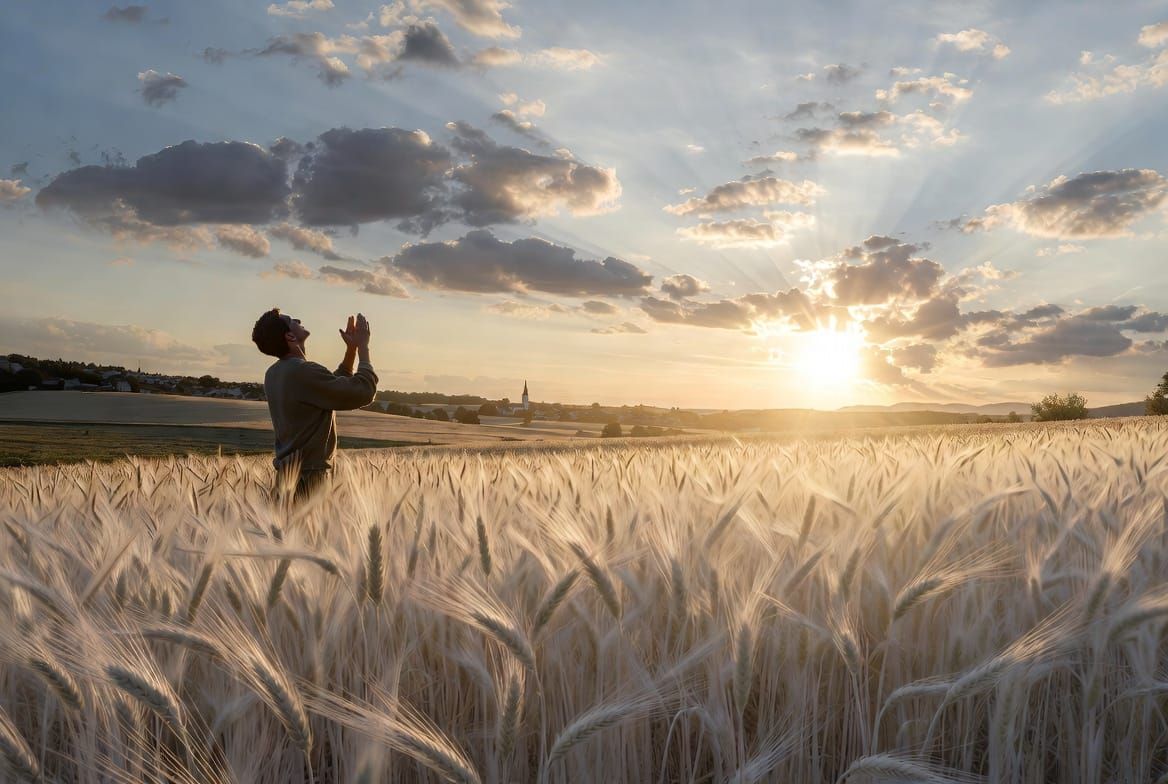
And then in verse 35 he lifts their eyes: “Do you not say, ‘There are yet four months, then comes the harvest’? Look, I tell you, lift up your eyes, and see that the fields are white for harvest.” (John 4:35, ESV) The disciples are looking at their lunch. Jesus is looking at the woman heading back toward Sychar, at the Samaritans already coming out to meet him. The harvest is not coming. It is here. The question is whether there are workers ready to enter it.
And verse 38 contains the word that ties the whole morning together: “I sent you to reap that for which you did not labor. Others have labored, and you have entered into their labor.” (John 4:38, ESV) The harvest that is white today was planted by someone else. Moses planted. The prophets planted. The seventy elders planted. One generation plants, another waters, another reaps, and God gives the growth. Nobody does it alone. The Spirit is distributed. The burden is shared. The fields are already white.
So what does this mean for us, this Wednesday morning?
First, it means we pray. Jesus does not say: feel the urgency and work harder. He says: “Pray earnestly to the Lord of the harvest to send out laborers into his harvest.” (Matthew 9:38, ESV) On these Ember Days we pray specifically — for seminarians and those in discernment for ordination, for the clergy of this diocese carrying burdens heavier than we often know, for faithful lay leaders in every parish who serve quietly and without recognition. Ember Days are the Church’s structured response to that command. We cannot outsource this prayer. It belongs to all of us.
Second, it means we look for the Eldad and Medad moments around us — the people in whose lives something is clearly happening, who may not fit the expected profile, but in whom the Spirit is visibly at work. Moses’ response to those moments was not alarm but blessing. Part of what the congregation does in Ember Days is train our eyes to recognize what God is doing in the people around us and be willing to say: I see something in you. Has anyone told you that?
Third — and this is perhaps the most personal word for this congregation — we need to hear verse 38 not just as a description of others but as a description of ourselves. “I sent you to reap that for which you did not labor. Others have labored, and you have entered into their labor.” Every one of us entered a harvest we did not plant. Someone prayed for us before we were born. Someone preached the Gospel to our parents or grandparents. Someone built this congregation long before we arrived. We have been reaping labors we did not begin. The faithfulness of this congregation — the decades of worship and prayer and service and giving that have happened in this place — is itself the planted harvest that someone else will one day reap. We may not see it. We do not need to. We plant, we water, and God gives the growth.
Here, then, is how to pray today in the Ember Day fashion the BCP gives us.
The BCP 2019 provides two collects for Ember Days on page 634. Pray the first collect in the morning and the second in the evening on each of the three days, so that both prayers shape the whole day of intercession. They are printed here for you.
The First Collect — BCP 2019, p. 634 — For use on Ember Days
Almighty God, the giver of all good gifts, in your divine providence you have appointed various orders in your Church: Give your grace, we humbly pray, to all who are [now] called to any office and ministry for your people; and so fill them with the truth of your doctrine and clothe them with holiness of life, that they may faithfully serve before you, to the glory of your great Name and for the benefit of your holy Church; through Jesus Christ our Lord, who lives and reigns with you, in the unity of the Holy Spirit, one God, now and for ever. Amen.
The Second Collect — BCP 2019, p. 634 — For use on Ember Days
O God, you led your holy apostles to ordain ministers in every place: Grant that your Church, under the guidance of the Holy Spirit, may choose suitable persons for the ministry of Word and Sacrament, and may uphold them in their work for the extension of your kingdom; through the great Shepherd and Bishop of our souls, Jesus Christ our Lord, who lives and reigns with you and the Holy Spirit, one God, for ever and ever. Amen.
Beyond the collects, the practice is simple. Fast in some form today — let the hunger be a physical reminder to turn your attention toward God and his work. Then pray by name: think of anyone you know who is in discernment about a call to ministry, ordained or lay. Think of the clergy who serve this parish and this diocese. Bring them before the Lord of the harvest by name. And consider a brief examination of your own calling — three or four honest lines in answer to the question: how is God using me right now, and am I being faithful to it? The calendar will bring these Ember Days back around in the Autumn. By then, the prayer will have begun to do its work.
Lift up your eyes. The fields are white. Lord of the harvest, send out laborers — and let it begin with us.
In the Name of the Father, and of the Son, and of the Holy Spirit. Amen.