Listen to Him: Transfiguration Sunday 2026 (Matthew 17:1-9)
On Transfiguration Sunday, the Church is shown the glory of Christ before entering Lent. The Father identifies Jesus as his beloved Son and gives a simple command: “Listen to him.” The mountain prepares us for the Cross by showing us who is going there.
February 15, 2026, Transfiguration Sunday, Year A, The Last Sunday of Epiphany
Matthew 17:1–9, Psalm 99, Philippians 3:7–14, Exodus 24:12–18
Grace, mercy, and peace from God our Father and the Lord Jesus Christ be with you on this Last Sunday of Epiphany, Transfiguration Sunday.
The Season of Epiphany began with a voice from heaven. At the Jordan, when Jesus was baptized, the Father said, “This is my beloved Son, with whom I am well pleased.” (Matthew 3:17, ESV) For these weeks since then, Matthew has been showing us what that means. Jesus has taught with authority, healed the sick, forgiven sins, driven back the powers of darkness, called disciples, and proclaimed the Kingdom of Heaven. Today, at the end of the season, the Father speaks again. This time he adds three words that prepare us for everything that comes next: “Listen to him.” Our Gospel is Matthew 17:1–9.
The setting matters because Matthew begins in verse 1, “And after six days Jesus took with him Peter and James, and John his brother, and led them up a high mountain by themselves.” (Matthew 17:1, ESV) Six days after what? Six days after the conversation at Caesarea Philippi. Peter has confessed Jesus to be “the Christ, the Son of the living God,” and Jesus has immediately begun telling the disciples what being the Christ will mean. He must go to Jerusalem, suffer many things, be killed, and on the third day be raised. Peter cannot accept it. He rebukes Jesus, and Jesus tells him, “Get behind me, Satan.” (Matthew 16:23, ESV) The Transfiguration therefore comes immediately after the disciples have been told that the Messiah is going to suffer, and after Peter has shown how badly he misunderstands what that means.
Matthew’s phrase “after six days” also echoes our reading from Exodus 24. Moses goes up Mount Sinai, the cloud covers the mountain for six days, and on the seventh day the Lord calls to Moses from the cloud. The glory of the Lord appears like a devouring fire on the top of the mountain. Matthew does not have to explain the connection. Mountain, six days, cloud, glory, divine voice. The imagery is already familiar. Once again God is revealing himself on a mountain, but this time Moses will not be the central figure.
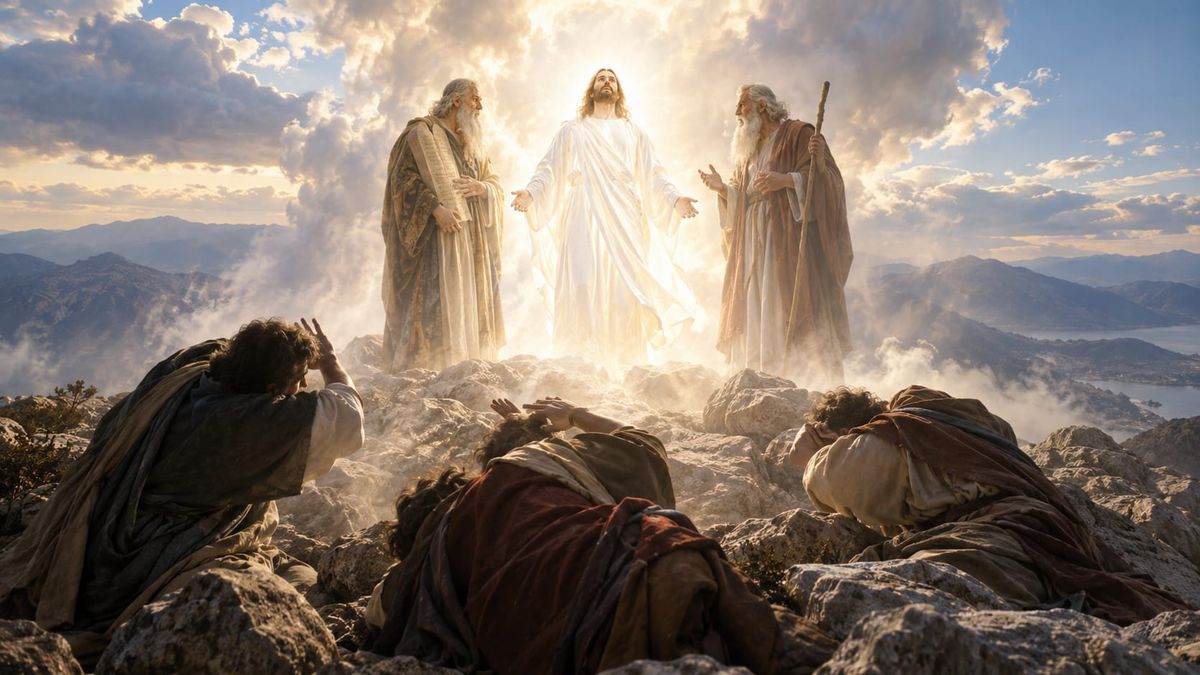
Verse 2 tells us what happens there: “And he was transfigured before them, and his face shone like the sun, and his clothes became white as light.” (Matthew 17:2, ESV) The word translated “transfigured” is metamorphoō (meh-tah-mor-FOH-oh), to be transformed in appearance. Matthew reaches for the brightest language he has. Jesus’ face shines like the sun. His clothing becomes white as light. This is not merely the reflected brightness Moses carried down from Sinai. The disciples are being granted an extraordinary manifestation of the glory that belongs to Jesus himself.
We need to be careful how we describe this. Jesus does not become divine on the mountain. He does not receive a status he lacked before. Neither is his humanity a costume that briefly falls away so that the real, divine Jesus can appear underneath it. The one standing before Peter, James, and John is the same Jesus who walked up the mountain with them, the same Jesus who becomes tired, eats, sleeps, touches lepers, and sits at tables with sinners. The eternal Son has truly taken our humanity, and on the mountain the disciples are allowed to see in visible splendor something of the glory that has belonged to him all along.
That is one of the reasons the Transfiguration belongs at the end of Epiphany. The season has been revealing Jesus gradually. Today the revelation becomes almost unbearable in its clarity. The one who has been walking the roads of Galilee in ordinary human appearance is the beloved Son, and the glory is his.
Verse 3 continues, “And behold, there appeared to them Moses and Elijah, talking with him.” (Matthew 17:3, ESV)Moses and Elijah are not random visitors. Moses is the great mediator of the Law. Elijah stands at the head of the prophetic tradition, and both men are associated with encounters with God on mountains. Moses ascends Sinai. Elijah encounters the Lord at Horeb. Now both of them stand with Jesus.
Luke tells us what they were discussing. They were speaking about Jesus’ “departure, which he was about to accomplish at Jerusalem.” (Luke 9:31, ESV) The word Luke uses for departure is exodos (EX-oh-dos). Moses, the man most closely associated with Israel’s Exodus from Egypt, is standing on the mountain talking with Jesus about the Exodus Jesus is going to accomplish in Jerusalem. The Cross is not an accident waiting to happen. Jesus is going to accomplish something there. He will lead his people through the greater bondage, not merely slavery under Pharaoh, but sin and death themselves.
That makes Moses and Elijah’s presence even more significant. They are not there to place Jesus beside themselves as the third member of a great biblical trio. The Law and the Prophets are standing with the one toward whom the Law and the Prophets have always been pointing. Jesus said earlier in Matthew, “Do not think that I have come to abolish the Law or the Prophets; I have not come to abolish them but to fulfill them.” (Matthew 5:17, ESV) Here that fulfillment is almost visible. Moses and Elijah stand before the Son, and the conversation is about the saving work he is going to accomplish in Jerusalem.
Then Peter speaks in verse 4: “Lord, it is good that we are here. If you wish, I will make three tents here, one for you and one for Moses and one for Elijah.” (Matthew 17:4, ESV) This verse has often been turned into the origin of the phrase “mountaintop experience,” as though Peter’s great mistake is simply that he wants to stay up there enjoying a spiritual high. But the other Gospels caution us against reading too much confidence into Peter’s words. Mark says, “he did not know what to say, for they were terrified,” and Luke says that Peter did not know what he was saying. (Mark 9:6; Luke 9:33, ESV) Peter is overwhelmed and trying to respond to something he does not yet understand.
His suggestion about tents may recall the Feast of Booths, with its associations of Exodus, wilderness, divine provision, and Israel’s hope. That is possible, but Matthew does not explain Peter’s motive, and we should not pretend to know more than he tells us. What is clear is that Peter places Jesus, Moses, and Elijah side by side in his proposal. Three figures, three tents. And before Peter can finish speaking, the Father interrupts him.
Verse 5 says, “He was still speaking when, behold, a bright cloud overshadowed them, and a voice from the cloud said, ‘This is my beloved Son, with whom I am well pleased; listen to him.’” (Matthew 17:5, ESV) The cloud brings us back again to Sinai. In Exodus 24, the glory of the Lord dwells upon the mountain and the cloud covers it. In the wilderness, the cloud marks the presence of God with his people. Now the cloud overshadows the disciples, and from it comes the voice of the Father.
The first part of the declaration should sound familiar: “This is my beloved Son, with whom I am well pleased.” We heard it at the Baptism. Epiphany begins there and ends here. But now the Father adds, “listen to him.” That addition matters enormously because of what has happened six days earlier. Peter has confessed Jesus correctly and then refused to listen when Jesus explained what the Messiah must do. Peter was willing to call Jesus the Christ as long as Peter could define what Christ meant. The Father now removes that option. This is my beloved Son. Listen to him.
That command also tells us how to understand Moses and Elijah. They are glorious servants of God, but they are not three equal authorities standing beside Jesus. Moses bears witness to him. Elijah bears witness to him. The Law and the Prophets find their fulfillment in him. The Father does not say, “Listen to all three equally.” He says of Jesus, “listen to him.”
That is a word the Church needs as Lent approaches. Christian repentance can easily become an exercise in listening to ourselves. What do I think I should give up? What religious program should I adopt? What version of myself am I trying to become? Self-examination has an important place, but it is not the center. The Father gives us a better starting point: listen to the Son.
Listen when he tells us what sin is, even when the culture has renamed it. Listen when he tells us to forgive, even when resentment feels justified. Listen when he says that whoever would save his life will lose it. Listen when he tells us to love our enemies, take up our cross, give in secret, pray without pretense, and seek first the Kingdom of God. Lent will not be spiritually fruitful because we become unusually creative with discipline. It will be fruitful insofar as discipline teaches us again to listen to Christ.
Verses 6 and 7 show what happens when the disciples hear the Father’s voice: “When the disciples heard this, they fell on their faces and were terrified. But Jesus came and touched them, saying, ‘Rise, and have no fear.’” (Matthew 17:6–7, ESV) Matthew gives us one of the most beautiful details in the whole account. The disciples hear the voice of God and collapse in terror, and the glorious Son walks over and touches them.
That is not incidental. The same Jesus whose face shines like the sun is the Jesus who comes near enough to lay a hand upon frightened disciples. The glory of Christ does not make him less accessible. His majesty does not cancel his mercy. Peter, James, and John are not told to climb back toward God after collapsing in fear. Jesus comes to them, touches them, and says, “Rise, and have no fear.”
That movement belongs at the heart of the Gospel. God does not save us because we successfully ascend to him. He comes to us. The eternal Son takes our flesh. He enters our world, bears our sin, goes to Jerusalem, and accomplishes the salvation we cannot accomplish for ourselves. Grace precedes response. Even here on the mountain, the terrified disciples are raised because Jesus comes near.
Verse 8 says, “And when they lifted up their eyes, they saw no one but Jesus only.” (Matthew 17:8, ESV) Moses and Elijah are gone. The cloud has passed. The voice has spoken. Jesus remains. Matthew does not need to explain the picture. The witnesses have done their work. The Father has identified his Son. The disciples are left with Jesus.
Then verse 9 turns the whole scene toward what is coming: “And as they were coming down the mountain, Jesus commanded them, ‘Tell no one the vision, until the Son of Man is raised from the dead.’” (Matthew 17:9, ESV) The Transfiguration is not Easter arriving early. Jesus has not yet died and risen bodily from the grave. The glory on the mountain anticipates what is coming, but the road to Resurrection still runs through Jerusalem, suffering, crucifixion, and burial.
This is why our Collect begins, “O God, who before the passion of your only-begotten Son revealed his glory upon the holy mountain.” Before the passion. The Church is shown the glory before Lent so that we will know whom we are following when the road becomes dark. The one who will be mocked is the one whose face shone like the sun. The one who will be stripped is the one whose clothing became white as light. The one who will hear the crowd shout for his crucifixion is the one of whom the Father has already said, “This is my beloved Son.”
Paul’s words in Philippians 3 bring the same two realities together. He says that he wants to “know him and the power of his resurrection,” but he immediately continues, “and may share his sufferings, becoming like him in his death.”(Philippians 3:10, ESV) Paul does not choose between glory and Cross, resurrection and suffering. To know Christ is to know the whole Christ, and to follow Christ is to follow him along the road he actually walks.
That brings us to the petition in the Collect: “Grant that we, beholding by faith the light of his countenance, may be strengthened to bear our cross, and be changed into his likeness from glory to glory.” The Prayer Book does not ask that we might reproduce Christ’s Transfiguration. His glory upon the mountain belongs uniquely to the incarnate Son. It asks instead that beholding him by faith would strengthen us to bear our cross and that God would change us into his likeness.
Notice again who does the acting. The Collect says, “Grant.” God must give the strength. God must accomplish the transformation. We do not become holy by staring harder at ourselves. Paul says elsewhere that as we behold the glory of the Lord we “are being transformed into the same image from one degree of glory to another,” and then adds, “this comes from the Lord who is the Spirit.” (2 Corinthians 3:18, ESV) Christian transformation is real, but it is the work of grace.
So what does Transfiguration Sunday ask of us as we stand only three days from Ash Wednesday? First, it asks us to see Jesus clearly before Lent begins. The disciplines of the coming season matter, but they are not the point. Jesus is the point. Fasting, prayer, self-examination, repentance, and works of mercy are useful only insofar as they turn our attention away from the false gods and false selves we have accumulated and back toward him.
Second, the Father tells us plainly what to do with what we have seen: listen to him. That means more than admiring Jesus or agreeing with selected portions of his teaching. Listening in Scripture carries obedience with it. As we approach Lent, it would be worth asking where we have been behaving like Peter at Caesarea Philippi, confessing Jesus accurately while quietly reserving the right to correct him when his words interfere with our assumptions, ambitions, politics, comforts, fears, or desires.
Third, the Transfiguration teaches us not to confuse glory with escape. Peter, James, and John do not remain on the mountain. Jesus leads them down, and eventually he leads them toward Jerusalem. The Christian life is not a search for enough spiritual experiences to keep ordinary suffering at a distance. God sometimes gives unusual consolation, clarity, beauty, and joy, but those gifts strengthen us for faithfulness rather than exempt us from it.
That is why this Sunday stands where it does in the calendar. Today the sanctuary is white. We behold Christ in glory. On Wednesday the color becomes purple, ashes are imposed, and we are reminded that we are dust and to dust we shall return. The purple does not deny the white. The Christ whom we follow into Lent remains the beloved Son whose glory was revealed on the mountain.
So do not rush past today in order to get to Lent. The Church places this revelation here because we need it. Before we speak of repentance, we are shown the one to whom we repent. Before we speak of bearing the Cross, we are shown the one who bears it first. Before the road descends toward Jerusalem, the Father tells us who is walking it.
This is my beloved Son.
Listen to him.
And when the road becomes difficult, when obedience costs more than we expected, when the glory seems hidden beneath suffering, remember the mountain. The one we follow is not merely a teacher whose life ended badly. He is the beloved Son, the fulfillment of the Law and the Prophets, the Lord whose glory was revealed before the Passion, who went willingly to the Cross for us, who rose bodily from the grave, and who by his Spirit is changing his people from glory to glory.
In the Name of the Father, and of the Son, and of the Holy Spirit. Amen.