Transfiguration Sunday: An Anglican Perspective
Transfiguration Sunday. The collect: the glory was revealed before the passion. The sequence is deliberate — the disciples needed to see who he was before following him to the cross. Ash Wednesday is four days away. The Church has been given a sight of glory before turning toward the cross.
The Last Sunday of Epiphany
The Last Sunday of Epiphany is Transfiguration Sunday, the culmination of the Church’s season of manifestation and the threshold of Lent. It is not a Principal Feast or a Red-Letter Holy Day, but the BCP 2019 specifically appoints the Transfiguration as the Last Sunday of Epiphany, with its Collect on page 604 and its three-year lectionary on page 720. The Sunday sequence of the Season of Epiphany begins with the Father’s voice at the Jordan: “This is my beloved Son, with whom I am well pleased.” (Matthew 3:17, ESV) It ends with the Father’s voice from the cloud on the mountain: “This is my beloved Son, with whom I am well pleased; listen to him.” (Matthew 17:5, ESV) Between those two declarations, the Church has watched Christ call disciples, teach with authority, heal, forgive, confront evil, and proclaim the Kingdom. Now, at the season’s end, Epiphany’s great question is answered in glory: the one whom the disciples have followed along ordinary roads is the beloved Son.
The placement is deliberate. Only days after this Sunday, the Church will enter Lent and begin turning more directly toward the Passion. Before the ashes appear, however, the disciples are shown who is going to the Cross. Jesus is not merely a teacher whose ministry will end tragically in Jerusalem. He is the beloved Son, the fulfillment of the Law and the Prophets, and the Lord whose glory belongs to him even as he willingly walks the road of suffering and death.
The BCP 2019 makes this movement explicit in the Collect for the day: “O God, who before the passion of your only-begotten Son revealed his glory upon the holy mountain: Grant that we, beholding by faith the light of his countenance, may be strengthened to bear our cross, and be changed into his likeness from glory to glory.” (BCP 2019, p. 604) The words “before the passion” interpret the entire Sunday. Glory is revealed before suffering so that the Church may know whom she is following when the road turns toward Jerusalem.
The Biblical Event
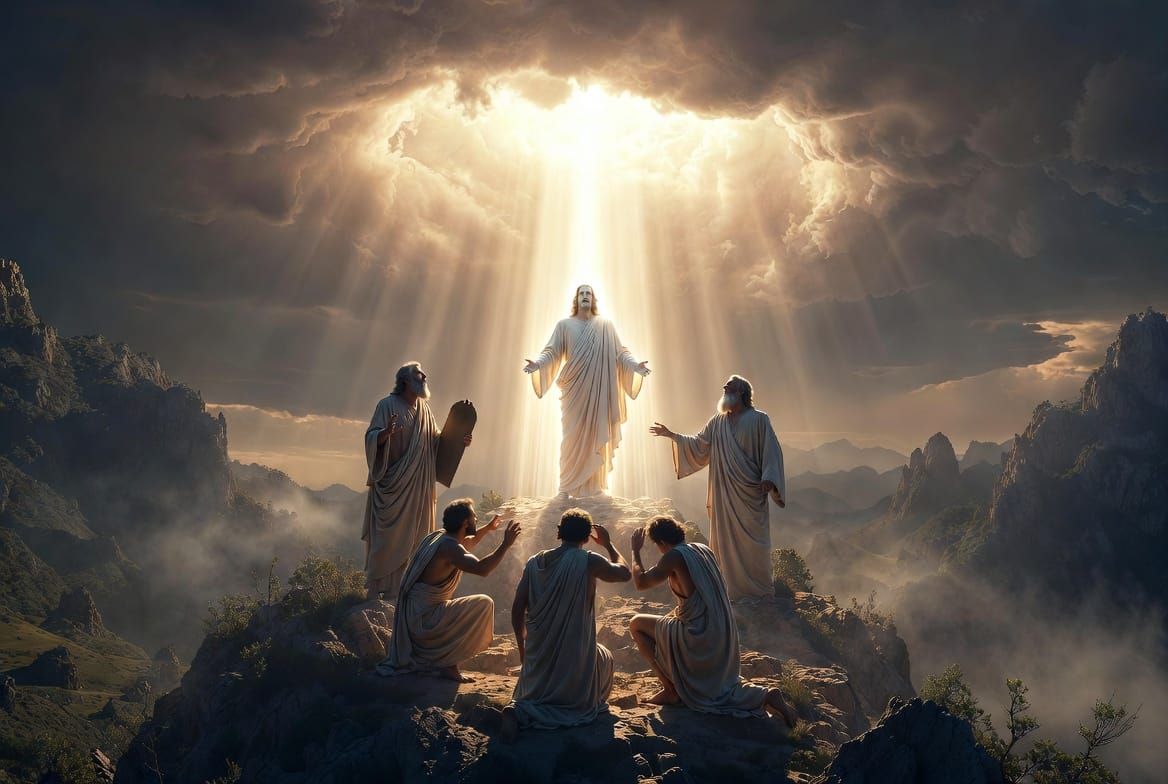
All three Synoptic Gospels record the Transfiguration. Jesus takes Peter, James, and John up a high mountain, where his appearance is transformed before them. Moses and Elijah appear, the divine cloud overshadows them, and the Father identifies Jesus as his beloved Son.
Matthew says, “And he was transfigured before them, and his face shone like the sun, and his clothes became white as light.” (Matthew 17:2, ESV) The Greek verb metamorphoō (meh-tah-mor-FOH-oh) means to be transformed or changed in form. Matthew’s imagery is overwhelming: the face of Jesus shines like the sun, and even his clothing becomes radiant.
The bright cloud is also part of the biblical theology of the scene. It recalls the cloud that covered Sinai when Moses ascended the mountain and the glory-cloud that filled the Tabernacle with the presence of God. The imagery of mountain, cloud, glory, and divine voice comes from deep within Israel’s Scriptures. Yet now the voice from the cloud does not simply deliver another commandment through a prophet. The Father directs the disciples to Jesus: “listen to him.”
The Transfiguration is not the moment when Jesus becomes something he was not before. He does not become divine upon the mountain, nor is a uniquely holy human being promoted into divine status. The eternal Son has been the eternal Son from before the foundation of the world. The one who walked up the mountain in ordinary human appearance is the same divine Person whose glory now becomes extraordinarily visible to the three disciples.
The Church therefore reads the event within the mystery of the Incarnation. The glory belongs to the Son who has truly taken our humanity. His divinity does not replace his humanity, and his humanity is not a disguise concealing his divinity. Jesus Christ is one Person, truly God and truly man, and upon the mountain the disciples are granted an extraordinary manifestation of the glory belonging eternally to the incarnate Son.
The Glory Was Always His
The Transfiguration is sometimes described as though a veil were temporarily pulled aside and the disciples glimpsed the divinity hidden beneath Jesus’ humanity. There is something useful in the image if handled carefully, but it can also suggest that Christ’s humanity is merely an outer covering over his true divine identity.
The Gospel gives us something richer. The disciples are granted an extraordinary manifestation of the glory that belongs eternally to the Son, seeing in visible splendor the one they have already been following along ordinary roads. The carpenter’s son from Nazareth, the teacher who sits beside them, the man who grows tired and eats with sinners, and the radiant Lord upon the mountain are one and the same Jesus.
John later writes of the incarnate Word, “And the Word became flesh and dwelt among us, and we have seen his glory, glory as of the only Son from the Father, full of grace and truth.” (John 1:14, ESV) Divine glory is not alien to the humanity of Jesus. In the mystery of the Incarnation, the eternal Son has truly taken human nature without ceasing to be who he eternally is.
The Transfiguration therefore does not correct a deficiency in Christ. It corrects a deficiency in the disciples’ sight. They are being shown more clearly who has been standing before them all along.
Not Yet the Resurrection
The Transfiguration should not be confused with the Resurrection before the Resurrection. Jesus has not yet passed through death or risen bodily into the life of the age to come. The Passion, burial, and bodily Resurrection still lie ahead.
Rather, the disciples are granted a real manifestation of the eternal Son’s glory before his Passion, an event that anticipates the vindication and glory still to come without collapsing the mountain into Easter itself. Matthew makes the distinction explicit when Jesus commands the disciples, “Tell no one the vision, until the Son of Man is raised from the dead.”(Matthew 17:9, ESV)
The event therefore points forward. The glory seen on the mountain assures the disciples that the humiliation soon to come will not reveal the final truth about Jesus. The mocked, scourged, and crucified one remains the beloved Son whose glory they have seen.
At the same time, Easter will be more than a return to the splendor of the mountain. The Resurrection is the bodily victory of Jesus over death and the firstfruits of the new creation. The Transfiguration anticipates glory; the Resurrection brings the crucified Christ bodily through death into the indestructible life of the age to come.
Moses, Elijah, and the Beloved Son
Matthew tells us, “And behold, there appeared to them Moses and Elijah, talking with him.” (Matthew 17:3, ESV) Their presence is not decorative. Moses and Elijah stand among the greatest figures of Israel’s Scriptures, and both are associated with mountain encounters with God.
Moses received the Law at Sinai and came down from the mountain with his face shining because he had been in the presence of the Lord. Elijah encountered God at Horeb after fleeing from Jezebel. Now Law and Prophet stand with Jesus upon another holy mountain.
The scene does not place three equal religious authorities side by side. Peter’s proposal to make three tents is interrupted by the divine cloud and the Father’s voice: “This is my beloved Son, with whom I am well pleased; listen to him.”(Matthew 17:5, ESV) When the disciples lift their eyes afterward, “they saw no one but Jesus only.” (Matthew 17:8, ESV)
Moses and Elijah bear witness to Christ. The Law and the Prophets do not disappear because they were mistaken or irrelevant. They reach their fulfillment in the Son toward whom they have always been pointing.
The contrast with Moses is particularly striking. Moses’ face shines after being in the presence of God. Jesus’ glory is manifested in his own Person. The distinction should not be pressed beyond what the text supplies, but the canonical contrast is fitting: Moses is the servant who receives revelation, while Jesus is the beloved Son whom the Father commands the Church to hear.
“Listen to Him”
The Father’s command is as important as the manifestation itself: “listen to him.” (Matthew 17:5, ESV) Epiphany does not culminate merely in seeing something spectacular. The revelation of Christ demands obedient hearing.
That command becomes particularly important as Lent approaches. Christian penitence begins not with listening more intently to ourselves but with listening to Christ. Self-examination has an important place, but it becomes spiritually unhealthy when the self becomes its own final point of reference. We learn what sin is, what holiness requires, what repentance means, and where forgiveness is found because God has spoken in his Son.
The command also establishes the relationship between Jesus and Moses and Elijah. The Father does not tell the disciples to balance three authorities equally. Moses and Elijah stand as witnesses, but the final command is directed toward the Son: listen to him.
The Church therefore enters Lent not chiefly asking what program of self-improvement she can construct but asking how more faithfully to hear and follow Christ. Before fasting, before ashes, and before intensified self-examination comes the Father’s command to listen to the beloved Son.
The Gospel in Year A
Year A appoints Matthew 17:1–9. Matthew emphasizes the brightness of Christ’s face, the Father’s declaration, and the terrified response of the disciples. When they hear the voice, “they fell on their faces and were terrified.” (Matthew 17:6, ESV)
Jesus then does something characteristic of the Gospel: “But Jesus came and touched them, saying, ‘Rise, and have no fear.’” (Matthew 17:7, ESV) The glorious Son before whom they fall in fear is also the Lord who comes near and touches them.
The appointed readings reinforce the scene. Exodus 24 places Moses upon Sinai amid the glory of the Lord. The cloud covers the mountain, and “the glory of the LORD dwelt on Mount Sinai.” (Exodus 24:16, ESV) Psalm 99 gathers the same biblical vocabulary of holiness, cloud, Moses, and the mountain of God, while Philippians 3 directs the Church toward knowing Christ, sharing his sufferings, and attaining the resurrection from the dead.
The lectionary therefore does not allow glory and suffering to be separated. Paul desires to know Christ “and the power of his resurrection,” but in the same breath speaks of “sharing his sufferings, becoming like him in his death.” (Philippians 3:10, ESV) That is precisely the direction in which Transfiguration Sunday sends the Church.
The Gospel in Year B
Year B appoints Mark 9:2–9. Mark emphasizes the astonishing brightness of Jesus’ clothing, which becomes “intensely white, as no one on earth could bleach them.” (Mark 9:3, ESV) The description almost strains the limits of ordinary language.
Mark also tells us that Peter proposes making three tents because “he did not know what to say, for they were terrified.”(Mark 9:6, ESV) That detail should caution against assigning too elaborate a motive to Peter’s proposal. His words emerge from fear and bewilderment before a mystery he does not yet understand.
The Year B Old Testament reading turns to Elijah’s encounter with the Lord, while Psalm 27 contains the longing, “You have said, ‘Seek my face.’ My heart says to you, ‘Your face, LORD, do I seek.’” (Psalm 27:8, ESV) On the mountain, the disciples behold the face of Christ in glory.
Year B also appoints 2 Peter 1:13–21, making the apostle’s later eyewitness testimony part of the Sunday lectionary. Peter recalls that he and the others were “eyewitnesses of his majesty” and heard the voice borne by the Majestic Glory: “This is my beloved Son, with whom I am well pleased.” (2 Peter 1:16–17, ESV)
Peter’s later testimony is especially valuable because it shows how the event was remembered apostolically. The Transfiguration was not merely an overpowering private experience whose meaning dissolved afterward. Peter says, “we were with him on the holy mountain.” (2 Peter 1:18, ESV) The event belongs to the apostolic testimony concerning Jesus Christ.
Peter then moves from what he heard upon the mountain to the prophetic Scriptures: “And we have the prophetic word more fully confirmed, to which you will do well to pay attention as to a lamp shining in a dark place, until the day dawns and the morning star rises in your hearts.” (2 Peter 1:19, ESV) The vision does not make Scripture unnecessary. The apostolic eyewitness and the prophetic Word belong together, directing the Church toward the full dawn still to come.
Because 2 Peter is appointed specifically in Year B, however, it should not be described as an appointed reading every Transfiguration Sunday. The lectionary gives each year its own scriptural pattern.
The Gospel in Year C
Year C appoints Luke 9:28–36. Luke offers two details of particular theological importance. First, Jesus goes up the mountain to pray, continuing Luke’s characteristic emphasis upon prayer at decisive moments in the Lord’s ministry.
Second, Luke tells us what Moses and Elijah are discussing with Jesus. They speak “of his departure, which he was about to accomplish at Jerusalem.” (Luke 9:31, ESV) The Greek word translated departure is exodos (EX-oh-dos).
The choice of word is extraordinary. Moses, the great human figure of Israel’s Exodus, stands with Jesus and speaks about the Exodus Jesus himself is going to accomplish at Jerusalem. The Cross is not merely the place where Jesus will suffer. It is part of the greater deliverance through which he will rescue his people from sin and death.
The language does not erase the historical Exodus from Egypt or turn it into a mere allegory. God’s deliverance of Israel remains a real saving act within covenant history. Precisely because it is real, it becomes part of the scriptural pattern through which the Church recognizes the greater redemption accomplished in Christ.
The Year C lectionary also appoints Exodus 34, where Moses descends from Sinai with a shining face. Paul’s discussion of spiritual gifts and love in 1 Corinthians 12 and 13 provides another useful corrective. The Church can behold extraordinary glory without becoming fascinated with spiritual spectacle for its own sake. Even the greatest gifts are nothing without love.
The manifestation of Christ’s glory is therefore ordered toward discipleship, love, the Cross, and the saving work he will accomplish at Jerusalem.
Peter’s Proposal and the Descent from the Mountain
Peter’s proposal to make three tents can easily be heard as an attempt to preserve or hold onto the moment, but the Gospel does not permit the disciples to remain on the mountain. The cloud comes, the Father speaks, and eventually Jesus leads them downward.
That descent is essential to the event. The glory is real, but the ministry of Jesus is not completed by remaining in a place of visible splendor. Jerusalem lies ahead.
Christian spirituality can experience a similar temptation. Moments of unusual consolation, clarity, beauty, or spiritual intensity are gifts, but they are not ordinarily places in which Christians are permitted to live permanently. The Lord who meets his people upon the mountain also leads them back into ordinary obedience.
The point is not that moments of glory are unimportant. The disciples will need what they have seen. The revelation strengthens them for what they will later struggle to understand.
The Church likewise carries the memory of the mountain into Lent. The journey downward is not a journey away from Christ’s glory but a journey with the glorious Christ toward the saving work he has come to accomplish.
The BCP 2019 Collect
The Collect gives the Sunday its theological and pastoral center: “O God, who before the passion of your only-begotten Son revealed his glory upon the holy mountain: Grant that we, beholding by faith the light of his countenance, may be strengthened to bear our cross, and be changed into his likeness from glory to glory.” (BCP 2019, p. 604)
The opening phrase prevents the Transfiguration from becoming an isolated mystical episode. God reveals the Son’s glory before the passion. The mountain prepares for the Cross.
The petition then turns from the disciples’ experience to the Church’s life. We do not stand physically upon the mountain with Peter, James, and John, but through their apostolic witness we behold Christ by faith. What they saw by sight, the Church receives through the testimony God has given in Scripture.
The Church asks that this faithful beholding would strengthen us to bear the Cross and transform us into Christ’s likeness. The grammar of grace matters. The Collect does not tell the Church to manufacture that transformation by greater determination. It asks God to grant it. Beholding, strength, cross-bearing, and transformation all unfold within grace.
The concluding phrase echoes 2 Corinthians 3:18, where Paul says that Christians, “beholding the glory of the Lord, are being transformed into the same image from one degree of glory to another,” and adds that “this comes from the Lord who is the Spirit.” (2 Corinthians 3:18, ESV)
Our transformation is not Christ’s Transfiguration repeated in us. The incarnate Son uniquely manifests his divine glory upon the mountain. Christians are instead progressively conformed by grace to his holiness and likeness as the Spirit sanctifies those united to Christ.
The Prefaces
The BCP 2019 permits either the Preface of the Epiphany or the Preface of the Transfiguration on the Last Sunday of Epiphany. Both interpret the Sunday appropriately from different angles.
The Preface of the Epiphany gives thanks through Christ, “who took on our mortal flesh to reveal his glory; that he might bring us out of darkness and into his own glorious light.” Its Incarnational emphasis gathers the whole season together. The Word who took our mortal flesh is the Son whose glory is now manifested upon the mountain.
The Preface of the Transfiguration, which is also used for the Presentation and Annunciation, declares, “Because in the mystery of the Word made flesh, you have caused a new light to shine in our hearts, to give the knowledge of your glory in the face of your Son Jesus Christ our Lord.” (BCP 2019, p. 153) The Preface grounds the mountain vision directly in the Incarnation. Because the Word has become flesh, the glory of God is known in the human face of Jesus Christ.
Neither Preface leaves the Church simply admiring brightness. Both locate the glory within the saving mystery of the incarnate Son. The one revealed upon the mountain is the Savior who goes to the Cross for his people.
Transfiguration Sunday and the August 6 Feast
The Anglican calendar returns to this same biblical event on August 6 in the Feast of the Transfiguration of Our Lord Jesus Christ, a fixed Red-Letter Holy Day. The two observances commemorate the same mystery but contemplate it from different places within the Christian year.
On the Last Sunday of Epiphany, the Transfiguration functions chiefly as the climax of manifestation and as preparation for Lent. The Collect emphasizes that Christ’s glory was revealed “before the passion” so that his people might be strengthened to bear the Cross. The Sunday therefore looks from the mountain toward Jerusalem.
The August 6 feast occurs during the Season after Pentecost and uses a different Collect, asking that, delivered from the “disquietude of this world,” God’s people may “by faith behold the King in his beauty.” The emphasis there is more deliberately contemplative, pausing in the midst of the long green season to behold the majesty of Christ.
These are not competing interpretations. The same mystery is viewed from two complementary angles. The Sunday observance looks especially from glory toward the Cross; the August feast pauses to contemplate the beauty and majesty of the King whose glory was revealed upon the mountain.
The Hinge Between Epiphany and Lent
The Last Sunday of Epiphany stands at one of the most dramatic transitions in the Christian year. The liturgical color is white, fitting the revelation of Christ’s glory and the festal climax of Epiphany. The season opened its Sunday sequence in white at the Baptism of Our Lord and closes in white at the Transfiguration. Three days later, on Ash Wednesday, the color turns to purple, ashes are imposed, and Christians hear the words of mortality and repentance.
That visual pattern reflects the theological structure of Epiphany. At the Jordan, the Father declares the identity of the beloved Son. On the mountain, he declares it again and commands the Church to listen to him. The contrast with Ash Wednesday is intentional and theologically rich. Lent does not begin because the light has failed. The Church enters the penitential season carrying the revelation of the mountain with her.
The white gives way to purple, but the purple does not deny the white. The Christ followed through fasting, temptation, controversy, suffering, and ultimately the Passion remains the beloved Son whose glory was manifested before the disciples. The brightness of Transfiguration Sunday is therefore not an interruption before the serious work begins. It is the revelation that makes the coming journey intelligible.
This protects Lent from becoming spiritual gloom. Christians know the identity of the one they follow, and they know where his road finally leads. The Cross is real, but it is the Cross of the glorious Son, willingly embraced as the saving work through which he will redeem his people.
Observing Transfiguration Sunday
To observe the Last Sunday of Epiphany, begin with the Gospel appointed for the year and allow each evangelist’s distinctive witness to shape the day. In Year A, notice Matthew’s shining face, the terror of the disciples, and Jesus’ reassuring touch. In Year B, hear Peter’s later testimony that he was an eyewitness of Christ’s majesty and receive the prophetic Word as a lamp shining in a dark place. In Year C, listen carefully to Moses and Elijah speaking of the exodosJesus will accomplish at Jerusalem.
Read the other appointed lessons rather than treating the Gospel as an isolated story. The Old Testament readings place the mountain within the larger biblical history of Sinai, Moses, Elijah, divine glory, cloud, and covenant revelation. The Epistles show how the apostolic Church understood suffering, glory, witness, transformation, and love.
Pray the Collect slowly. Notice that the Church does not ask merely to admire Christ’s glory but to behold him by faith, receive strength to bear the Cross, and be changed into his likeness. Then notice that all of these are petitions for what God must give.
The Sunday is also a fitting occasion to ask what the Father’s command “listen to him” means in concrete Christian life. Where has Christ’s Word been resisted, selectively heard, or displaced by cultural assumptions, personal desires, or fear? The appropriate response to revelation is not merely admiration but obedient faith.
Then allow the Sunday to perform its liturgical work. Do not rush past the glory in order to get to Lent, and do not treat the glory as an escape from the road that follows. See who Jesus is, hear the Father command the Church to listen to him, and follow the Son down the mountain and toward Jerusalem.
Conclusion
Transfiguration Sunday brings the Season of Epiphany to its proper climax. The Father who identified Jesus at the Jordan speaks again from the cloud, Moses and Elijah bear witness to him, and the disciples are granted an extraordinary manifestation of the glory belonging to the incarnate Son. The event does not make Jesus divine, nor is it Easter arriving early. It reveals before the Passion the glory of the one who will willingly go to the Cross and then rise bodily from the dead.
The placement therefore matters. The Church is shown the glory of Christ before she enters Lent so that repentance and cross-bearing may be undertaken in the knowledge of whom she follows. Moses and Elijah recede from view, but Jesus remains. The Father’s command is simple: “listen to him.” The Church enters Lent not with confidence in her own disciplines but looking toward the Son, asking God to grant strength, obedience, and transformation through grace.
The Collect gives the final prayer: “Grant that we, beholding by faith the light of his countenance, may be strengthened to bear our cross, and be changed into his likeness from glory to glory.” The sanctuary will soon turn from white to purple, but the glory has not disappeared. The Church carries the mountain into Lent, follows the beloved Son toward Jerusalem, and does so knowing that the one who goes to the Cross is the glorious Lord whose Passion will lead through the grave to bodily Resurrection and everlasting life.